Arclab’s 2019 pitch deck targets the underserved 'deskless' workforce in Asia through a mobile-centric 'nano-learning' SaaS platform. The company identifies a specific pain point: traditional L&D systems are too expensive and time-consuming for high-turnover industries like retail and hospitality. By offering a tiered SaaS model, Arclab aims to capture a $100M market across Indonesia, India, Philippines, Malaysia, and Singapore. The deck demonstrates early traction with partners like the Singapore Tourism Board and ArtScience Museum. However, it lacks specific financial performance data, unit…
Key takeaways
- The platform focuses on 'nano-learning' to reduce training time while maintaining productivity for rank-and-file workers (Slide 2).
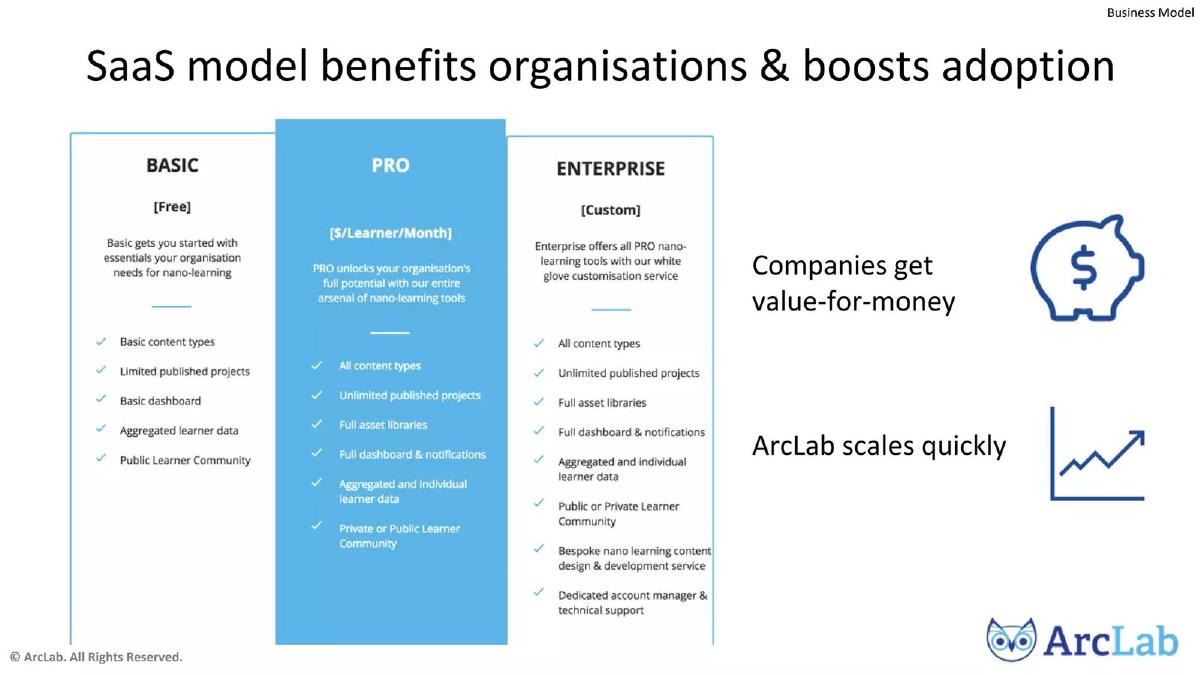
- Arclab utilizes a three-tier SaaS model: Basic (Free), Pro ($/Learner/Month), and Enterprise (Custom) (Slide 5).
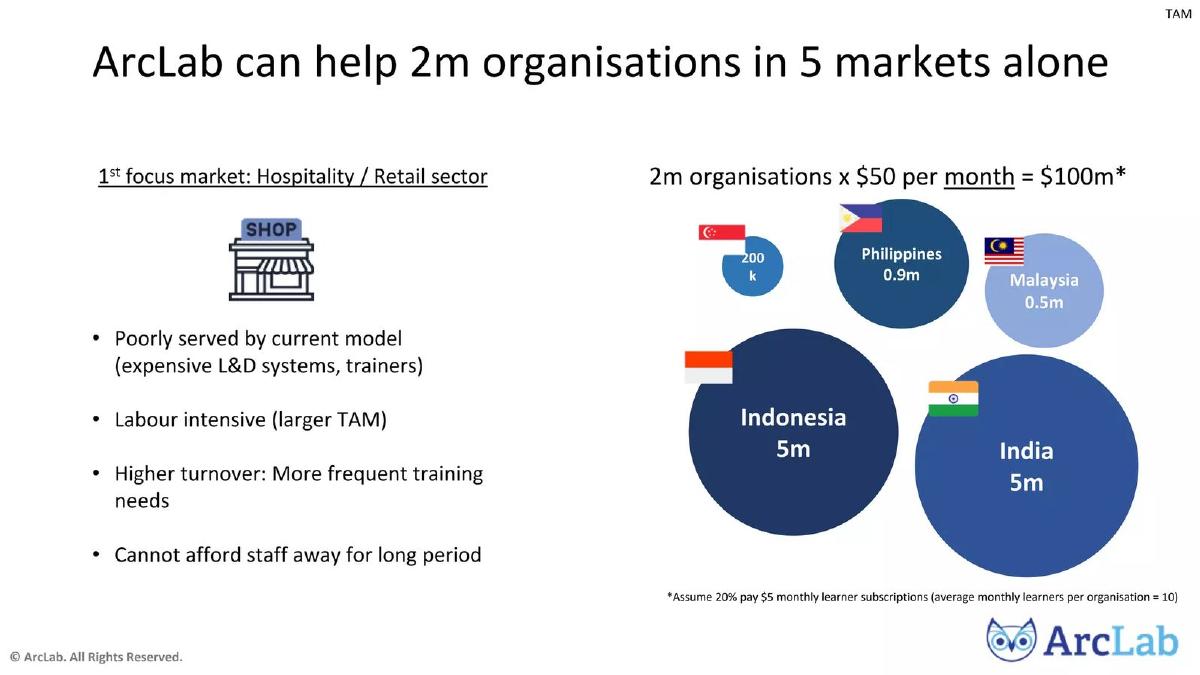
- The company projects a $100M market opportunity based on 2 million organizations across five Asian markets paying an average of $50 per month (Slide 6).
- Indonesia and India represent the largest target segments with 5 million potential organizations each (Slide 6).
- The deck identifies regional competitors like Gnowbe and SmartUp in Asia, while positioning against Western firms like Lessonly and Axonify (Slide 7).
- Traction is demonstrated through a one-year timeline including acceptance into AWS EdStart and pilots with the Singapore Tourism Board (Slide 9).
- The team is supported by a five-member Advisory Board with backgrounds in HR, strategic management, and special needs education (Slide 8).
- The deck completely omits a specific funding 'ask' or financial projections, concluding only with a request to 'help us scale' (Slide 11).
Executive Summary: The Mobile Training Gap in Asia
Arclab’s 2019 pitch deck addresses a specific logistical challenge: how to train millions of 'deskless' workers in Asia who lack access to traditional corporate learning environments. By focusing on 'nano-learning'—short, mobile-optimized modules—Arclab positions itself as a cost-effective alternative to heavy Learning Management Systems (LMS). The deck is structured to move from a broad regional problem to a specific SaaS solution, backed by a year of early-stage traction in Singapore and the Philippines.
Slide 1: Title and Positioning
The cover slide introduces Arclab with the tagline "Train Effectively with Nano Learning." It explicitly states the mission: "ArcLab helps organisations train rank-and-file ‘deskless’ workers." The slide includes a QR code for immediate engagement and lists James Chia (CEO) and Steven Chan (CTO) as the leads. Notably, it displays the "AWS EdStart Member" and "Tinker" logos, providing immediate third-party validation.
Slide 2: The Problem
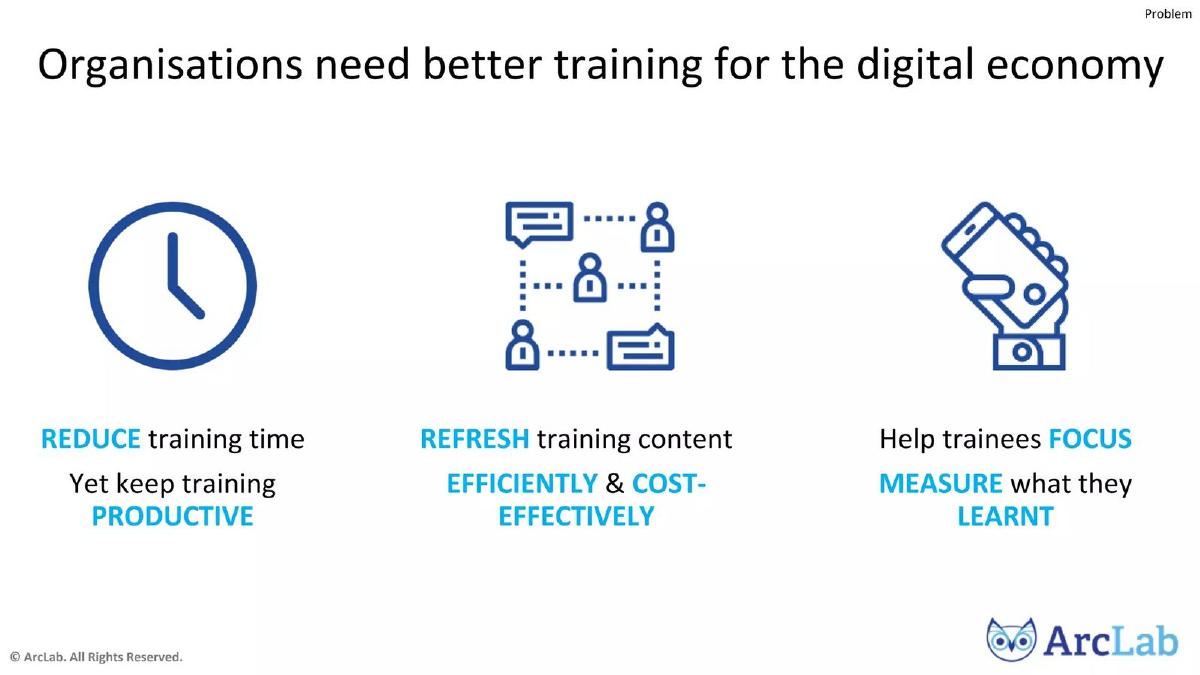
Slide 2 identifies three core needs for organizations in the digital economy: reducing training time while staying productive, refreshing content cost-effectively, and helping trainees focus while measuring outcomes. The use of simple iconography emphasizes that current training methods are likely too slow or too difficult to track for modern workforces.
Slide 3: The Solution
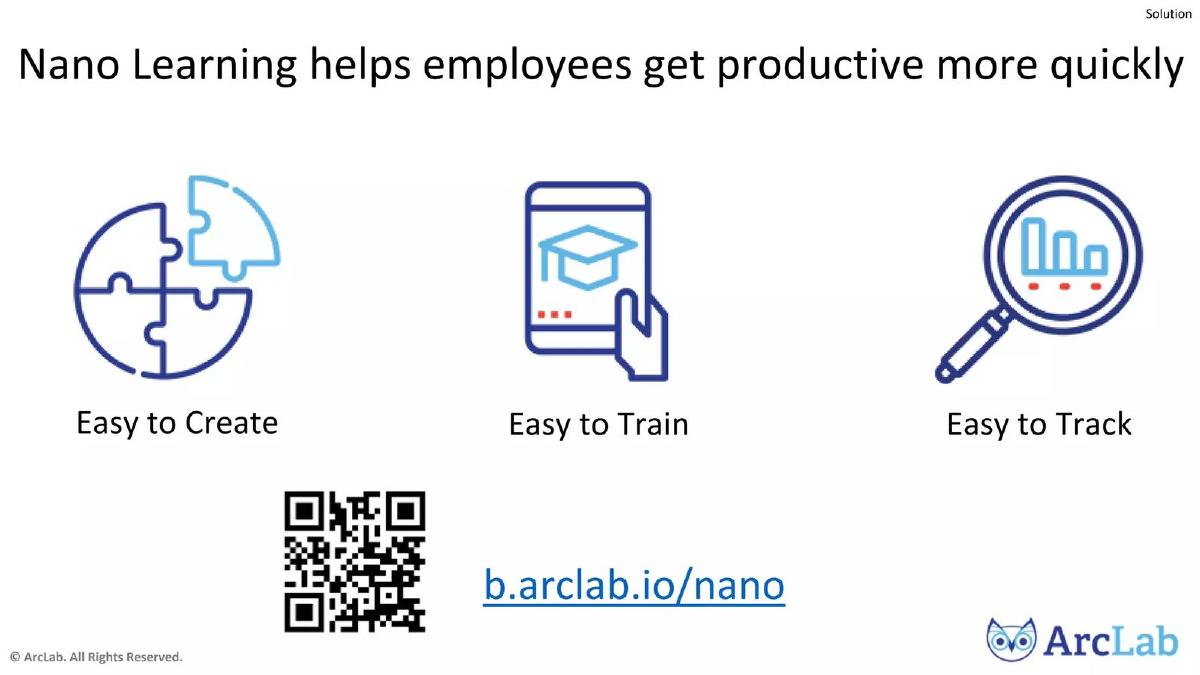
The solution is presented as "Nano Learning," which helps employees become productive more quickly. The slide highlights three pillars: "Easy to Create," "Easy to Train," and "Easy to Track." A second QR code and a direct URL (b.arclab.io/nano) are provided, suggesting the product was live and ready for testing at the time of the pitch.
Slide 4: Value Proposition
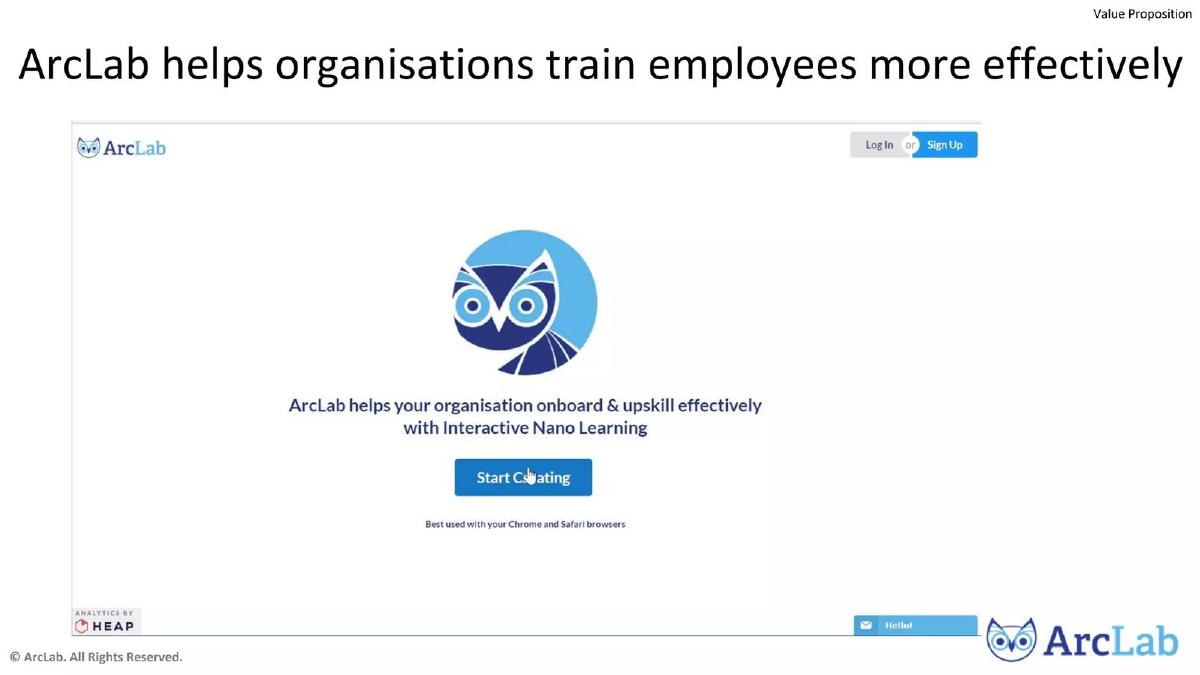
This slide features a screenshot of the Arclab interface. The messaging focuses on onboarding and upskilling effectively. A small "Analytics by Heap" logo in the corner suggests the platform is built with data tracking in mind, reinforcing the "Easy to Track" claim from the previous slide.
Slide 5: Business Model
Arclab utilizes a three-tiered SaaS model. The Basic tier is free and offers limited projects and basic dashboards. The Pro tier is priced per learner per month and unlocks unlimited projects and full asset libraries. The Enterprise tier is custom-priced and includes bespoke content design and dedicated support. The slide claims this model allows companies to get "value-for-money" while Arclab "scales quickly."
Slide 6: Total Addressable Market (TAM)
The deck makes a bold claim: "ArcLab can help 2m organisations in 5 markets alone." It focuses on the Hospitality and Retail sectors, citing high turnover and the inability to afford long staff absences as key drivers. The math provided is: 2m organisations x $50 per month = $100m. This calculation assumes a 20% conversion rate of organizations paying $5 monthly for an average of 10 learners. The geographic breakdown highlights Indonesia and India as the largest opportunities with 5 million potential organizations each.
Slide 7: Competitive Landscape
Slide 7 maps the competition by geography. It acknowledges European players (Gomo, Talentcards) and North American players (Lessonly, Axonify). Crucially, it identifies Gnowbe and SmartUp as the primary Asian competitors. The slide concludes that "NOW is the time to establish the Asian beach-head & scale," suggesting a first-mover advantage in specific Southeast Asian niches.
Slide 8: The Team and Advisory Board
The team slide is heavy on advisors, featuring five individuals with impressive credentials, including a former Executive Director of HR at the Monetary Authority of Singapore and professors from SMU and SIT. The core team listed includes an Instructional Designer (Carolynne Ng), the CEO (James Chia), and the CTO (Steven Chan). While the advisors add gravitas, the slide lacks specific details on the founders' previous startup exits or technical achievements.
Slide 9: Traction and Timeline
Titled "We executed this in 1 year," this slide provides a chronological look at the company's progress from April 2018 to March 2019. Key highlights include:
July 2018: Accepted to AWS EdStart. · Aug 2018: Completed MVP for SMU Academy. · Feb 2019: Completed commercial version and won the STB Attractions Innovation Challenge with ArtScience Museum. · Mar 2019: First pilot user in the Philippines.
This slide is the strongest evidence of the team's ability to ship product and secure enterprise-level interest.
Slide 10: Future Roadmap
The roadmap is divided into three categories: Data & AI (automated content and skills gap mapping), Accreditation (partnering with certification bodies), and Partnerships (platform integrations and channel resellers). This indicates a move toward becoming a more integrated part of the professional certification ecosystem rather than just a content delivery tool.
Slide 11: The Conclusion
The deck ends abruptly with a photo of mountain climbers and the text "We’re now at #Day1. Help us scale." This is a significant missed opportunity. There is no mention of the amount of capital being raised, the valuation, or the specific use of proceeds. For an investor, this lack of a clear "ask" makes the deck feel more like a general company overview than a fundraising tool.
What Arclab Does Well
The deck excels at identifying a specific, underserved niche. By focusing on the "deskless worker" in Asia, Arclab avoids competing directly with established Western LMS giants that focus on office-based corporate environments. The regional focus is backed by specific market sizes for Indonesia, India, and Malaysia, which demonstrates that the founders have done their homework on where the volume of labor resides. The inclusion of the STB (Singapore Tourism Board) and ArtScience Museum logos provides strong social proof that the product works in high-traffic, professional environments.
What is Missing from the Deck
The most glaring omission is the financial data. Investors need to see more than just a TAM calculation; they need to see current Monthly Recurring Revenue (MRR), churn rates, and the cost to acquire a customer (CAC). Furthermore, the "Team" slide is disproportionately focused on advisors rather than the full-time operators. Most importantly, the deck lacks a "The Ask" slide. Without a specific dollar amount and a plan for how that money will be spent (e.g., hiring 5 engineers, expanding into Jakarta), the pitch lacks a sense of urgency and professional structure.
Founder's Takeaway: Copy the Traction, Fix the Ask
Founders should emulate Arclab’s use of a clear, chronological traction slide. Showing a steady cadence of development—from incorporation to MVP to commercial launch within 12 months—builds significant trust. However, founders must avoid the mistake of omitting the funding ask. A pitch deck is a sales document for equity; if you don't tell the investor what you want and what they get in return, the conversation cannot move forward. Additionally, if you are targeting a massive market like India or Indonesia, be prepared to explain the localized challenges of those markets, such as language barriers or internet connectivity, which Arclab mentions only briefly through the 'mobile-first' lens.
Frequently asked questions
- What is 'nano-learning' according to Arclab?
- Arclab defines nano-learning as a mobile-first, micro-learning approach designed to help employees get productive quickly. Slide 3 emphasizes that the system is 'Easy to Create, Easy to Train, and Easy to Track.' It is intended to replace expensive, labor-intensive traditional L&D systems that deskless workers in high-turnover roles cannot afford to spend long periods attending.
- How does Arclab plan to monetize its platform?
- The company uses a standard SaaS subscription model detailed on Slide 5. It includes a 'Basic' free tier for essentials, a 'Pro' tier charged per learner per month that unlocks unlimited projects and asset libraries, and an 'Enterprise' tier for custom needs, including white-glove customization and dedicated account management.
- Which geographic markets is Arclab prioritizing?
- Arclab is focused exclusively on the Asian market. Slide 6 specifically identifies Singapore (200k organizations), Philippines (0.9m), Malaysia (0.5m), Indonesia (5m), and India (5m). The company views these regions as a 'beach-head' where mobile-first learning is still a relatively new concept compared to Europe and North America.
- What evidence of product-market fit does the deck provide?
- Slide 9 outlines a year of execution starting from April 2018. Key milestones include completing an MVP for SMU Academy, being accepted into the AWS EdStart program, and winning the STB Attractions Innovation Challenge. They also cite partnerships with Singapore Polytechnic and a pilot user in the Philippines as of March 2019.
- What are the major weaknesses of this pitch deck?
- The most significant weakness is the lack of financial transparency. There are no mentions of current revenue, burn rate, or customer acquisition costs. Furthermore, the deck fails to state how much money the company is looking to raise or how those funds would be allocated, which is a critical requirement for a professional investor pitch.