The New Elija project is a debt-based real estate offering seeking EUR 2 million through the Röntgen crowdfunding platform. The project, located in Šventoji, Lithuania, consists of 270 apartments, with over 33% already sold at the time of the presentation. The loan carries a 7% interest rate over 36 months, secured by a first mortgage on unsold assets valued at EUR 8.5 million. The deck is notably transparent regarding the project's troubled history, including a four-year litigation period that halted sales between 2010 and 2014. By focusing on a low Loan-to-Value (LTV) ratio of 24% and a cle…
Key takeaways
- The project seeks a EUR 2 million loan at 7% interest with a 36-month maturity (Slide 4).
- Collateral consists of a first mortgage on unsold apartments valued at EUR 8.5 million, representing a 24% LTV (Slide 28).
- The development faced a significant legal dispute between 2010 and 2014 regarding the lawfulness of the structures, which was resolved by a court ruling (Slide 7).
- Sales traction is demonstrated by 93 units sold out of the first 152 offered across three buildings (Slide 13).
- The project offers flexible unit layouts, with apartments starting at 22 square meters and prices from EUR 29,000 (Slide 9).
- Ownership is split between Gage Partners (53%), DAO Family (40%), and small investors (7%) (Slide 16).
- The DAO management team features former executives from SEB Bank and Lords LB Asset Management (Slide 19).
- Financial projections estimate EUR 11.85 million in apartment sales revenue for the 2019-2021 period (Slide 25).
The New Elija Pitch Deck Teardown
Slide 1: Title and Regulatory Disclosure
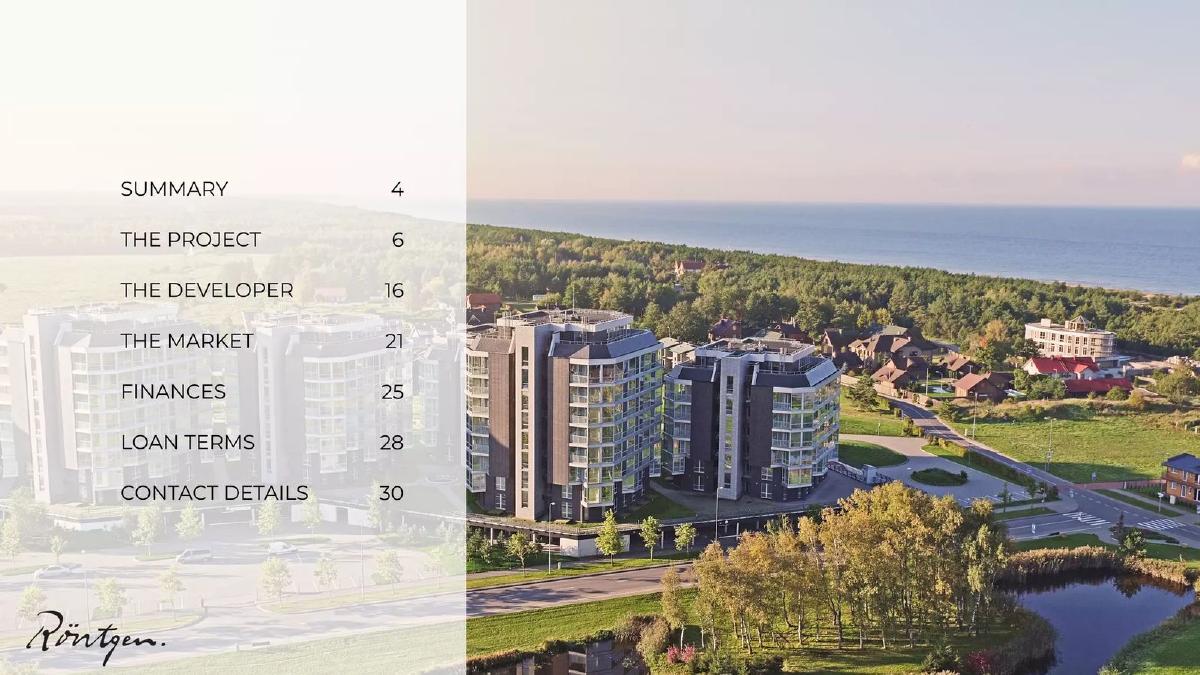
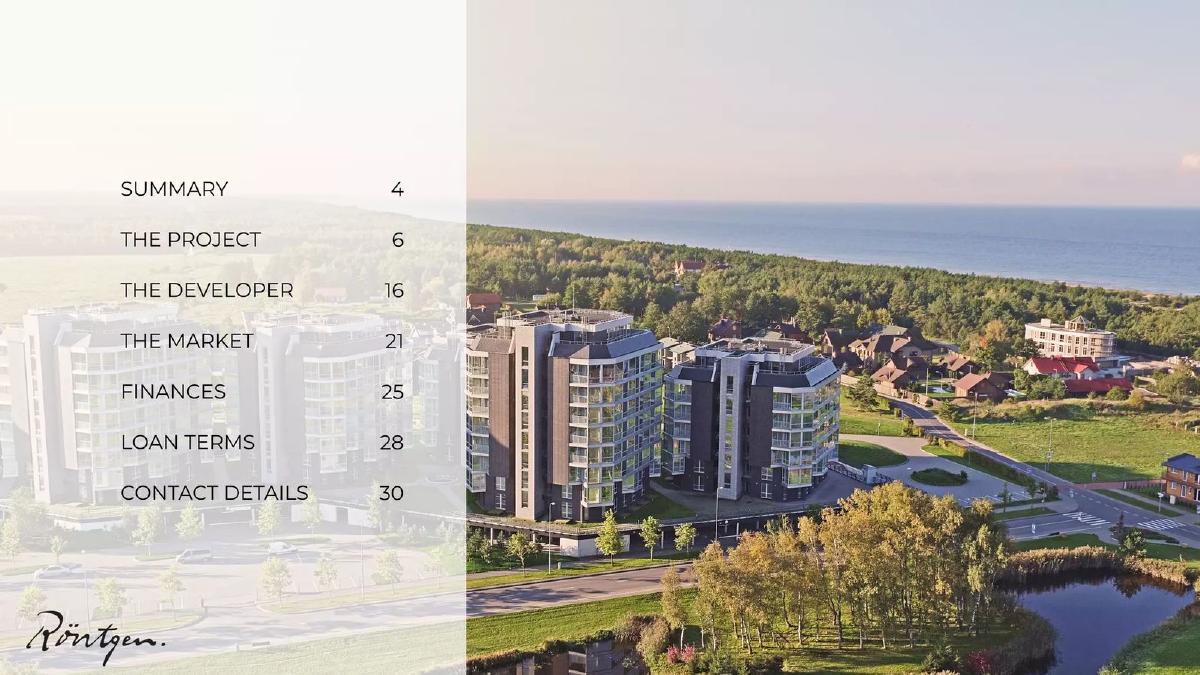
The cover slide introduces 'The New Elija' investment presentation. It features the branding of Röntgen, a crowdfunding platform licensed by the Bank of Lithuania. The use of a prominent architectural image (the Flatiron Building) is stylistic and does not represent the project site, which is located in Lithuania. The footer establishes the regulatory framework under the Law on Crowdfunding, signaling a formal, compliant investment offering.
Slide 4: Executive Summary and Key Terms
This slide provides a high-level overview of the debt offering. The loan recipient, UAB Naujoji Elija, seeks EUR 2 million for a 36-month term at 7% interest, payable quarterly. The project consists of 5 buildings totaling 270 apartments. The slide notes that over 90 apartments (>33%) have been sold since 2017. Crucially, it defines the collateral: a pledge of all unsold apartments and sales revenue, valued at EUR 8.5 million. This establishes a low initial Loan-to-Value (LTV) ratio, a key metric for debt investors.
Slide 7: Project History and Litigation Disclosure
Real estate decks often gloss over delays, but this slide addresses a significant historical hurdle. It states that construction was completed in 2010, but a legal dispute regarding the 'lawfulness of the structures' halted sales until a 2014 court ruling. It tracks the recovery: a strategic investor joined in 2016, and Citadele Bankas provided EUR 4.3 million in 2017. The transition from bank financing to crowdfunding is framed as a planned step for fitting out the final two buildings.
Slide 9: Project Design and Pricing
This slide focuses on the product's marketability. It highlights 'flexible layouts' with up to 14 apartments per floor and units starting at 22 square meters. The pricing strategy is aggressive, starting from EUR 29,000. The text argues that the ability to join or split units increases liquidity and creates 'opportunities for alternative uses,' which is a hedge against changing market demands for vacation homes.
Slide 13: Sales Traction and Inventory
Using a 3D render of the complex, this slide visualizes the current sales status. It breaks down the inventory across five buildings: 41/64 sold, 39/56 sold, and 13/32 sold in the active phases. Two buildings are marked for 'Planned sales' in Q3 2019 and Q4 2020. Providing specific 'Sold / Total' ratios for each block allows investors to verify the '33% sold' claim made earlier in the deck.
Slide 16: Ownership Structure
The equity stack is clearly defined here. Gage Partners holds a majority 53% stake and has provided a shareholder loan. DAO Family, described as the 'active investor making the project development decisions,' holds 40%. The remaining 7% belongs to small investors. A footnote clarifies that the shareholder loan is subordinated to the platform loan, ensuring that the crowdfunded investors have priority for repayment.
Slide 19: The Management Team
The 'DAO team' is presented with a focus on institutional financial backgrounds. Vykintas Misiūnas and Evaldas Čepulis both bring experience from SEB Bank (Treasury and Venture Capital, respectively). Artūras Razgūnas provides the legal and relationship management expertise. For a project that previously suffered from litigation, highlighting a team with deep banking and legal roots is a strategic move to restore investor confidence.
Slide 22: Market Statistics
This slide provides macro-economic context for the Palanga and Šventoji regions. It charts housing transactions and average values from 2007 to 2018. Key data points include an 11.5% annual increase in transactions and an 11.9% increase in transaction value since the 2008 crisis. The deck positions Elija as a value play, noting its EUR 1,400/sqm price point is significantly below the EUR 1,748/sqm market average for new apartments in 2018.
Slide 25: Business Plan and Cash Flow Summary
The financial model for 2019-2021 is presented as a simple cash-flow table. It shows the EUR 2 million inflow from the Röntgen loan being used to pay down EUR 1.5 million in bank debt. Total projected revenue from apartment sales and hotel/facility income is EUR 12.74 million. After finishing costs (EUR 2M), administrative costs (EUR 1.2M), and financing costs (EUR 1.54M), the plan shows a final owner earning of EUR 3.65 million after the Röntgen loan is fully repaid.
Slide 28: Detailed Investment Terms
The final slide in this selection acts as a term sheet. It reiterates the EUR 2 million size and 7% rate but adds critical details: a minimum investment of EUR 1,000, a first mortgage priority, and a 'Class A (low risk)' assessment by Röntgen. It also specifies a minimum 24-month interest guarantee for early repayment, protecting the investor's yield if the apartments sell faster than anticipated.
What The New Elija Deck Does Well
Transparency on Litigation: Many developers would hide a four-year sales halt. By explicitly stating the 2010-2014 legal dispute and the subsequent court victory, the founders turn a potential 'red flag' into a 'resolved risk.' This builds significant trust with sophisticated debt investors.
Conservative LTV: The deck leans heavily on the 24% Loan-to-Value ratio. In real estate debt, the 'margin of safety' is the most important metric. Showing that the loan is covered four times over by existing, completed assets is a powerful closer.
Institutional Pedigree: The team slide does not just list names; it lists specific roles at recognizable institutions (SEB Bank, Lords LB). For a crowdfunding campaign, this 'institutional-grade' management helps bridge the gap between retail investors and professional real estate development.
What Is Missing from The New Elija Deck
Operating Expenses Detail: While Slide 25 lists 'Administrative costs' of EUR 1.2 million, it does not break down the ongoing costs of maintaining the unsold units (taxes, utilities, security) or the marketing budget required to move the remaining 180 units.
Sensitivity Analysis: The business plan assumes EUR 11.8 million in sales. The deck lacks a 'downside scenario' showing how the loan would be serviced if sales velocity slowed by 50% or if market prices dropped. Given the project's history, a stress test would have been appropriate.
Exit Strategy for Equity: While the debt exit is clear (repayment from sales), the deck does not explain the long-term plan for the 'hotel revenue' and 'other facilities' mentioned on Slide 25. It is unclear if these will be sold off or managed by the developers indefinitely.
What Other Founders Should Copy
Visualizing Inventory: Slide 13 is a masterclass in communicating sales progress. Instead of a spreadsheet, the use of a 3D model with 'Sold / Total' overlays makes the project's status immediately intuitive. This is highly effective for multi-unit developments.
Subordination Clarity: The footnotes on Slides 16 and 25 regarding the subordination of shareholder loans are excellent. Founders seeking debt should always be explicit about where the new money sits in the capital stack compared to 'insider' money.
Specific Use of Funds: The deck doesn't just ask for 'working capital.' It specifies exactly how much is going to refinance old debt (EUR 1.5M) versus new fit-out costs (EUR 0.5M). This level of granularity prevents investors from feeling like their money is disappearing into a 'black hole' of general expenses.
Frequently asked questions
- What is the primary purpose of this capital raise?
- The project is raising EUR 2 million to refinance an existing bank loan from Citadele Bankas and to provide working capital for the final fit-out of 110 unsold apartments. According to Slide 25, EUR 1.5 million is allocated to debt repayment, while the remaining funds support the transition of units to 'fully finished' status to accelerate sales.
- How is the investment secured for the lenders?
- The loan is secured by a first mortgage pledge on all unsold apartments and future sales revenue. Slide 28 notes the collateral value is EUR 8,534,000 against a EUR 2 million loan, resulting in a conservative 24% Loan-to-Value (LTV) ratio, which the deck notes will not exceed 50% even with additional draws.
- What happened during the project's litigation phase?
- Construction was completed in 2010, but the project entered a legal dispute regarding the lawfulness of the buildings. Sales were halted for four years until a 2014 court ruling recognized the assets as lawful. Sales only renewed in 2016 after securing a strategic investor, explaining the long gap in the project timeline (Slide 7).
- Who are the key individuals managing the project?
- The project is managed by the DAO team, led by Vykintas Misiūnas (former Head of Treasury at SEB Bank), Evaldas Čepulis (former CEO of SEB Venture Capital), and Artūras Razgūnas (legal support). Their collective background in institutional banking and asset management is used to build credibility for a crowdfunded debt instrument (Slide 19).
- What are the market conditions in the project's location?
- The project is located in Šventoji, near Palanga. Slide 22 shows a stable growth trend with an 11.5% average annual increase in housing transactions since the 2008 crisis. The deck highlights that Elija’s average price of EUR 1,400 per square meter is lower than the 2018 market average of EUR 1,748 per square meter.