The Array pitch deck from 2018 is a classic example of a vertical SaaS seed pitch. Seeking $500,000, the company targets the highly specific and underserved 'Australian Independent Living Retirement Sector.' The strength of the deck lies in its team's domain expertise, with two co-founders coming from Lend Lease Retirement Living. While the financial projections are aggressive—scaling from zero to over $120 million in ten years—the deck successfully identifies a clear pain point: the reliance on paper-based processes in retirement village management. The strategy involves building a subscript…
Key takeaways
- The company sought a $500,000 investment to develop an MVP and execute an initial sales plan (Slide 10).
- The founders have direct industry experience, including 9 years and 5 years respectively at Lend Lease Retirement Living (Slide 3).
- The product aims to replace costly paper-based processes and manual data analysis for retirement village owners (Slide 4).
- Array positions itself as a comprehensive solution, claiming features like a 'Complex Exit Calculator' that competitors lack (Slide 7).
- The business model relies on two phases: initial subscription revenue followed by future supply chain monetization (Slide 8).
- Financial projections show a target of $36,000 in monthly recurring revenue from 3,600 units by June 2019 (Slide 10).
- The long-term vision involves expanding from the Australian retirement sector into the global property market (Slide 2).
- The deck identifies a 'Why Now' catalyst in the growing acceptance of technology by the older generation (Slide 6).
Introduction and Executive Summary
The Array pitch deck, dated August 2018, presents a specialized software-as-a-service (SaaS) solution for the retirement living industry. The deck is structured as a seed-stage proposal, seeking $500,000 to move from concept to a functional Minimum Viable Product (MVP) and initial market entry. The core value proposition is the simplification of property data management, specifically targeting the inefficiencies of paper-based systems in retirement villages.
Slide 1: Title Slide
The opening slide introduces the company name, Array, with the tagline: "Simplifying property data management for better business decisions." It lists the three key leadership figures: Paul McGee (Co-Founder, CEO), Matt Slutzkin (Co-Founder, CFO), and Marty Rodowsky (CTO), along with their direct contact information. The branding is clean, utilizing a green and grey color palette that suggests a professional, corporate-facing service.
Slide 2: Our Vision/Our Mission
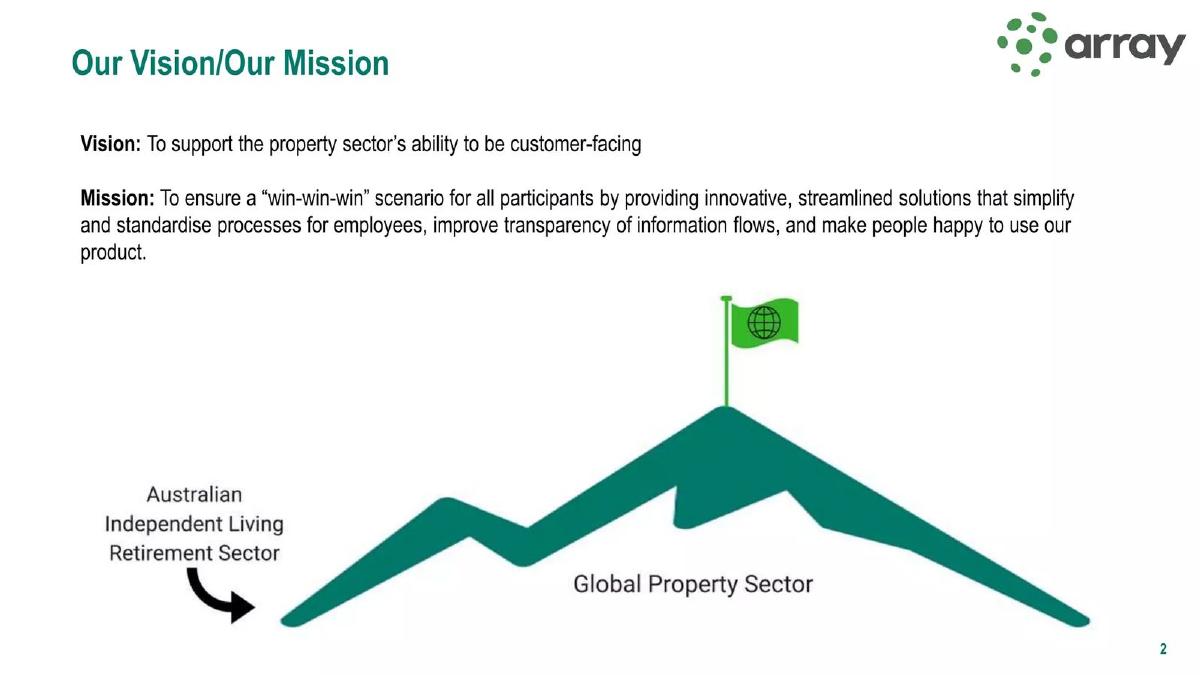
Slide 2 defines the company's scope. The vision is "To support the property sector’s ability to be customer-facing," while the mission focuses on a "win-win-win" scenario for employees and residents through standardized processes and improved transparency. A mountain graphic illustrates the growth strategy: starting in the "Australian Independent Living Retirement Sector" and ascending toward the "Global Property Sector." This indicates that while the initial focus is a niche, the founders view it as a beachhead for a much larger market.
Slide 3: Meet the Team
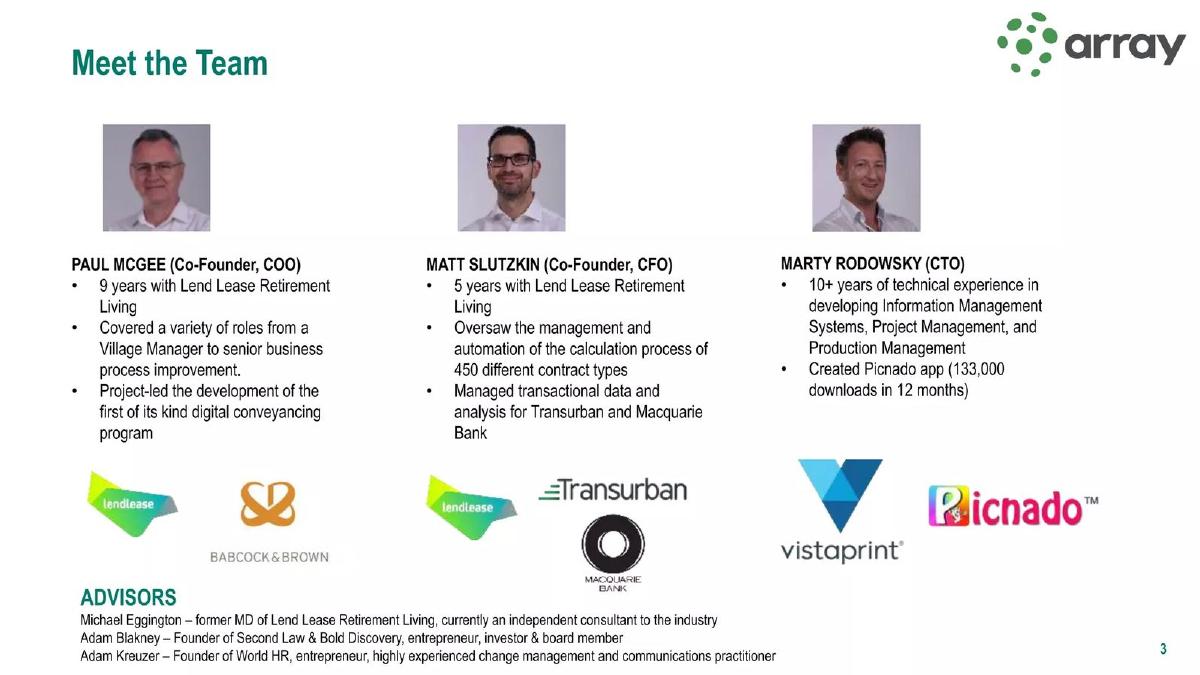
This is arguably the strongest slide in the deck. It highlights deep industry expertise. Paul McGee and Matt Slutzkin both have significant tenures at Lend Lease Retirement Living (9 years and 5 years respectively). McGee's experience ranges from village management to digital conveyancing, while Slutzkin managed calculations for 450 different contract types. CTO Marty Rodowsky brings technical credibility with 10+ years of experience and a successful app launch (Picnado). The slide also lists three advisors with backgrounds in industry leadership, entrepreneurship, and HR, providing a well-rounded support structure for a seed-stage startup.
Slide 4: The Problem for Retirement Village Owners
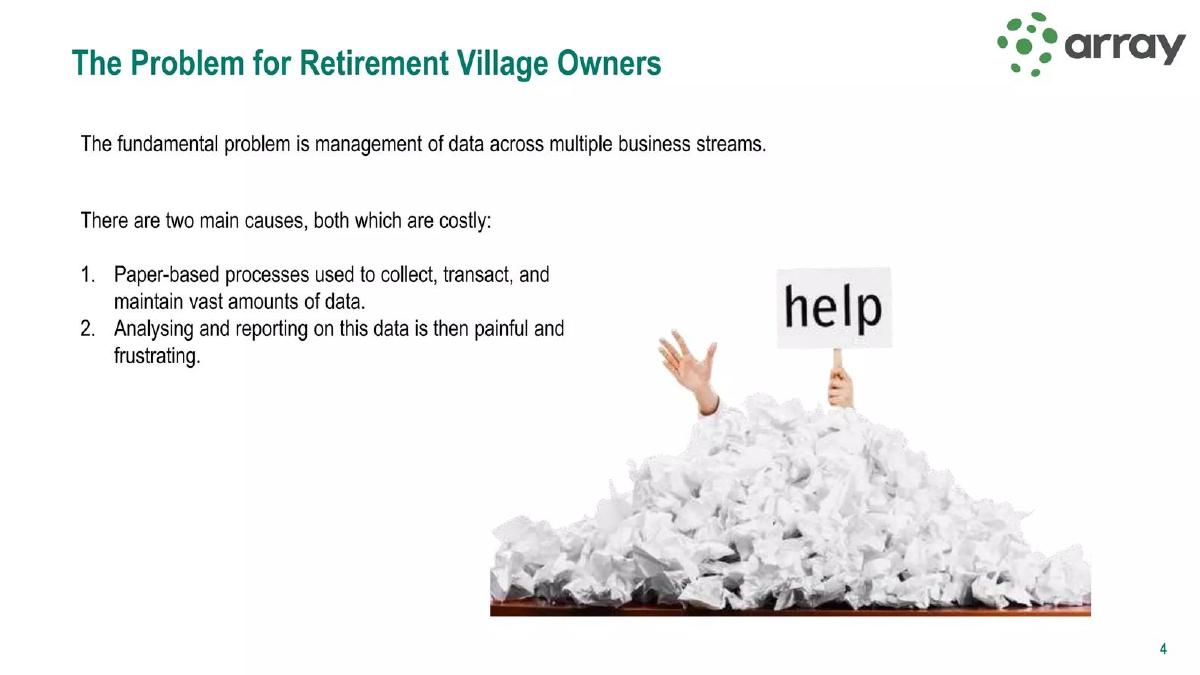
The problem slide uses a visual of a person buried in paper to emphasize the "fundamental problem" of data management across multiple business streams. It identifies two specific pain points: the cost of paper-based processes for data collection and the frustration of manual analysis and reporting. By focusing on "Retirement Village Owners," the deck identifies a specific buyer with clear operational headaches.
Slide 5: Array is the Solution
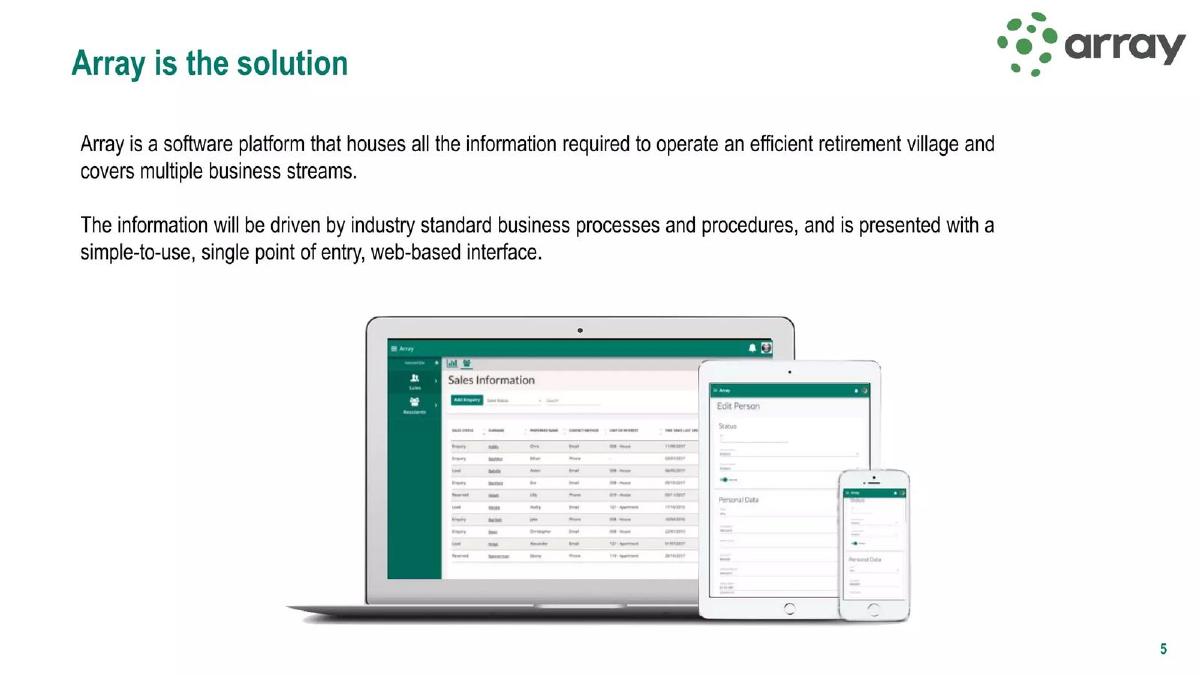
The solution is described as a "software platform that houses all the information required to operate an efficient retirement village." It promises a web-based interface that is simple to use and provides a single point of entry. The slide includes mockups of the interface on a laptop, tablet, and smartphone, suggesting a modern, cross-platform accessibility that would be a significant upgrade over the paper systems mentioned in the problem slide.
Slide 6: Why Now?
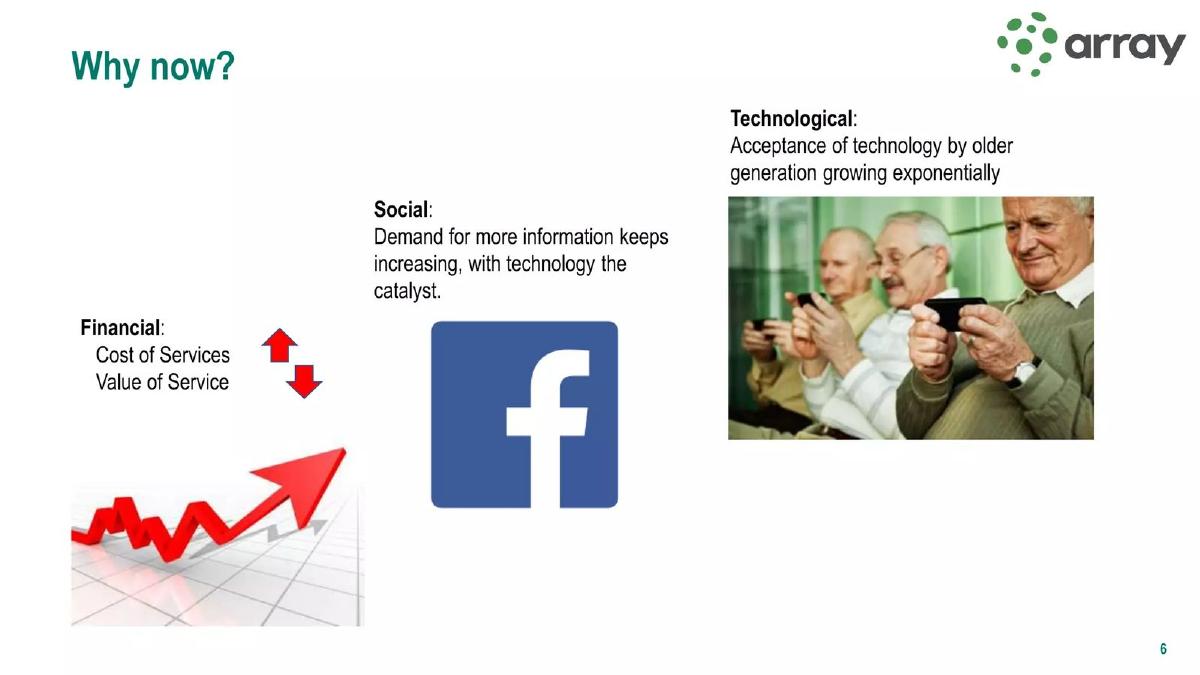
This slide addresses market timing through three lenses: Financial, Social, and Technological. It notes the rising cost of services and the increasing social demand for information. The most critical point is the technological one: "Acceptance of technology by older generation growing exponentially." This addresses a common objection in the retirement sector—that the end-users (seniors) might be resistant to digital tools.
Slide 7: Competition
Array uses a standard competitive matrix to compare itself against five rivals: Village Master, Epicor, Procura, BrightFox, and Vcare. Array claims to be the only solution that covers all ten listed features, including a "Complex Exit Calculator," "Compliance," and "Third Party Access." This slide positions Array as a comprehensive, all-in-one utility compared to the fragmented or incomplete offerings of incumbents.
Slide 8: The Business Model
The business model is presented in two phases. Phase one is a subscription-based platform for owners. Phase two involves leveraging "supply chain power" to source services for residents. A chart shows revenue projections through 2028, scaling from nearly zero in 2019 to over $120 million. Notably, the "Supply Chain" revenue (blue) is projected to dwarf the "Subscriptions" revenue (green) by a factor of roughly five to one in the long term, suggesting the software is a Trojan horse for a larger marketplace play.
Slide 9: The Future
This slide is a simple conceptual graph showing an arrow pointing up and to the right. The axes are "Australia, NZ, UK, Asia, USA" and "Property Sub-sectors." It reinforces the message from Slide 2: the company intends to expand geographically and vertically into other property types once the retirement sector is secured. However, it lacks specific dates or milestones for these expansions.
Slide 10: What do we need?
The "Ask" slide is direct. Array seeks $500,000 to develop the MVP and launch marketing. It specifies a 12-month runway and sets a clear performance target: $36,000 in monthly recurring revenue (MRR) by June 2019, based on 3,600 units. This provides investors with a concrete metric to measure success against the capital provided.
Slide 11: Get in Touch
The final slide repeats the team photos and provides expanded contact details, including LinkedIn profiles and social media handles for the company. This facilitates easy follow-up for interested investors.
What Works Well in This Deck
The primary strength of the Array deck is founder-market fit . In the retirement living sector, which is heavily regulated and operationally complex, having founders who spent years at a market leader like Lend Lease is a significant advantage. They clearly understand the specific pain points, such as the "Complex Exit Calculator," which is a notorious hurdle in retirement village administration.
The narrow focus of the initial target market is also a plus. By specifically naming "Australian Independent Living Retirement Sector," the founders demonstrate they aren't trying to boil the ocean on day one. This specificity makes the $500,000 ask feel appropriate for the task at hand.
What is Missing or Could Be Improved
The most significant weakness is the lack of unit economics . While the deck projects $120 million in revenue by 2028, it doesn't explain the pricing model. How much does a subscription cost per unit? What is the expected margin on the "supply chain" revenue? Without these details, the hockey-stick growth chart on Slide 8 feels speculative.
Furthermore, the technology stack is barely mentioned. For a CTO with 10+ years of experience, there is very little detail on how the platform is built, how it handles data security (critical in a sector dealing with elderly residents' information), or how it integrates with existing legacy systems. Investors would likely want to know if this is a ground-up build or a configuration of existing tools.
Finally, the "Why Now" slide is a bit generic. While it mentions the older generation's acceptance of technology, it doesn't cite specific regulatory changes or market shifts in 2018 that make this the optimal moment for Array to launch. More data on the size of the Australian retirement market (TAM/SAM) would have strengthened the case for the initial investment.
Founder Takeaways
Leverage your pedigree: If you have worked for the industry leader in your target sector, make that the centerpiece of your team slide. Use logos of former employers to build instant credibility. · Identify the 'Unsexy' Problem: Array doesn't try to be a flashy social network; it targets paper-based data management. Solving boring, expensive operational problems is often a more viable path to a B2B exit. · Be specific with your Ask: Slide 10 is a model for seed decks. It states the amount, the use of funds, the runway, and a specific revenue outcome. This shows you have a plan for the money beyond just 'hiring and growth.' · Phase your growth: Don't just show one revenue stream. If your software enables a secondary marketplace or supply chain play, show how that scales over time, but keep it distinct from your core SaaS revenue.
Frequently asked questions
- What is the specific problem Array is trying to solve?
- According to Slide 4, the fundamental problem is the management of data across multiple business streams for retirement village owners. This is caused by two main factors: the use of paper-based processes to collect and maintain data, and the subsequent 'painful and frustrating' task of analyzing and reporting on that data manually.
- How does Array plan to generate revenue beyond software subscriptions?
- Slide 8 outlines a two-step business model. The first step is building a subscription-based platform for retirement village owners. The second, future step is to use 'supply chain power' to source better value services for retirement village customers, which accounts for the vast majority of the projected $120M+ revenue by 2028.
- What is the background of the founding team?
- The team has significant domain and technical experience as shown on Slide 3. Paul McGee (CEO) spent 9 years at Lend Lease Retirement Living, Matt Slutzkin (CFO) spent 5 years there managing complex contracts, and Marty Rodowsky (CTO) has 10+ years of technical experience, including creating an app with 133,000 downloads.
- Who are Array's primary competitors in the retirement sector?
- Slide 7 lists five competitors: Village Master, Epicor Senior Living Solution, Procura (by ANZ), BrightFox, and Vcare. Array differentiates itself by claiming to offer a 'Complex Exit Calculator,' 'Third Party Access,' and 'Compliance' features that most of these competitors lack.
- What are the specific goals for the $500,000 investment?
- As stated on Slide 10, the funds are intended to cover the development of the MVP, the creation and execution of an initial marketing and sales plan, and other commercialization costs. The goal is to achieve 12 months of runway and reach $36,000 in monthly recurring revenue by June 2019.