Array presents a classic vertical SaaS proposition, focusing on the operational inefficiencies of the senior housing sector. The deck identifies a clear pain point—reliance on paper-based processes—and proposes a specialized ERP to centralize complex tasks like exit calculations and compliance. With a team deeply rooted in the industry (Lendlease Retirement Living), the founders leverage domain expertise to justify their $500,000 ask. The deck is notable for its aggressive financial projections, aiming for a jump from MVP development to $81,000 in monthly recurring revenue within a 12-month r…
Key takeaways
- The company is seeking $500,000 to develop their MVP and execute initial marketing, as stated on slide 10.
- The founders, Paul McGee and Matt Slutzkin, bring significant domain expertise from Lendlease Retirement Living, cited on slide 3.
- Array identifies paper-based processes and painful data reporting as the primary industry problems on slide 4.
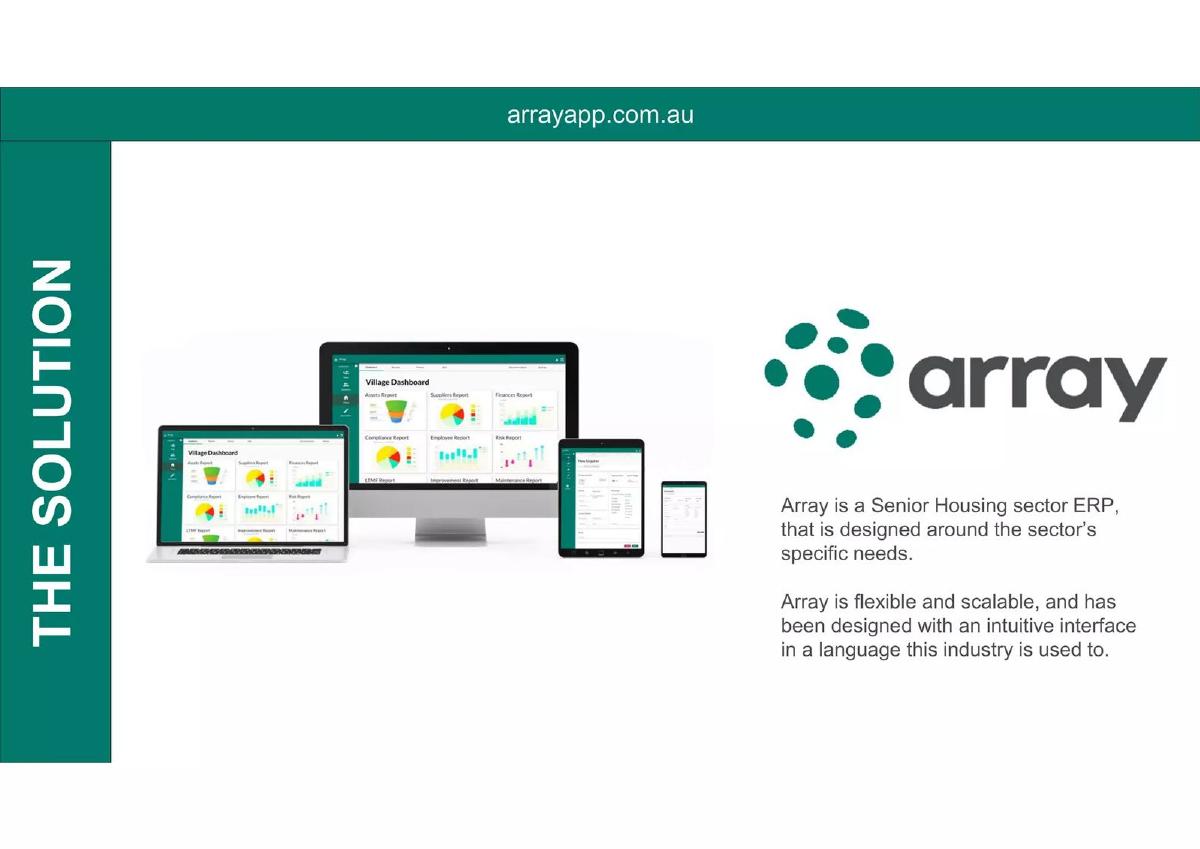
- The product is positioned as a specialized ERP for the senior housing sector, featuring an intuitive interface on slide 5.
- A competitive comparison on slide 7 highlights a 'Complex Exit Calculator' as a unique feature not offered by five named competitors.
- The business model projects a shift from subscription revenue to a much larger 'supply chain' revenue stream by FY29, shown on slide 8.
- The funding goal is to reach $81,000 in monthly recurring revenue from 8,100 units by June 2020, according to slide 10.
- Future expansion plans target geographic markets including New Zealand, the UK, Asia, and the USA, as illustrated on slide 9.
Executive Summary
Array's seed pitch deck is a focused, 11-slide presentation targeting the senior housing and retirement village sector. The deck relies heavily on the 'Founder-Market Fit' narrative, showcasing a leadership team with direct experience at one of the industry's largest players. The value proposition is centered on digitizing a traditionally paper-heavy industry through a specialized ERP. While the deck is light on current traction, it provides a clear roadmap for product development and a secondary revenue model based on supply chain aggregation.
Slide 1: Title Slide
The cover slide introduces the company name, Array, with the tagline 'Focus on People, not Paperwork.' It further defines the business as 'Simplifying property data management for better business decisions.' The branding is clean, using a professional teal and grey color palette that persists throughout the deck.
Slide 2: The Vision and Mission
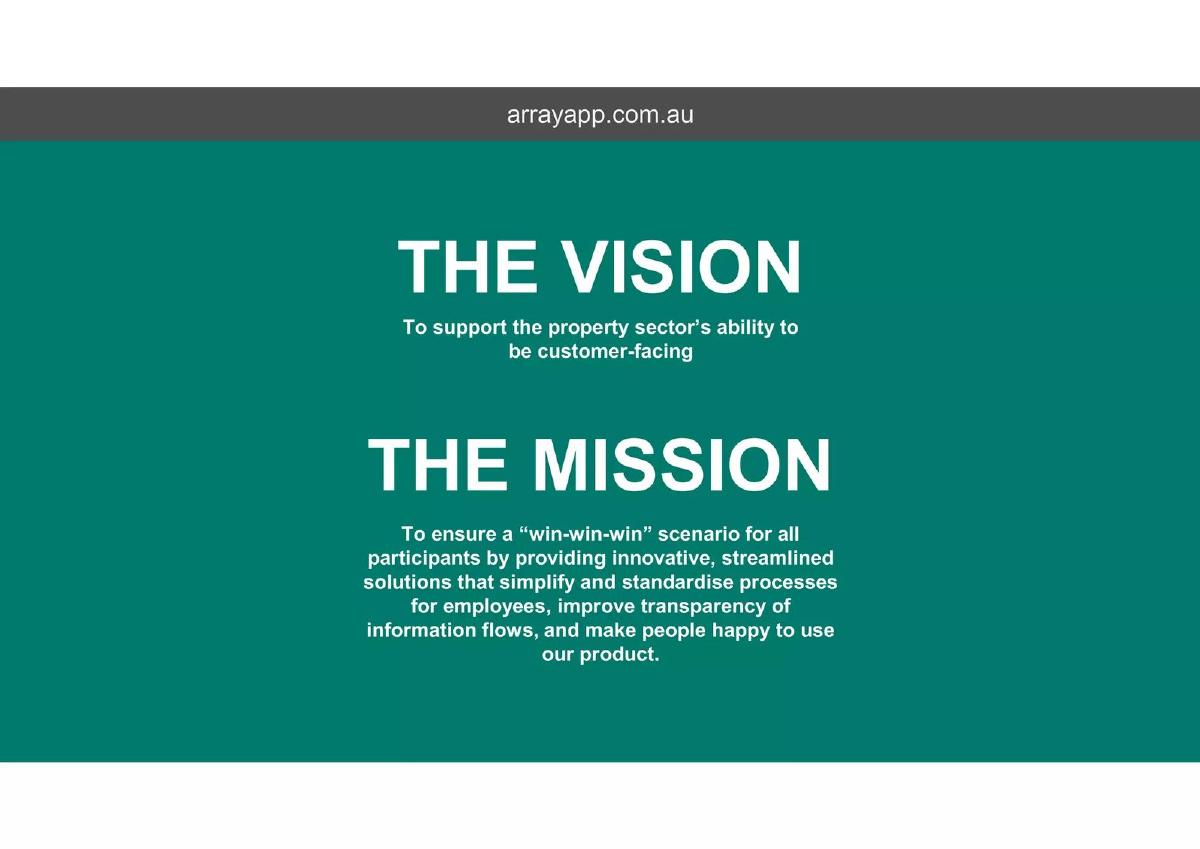
Slide 2 outlines the company's core purpose. The vision is 'To support the property sector’s ability to be customer-facing.' The mission focuses on a 'win-win-win' scenario for all participants by providing streamlined solutions that simplify processes for employees and improve transparency. This slide establishes the emotional and operational goals of the company before diving into the technical details.
Slide 3: The Team
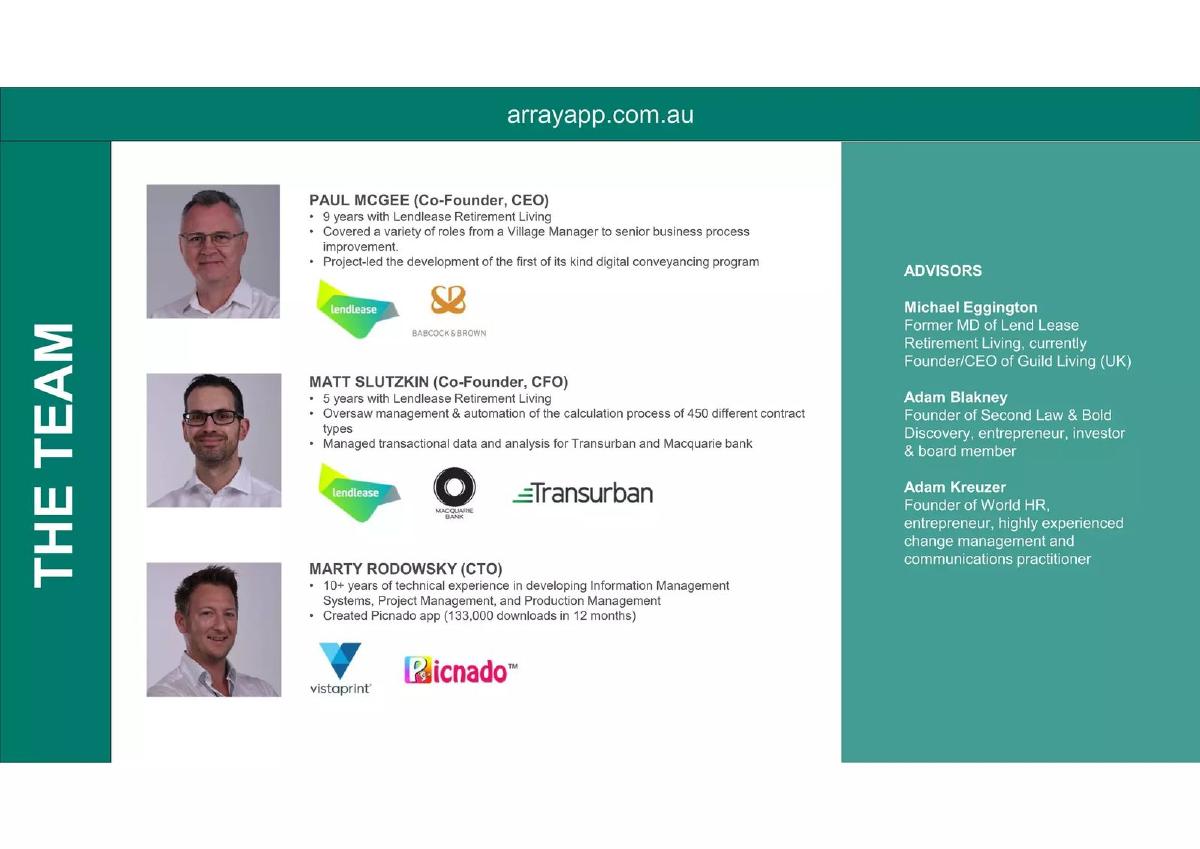
This is arguably the strongest slide in the deck. It lists the three co-founders and three advisors. Paul McGee (CEO) and Matt Slutzkin (CFO) both highlight their tenure at Lendlease Retirement Living (9 years and 5 years, respectively). Marty Rodowsky (CTO) brings technical credibility, citing 10+ years of experience and 133,000 downloads for a previous app, Picnado. The inclusion of Michael Eggington, former MD of Lend Lease Retirement Living, as an advisor adds significant industry weight.
Slide 4: The Problem
The problem is framed through the lens of increasing operational costs. Two icons represent the core issues: 'Paper-based processes' and the 'painful and frustrating' nature of analyzing and reporting on data. By focusing on the inefficiency of physical paperwork, Array sets the stage for a digital transformation solution.
Slide 5: The Solution
Array is defined here as a 'Senior Housing sector ERP.' The slide features product mockups across desktop, tablet, and mobile devices, showing various dashboards (Assets, Suppliers, Finances, etc.). The text emphasizes that the software is 'designed around the sector’s specific needs' and uses 'a language this industry is used to,' reinforcing the niche expertise of the founders.
Slide 6: The Timing
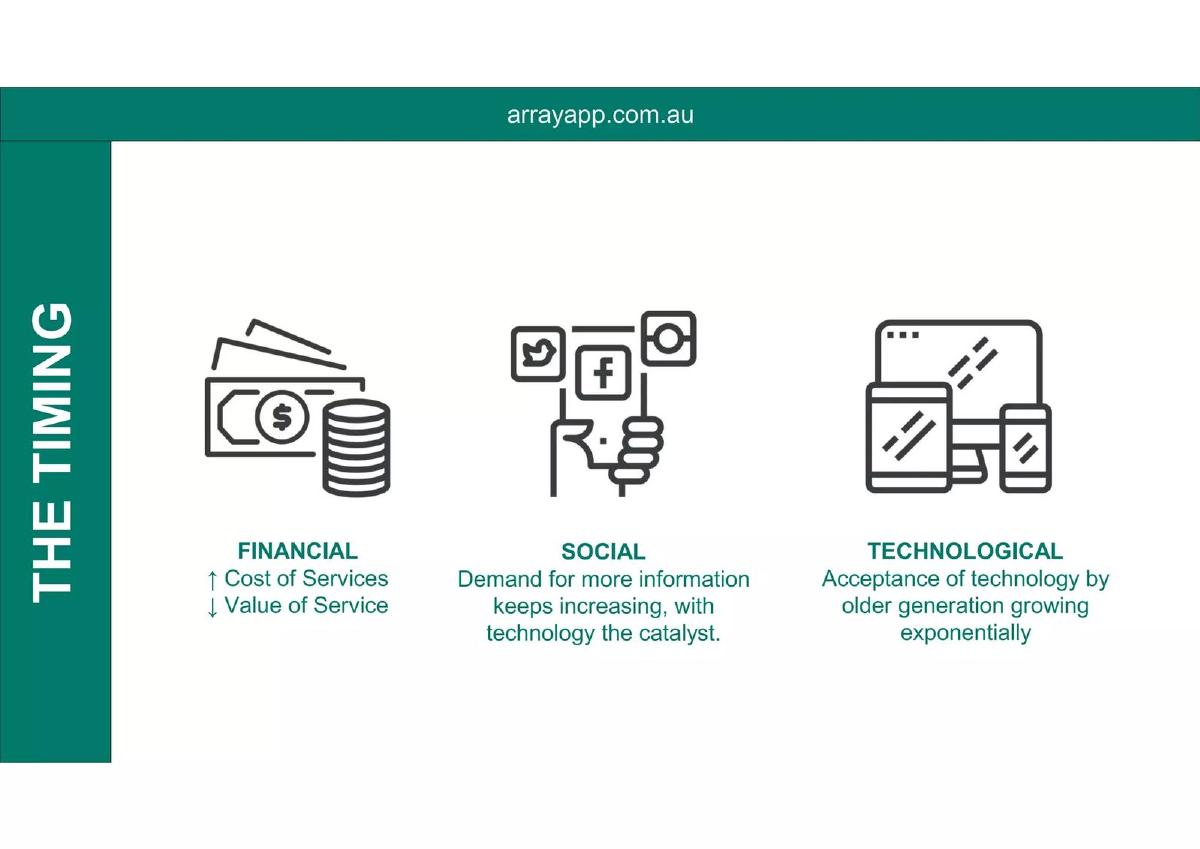
The 'Why Now?' slide is broken into three categories: Financial, Social, and Technological. Financial refers to the increasing cost of services; Social points to the demand for more information; and Technological highlights the 'exponentially' growing acceptance of technology by the older generation. This slide attempts to prove that the market is finally ready for a digital overhaul.
Slide 7: The Competition
This slide uses a standard checkmark matrix to compare Array against five competitors: Village Master, Epicor Senior Living Solution, Procura (by ANZ), BrightFox, and Vcare. Array claims to have a full sweep of 10 features, most notably the 'Complex Exit Calculator' and 'Resident Portal,' which are shown as missing from most or all of the competitors listed.
Slide 8: The Business Model
Array presents a two-step revenue strategy. The first is a subscription-based platform for retirement village owners. The second, labeled as 'Future,' is using 'supply chain power' to source services for customers. A financial chart shows revenue projections from FY20 to FY29, with the 'Supply Chain' revenue eventually becoming the dominant income source, projecting a total revenue scale exceeding $125M by year ten.
Slide 9: The Future
This slide illustrates geographic and sector expansion. An upward arrow points from Australia toward New Zealand, the UK, Asia, and the USA. Below the arrow, it mentions expanding into other property sub-sectors such as Aged Care, Owner’s Corp, and Retail. This slide is intended to show the potential for the company to scale beyond its initial niche.
Slide 10: The Ask
The company is seeking $500,000. The use of funds is clearly defined: MVP development, marketing, sales, and commercialization. The slide explicitly states a 12-month runway and a target outcome of '$81K recurring monthly revenue by June 2020' based on 8,100 units. This provides a clear, measurable goal for potential investors.
Slide 11: Get In Touch
The final slide provides contact information for the three founders, including phone numbers, email addresses, and LinkedIn profiles. It also lists the company's social media handles and website URL, ensuring investors have multiple ways to perform due diligence or reach out.
What Works Well
Industry Expertise: The team slide is excellent. Having two founders and a lead advisor from a major industry player like Lendlease immediately validates the problem they are solving. · Specific Feature Differentiation: By identifying a 'Complex Exit Calculator' as a unique selling point, Array shows they understand the specific mathematical pain points of retirement village management that generic ERPs might miss. · Clear Financial Goal: The 'Ask' slide doesn't just ask for money; it ties that money to a specific revenue and unit count outcome, which makes the investment feel more like a calculated bet than a blind contribution.
What Is Missing
Current Traction: The deck mentions the $500k will be used to 'develop the MVP,' which implies there is no current product or revenue. While the team has experience, the lack of a pilot program or early-stage user feedback is a notable gap. · Unit Economics: While the deck mentions 8,100 units leading to $81k in revenue (suggesting a $10/unit/month price point), it does not detail the cost of acquisition (CAC) or the lifetime value (LTV) of these customers. · Market Size (TAM/SAM/SOM): The deck skips the standard market sizing slide. While it hints at global expansion, it doesn't quantify the total number of retirement units available in Australia or the other target regions.
Founder Takeaways
Vertical SaaS requires deep roots: If you are building for a specific niche, your team slide must scream 'we know this industry better than anyone.' Array does this perfectly by highlighting their years at Lendlease. · Secondary revenue streams add scale: A pure SaaS play can sometimes feel limited in a small niche. By adding a 'supply chain' revenue model, Array shows investors a path to a $100M+ business that isn't solely dependent on seat licenses. · Be explicit with the 'Ask': Don't just list a dollar amount. Follow Array's lead by stating exactly what that money buys in terms of time (runway) and results (MRR targets).
Frequently asked questions
- What specific problem is Array solving in the senior housing market?
- According to slide 4, Array addresses the rising operational costs caused by 'paper-based processes' used to collect and maintain vast amounts of data. They also highlight that current methods for analyzing and reporting on this data are 'painful and frustrating' for operators, suggesting a lack of modern, centralized digital tools in the sector.
- Who are the key members of the Array leadership team?
- The team consists of CEO Paul McGee, who spent 9 years at Lendlease Retirement Living; CFO Matt Slutzkin, who spent 5 years at the same firm; and CTO Marty Rodowsky, who has over 10 years of technical experience and created the Picnado app. Slide 3 also lists three advisors with backgrounds in real estate, law, and HR.
- How does Array plan to generate revenue beyond software subscriptions?
- Slide 8 outlines a two-phase business model. While they are currently building a subscription-based platform, their 'Future' plan involves using 'supply chain power' to source better value services for retirement village customers. Their financial chart suggests that by FY29, this supply chain revenue is expected to significantly dwarf subscription income.
- What are the primary features that differentiate Array from its competitors?
- Slide 7 provides a feature matrix comparing Array to five competitors like Village Master and Epicor. Array claims to be the only provider offering a 'Complex Exit Calculator,' 'Compliance' tracking, a 'Resident Portal,' and 'Third Party Access' all within a single platform, whereas competitors lack several of these specific modules.
- What is the intended use of the $500,000 investment?
- As detailed on slide 10, the $500,000 will be used to develop the MVP (Minimum Viable Product), create and execute an initial marketing and sales plan, and cover other commercialization costs. The founders expect this capital to provide 12 months of runway and result in $81,000 of monthly recurring revenue.