Arrival’s investor presentation is a masterclass in positioning a hardware company as a high-margin technology firm. By focusing on 'Microfactories'—low-CAPEX, small-footprint assembly cells—Arrival argued they could achieve profitability at much lower volumes than traditional OEMs. The deck leans heavily on vertical integration, showcasing in-house components, proprietary composite materials, and a modular 'skateboard' platform. While the financial projections were aggressive, claiming a 0.4x revenue multiple based on a 2024 forecast of $14.1 billion, the presentation successfully communicat…
Key takeaways
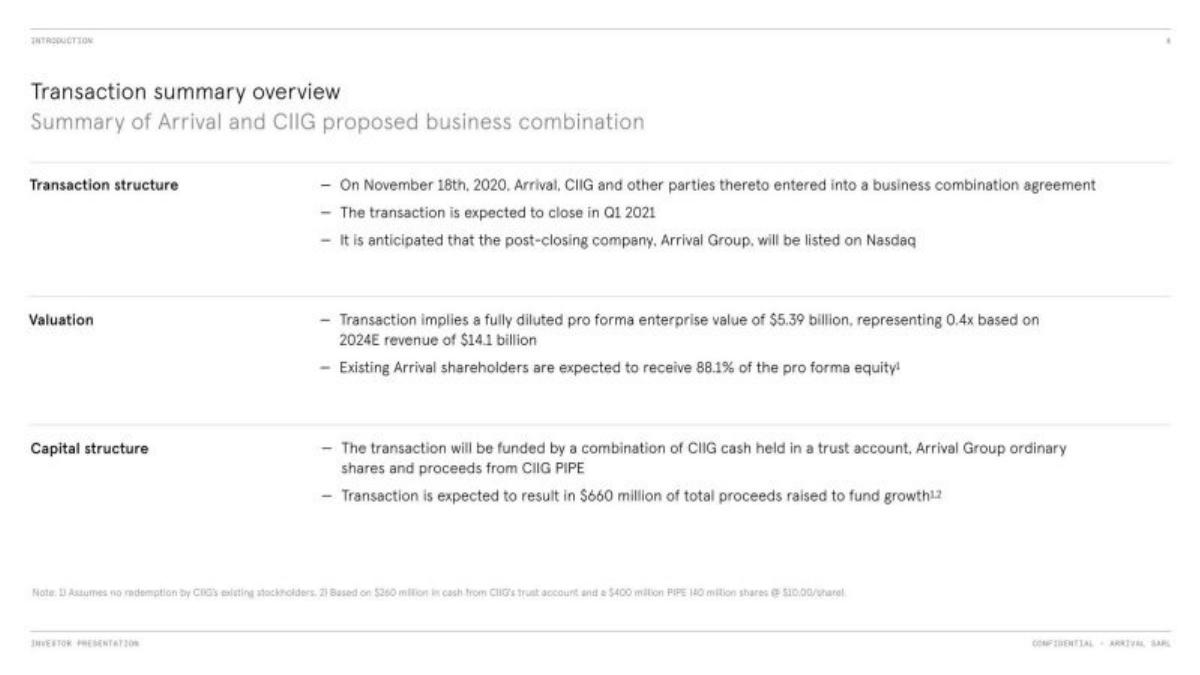
- The transaction implied a pro forma enterprise value of $5.39 billion, which the company framed as 0.4x its projected 2024 revenue of $14.1 billion (Slide 4).
- Arrival's core differentiator is the 'Microfactory' model, designed for low footprint, low CAPEX, and rapid deployment in response to local demand (Slide 20).
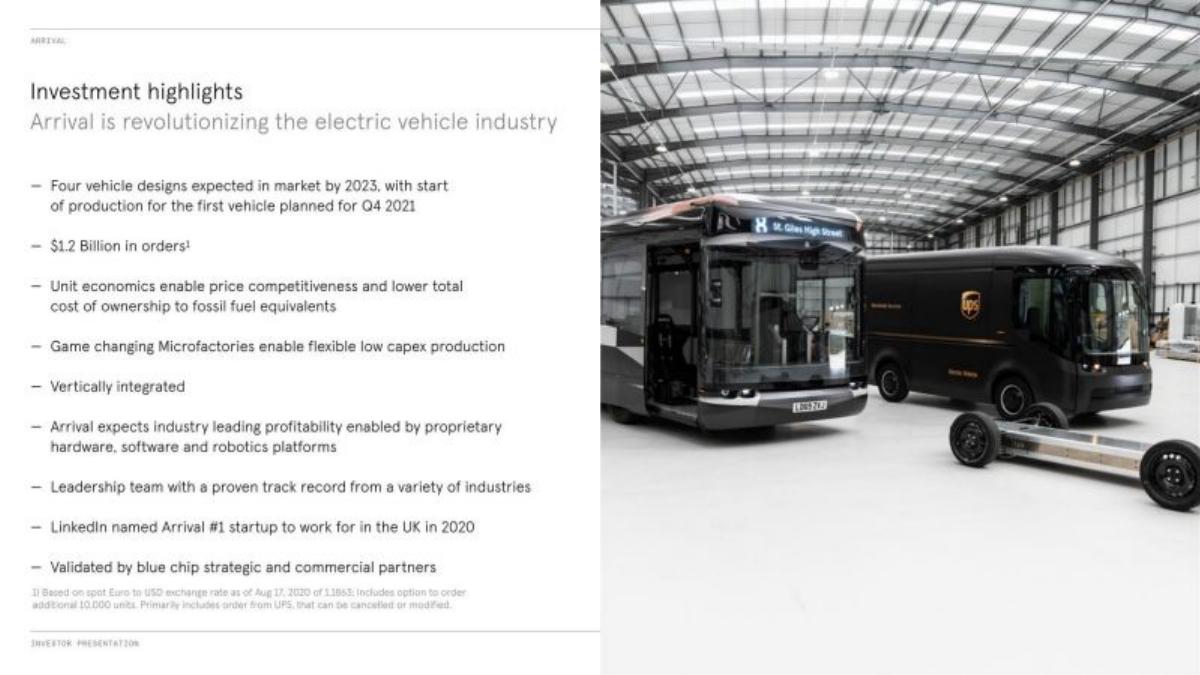
- The product pipeline included an electric bus (2021), electric van (2022), and a small vehicle platform (2023), with the van already claiming over 10,000 orders (Slide 8).
- The company utilizes proprietary composite materials for body panels, which are shown to be more durable than generic steel in a 10mph impact test (Slide 30).
- Vertical integration is a primary theme, with Arrival developing in-house 'Plug & Play' components and its own vehicle software to optimize total cost of ownership (Slide 20).
- The 'Modular Skateboard Platform' is designed to support FWD, RWD, and AWD configurations using the same battery module and aluminum structure (Slide 29).
- Future revenue streams beyond vehicle sales include a SaaS platform for fleet optimization and the sale of emissions credits to traditional OEMs (Slide 45).
- The management team features leaders with experience from Disney, Apple, Google, and Tesla, emphasizing a 'technology-first' pedigree (Slide 50).
The Vision: A Technology Company That Happens to Build Vans
Arrival’s investor presentation for its 2021 SPAC merger with CIIG Merger Corp is a quintessential example of the "New Auto" pitch. It avoids the traditional metrics of manufacturing—like line speed or stamping pressure—and instead uses the language of Silicon Valley: modularity, vertical integration, and software-defined hardware. The deck aims to convince investors that the $5.4 billion valuation is actually conservative by projecting a massive revenue jump to $14.1 billion within three years.
Slide 1: Title Slide
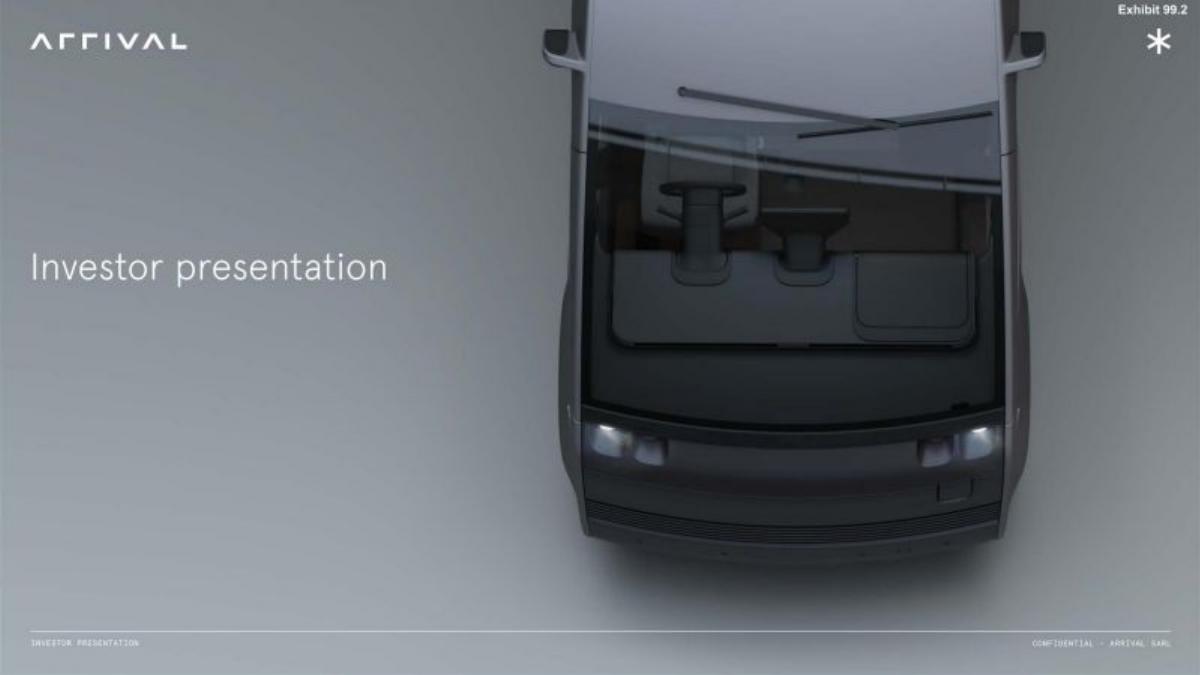
The deck opens with a high-angle, minimalist render of the Arrival Van. The branding is clean and futuristic, immediately signaling that this is not a legacy industrial company. The "Exhibit 99.2" mark in the corner identifies this as a formal SEC filing, typical for SPAC investor presentations.
Slide 4: Transaction Summary Overview
This slide lays out the financial mechanics of the deal. Arrival and CIIG entered the agreement on November 18th, 2020. Key figures include a $5.39 billion pro forma enterprise value . Notably, they justify this valuation by citing it as 0.4x based on 2024E revenue of $14.1 billion . This is a classic SPAC-era tactic: using distant, aggressive projections to make a multi-billion dollar valuation appear like a value play. The capital structure shows $660 million in total proceeds , including a $400 million PIPE (Private Investment in Public Equity).
Slide 8: Product Pipeline
Arrival presents a multi-vehicle strategy. The Electric Bus was slated for Q4 2021, the Electric Van for Q3 2022 (with >10,000 orders ), and a Small Vehicle Platform for 2023. The slide emphasizes that these vehicles are "competitively priced to ICE vehicles" and "autonomous ready." This is a critical claim, as the higher cost of EVs has historically been the primary barrier to B2B adoption.
Slide 11-16: Visual Galleries
These slides are purely aesthetic, designed to showcase the design language of the Van and Bus. The interior of the Arrival Van (Slide 15) features a large central touchscreen and a minimalist dashboard, echoing Tesla’s design philosophy. The Bus gallery (Slide 16) highlights large digital displays for passenger information and a modular seating arrangement. These images serve to prove that the product is "real" and highly polished, even if mass production had not yet commenced.
Slide 20: Arrival’s New Method
This is the most important slide in the deck. It defines Arrival as a "technology company" rather than an OEM. It breaks down the "New Method" into three pillars: In-house Plug & Play components , Proprietary composite materials , and a Modular skateboard platform . These feed into Microfactories , which are described as having a "low footprint" and "low CAPEX." The promise is that this method leads to "greater profitability at lower capex compared to existing OEMs."
Slide 23: Rock Hill, South Carolina Microfactory
To ground the abstract "Microfactory" concept, Arrival shows an aerial photo of a facility in Rock Hill. Unlike the sprawling, multi-mile complexes of Ford or VW, this is a standard industrial warehouse. This visual supports the claim that Arrival can set up production anywhere quickly without building specialized, high-cost infrastructure.
Slide 26: In-house Plug & Play Components
A dark, stylized render shows what appears to be battery modules or power electronics. The text "In-house Plug & Play components" reinforces the vertical integration narrative. By making their own parts, Arrival claims they can reduce costs and ensure all parts of the vehicle work together seamlessly.
Slide 29: Modular Skateboard Platform
This slide details the technical foundation of their vehicles. The platform uses an aluminum structure to optimize strength and is flexible enough to support FWD, RWD, and AWD . Crucially, it mentions the "elimination of welding and high-wage skilled labor," replaced by a "minimal number of interfaces and specialist fixings." This is the core of their margin expansion thesis.
Slide 30: Proprietary Composite Materials
Arrival provides a side-by-side comparison of their composite body panel versus a generic steel body panel after a 10mph impact test. The steel panel is visibly dented, while the composite panel appears unscathed. This is a powerful visual for fleet managers concerned with repair costs and vehicle downtime.
Slide 35: Software and HMI
A four-pane gallery shows the software ecosystem: driver apps, fleet management tools on tablets, and the in-vehicle Human-Machine Interface (HMI). This slide positions Arrival as a software-as-a-service (SaaS) provider, not just a hardware manufacturer.
Slide 41: Pro Forma Equity Ownership
This slide provides the cap table post-merger. Existing Arrival shareholders retain a massive 88% of the company. CIIG public shareholders represent 4%, PIPE investors 7%, and the SPAC sponsor 1%. This high level of insider retention is usually intended to signal founder confidence to new investors.
Slide 45: Future Opportunities
Arrival looks beyond the initial van sales to four revenue drivers: Multiple vehicles (rapid customization), Autonomous (depot trials), SaaS platform (recurring revenue), and Emissions credits . The mention of selling credits to "traditional OEMs under pressure from government CO2 targets" highlights a high-margin revenue stream that helped companies like Tesla reach profitability.
Slide 50: Arrival Management Team
The team slide focuses on functional expertise rather than just titles. Sergey Malygin (Technology) brings 15 years of experience; Jeremy Offer (Design) has 30 years and worked with Google and Apple; Kwame Nyanning (Experience) has a background with NASA and Disney. The pedigree is intentionally diverse, pulling from tech, aerospace, and consumer electronics rather than just traditional Detroit auto backgrounds.
Slide 53-54: Component Gallery
The deck concludes with technical specs for their HMI module , measuring 300mm x 100mm x 100mm. Including these specific dimensions and hardware renders is a way to signal "engineering readiness" to sophisticated investors who might be skeptical of the Microfactory model.
What Arrival Does Well
Arrival’s deck is exceptionally strong at redefining the category . They don't want to be compared to Ford; they want to be compared to a software company with a hardware distribution model. The focus on Microfactories is a brilliant way to address the biggest fear in EV investing: the "Valley of Death" caused by massive CAPEX requirements for traditional factories. By showing that they can build in standard warehouses, they lower the perceived risk of scaling.
The visual evidence —from the impact test of the composite panels to the aerial photo of the Rock Hill facility—provides much-needed tangibility to a highly speculative business model. Finally, the vertical integration story is comprehensive, covering everything from the chemical makeup of the body panels to the code in the fleet management app.
What Is Missing
The most glaring omission in these slides is historical financial data . While common for SPAC decks of this era, there is no mention of previous losses, current burn rate, or the actual cost to produce a single prototype. The deck relies entirely on "2024E" projections.
There is also a lack of competitive analysis . The EV space in 2021 was already crowded with Rivian, Ford (E-Transit), and BrightDrop (GM). Arrival mentions "existing OEMs" as a monolith but doesn't explain how they will defend their niche against specific, well-capitalized incumbents who also have fleet relationships.
Finally, the unit economics are stated as "unrivalled" (Slide 8) but never actually broken down. Investors are asked to take it on faith that the Microfactory model is cheaper, without seeing a per-unit Bill of Materials (BOM) or a comparison of labor hours per vehicle versus a traditional line.
What Other Founders Should Copy
The "New Method" Framework: If you are disrupting a legacy industry, don't just say your product is better. Explain why your process is fundamentally different. Arrival’s Slide 20 is a perfect template for this. · Visual Proof of Durability: For hardware startups, a simple "torture test" (like Slide 30’s impact test) is worth more than ten slides of technical specifications. · Modular Architecture: Showing how one platform (the skateboard) can serve multiple markets (Bus, Van, Small Vehicle) demonstrates capital efficiency and a larger Total Addressable Market (TAM). · Clean, High-Fidelity Renders: In the absence of a mass-produced product, high-quality design work signals a level of professionalism and attention to detail that attracts institutional capital.
Frequently asked questions
- What is Arrival's 'Microfactory' concept?
- Unlike traditional automotive plants that require billions in investment and massive land, Arrival's Microfactories are designed for low CAPEX and a small footprint. As shown on Slide 20, these are intended to be deployed rapidly in existing warehouse-style buildings (like the one pictured in Rock Hill, South Carolina on Slide 23) to serve local market demand using cell-based robotic assembly rather than a traditional moving line.
- How does Arrival justify its unit economics?
- Arrival claims 'unrivalled unit economics' by eliminating expensive processes like welding and painting. Slide 29 explains that their modular skateboard platform uses aluminum extrusions and castings, while Slide 30 highlights proprietary composite panels that don't require a paint shop. By reducing tooling costs and using in-house components, they aim to price EVs competitively with internal combustion engine (ICE) vehicles while maintaining high margins.
- What was the valuation and deal structure of the SPAC merger?
- According to Slide 4, the transaction implied a fully diluted pro forma enterprise value of $5.39 billion. The deal was funded by $260 million from CIIG's trust account and a $400 million PIPE. Existing Arrival shareholders retained the vast majority of the company, receiving 88.1% of the pro forma equity.
- What products were in Arrival's immediate pipeline?
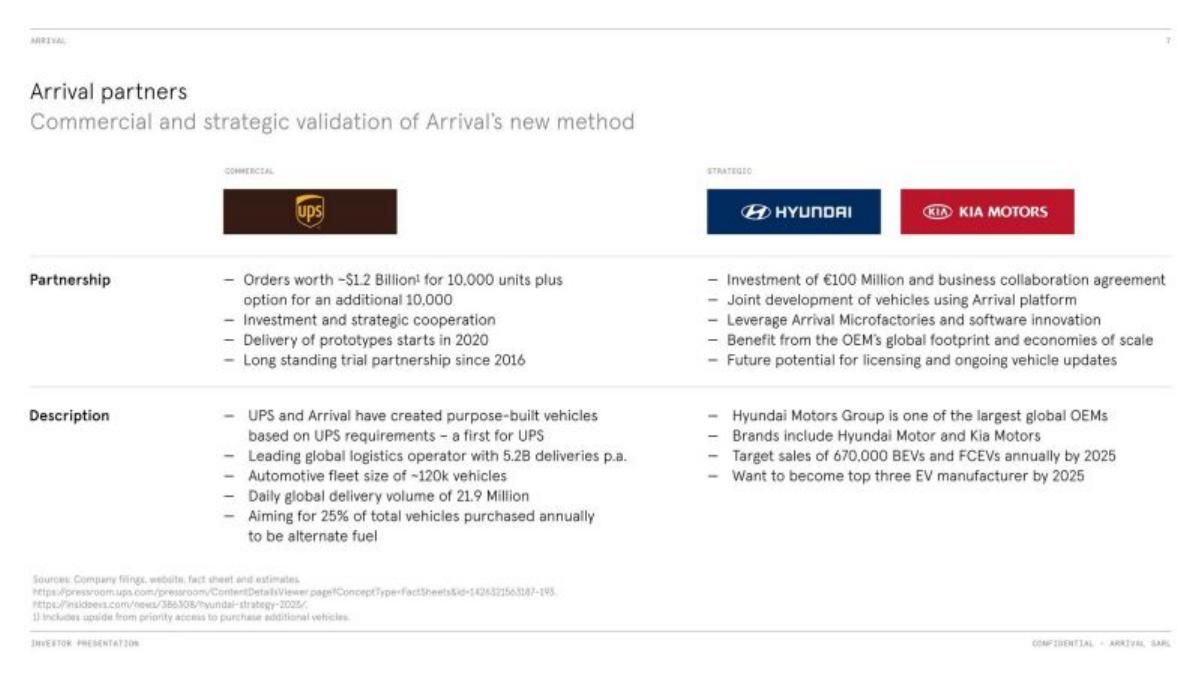
- Slide 8 lists four key platforms: the Electric Bus (expected Q4 2021), the Electric Van (expected Q3 2022), the Large Electric Van (expected Q3 2022), and a Small Vehicle Platform (expected Q3 2023). The Electric Van is noted as having over 10,000 orders, which includes the well-publicized order from UPS.
- What are the 'Future Opportunities' mentioned in the deck?
- Beyond selling hardware, Slide 45 identifies three major growth areas: Autonomous driving (currently in depot trials), a SaaS platform for fleet management and vehicle health monitoring, and the sale of emissions credits. They anticipate that traditional OEMs failing to meet CO2 targets will be a significant market for Arrival’s surplus credits.