<strong>Quantify the Pain in Dollars:</strong> The deck brilliantly frames the problem not as a vague inefficiency, but as a concrete '$10,011 per worker per year' cost, making the need for a solution urgent and budgetable. <strong>Ride a Macro Trend:</strong> Yammer positions itself as the inevitable enterprise version of a massive consumer behavior shift (social networking > email) and a technology shift ('The Consumerization of Enterprise Software'). <strong>Show, Don't Just Tell, Credibility:</strong> The deck immediately establishes authority with founder David Sacks' (ex-PayPal COO) ped…
Key takeaways
- <strong>Quantify the Pain in Dollars:</strong> The deck brilliantly frames the problem not as a vague inefficiency, but as a concrete '$10,011 per worker per year' cost, making the need for a solution urgent and budgetable.
- <strong>Ride a Macro Trend:</strong> Yammer positions itself as the inevitable enterprise version of a massive consumer behavior shift (social networking > email) and a technology shift ('The Consumerization of Enterprise Software').
- <strong>Show, Don't Just Tell, Credibility:</strong> The deck immediately establishes authority with founder David Sacks' (ex-PayPal COO) pedigree, a TechCrunch50 win, and '$40 MM funding from Tier 1 VCs'.
- <strong>Deploy Overwhelming Social Proof:</strong> The traction slide is a knockout punch: '100,000+ companies, including 82% of the Fortune 500'. This silences most adoption and market-fit questions.
- <strong>Close the Loop with ROI:</strong> The deck starts with a quantified problem (hours wasted) and ends with a quantified solution, citing LG's estimate of 'three hours a week' saved, creating a powerful and symmetrical narrative.
- <strong>Position as an Ally, Not Just a Killer:</strong> The SharePoint integration slide is a savvy go-to-market move, framing Yammer as an easy, low-cost enhancement to an existing enterprise giant rather than declaring war on it.
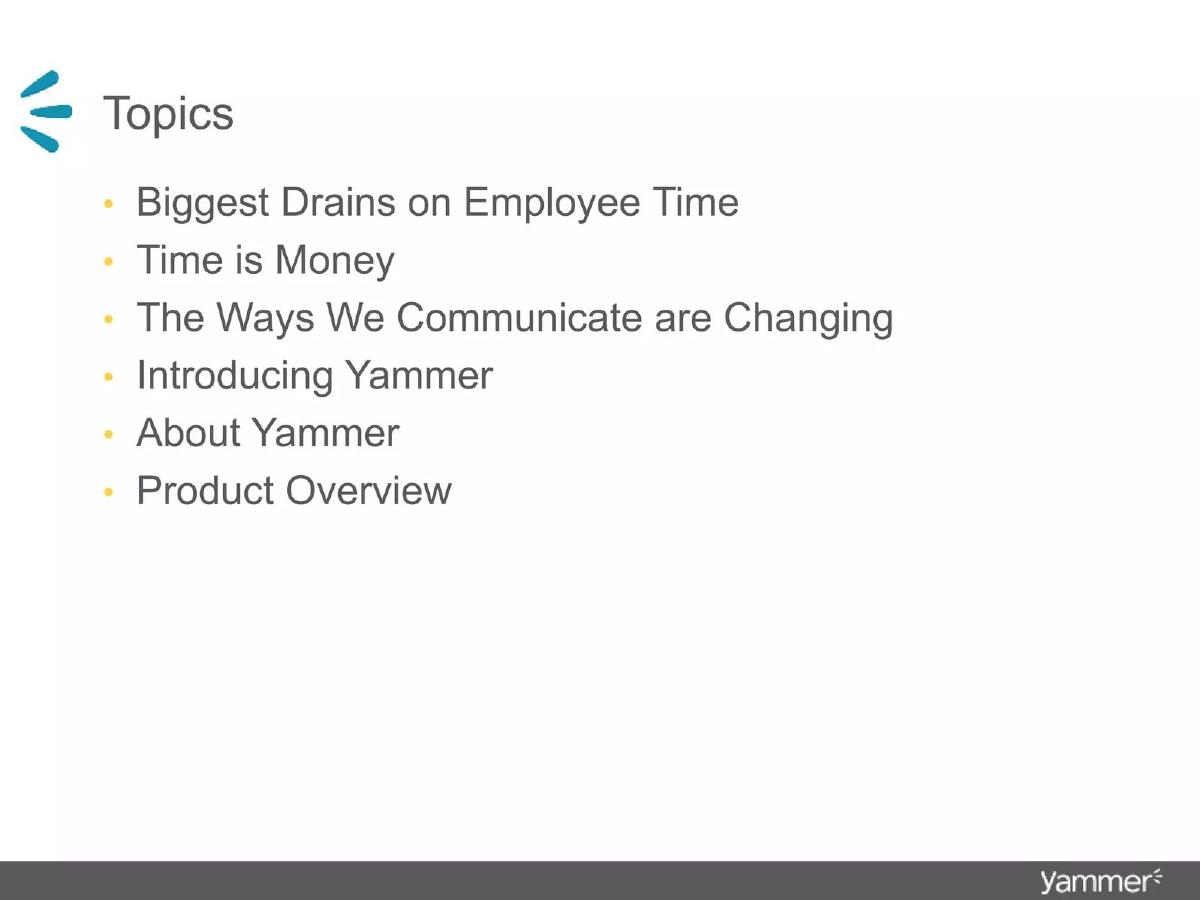
- <strong>Structure is Narrative:</strong> The 'Topics' slide at the beginning lays out a clear story: here's a costly problem, here's why the world is ready for a new solution, here is our solution, and here is definitive proof that it works.
Introduction: Who is This Deck For?
Before diving into the slides, it's critical to understand the context of this Yammer deck. The slide 'About Yammer' mentions the company has already raised '$40 MM funding from Tier 1 VCs'. This is not a seed-stage company trying to secure its first check. Furthermore, the deck contains no 'ask' slide, no detailed financials, and no forward-looking projections. This strongly suggests it is not a traditional fundraising deck for a specific round of financing.
Instead, this appears to be a general overview or investor relations deck, likely used for sales enablement, partnership discussions, or briefing later-stage investors where the core financial conversation happens outside the presentation. For founders, its value lies not in its template for a Series A raise, but as a masterclass in how a category-defining company frames its problem, validates its solution, and asserts its market leadership.
The Problem: From Annoyance to a $10 Million Drag
Yammer doesn't waste time with vague statements about communication being broken. It immediately gets specific and financial. The presentation dedicates two full slides to methodically building a case for a painful, expensive, and universal problem inside knowledge-based organizations.
h3>Quantifying the Invisible Cost
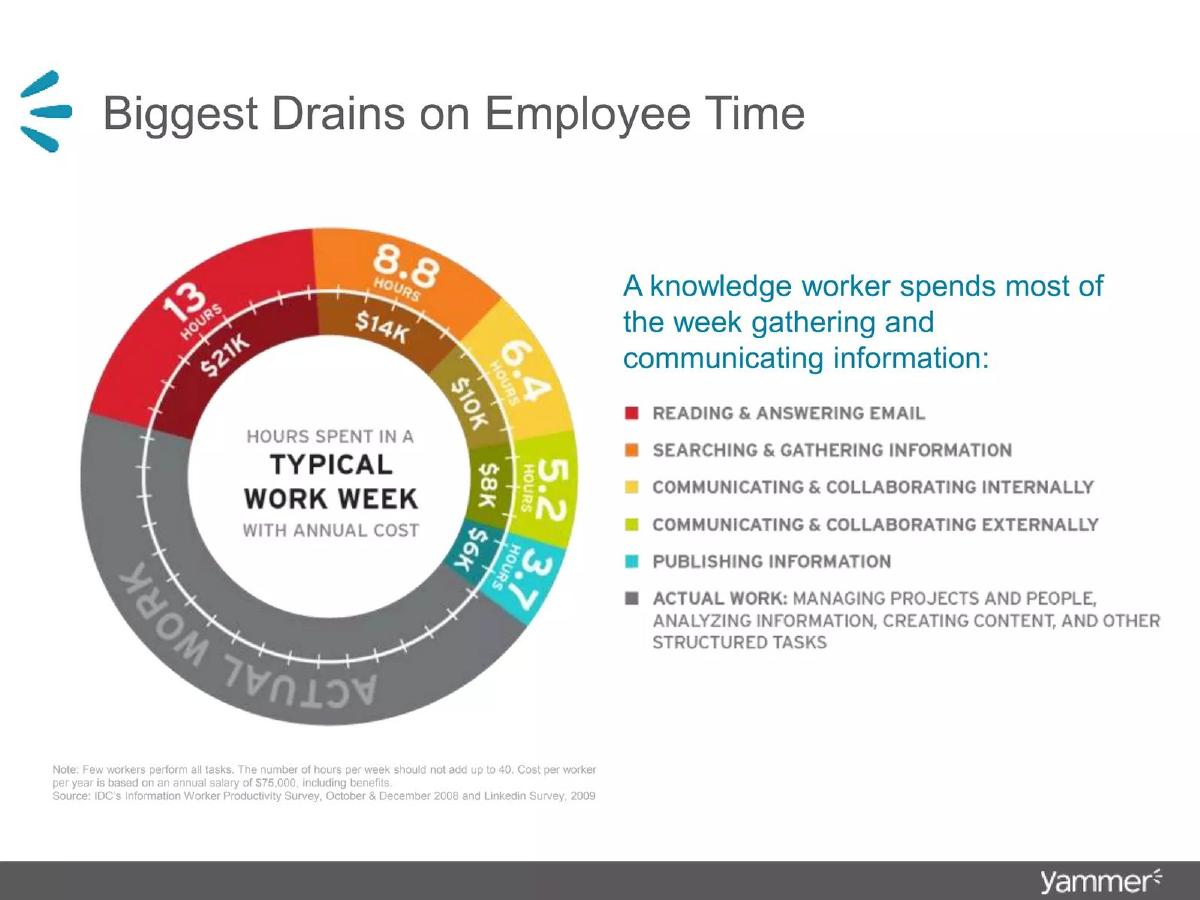
The slide titled 'Biggest Drains on Employee Time' is a powerful opening salvo. It uses data from IDC to break down a knowledge worker's week into buckets like 'gathering and communicating information'. This approach is effective because it takes a familiar, everyday frustration and puts it under a microscope. It translates the feeling of a chaotic workday into a structured, data-driven analysis.
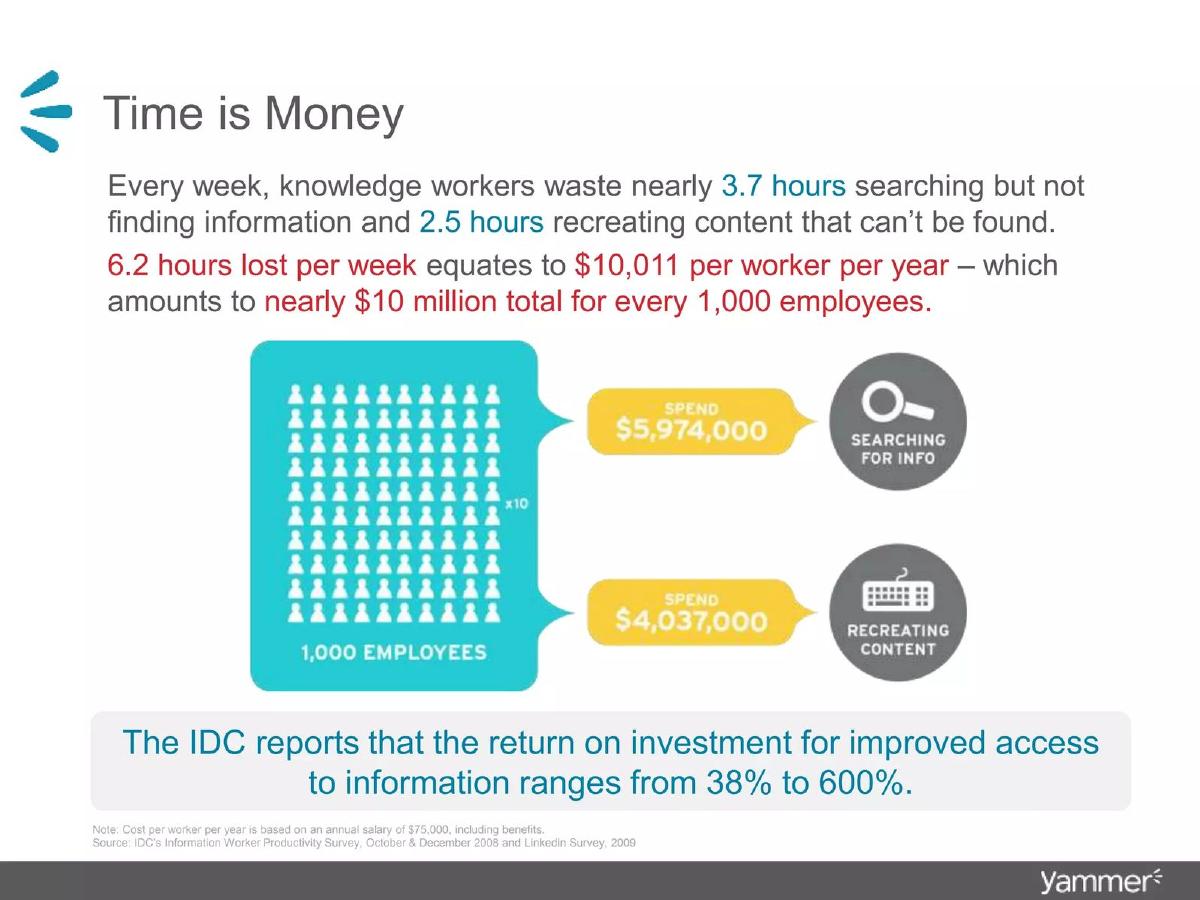
The deck's masterstroke comes on the next slide, 'Time is Money'. The text is direct and alarming: 'Every week, knowledge workers waste nearly 3.7 hours searching but not finding information and 2.5 hours recreating content that can’t be found.' By consolidating this lost time into '6.2 hours lost per week', Yammer creates a single, memorable pain metric. Then, it brilliantly converts that time into a dollar amount based on an average salary: '$10,011 per worker per year'.
This transforms the problem from an HR issue into a CFO issue. It's no longer about employee happiness; it's about a '$10 million total' annual loss 'for every 1,000 employees'. This framing is designed to grab the attention of budget-holders and makes the status quo seem unacceptably expensive. This is a critical lesson for any B2B founder: find the financial heart of your customer's pain.
The 'Why Now': Riding the Wave of Consumerization
After establishing a costly problem, the deck pivots to explain why the time is right for Yammer's solution. It builds a case based on two powerful forces: a widespread behavioral shift and a fundamental change in enterprise software delivery.
h3>The Inexorable Rise of Social
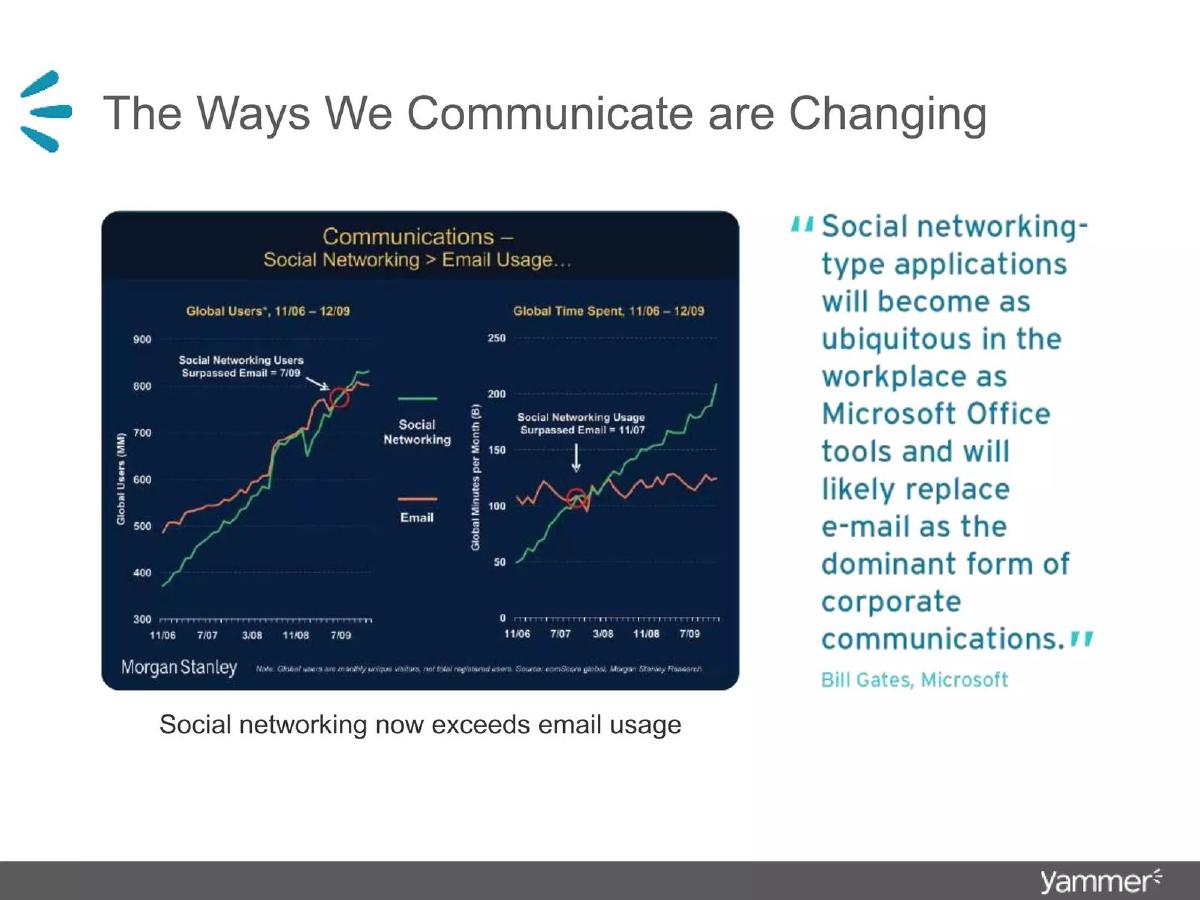
The slide 'The Ways We Communicate are Changing' is visually simple but argumentatively profound. A single line graph shows 'Social networking now exceeds email usage'. This single chart does tremendous work. It anchors Yammer's entire premise in an undeniable, global trend. The message is clear: the way people connect in their personal lives is fundamentally different, and it's only a matter of time before their work lives follow suit. Yammer isn't just an idea; it's an inevitability.
h3>The Manifesto for Modern Enterprise Software
Perhaps the most intellectually compelling slide in the entire deck is 'The Consumerization of Enterprise Software'. This isn't just a feature list; it's a declaration of a new world order for B2B technology. With bullet points like:
Designed for, and adopted by, the end user · No training · Spreads virally: value proven first, pay later · Organic, serendipitous discovery of relevant content
Yammer defines the movement and simultaneously positions itself as its chief protagonist. This slide tells investors and customers, 'We understand the fundamental shift that is happening, and our product is built from the ground up on these modern principles.' It frames legacy tools not just as old, but as philosophically obsolete. For founders, this is a powerful technique: don't just sell your product, sell your worldview and show how your product is its perfect expression.
Finally, the 'Better Communications = Higher Total Returns' slide, citing a Towers Watson study, elevates the entire pitch. It connects the dots between social tools, communication effectiveness, and the ultimate metric for public companies: shareholder returns. This takes the argument from a departmental productivity tool to a strategic boardroom imperative.
The Solution and Product: An 'Enterprise Social Network'
With the problem and market shift established, Yammer introduces its solution cleanly and comprehensively. The core solution slide, 'Yammer: The Enterprise Social Network', lays out the value proposition with elegant simplicity: 'Easy. Shared. Searchable. Real-time. Where your company’s knowledge lives.'
The feature list that follows (Messaging, Profiles, Groups, File Sharing) is thorough but not overwhelming. It's followed by a series of clean, screenshot-style slides that give a visual feel for the core user experience: Feeds, Direct Messaging, Search, and Groups. The goal here isn't to be a user manual, but to provide a tangible sense of the product's look and feel, reinforcing the 'Easy' and consumer-like promise.
h3>Beyond a Tool, Towards a Platform
Yammer demonstrates a grander vision with 'The Yammer Apps Platform' slide. By showcasing built-in applications like Polls, Events, and Ideas, and integrations with tools like ZenDesk and Box.net, Yammer elevates itself from a simple communication stream to a central nervous system for work. This signals a strong product strategy and a wider moat against competitors.
The 'SharePoint Integration' slide is a particularly brilliant piece of go-to-market strategy. SharePoint was the slow, clunky, but deeply entrenched incumbent. Instead of picking a direct fight, Yammer frames itself as a nimble, modern layer on top. The claims 'Add Enterprise Social Networking...for less than 5% of your SharePoint costs' and 'Setup takes under 20 minutes' are tactical genius. It makes trial and adoption a low-risk, high-reward decision for IT managers already invested in the Microsoft ecosystem.
Traction & Social Proof: An Avalanche of Credibility
This is where the deck truly separates itself into the top tier. Yammer doesn't just claim to have traction; it presents an overwhelming, multi-faceted case that leaves little room for doubt.
h3>De-Risking the Venture from the Start
The 'About Yammer' slide is a masterclass in building instant credibility. In just a few bullets, it establishes:
Founder Pedigree: 'Founded by David Sacks, former COO of PayPal'. This immediately signals elite-level experience in building and scaling a world-changing tech company. · Early Validation: 'Won TechCrunch50'. In its era, this was a massive stamp of approval and a signal of industry excitement. · Financial Strength: '$40 MM funding from Tier 1 VC’s'. This tells any reader that the smartest money in the world has already vetted and backed this team and vision.
h3>The Knockout Punch: Unassailable Traction
The slide 'Customer Success = Proven Value' is arguably the most powerful in the entire deck. The headline figures—'100,000+ companies, including 82% of the Fortune 500'—are simply staggering. This number is so large and the enterprise penetration so deep that it borders on irrefutable proof of product-market fit. It preemptively answers questions about adoption, scalability, and enterprise-readiness.
h3>Proving the ROI
Yammer then masterfully closes the narrative loop it began in the 'Problem' section. The 'Active Users Enjoy 7.5% Increased Productivity' slide doesn't rely on Yammer's own marketing claims. It uses a direct quote from a VP at LG Electronics, who estimates that users save 'approximately three hours a week'.
The deck then translates this back into the financial terms it established earlier, calculating the savings per employee and company-wide. It started by stating a problem worth ~$10,000 per employee per year. It now provides customer-validated proof that it can deliver ~$7,500 of that back in value. This symmetry between the problem and the proven solution is exceptionally persuasive.
What’s Not in the Deck? A Guide for Founders
While the deck is brilliant, it's crucial to note what is absent, especially for founders using it for inspiration.
The Ask: There is no slide asking for a specific amount of funding in exchange for a percentage of equity. This is the clearest sign that this is not a deck for a specific fundraising round. · Business Model & Financials: The deck completely omits pricing, revenue, customer acquisition cost (CAC), lifetime value (LTV), and financial projections. In a real fundraising deck, this section is non-negotiable. Yammer's freemium, viral adoption model is hinted at ('value proven first, pay later'), but the mechanics of monetization are not explained. · Competition: There is no 2x2 matrix or direct comparison with named competitors like Jive or Chatter. Yammer opts for a more confident posture, positioning itself against the 'old way' (email, inefficient meetings) and incumbents (SharePoint). With their level of traction, they could afford this swagger. An earlier-stage startup cannot; you must show you understand your competitive landscape. · Detailed Team Slide: While David Sacks is name-dropped for maximum impact, there is no slide introducing the broader executive team and their pedigrees. For an earlier-stage company, demonstrating the depth of the entire founding team is critical.
In conclusion, Yammer's deck is a powerful artifact of a company that had already achieved significant escape velocity. It leans almost entirely on a well-quantified problem, a compelling macro trend, and an avalanche of social proof. For founders today, the key lesson is not to copy its structure slide-for-slide, but to aspire to its level of narrative discipline: quantify the pain, demonstrate customer love, and prove your financial value.
Frequently asked questions
- Is this a good deck for raising a seed or Series A round?
- No. This deck's power comes from a level of traction (100k+ companies, 82% of F500) and prior funding ($40M) that early-stage startups do not have. An early-stage deck must include detailed financials, a clear 'ask', a competitive analysis, and a more comprehensive team slide.
- What's the single biggest lesson a founder can take from this deck?
- Quantify everything. Yammer quantifies the problem in dollars ('$10,011 per worker per year') and then proves its solution's ROI using customer data ('saves them approximately three hours a week'). This creates a powerful, closed-loop argument that resonates with budget-conscious decision-makers.
- The deck mentions $40M in funding. Why would they be presenting a deck at all?
- This is most likely a general purpose or 'overview' deck, not one for a specific fundraise. Its purpose could be for sales to large enterprise clients, for discussions with potential strategic partners, or for updating later-stage board members and investors on the company's positioning and progress.
- How does Yammer's deck handle the topic of competition?
- Subtly and with confidence. It avoids a standard competitive landscape slide. Instead, it frames the competition as the 'old way' of working (email, wasted meetings) and strategically positions itself as a complementary enhancement to the big incumbent, SharePoint, making adoption seem less risky.
- What does the 'Consumerization of Enterprise Software' slide accomplish?
- It's a masterful piece of thought leadership. It frames Yammer not as just another tool, but as the standard-bearer for a massive, inevitable shift in how business software is bought and used. It makes adopting Yammer feel like getting on the right side of history.