Navina’s 10-slide deck is a concise argument for the necessity of AI in primary care. Founded by veterans of the IDF’s Unit 8200, the company positions its technology as a solution to the 'chaotic data' that consumes 33% of a physician's EMR time. The deck is notably light on traditional financial metrics—omitting revenue, burn rate, and specific customer logos—but heavy on the 'why now' and the pedigree of the team. It leans into the shift toward Value-Based Care, specifically targeting the Risk Adjustment Factor (RAF) as a primary revenue driver for providers. By framing the problem as a $3…
Key takeaways
- Chart review is identified as the number one time-consuming activity for physicians, taking up 33% of EMR time (Slide 2).
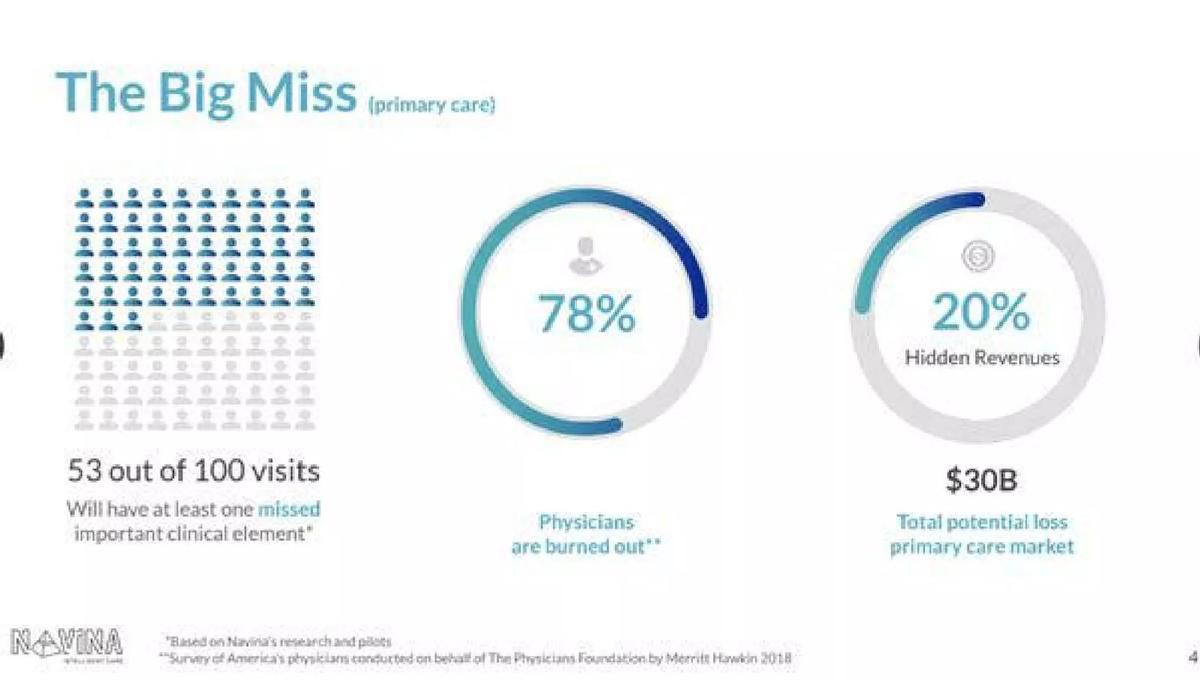
- The primary care market faces a total potential loss of $30 billion due to missed clinical elements and burnout (Slide 4).
- Navina claims that 53 out of 100 patient visits currently miss at least one important clinical element (Slide 4).
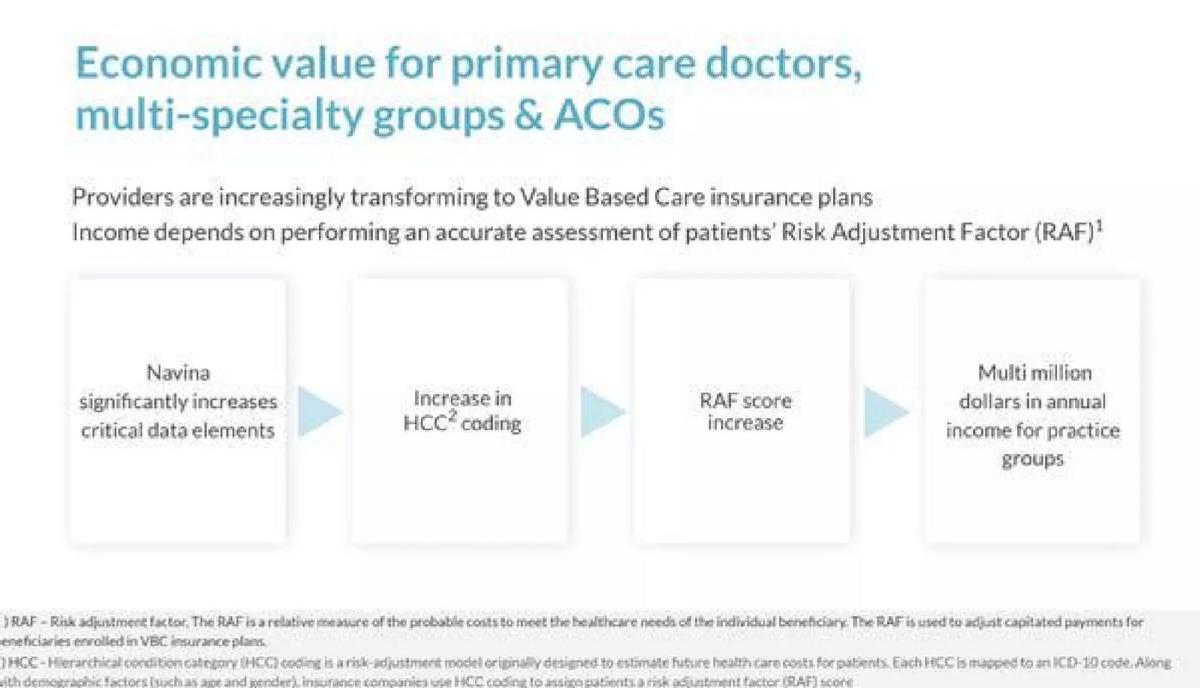
- The platform focuses on increasing HCC coding and RAF scores to generate 'multi-million dollars' in annual income for practice groups (Slide 6).
- The founding team has a 24-year background in the IDF's 8200 unit, specifically building AI decision support systems for military intelligence (Slide 7).
- The management team includes a mix of MDs, PhDs, and veterans from companies like MeMed Dx (Slide 8).
- The deck positions the post-COVID era as a catalyst for growth due to increased primary care visits and the necessity of telemedicine data access (Slide 9).
- The presentation omits a specific funding ask, current revenue figures, or a detailed competitive landscape (Slides 1-10).
The Strategic Lean: Pedigree Over Performance Metrics
The Navina pitch deck is an interesting artifact of a Series B raise that relies heavily on the 'Founder-Market Fit' narrative. While many Series B decks are spreadsheets disguised as slides, Navina focuses on the qualitative transformation of healthcare data. The deck is structured to move an investor from a massive, systemic pain point to a highly specialized team capable of solving it, and finally to the economic windfall resulting from that solution.
Slides 1-2: The Problem of Data Chaos
Slide 1 introduces the brand with the tagline: "The Patient, Revealed. Replacing chaotic data with intuitive Patient Portraits." This sets the stage for a visual-first solution to a data-heavy problem.
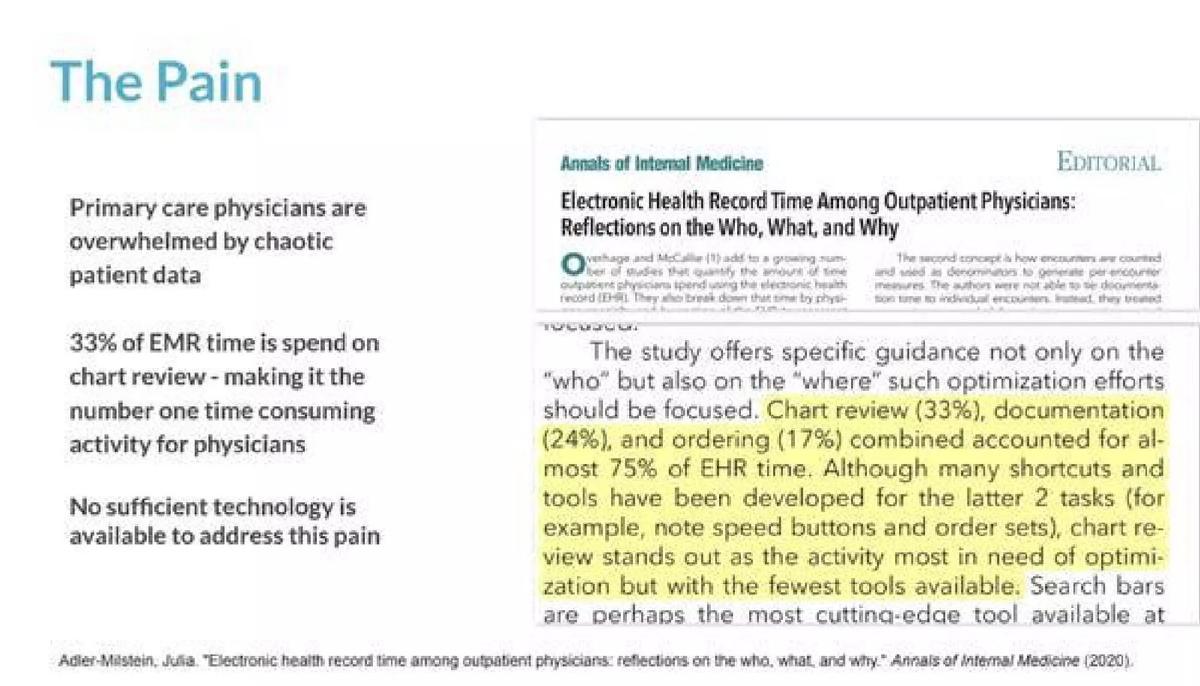
Slide 2 , titled "The Pain," uses external validation from the Annals of Internal Medicine to anchor the problem in reality. It cites that 33% of EMR time is spent on chart review, making it the "number one time consuming activity for physicians." By highlighting that "no sufficient technology is available to address this pain," Navina carves out a market vacancy that they intend to fill. This slide is effective because it uses a third-party source to justify the company's existence before the founders even introduce their product.
Slides 3-4: The Overview and the 'Big Miss'
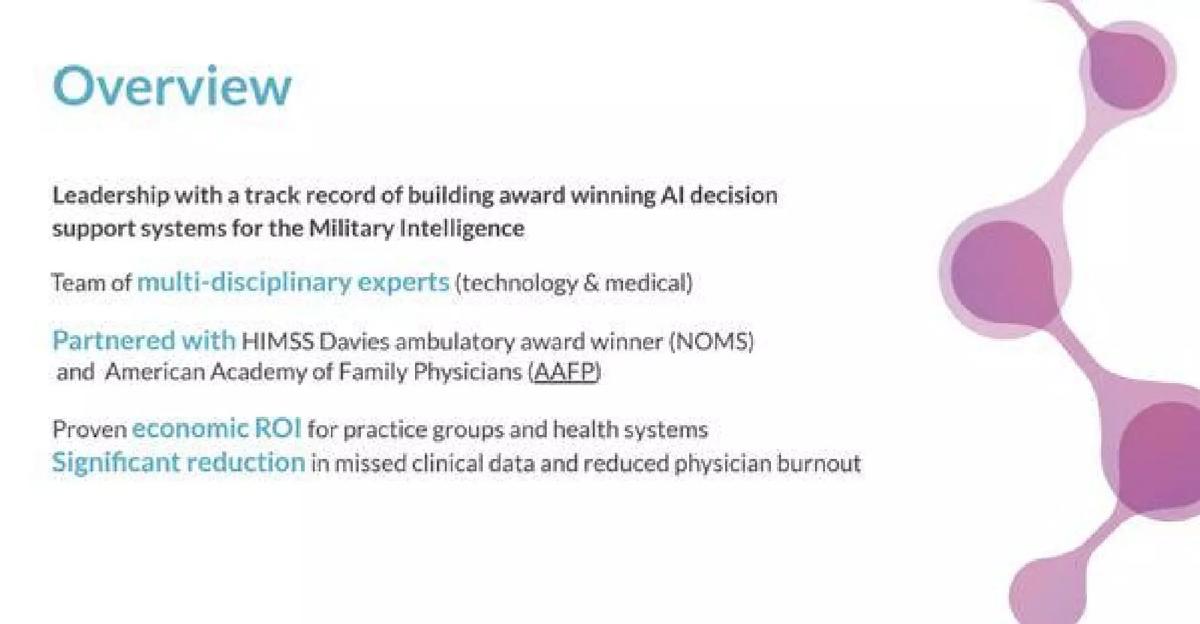
Slide 3 provides a high-level summary of the company's strengths. It mentions leadership with a track record in military intelligence and partnerships with the American Academy of Family Physicians (AAFP). This is a 'credibility slide' designed to stop an investor from questioning the technical feasibility of the project early on.
Slide 4 , "The Big Miss," quantifies the cost of the status quo. It presents three staggering statistics: 53 out of 100 visits miss an important clinical element, 78% of physicians are burned out, and there is a $30 billion total potential loss in the primary care market. The term "Hidden Revenues" (20%) is used here to pivot the conversation from clinical outcomes to financial incentives, which is a critical move for a Series B pitch.
Slides 5-6: The Solution and Economic Value
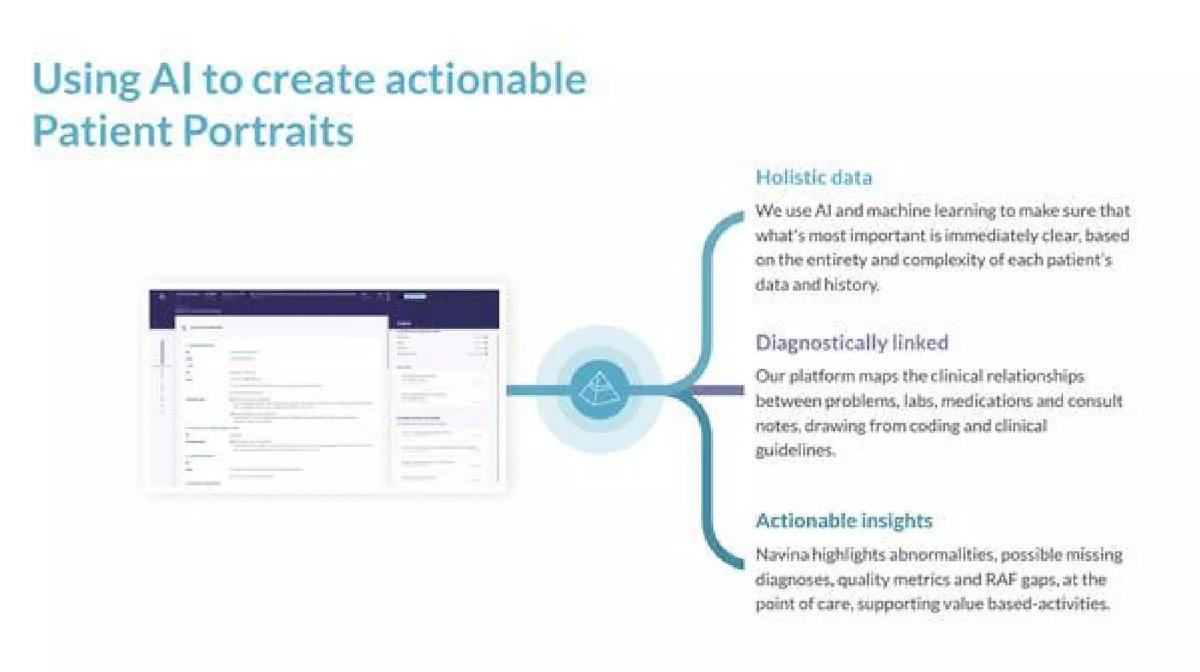
Slide 5 shows a glimpse of the product interface. It describes the "Patient Portraits" as being diagnostically linked and actionable. It explicitly mentions "RAF gaps," which signals to the investor that Navina understands the specific billing and reimbursement codes that drive healthcare profitability.
Slide 6 is perhaps the most important for a commercial investor. It maps out the "Economic value for primary care doctors, multi-specialty groups & ACOs." It creates a linear path: Navina increases data elements -> Increase in HCC coding -> RAF score increase -> Multi-million dollars in annual income. This slide moves the product from a 'nice-to-have' clinical tool to a 'must-have' revenue generator.
Slides 7-8: The Team Pedigree
Slide 7 , "Better Together," focuses on the co-founders, Ronen Lavi and Shay Perera. Their background in the IDF's 8200 unit is the centerpiece. The slide notes they have worked together since 2012 and that Navina is their 11th joint project. This level of co-founder history is rare and serves to de-risk the 'people' element of the investment.
Slide 8 rounds out the management team. It includes a CSIO (Kfir Oved) with a PhD and experience in Precision Medicine, a VP Medical (Yair Lewis) who is an MD/PhD, and VPs for Business and Product with 10+ years of experience. The team is balanced between deep technical AI expertise and clinical/business healthcare experience.
Slides 9-10: The Macro Context and Conclusion
Slide 9 addresses the "Why Now" by looking at the post-COVID era. It argues that the health footprint of the pandemic has led to a "significant increase in primary care visits" and that "improving efficiency is a must." This slide attempts to capture the tailwinds of a global crisis to justify rapid scaling.
Slide 10 is a simple "Thank You" slide with the company logo, offering no further calls to action or contact details in this version.
What Works in the Navina Deck
The Narrative Arc: The deck does a great job of connecting military-grade AI to healthcare revenue. It doesn't just say "we have better AI"; it says "we have AI built for high-stakes military decision-making, and we are applying it to the $30B problem of missed clinical data."
Focus on Value-Based Care: By specifically mentioning RAF (Risk Adjustment Factor) and HCC (Hierarchical Condition Category) coding, Navina speaks the language of their actual buyers (health systems and payers). This shows a deep understanding of the US healthcare reimbursement landscape, which is often a blind spot for international founders.
Founder-Market Fit: The 24-year tenure of the CEO in elite intelligence units is a powerful signal. It suggests that the technical hurdles of data synthesis have already been solved in more demanding environments.
What is Missing from the Navina Deck
Traction Metrics: For a Series B deck, the lack of hard data is surprising. There are no mentions of Annual Recurring Revenue (ARR), number of active provider users, or the number of patient lives currently managed on the platform. While the catalogue facts state they raised $44M, the deck itself doesn't show the growth curve that usually justifies such a round.
Competitive Landscape: The deck claims no sufficient technology exists, but the 'Clinical Decision Support' and 'AI Scribe' markets are crowded. A slide differentiating Navina from incumbents like Epic/Cerner or other AI startups would have been beneficial.
The Ask: There is no slide detailing how much they are raising or what the milestones for the next 18-24 months are. This suggests this deck might be a 'teaser' or a high-level overview used for initial partner meetings rather than the final diligence deck.
What Other Founders Should Copy
The 'Economic Value' Flowchart: Slide 6 is a perfect example of how to explain a complex B2B value proposition. If your product helps a customer make more money, show the exact steps—from product feature to bank account—in a simple left-to-right diagram.
Third-Party Validation: Using a screenshot of a medical journal (Slide 2) to define the problem is much more persuasive than a founder simply stating that physicians are busy. It proves the market has already acknowledged the pain point.
Pedigree Highlighting: If your team has a unique, high-prestige background (like elite military units or Ivy League research labs), don't bury it. Navina makes the 8200 unit background a core pillar of their brand identity, which helps them stand out in a sea of generic AI startups.
Frequently asked questions
- What is the core problem Navina is solving?
- Navina addresses the 'data chaos' in primary care. According to Slide 2, physicians spend 33% of their EMR time on chart review, which is the most time-consuming task with the fewest available tools. This leads to a 78% burnout rate and missed clinical data in over half of all patient visits, resulting in significant financial losses for healthcare providers.
- How does Navina's technology work?
- As described on Slide 5, the platform uses AI and machine learning to create 'Patient Portraits.' It maps clinical relationships between labs, medications, and consult notes. The goal is to highlight abnormalities and missing diagnoses at the point of care, specifically supporting value-based activities like HCC coding.
- What is the business model or value proposition for providers?
- The value proposition is tied to the transition to Value-Based Care. Slide 6 explains that by increasing the capture of critical data elements, Navina helps providers improve their Risk Adjustment Factor (RAF) scores. This leads to an increase in annual income for practice groups, potentially capturing a portion of the $30 billion in 'hidden revenues' mentioned on Slide 4.
- What is the background of the founders?
- The founders, Ronen Lavi and Shay Perera, have worked together since 2012. Lavi is a retired Lieutenant Colonel from the IDF's 8200 unit with 24 years of experience, while Perera is a retired Major from the same elite intelligence unit. They previously built AI decision support systems for military intelligence (Slide 7).
- Is there a specific 'Ask' in this deck?
- No. This 10-slide version of the deck does not include a slide detailing the amount of capital being raised, the valuation, or the specific use of funds. It functions more as a high-level strategic overview of the company's mission and team pedigree rather than a transactional fundraising document.