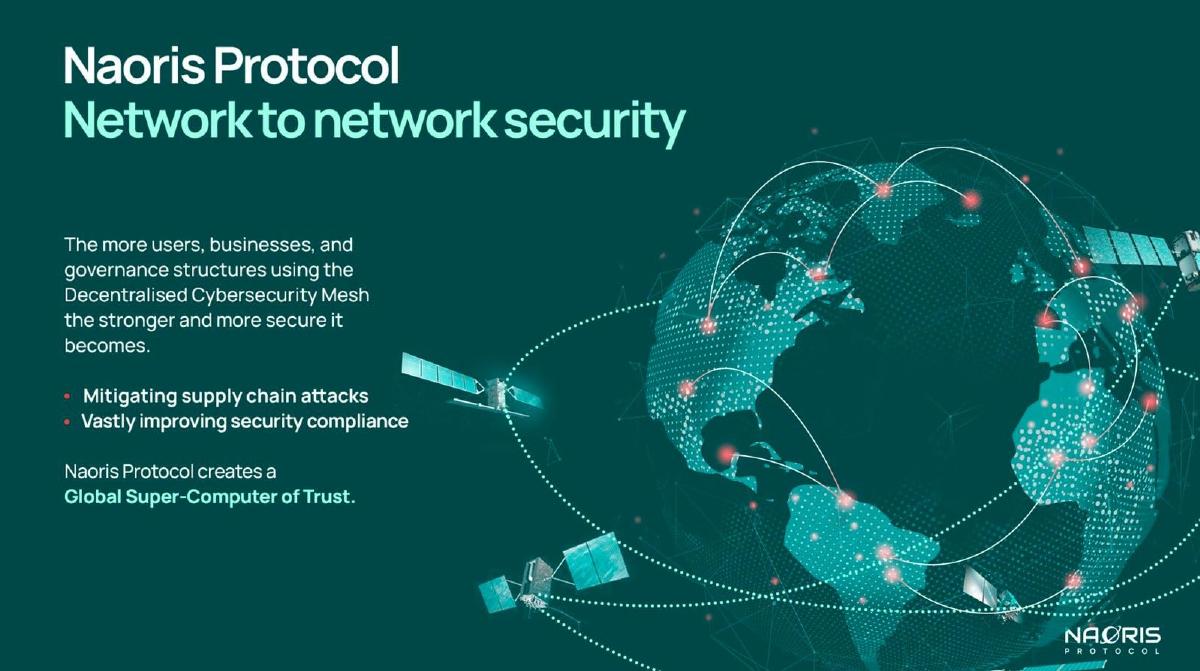
Naoris Protocol's deck is a masterclass in high-concept positioning, leveraging the 'Cybersecurity Mesh' trend identified by Gartner to frame their decentralized approach. The company raised $11.5M by proposing a shift from centralized security models, where one breached device compromises a network, to a distributed model where devices validate each other. The deck leans heavily on third-party validation, featuring endorsements from former NATO intelligence leadership and a long list of accelerator wins. While it excels at explaining the 'why' and the high-level architecture—including the $C…
Key takeaways
- The deck positions the product as a 'Decentralized CyberSecurity Mesh,' directly aligning with a Gartner-identified strategic technology trend (Slide 6).
- It utilizes a 'Sustainability Loop' to explain the $CYBER token's role as the 'fuel' for rewards and trust validations (Slide 5).
- Third-party credibility is established early through a quote from Kjell GrandHagen, Former Chairman of NATO/OTAN Intelligence Committee (Slide 9).
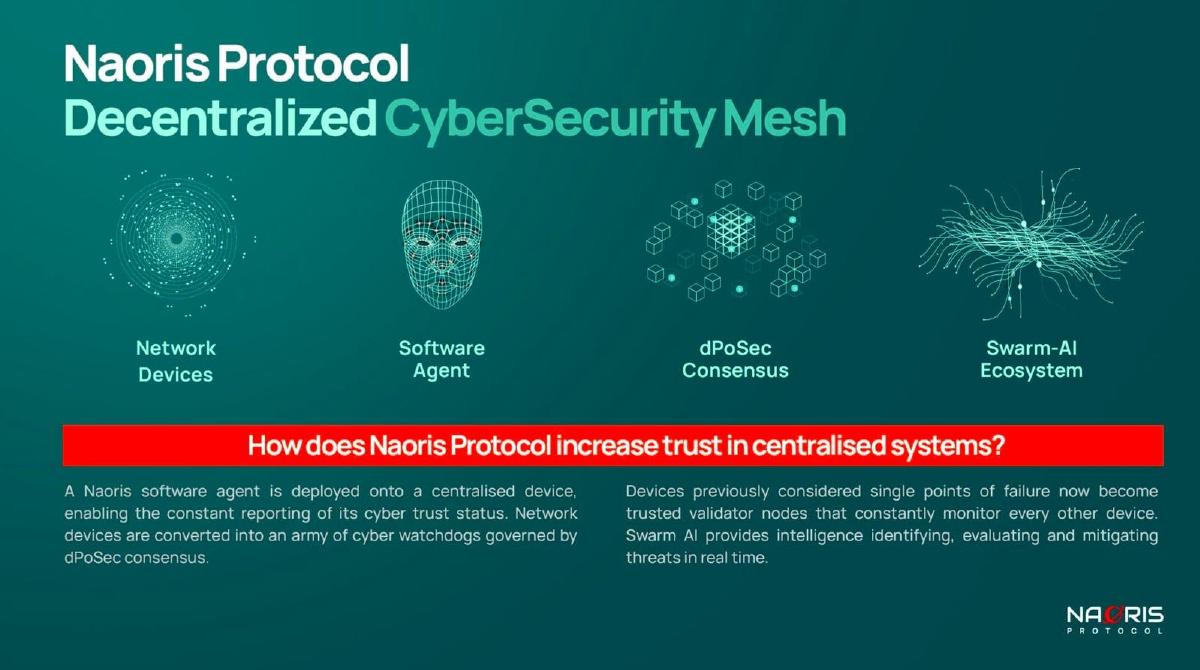
- The technical architecture relies on four pillars: Network Devices, Software Agents, dPoSec Consensus, and a Swarm-AI Ecosystem (Slide 3).
- Market scaling is visualized as a 'Path to the First $1billion,' targeting 1 billion secured devices in Big Tech (Slide 8).
- The 'Why Now?' slide cites the convergence of Blockchain Scalability, Swarm AI, Crypto Economics ($2T+), and Web3 growth (Slide 10).
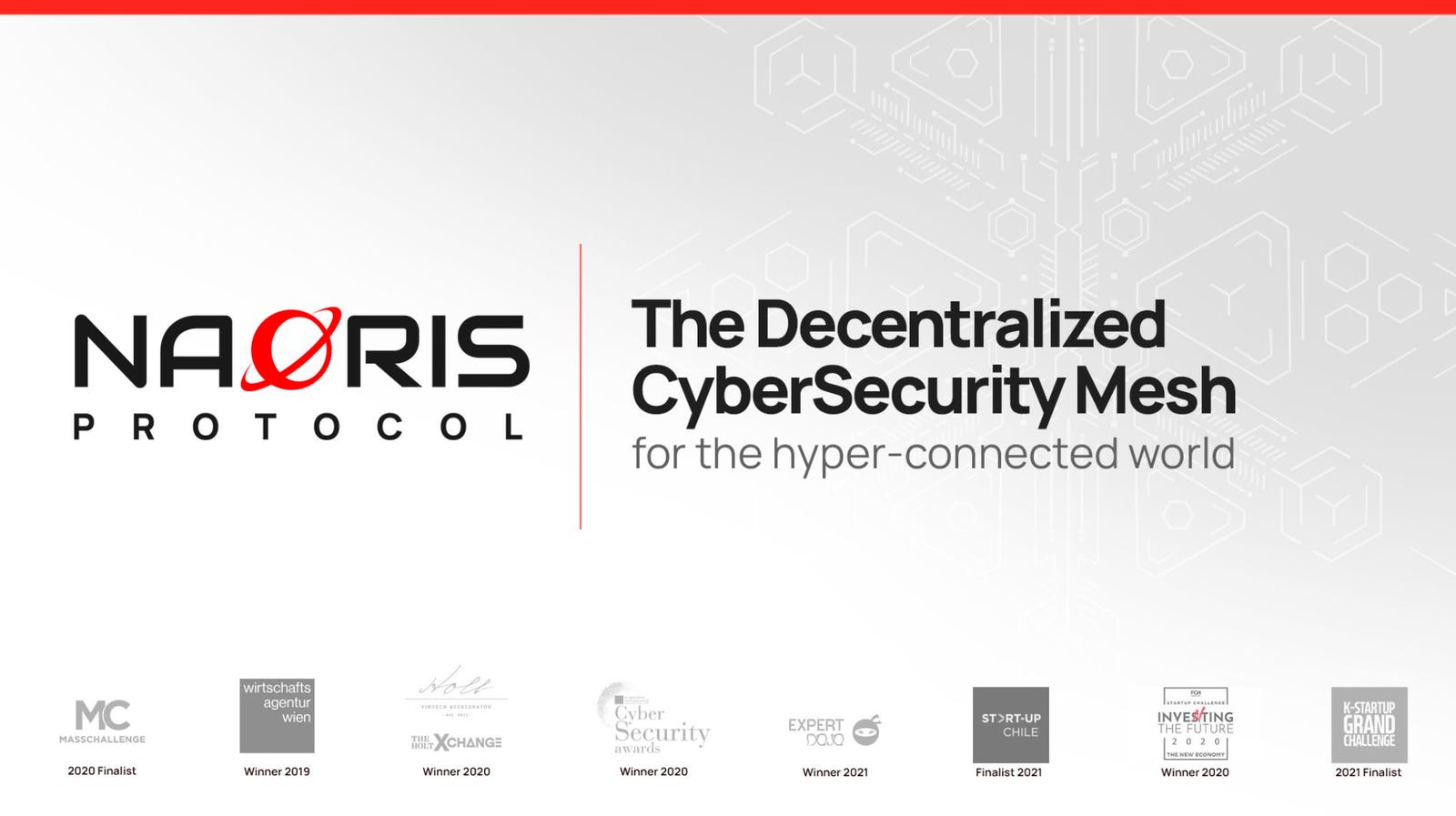
- Accelerator validation is a core trust signal, listing wins and finalist spots in eight different programs including MassChallenge and Expert Dojo (Slide 7).
- The deck emphasizes 'Device to device security' across banking, industrial, and critical networks to remove single points of failure (Slide 4).
The Decentralized Cybersecurity Mesh: A Strategic Positioning
Naoris Protocol’s deck is a study in how to sell a complex, infrastructure-level blockchain solution to a strategic audience. Rather than getting bogged down in code snippets, the deck focuses on high-level architectural shifts and massive market trends. The central thesis is that centralized security is fundamentally broken because it creates single points of failure. By rebranding decentralized security as a 'Cybersecurity Mesh'—a term popularized by Gartner—Naoris bridges the gap between the 'crypto' world and the enterprise IT world.
Slide 1-2: The Hook and The Vision
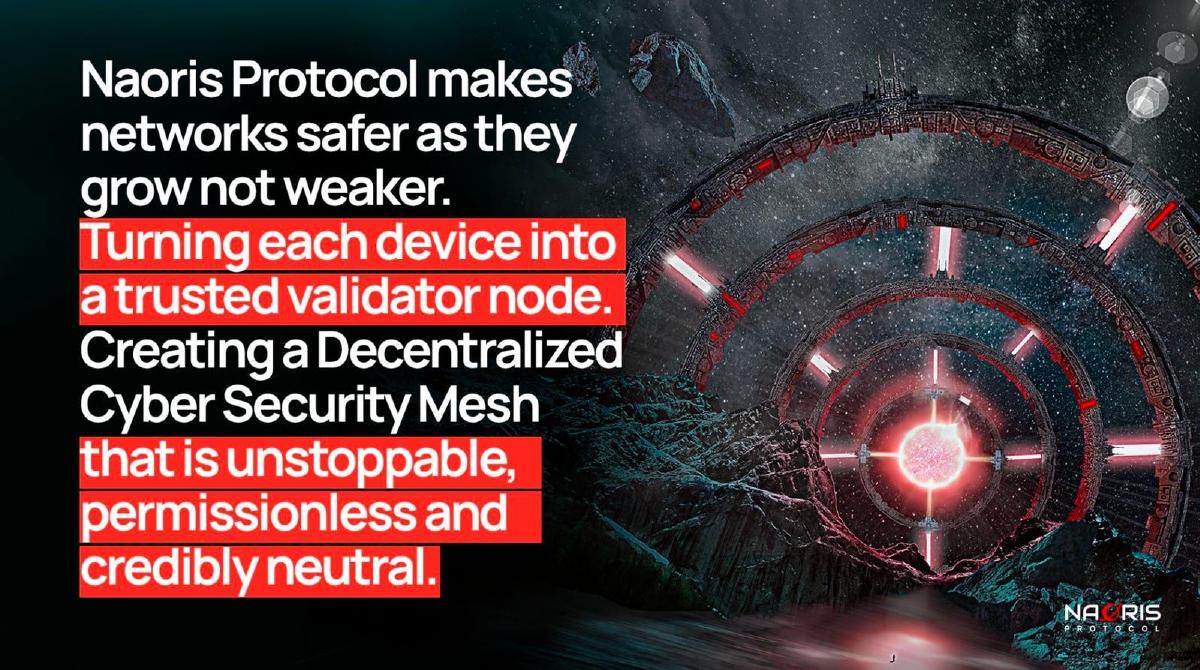
The opening slides establish the brand identity and the core value proposition: "The Decentralized CyberSecurity Mesh for the hyper-connected world." Slide 2 introduces a critical concept: "Naoris Protocol makes networks safer as they grow not weaker." This is a direct challenge to traditional security logic, where a larger attack surface usually implies greater vulnerability. The use of terms like "unstoppable, permissionless and credibly neutral" signals a deep alignment with Web3 values while maintaining a professional cybersecurity tone.
Slide 3: The Technical Pillars
Slide 3 breaks down the 'how' into four digestible components: Network Devices , Software Agent , dPoSec Consensus , and Swarm-AI Ecosystem . The text explains that a software agent is deployed onto centralized devices, turning them into an "army of cyber watchdogs." This is the most technical the deck gets in this sequence, providing just enough detail to explain the transition from a single point of failure to a distributed validator network.
Slide 4: Device to Device Security
This slide visualizes the application of the protocol across different sectors. It highlights Banking networks , Critical networks , and Industrial networks . The graphic shows a mesh of interconnected devices (laptops, phones, tablets) securing each other. This slide is crucial for showing that the protocol isn't just for 'crypto companies' but has horizontal utility across the most sensitive sectors of the global economy.
Slide 5: The $CYBER Token Economics
For a strategic round, investors need to understand the utility of the native asset. Slide 5 introduces the Sustainability Loop . It lists four key points about the $CYBER token: it acts as fuel, provides a win-win for Web2 and Web3 participants, enables monetization of security data, and rewards validators for staking. This slide attempts to justify the blockchain element of the business, showing that the token is "fundamental" to the protocol’s operation rather than an afterthought.
Slide 6: The Gartner Validation
One of the strongest slides in the deck, Slide 6, leverages external authority. It quotes Gartner stating that by 2024, organizations adopting a cybersecurity mesh architecture will "reduce the financial impact of individual security incidents by 90%." By citing a specific URL and a top-tier research firm, Naoris moves from being a 'startup with an idea' to a 'provider of a top strategic technology trend.'
Slide 7: Accelerator and Investor Validation
Slide 7 is a 'wall of logos' that actually carries weight. It lists wins and finalist positions from 2018 through 2021, including MassChallenge , Pioneers '19 , Holt Fintech Accelerator , and Expert Dojo . The slide includes testimonials from partners, with the Expert Dojo quote mentioning that Naoris is helping "Fortune 500 companies run more securely." This provides the 'social proof' necessary to back up the ambitious claims made in earlier slides.
Slide 8: The Path to $1 Billion
The growth slide (Slide 8) is a classic 'TAM/SAM/SOM' variant but framed as a scaling roadmap. It sets a target of 1 billion secured devices . The breakdown is specific: 100k for SMBs, 1M for Global Corporations, 10M for Industry Sectors, 100M for IoT/Mobile, and 1B for Big Tech. While it doesn't provide a timeline, it gives investors a sense of the 'order of magnitude' the founders are aiming for.
Slide 9: The Intelligence Endorsement
Slide 9 features Kjell GrandHagen , Former Chairman of the NATO Intelligence Committee. His quote, "We don't need to play a better game against cyber-criminals, we need to play a different game," perfectly encapsulates the company's disruptive narrative. Having a high-ranking military intelligence figure validate the shift from centralized to distributed security is a massive credibility booster for a cybersecurity startup.
Slide 10: The Convergence (Why Now?)
The final slide in this sequence addresses the 'Why Now?' question by citing four converging technologies: Blockchain Scalability (High TPS), Swarm AI (Real-time decisions), Crypto Economics (+$2 Trillion market), and Web3 (4k DApps, 7k Smart Contracts). This frames Naoris as the inevitable result of these four trends hitting maturity simultaneously.
What Works in the Naoris Protocol Deck
Strategic Alignment: The deck does an excellent job of tying the product to the 'Cybersecurity Mesh' trend. This makes the company feel like a market leader in an emerging category rather than a niche blockchain tool.
Authority Building: The inclusion of a NATO intelligence head and a long list of accelerator wins creates a 'moat of credibility.' In cybersecurity, trust is the primary currency, and this deck spends its slides building that trust effectively.
Clear Paradigm Shift: The contrast between 'Centralized' (single point of failure) and 'Distributed' (mesh) is repeated visually and textually, making the core value proposition easy to remember and repeat.
What is Missing from the Naoris Protocol Deck
Financial Specifics: The provided slides contain no revenue figures, burn rate, or specific unit economics. While it mentions a 'Path to $1billion,' there is no breakdown of how device counts translate into specific revenue per device or contract sizes.
Competitive Landscape: There is no slide comparing Naoris to existing cybersecurity giants (like CrowdStrike or Zscaler) or other decentralized security protocols. Investors are left to guess how Naoris differentiates itself from incumbents beyond just being 'decentralized.'
The Team: While the NATO advisor is featured, the actual founders and their technical backgrounds are missing from this 10-slide sequence. For a $11.5M round, the pedigree of the engineering team building the 'dPoSec' consensus is a critical omission.
The Ask: There is no slide detailing how much capital is being raised in this specific deck or how the funds will be allocated (e.g., R&D vs. Sales). The publisher reports $11.5M was raised, but the deck itself doesn't state the target.
Founder's Playbook: What to Copy
Use Third-Party Frameworks: If a major research firm like Gartner or Forrester has named a trend that fits your product, use their language. It validates your market and saves you from having to educate the investor on why your category matters.
Visualizing the 'Sustainability Loop': If your business involves a token or a complex ecosystem, use a circular diagram (like Slide 5) to show how value flows between participants. It’s much more effective than a list of bullet points.
The 'Order of Magnitude' Growth Slide: Instead of a standard bar chart, the concentric circles on Slide 8 showing device growth (100k to 1B) effectively communicate the scale of the ambition. It forces the investor to think about the 'end game' rather than just next year's projections.
High-Level Endorsements: A quote from a recognized global authority (like a NATO official) is worth ten quotes from unknown customers. If you have a high-profile advisor, give them their own slide.
Frequently asked questions
- What is the core technology behind Naoris Protocol?
- According to Slide 3, the protocol is built on a 'Decentralized CyberSecurity Mesh' consisting of software agents deployed on devices, a 'dPoSec' consensus mechanism, and a Swarm-AI ecosystem. This architecture turns every device into a 'trusted validator node' that monitors other devices in the network, rather than relying on a central security authority.
- How does the $CYBER token function within the ecosystem?
- Slide 5 describes the $CYBER token as the 'fuel for the whole ecosystem.' It is used for the monetization of cybersecurity data through trust validations. Validators stake $CYBER at different levels and receive rewards over time, creating what the company calls a 'Sustainability Loop' between token holders, validator devices, and secured environments.
- What market size or growth potential does Naoris claim?
- Slide 8 outlines a 'Path to the First $1billion' based on the number of secured devices. The growth tiers start at 100k devices for SMBs/individuals and scale up to 1 billion devices for 'Big Tech.' Intermediate milestones include 1M devices for global corporations and 100M for IoT and mobile sectors.
- Does the deck include a team slide or founder backgrounds?
- The provided 10 slides do not include a dedicated team slide listing founders or executives. However, Slide 9 features a prominent endorsement and photo of Kjell GrandHagen, the Former Chairman of the NATO Intelligence Committee, which serves as a high-level advisory validation for the company's mission.
- What is the primary problem Naoris Protocol aims to solve?
- As stated on Slide 9, the protocol addresses the 'categorically flawed' centralized model where hacking a single device compromises an entire network. By using blockchain to ensure 'no single device exists in a silo,' they aim to reduce the financial impact of security incidents by 90%, a figure they attribute to Gartner research on Slide 6.