Airport Continuity addresses the collapse of passenger confidence following the COVID-19 pandemic by proposing a new 'customer journey' centered on health risk management. The deck relies heavily on IATA survey data to establish a need for safety-first travel protocols, suggesting that 70% of 400 million travelers require better health information. The core value proposition is a 'Pax Travel Log' that tracks nationality, movement, and social distance contraventions to identify high-risk individuals. While the technical architecture slide shows a deep understanding of airport stakeholders like…
Key takeaways
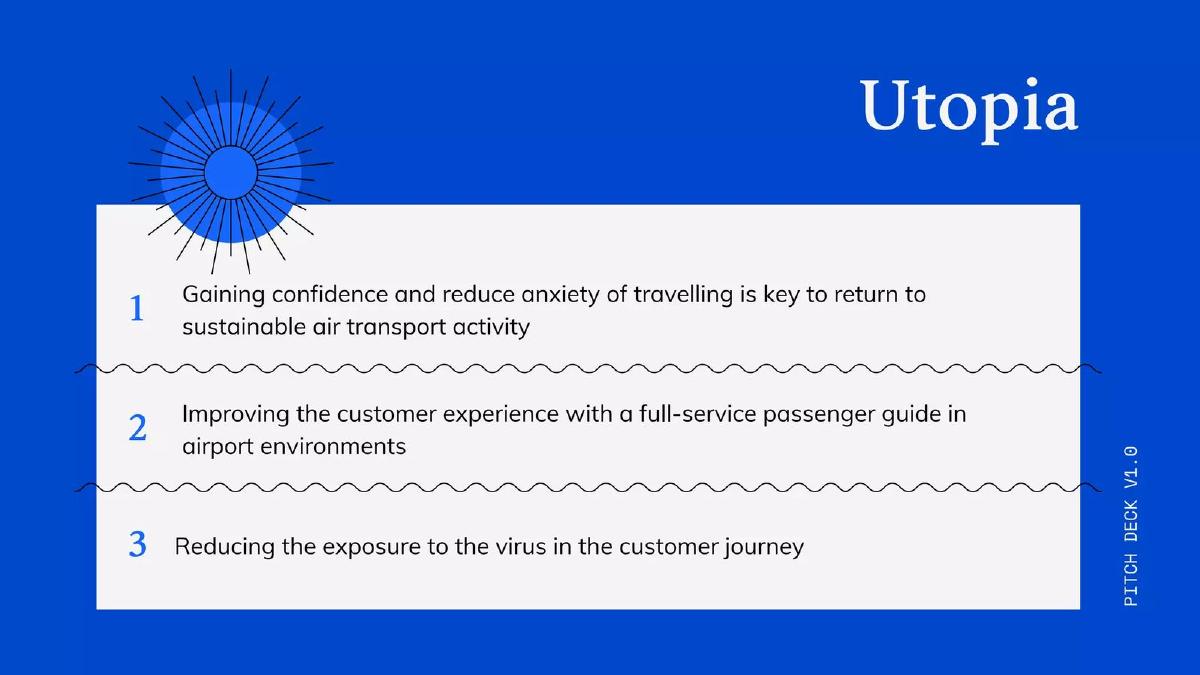
- The deck identifies a specific market pain point: decreasing passenger confidence in air travel post-COVID-19 (Slide 2).
- It targets a massive European market, citing that 70% of 400 million travelers need better health and travel info (Slide 3).
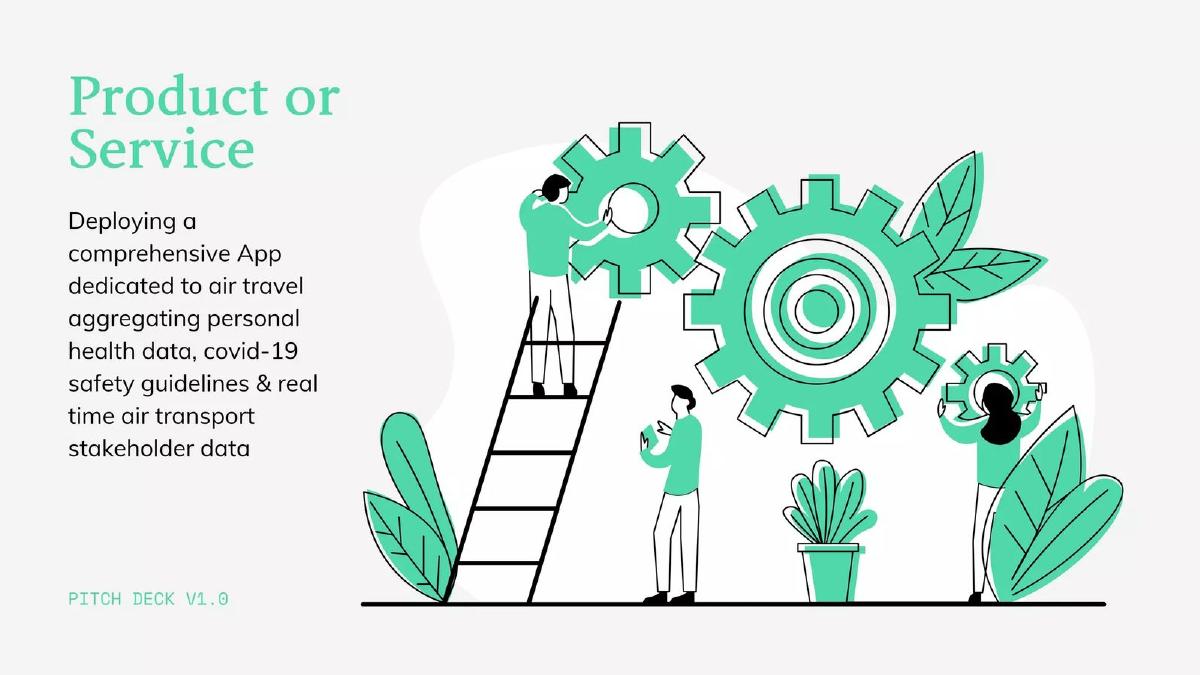
- The proposed solution involves a 'Pax Travel Log' tracking variables like social distance contraventions and risk factors (Slide 5).
- Technical integration is planned with major aviation infrastructure including SITA and ADS-B Aircraft Systems (Slide 5).
- The primary competitive advantage is the ability to identify passengers coming from 'High-Risk Zones' using historical travel data (Slide 6).
- Data privacy is addressed through a voluntary acquisition model and adherence to EU legislation (Slide 7).
- The deck omits critical startup metrics such as a business model, revenue streams, and a specific investment ask.
- There is no information provided regarding the current stage of the product or existing partnerships with airports.
Slide-by-Slide Analysis
Slide 1: Title Slide
The title slide introduces the company as 'Airport Business' (though the source listing refers to it as Airport Continuity). The subtitle is 'Connecting Europe Aviation through a new customer journey after Covid19.' Four individuals are listed: Borja Blond, Elizabeth Manikath, Raluca Anghelache, and Etienne Sortais. The visual style is clean, using flat vector illustrations of travelers, suggesting a modern, tech-focused approach to travel logistics.
Slide 2: Traction (Market Sentiment)
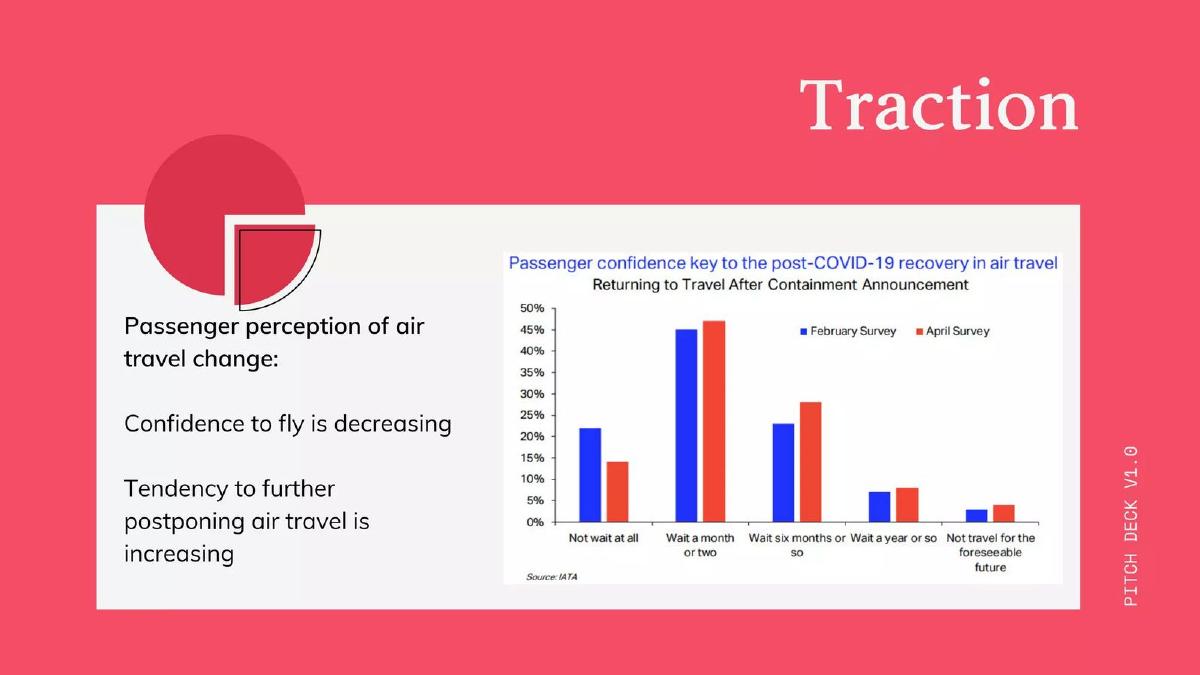
Labeled 'Traction,' this slide actually focuses on market sentiment rather than internal company growth. It features an IATA chart titled 'Passenger confidence key to the post-COVID-19 recovery in air travel.' The data compares February and April surveys, showing that the percentage of people willing to travel 'Not wait at all' dropped from approximately 22% to 14%. The slide concludes that confidence is decreasing and the tendency to postpone travel is increasing, establishing a 'burning platform' for their solution.
Slide 3: Target Market
This slide quantifies the opportunity within the European market. It cites that 30% of European corporate travelers fly once per month, while 5% fly 21 to 40 times per year. The most significant figure is the claim that 'More than 70% of 400 MM travelers requires better info about Health & Travel.' The sources cited are flyaeolus.com and Eurostat. The slide frames the problem as a requirement for travelers to 'feel safe' and for airports to 'rethink social distance configuration.'
Slide 4: Customer Journey (Pre-Covid19)
This slide uses an isometric illustration to depict the standard airport experience prior to the pandemic. It shows check-in, security, boarding control, and waiting areas. There is no text on this slide other than the header and 'Pre Covid19.' It serves as a baseline to contrast with the proposed changes in the following slides, though the 'Post-Covid' journey slide is not included in this selection.
Slide 5: System Architecture
This is the most technical slide in the deck, titled 'System architecture: stakeholders & customer interactions.' It maps out a complex flow involving Airlines (referencing Amadeus, Sabre, and Navitaire), SITA, and ADS-B Aircraft Systems. The central feature is the 'Pax Travel Log,' which collects data on nationality, health pre-checks, movement, social distance contraventions, and total flights. This data feeds into a 'Risk Factor' assessment. The diagram includes icons for thermal cameras and mobile alerts, suggesting a real-time monitoring system within the airport terminal.
Slide 6: Advantages
The deck lists two primary advantages. 'Advantage 1' is the availability of travel history per passenger to identify individuals coming from 'High-Risk Zones.' 'Advantage 2' is the increase in passenger experience and safety through active monitoring of that history. The slide uses mobile phone icons to suggest that this information is delivered or managed via a smartphone app.
Slide 7: Data Handling
Given the intrusive nature of tracking travel history and 'social distance contraventions,' this slide addresses privacy. It states that data acquisition is 'on a voluntary basis by the customers.' It also claims that the 'Data protection & record keeping policy' is 'as per EU legislation & best practices.' A stock photo of a pen signing an 'I Agree' document reinforces the concept of informed consent.
What Airport Continuity Does Well
Industry Context: The deck does an excellent job of rooting its existence in a specific, global crisis. By using IATA data, the founders demonstrate that they aren't just building a tool for fun, but are responding to a documented collapse in consumer confidence that threatens a multi-billion dollar industry.
Technical Mapping: Slide 5 shows a sophisticated understanding of how airports actually work. Mentioning SITA (the primary IT provider for the air transport industry) and ADS-B systems suggests the team has a background in aviation technology. This isn't a high-level 'magic' solution; it is a system designed to plug into existing infrastructure.
Market Segmentation: The distinction between corporate and tourist travelers on Slide 3 is helpful. It acknowledges that different types of travelers have different frequencies and needs, which would eventually dictate how the product is marketed or sold.
What is Missing from the Deck
The Business Model: There is no mention of how Airport Continuity generates revenue. Do they charge airports a licensing fee? Do they charge airlines per passenger? Is it a government-funded infrastructure project? Without this, it is a project, not a business.
Competitive Landscape: During the pandemic, dozens of 'health pass' and 'digital identity' startups emerged (such as Clear or CommonPass). This deck fails to mention any competitors or explain why their specific architecture is superior to existing biometric or health-tracking solutions.
Team Bios: While four names are listed on the first slide, there is no information about their backgrounds. In a highly regulated and technical field like aviation, investors need to know if the founders have the credentials to navigate FAA/EASA regulations and secure contracts with major hubs.
The Ask: The deck ends without a call to action. There is no slide detailing how much money is being raised, what the milestones for that capital are, or what the current runway looks like. This is a significant omission for a fundraising document.
Founder Takeaways
Visualize the 'Before and After': Using Slide 4 to show the 'Pre-Covid' journey is a good setup, but it only works if you follow it immediately with a 'Post-Solution' journey slide. Founders should ensure that if they show a baseline, the 'new way' is clearly illustrated to highlight the contrast in efficiency or safety.
Address Privacy Head-On: For any startup dealing with tracking or health data, especially in the EU (GDPR), a single slide saying 'we follow the law' is rarely enough. Founders should be prepared to explain the specific encryption or anonymization techniques used to protect user data, as this will be the first question from any sophisticated investor.
Connect Tech to Value: The architecture slide (Slide 5) is impressive but dense. It is important to translate these technical flows into specific business outcomes. For example, 'By integrating with SITA, we reduce boarding delays by X% while maintaining safety protocols.' Technical prowess must always be tied to the bottom line.
Frequently asked questions
- What problem is Airport Continuity trying to solve?
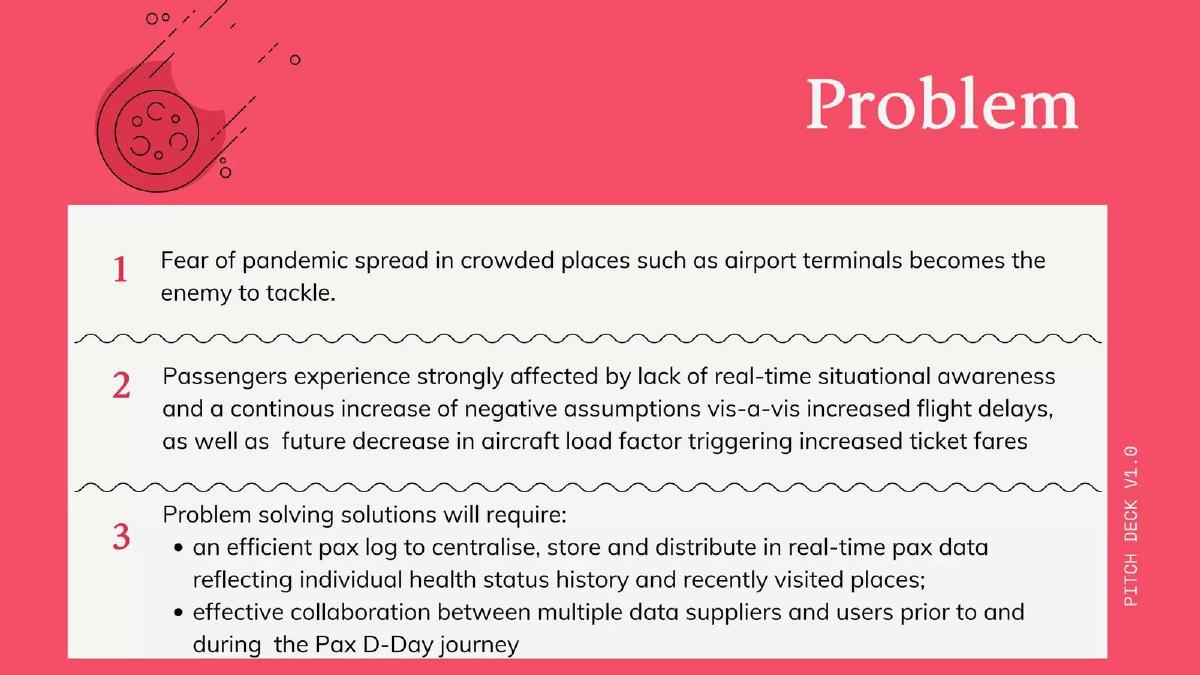
- The company is addressing the decline in air travel caused by the COVID-19 pandemic. According to Slide 2, passenger confidence is decreasing, and the tendency to postpone travel is increasing. The deck argues that for the aviation industry to return to normal, airports must rethink social distancing and airlines must manage passenger health risks before they fly.
- How does the technology work according to the deck?
- The system architecture (Slide 5) shows a complex web of interactions between airlines, airport tech infrastructure (like SITA), and a 'Pax Travel Log.' This log tracks nationality, health pre-checks, movement, and social distance contraventions. It uses this data to calculate a 'Risk Factor' based on the passenger's route, origin, and destination to determine if they are safe to fly.
- Who is the target audience for this product?
- The deck targets the European aviation market. Slide 3 breaks this down into corporate travelers (30% of whom fly once per month) and tourist passengers. It specifically highlights that more than 70% of 400 million travelers require better information about health and travel safety to resume their normal habits.
- How does the company handle sensitive passenger data?
- Slide 7, titled 'Data handling,' states that data acquisition is performed on a voluntary basis by the customers. The company claims its data protection and record-keeping policy follows EU legislation and industry best practices. This is a critical point given the sensitivity of tracking health and movement data within the European Union.
- What is missing from this pitch deck?
- The deck is missing several standard fundraising components. There is no business model explaining how the company makes money, no financial projections, and no competitive analysis. Furthermore, while four names are listed on the cover, there are no bios to establish their expertise. Most importantly, there is no 'Ask' slide detailing how much capital they are seeking.