AI Rudder’s Series B deck is a study in efficiency, using just 8 slides to command a $50M investment. The deck bypasses technical jargon in favor of aggressive growth metrics, citing 4x year-on-year revenue increases and a presence in over 10 countries. By framing the problem as a scalability crisis in human-led customer engagement, the company positions its 'full stack of AI technology' as an operational necessity rather than a luxury. The inclusion of a heavy-hitting leadership team with experience from Zendesk and Microsoft, alongside a clear funding history featuring Sequoia, provides the…
Key takeaways
- The company reports explosive growth with revenue increasing 4x year-on-year as stated on slide 2.
- AI Rudder has commercialized its solution in 10+ countries across Asia Pacific, Latin America, and Africa (slide 2).
- The problem is defined by the fact that human-led customer engagement is neither scalable nor viable due to high operational costs (slide 3).
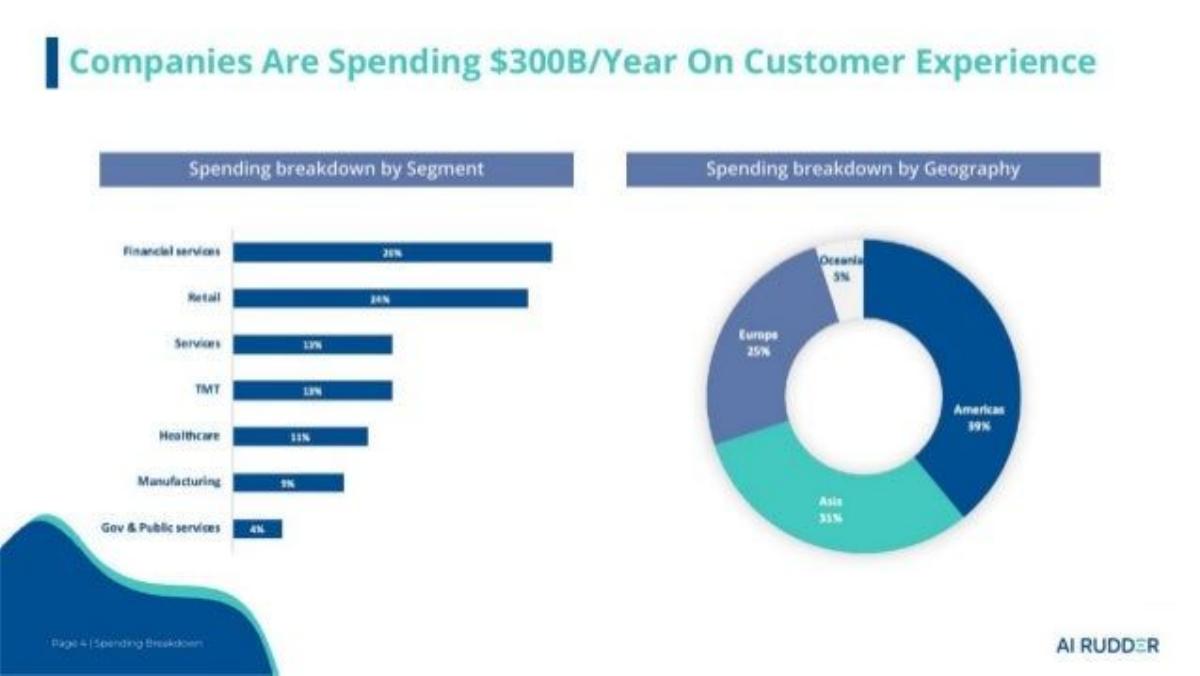
- The total addressable market is framed by a $300B annual global spend on customer experience (slide 4).
- Market segmentation shows Financial Services (25%) and Retail (24%) as the largest spending blocks (slide 4).
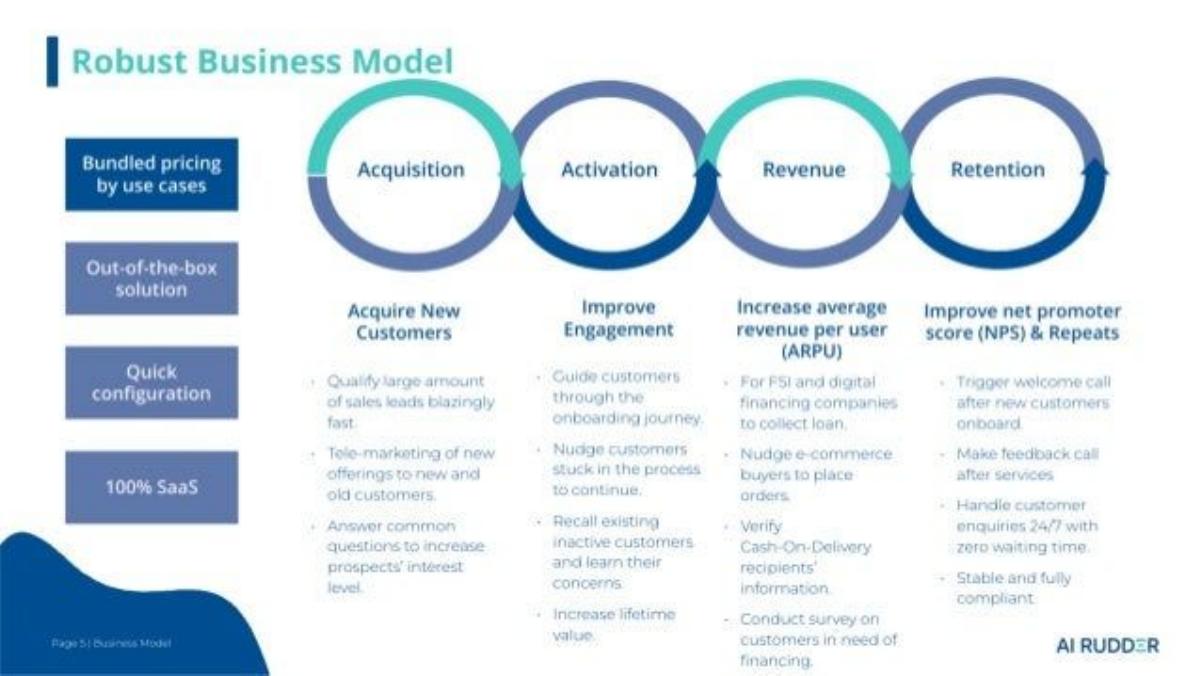
- The business model is 100% SaaS with bundled pricing based on specific use cases (slide 5).
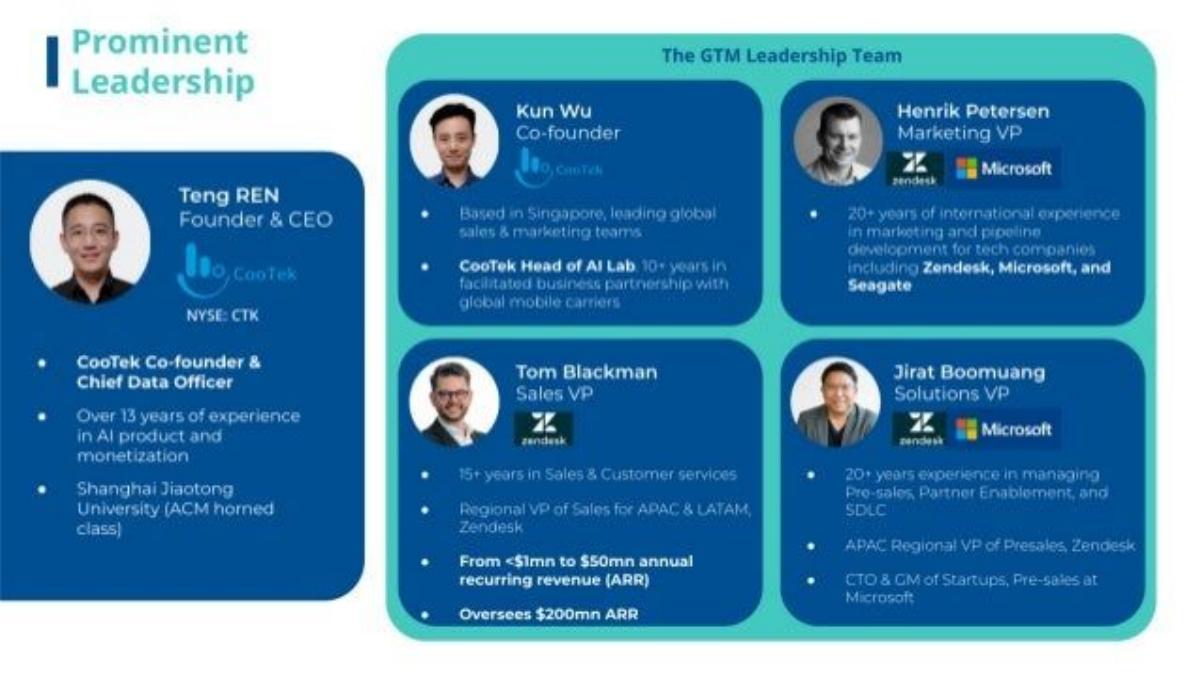
- The leadership team includes executives with prior experience at Zendesk, Microsoft, and Seagate (slide 6).
- The company's funding history includes a Series A led by Sequoia, following Seed and Pre-A rounds (slide 7).
Executive Summary: The 8-Slide $50M Power Play
AI Rudder’s 2022 Series B deck is a masterclass in brevity. In an era where Series B decks often stretch to 20 or 30 slides of dense data, AI Rudder secured $50M using just eight. The narrative is tight, moving rapidly from a massive market problem to a validated solution backed by a high-pedigree team. The deck relies heavily on the momentum of its 4x year-on-year growth to carry the weight of the pitch, allowing the founders to skip the granular technical explanations that often bog down AI startups.
Slide 1: Title and Positioning
The cover slide is minimalist, featuring the company name and the tagline: "Leading Customer Experience with Multi-Lingual Conversational AI." This immediately establishes two critical differentiators: the focus on 'Customer Experience' (a business outcome) rather than just 'AI' (a technology), and the 'Multi-Lingual' capability, which hints at the global scalability detailed later in the deck.
Slide 2: Company Highlights
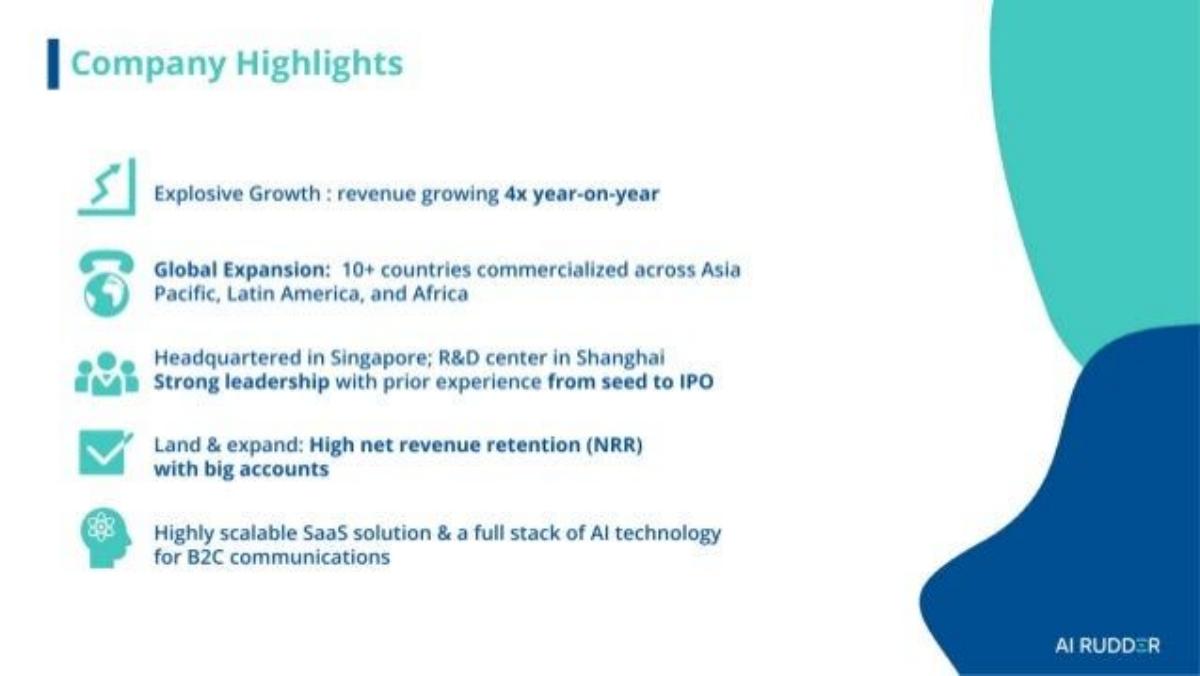
AI Rudder chooses to lead with its strongest hand. Slide 2 serves as a summary of the entire investment thesis. It lists five key pillars: "Explosive Growth" (4x year-on-year revenue), "Global Expansion" (10+ countries), "Strong leadership" (experience from seed to IPO), "Land & expand" (High NRR), and a "Highly scalable SaaS solution." By putting these metrics on the second slide, the company sets a high-confidence tone for the rest of the presentation.
Slide 3: The Problem Statement
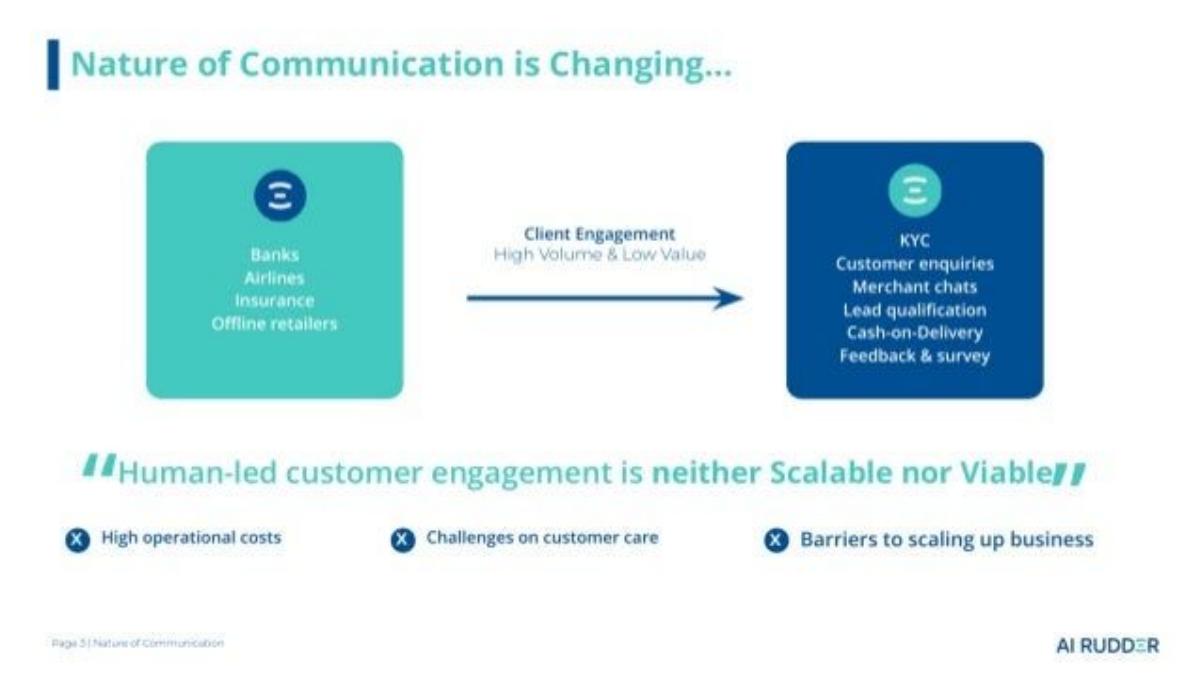
The deck frames the problem as a fundamental shift in communication. It notes that "Human-led customer engagement is neither Scalable nor Viable." The slide identifies the specific pain point: "High Volume & Low Value" interactions. By listing examples like KYC, lead qualification, and feedback surveys, AI Rudder identifies the 'grunt work' of customer service that is most expensive for enterprises to staff with humans. The slide explicitly calls out "High operational costs" and "Barriers to scaling up business" as the primary consequences of the status quo.
Slide 4: Market Opportunity
To justify a $50M Series B, the market must be enormous. Slide 4 claims that "Companies Are Spending $300B/Year On Customer Experience." The deck breaks this down by segment and geography. Financial Services (25%) and Retail (24%) are the dominant sectors, while the Americas (39%) and Asia (31%) represent the largest geographic opportunities. This data validates why the company has focused its expansion on the APAC region while maintaining global ambitions.
Slide 5: The Business Model
Slide 5 outlines a "Robust Business Model" based on the standard SaaS flywheel: Acquisition, Activation, Revenue, and Retention. It highlights that the product is an "Out-of-the-box solution" with "Quick configuration." This is a crucial point for Series B investors; it suggests that the company has moved past the 'bespoke consulting' phase and has a repeatable, scalable product. The slide also mentions "Bundled pricing by use cases," which aligns revenue directly with the value provided to the customer (e.g., qualifying leads or collecting loans).
Slide 6: Prominent Leadership
The team slide is exceptionally strong for a startup in the APAC region. It features Founder & CEO Teng Ren and Co-founder Kun Wu, both with backgrounds at CooTek (NYSE: CTK). The "GTM Leadership Team" is even more impressive, featuring three VPs with deep roots at Zendesk and Microsoft . Tom Blackman, the Sales VP, is credited with growing revenue from "<$1mn to $50mn annual recurring revenue (ARR)" and overseeing "$200mn ARR." This level of executive experience significantly de-risks the execution of the global expansion plan.
Slide 7: Funding Journey
Slide 7 visualizes the company's trajectory from Seed to Series B. It highlights the involvement of Sequoia in the Series A, which serves as a powerful institutional endorsement. Other listed investors include ZhenFund, IMO Ventures, Huashan Capital, and Zizhu Xiaomiao Fund. This timeline demonstrates a consistent ability to attract top-tier capital at every stage of the company's lifecycle.
Slide 8: Closing
The final slide is a simple "Thank you!" with the company URL. Notably, there is no 'Ask' slide in this version of the deck. While the catalogue facts state the round was for $50M, the deck itself does not specify the amount, the valuation, or the intended use of funds. This is common in highly competitive rounds where the terms may be shifting rapidly or where the deck is used as a teaser for a broader conversation.
What AI Rudder Does Well
The deck’s greatest strength is its clarity of purpose . It doesn't get lost in the 'how' of the AI (natural language processing, machine learning models, etc.). Instead, it focuses entirely on the 'what'—the business value of automating low-value interactions. By quantifying the market at $300B and showing a 4x growth rate, the founders make the case that they are the inevitable winners in a massive category.
The geographic diversity mentioned on slide 2 is also a major plus. Showing commercialization in 10+ countries across APAC, LATAM, and Africa proves that the 'Multi-Lingual' aspect of their AI isn't just a feature—it's a proven global growth engine. This is particularly attractive to Series B investors looking for 'global-first' companies.
What is Missing from the Deck
For a Series B teardown, the omissions are striking. There is a total lack of unit economics . While 'High NRR' is mentioned, there are no specific percentages for churn, LTV, or CAC. Investors at this stage typically want to see that for every dollar spent on sales and marketing, a predictable multiple of revenue is returned. The deck relies on the '4x growth' headline to bypass these details.
There is also no competitive landscape slide . The conversational AI space is crowded with players like Intercom, Drift, and various legacy call center automation tools. AI Rudder assumes the investor already understands the space or that their growth metrics are so superior that the competition is irrelevant. Finally, the absence of an 'Ask' slide means the deck functions more as a high-level company profile than a specific funding proposal.
Founder's Takeaway: What to Copy
Founders should emulate AI Rudder’s segmentation of the problem . By identifying 'High Volume & Low Value' tasks, they make it easy for a C-suite executive or an investor to visualize exactly where the software sits in an organization. This is much more effective than saying 'we automate customer service.'
Additionally, the GTM Leadership slide is a perfect example of how to showcase a team. Instead of just listing titles, they listed specific achievements (e.g., growing revenue from $1M to $50M) and used recognizable logos (Zendesk, Microsoft) to borrow credibility. If you are raising a mid-stage round, your team slide needs to prove that you have the 'adults in the room' capable of managing a global scale-up.
Final Verdict: This deck is designed for a 'hot' round where the metrics speak for themselves. It is a high-velocity document meant to confirm what the investor likely already knows: the company is growing fast, the market is huge, and the team is elite. For founders without 4x year-on-year growth, a more detailed explanation of unit economics and competitive advantage would be necessary.
Frequently asked questions
- What is the primary value proposition of AI Rudder?
- AI Rudder positions itself as a 'full stack of AI technology' designed to automate B2C communications. According to slide 3, the platform targets 'high volume & low value' client engagements such as KYC, lead qualification, and debt collection. By replacing human-led interactions in these specific areas, the company claims to solve the scalability limits and high operational costs inherent in traditional customer service models.
- How does AI Rudder demonstrate market traction?
- Traction is demonstrated through two primary lenses: revenue growth and geographic footprint. Slide 2 highlights a 4x year-on-year revenue growth rate and successful commercialization in more than 10 countries across three continents (APAC, LATAM, and Africa). Additionally, slide 2 mentions 'High net revenue retention (NRR) with big accounts,' though specific NRR percentages are not disclosed in the deck.
- What specific industries does AI Rudder target?
- While the technology is applicable across B2C, slide 4 identifies Financial Services (25%) and Retail (24%) as the primary spending segments. Slide 3 specifically lists Banks, Airlines, Insurance, and Offline Retailers as the core client base. The business model slide further emphasizes use cases for 'FSI (Financial Services Industry) and digital financing companies' for loan collection and e-commerce for order placement.
- Who are the key members of the leadership team?
- The team is led by Founder & CEO Teng Ren and Co-founder Kun Wu, both formerly of CooTek (NYSE: CTK). The 'GTM Leadership Team' featured on slide 6 includes Henrik Petersen (Marketing VP), Tom Blackman (Sales VP), and Jirat Boomuang (Solutions VP). These individuals bring significant enterprise experience from major tech firms including Zendesk, Microsoft, and Seagate.
- What is missing from this pitch deck?
- Despite being a Series B deck, it lacks several standard components. There is no slide detailing the specific 'Ask' (the $50M mentioned in the catalogue), no use of funds breakdown, and no detailed financial projections. Furthermore, the deck does not include a competitor analysis or specific unit economics like Customer Acquisition Cost (CAC) or Lifetime Value (LTV) beyond a general mention of high NRR.