Aisera raised $90M in 2022 for their Series D round, a period marked by significant market volatility. The deck succeeds by immediately establishing massive scale: Slide 2 cites 300% YoY growth and over $150M previously raised. Rather than focusing on technical jargon, the narrative centers on macroeconomic pressures—inflation and market downturns—to frame their AI automation as a financial necessity for cost reduction. The deck is heavy on third-party validation, dedicating multiple slides to Gartner and Forrester recognition, and listing blue-chip customers like Zoom, Snowflake, and McAfee.…
Key takeaways
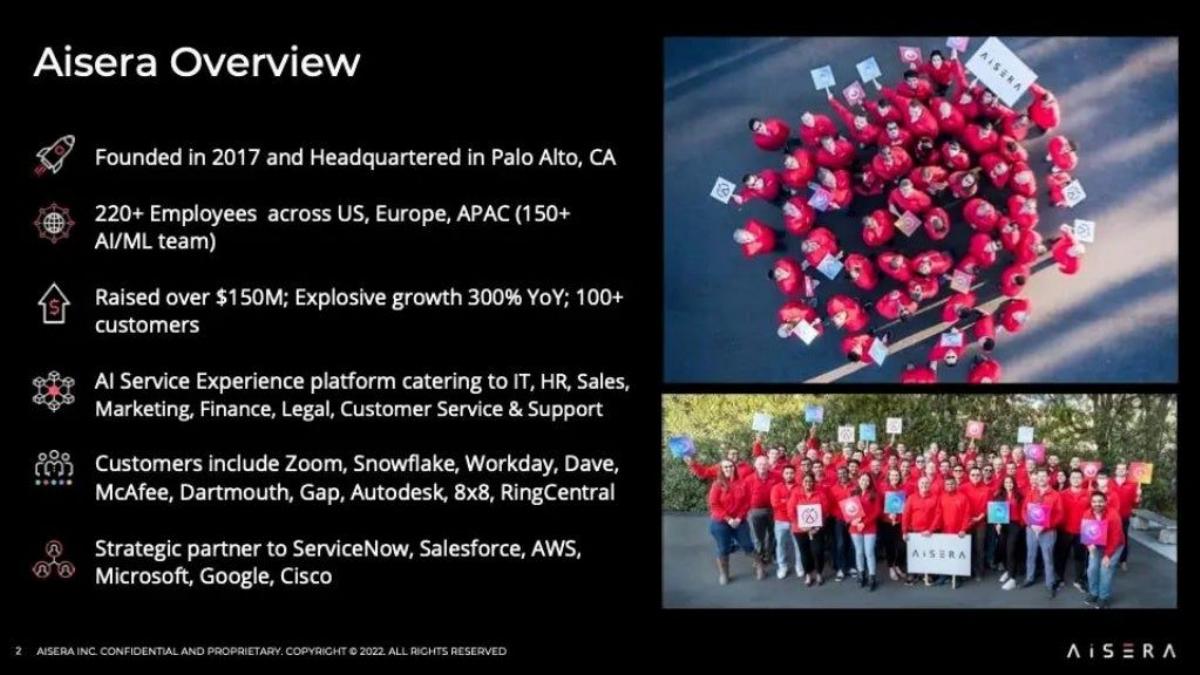
- The company leads with a high-impact overview slide citing 300% YoY growth and 100+ customers (Slide 2).
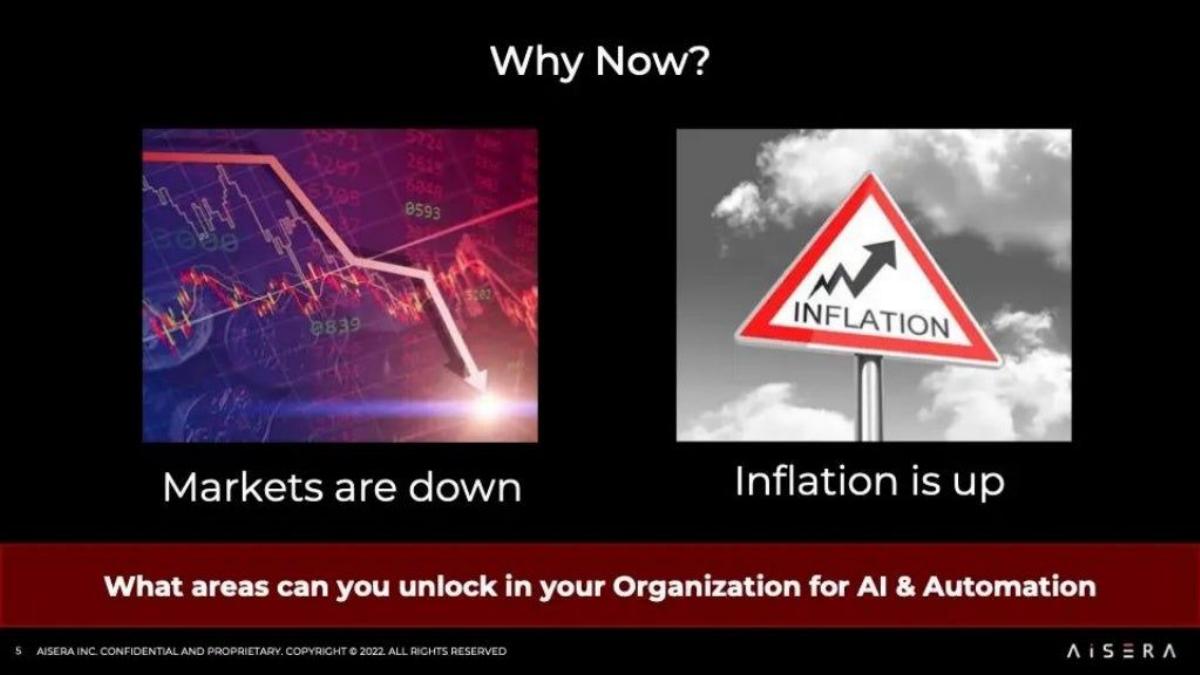
- Aisera frames its 'Why Now?' around macroeconomic factors like rising inflation and market downturns (Slide 5).
- The deck highlights a massive technical moat by stating they have a 150+ person AI/ML team (Slide 2).
- Social proof is prioritized through a dedicated slide for customer case studies including Zoom, Carta, and Snowflake (Slide 11).
- The platform is positioned as a horizontal solution covering IT, HR, Sales, and Finance (Slide 2).
- Aisera leverages significant analyst validation, specifically citing the Gartner Hype Cycle for ITSM 2022 (Slide 17).
- The solution is presented as a three-pillar architecture: Employee Experience, Ops Experience, and Customer Experience (Slide 13).
- The deck concludes with a powerful roster of Tier-1 investors including Goldman Sachs, Norwest, and Khosla Ventures (Slide 19).
Aisera Series D Teardown: Selling Efficiency in a Down Market
Aisera’s 2022 Series D pitch deck is a textbook example of how a late-stage enterprise SaaS company should present itself during periods of economic uncertainty. Raising $90M in a year where venture activity began to cool required more than just a 'cool' product; it required proof of indispensability. Aisera achieved this by leaning heavily into two areas: massive growth metrics and overwhelming third-party validation.
Slides 1-4: The Foundation of Scale
The deck opens with a clear, professional title slide (Slide 1) featuring CEO Muddu Sudhakar. However, the real work begins on Slide 2, the 'Aisera Overview.' This is one of the most information-dense slides in the deck, and for good reason. It establishes immediate credibility by stating the company was founded in 2017, is headquartered in Palo Alto, and employs over 220 people. Most importantly, it highlights a 150+ person AI/ML team . For a Series D investor, this signals a significant technical moat. The slide also quotes 300% YoY growth and a customer base of 100+ , including household names like Zoom and Snowflake. By the end of the second slide, the investor already knows this is a high-growth, well-capitalized leader in its space.
Slides 3 and 4 cover the Vision and Mission. While these are often 'fluff' slides in early-stage decks, here they serve to broaden the scope. Aisera isn't just a chatbot; their vision is to 'deliver exceptional Customer & Employee Experience.' This horizontal positioning is critical for justifying a Series D valuation, as it suggests a massive Total Addressable Market (TAM) across multiple business units.
Slides 5-7: The Macroeconomic Hook
Slide 5 is a strategic pivot. Titled 'Why Now?', it features two stark images: a crashing stock market graph and an inflation warning sign. The text is simple: 'Markets are down' and 'Inflation is up.' By framing the problem through the lens of the 2022 economy, Aisera makes its solution feel like a financial hedge. They aren't selling 'innovation' for innovation's sake; they are selling a way to survive and thrive when costs are rising.
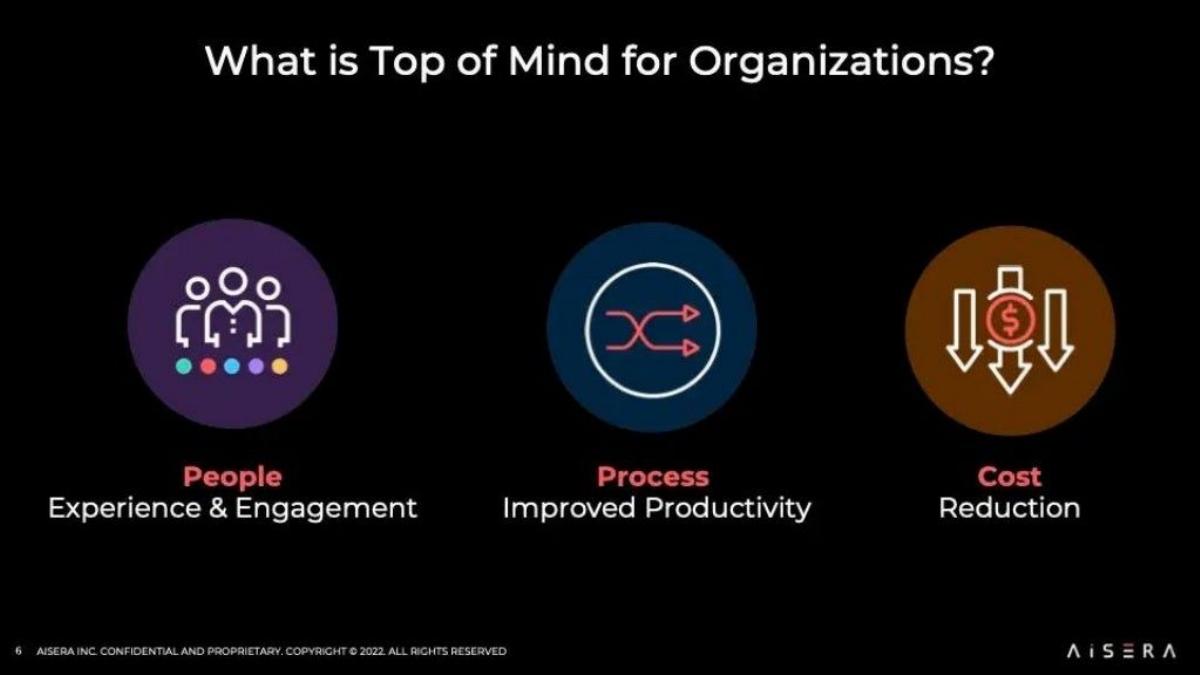
Slide 6 reinforces this by identifying what is 'Top of Mind for Organizations': People, Process, and Cost Reduction . Slide 7 then brings in the 'big guns' of analyst data, citing Forrester (65% of respondents expect instant responses), Gartner (70% of white-collar workers will interact with conversational platforms daily), and MIT Technology Review (80% of consumers claim 24/7 service is the most useful bot functionality). This trio of data points validates the market demand without the founders having to make the claims themselves.
Slides 8-10: Defining the Enterprise Pain
Slides 8, 9, and 10 drill down into the specific 'Business Challenges.' Slide 9 is particularly effective, listing 'siloed systems,' 'landscape sprawl,' and a 'lack of ROI from SaaS solutions' as the key problems. This resonates with enterprise CIOs who are often overwhelmed by the number of disconnected tools in their stack. Aisera positions itself as the connective tissue that brings efficiency to this sprawl. Slide 10 summarizes the 'Current State of Affairs' as a world of high effort, manual resolution, and high costs.
Slides 11-12: The Power of Social Proof
Slide 11 is a 'Wall of Logos' on steroids. Instead of just showing icons, it categorizes them into 'Employee Experience' (Chegg, Autodesk, Workday) and 'Customer Experience' (Zoom, Carta, Dave, McAfee, Snowflake). Each logo is paired with a 'Case Study' link. This tells the investor that Aisera isn't just being tested; it is being deployed at scale for different use cases across the world's most successful companies.
Slide 12 features a video thumbnail of Microsoft CEO Satya Nadella (linked to a YouTube URL). While the deck doesn't transcribe the video, the mere presence of Nadella’s image associated with Aisera provides a level of 'halo effect' validation that is hard to replicate. It suggests that Aisera is a key player in the broader AI ecosystem led by giants like Microsoft.
Slides 13-15: The Platform Architecture
Slide 13 explains the 'AI Service Experience Platform.' It visualizes a three-layered approach: Services (the underlying tech like Knowledge Graphs and NLP), Products (AI Service Desk, AI Contact Center, etc.), and Experiences (Employee, Ops, and Customer). This slide is crucial for showing that Aisera is a platform, not a point product. Slide 14 further illustrates this with a 'Disruptive AI' arc, showing capabilities ranging from 'Outage Prediction' to 'User Behavior Intelligence.' Slide 15 humanizes the tech with the slogan 'Automate the Mundane, Elevate the Humane,' showing a professional user interacting with the virtual assistant.
Slides 16-18: Analyst Dominance
Late-stage enterprise deals often live or die by analyst reports. Aisera dedicates three full slides to this. Slide 16 highlights their status as a Gartner 'Cool Vendor' and their inclusion in Forrester Research. Slide 17 shows the actual Gartner ITSM Hype Cycle 2022 , presumably with Aisera’s category positioned favorably. Slide 18 is a collage of awards, including 'CNBC Upstart 100,' 'Forbes AI 50,' and 'Red Herring 100.' For a Series D investor, this volume of awards acts as a final 'de-risking' mechanism, proving that the industry has already vetted and crowned the company.
Slide 19: The Investor Roster
The final content slide (Slide 19) lists their existing investors. The list is prestigious: Goldman Sachs, Norwest, Menlo Ventures, True Ventures, Khosla Ventures, First Round, and Workday. When a company has this level of backing, the Series D is often about participating in a 'winner-takes-all' scenario rather than questioning the business model. The presence of Workday as an investor also hints at strong strategic alignment with major ERP/HR platforms.
What Works in the Aisera Deck
Metric Dominance: Leading with 300% YoY growth and $150M raised (Slide 2) sets a high bar for the rest of the deck. · Macro-Economic Alignment: Connecting AI to inflation and market downturns (Slide 5) makes the product feel like a 'must-have' rather than a 'nice-to-have.' · Categorization of Success: By splitting case studies into Employee and Customer experiences (Slide 11), they prove the horizontal versatility of the platform. · Analyst Validation: The heavy use of Gartner and Forrester data (Slides 16-17) provides objective proof of market leadership.
What is Missing from the Aisera Deck
The Ask: There is no slide detailing how the $90M will be spent. While common in late-stage decks where terms are often pre-negotiated, it leaves the reader wondering about the specific expansion plans. · Individual Team Bios: While Slide 2 mentions the size of the team, there are no bios for the leadership team. In a Series D, the 'who' is often as important as the 'what,' especially regarding the executive team's ability to scale toward an IPO. · Unit Economics: The deck lacks data on CAC (Customer Acquisition Cost), LTV (Lifetime Value), or Net Revenue Retention (NRR). While 300% growth is impressive, sophisticated investors would want to see the efficiency of that growth. · Competitive Landscape: There is no slide comparing Aisera to competitors like ServiceNow or Moveworks. They rely on the 'Platform' argument to differentiate, but a direct comparison is absent.
Founder's Playbook: Lessons from Aisera
Sell the 'Why Now' using the news: If the economy is changing, show how your product solves the new problems created by that change. Aisera used inflation to sell automation. · Front-load your best facts: Don't wait until Slide 15 to show your growth. If you have 300% growth, put it on Slide 2. · Use 'Social Proof' categories: Don't just list logos. Show how those logos use different parts of your product. It proves you aren't a one-trick pony. · Leverage third-party voices: If Gartner or a major publication has praised you, give them their own slide. An analyst's opinion often carries more weight than a founder's claim in late-stage rounds. · Show technical scale: Mentioning the size of your engineering or AI team (e.g., '150+ AI/ML team') is a quick way to signal that your product isn't easily replicated by a smaller startup.
Frequently asked questions
- What is Aisera's primary value proposition according to the deck?
- Aisera positions itself as an 'AI Service Experience Platform' that automates tasks across IT, HR, and Customer Service. According to Slide 15, their goal is to 'Automate the Mundane, Elevate the Humane,' focusing on driving enterprise-wide productivity and cost reduction through a unified AI layer rather than fragmented point solutions.
- How does Aisera handle the 'Why Now' argument?
- Unlike many startups that focus on technology shifts, Aisera uses Slide 5 to point toward macroeconomic pain. They cite that 'Markets are down' and 'Inflation is up,' arguing that these conditions force organizations to seek AI and automation to unlock efficiency and reduce operational costs.
- What metrics does the deck use to prove traction?
- The deck is light on granular unit economics but heavy on growth and scale. Slide 2 highlights 300% Year-over-Year growth, a customer base of over 100 enterprise clients, and a total of $150M raised prior to this round. They also emphasize their workforce scale, noting 220+ employees.
- Who are Aisera's key customers and partners?
- Slide 2 and Slide 11 list a high-density roster of enterprise clients including Zoom, Snowflake, Workday, McAfee, Autodesk, and Gap. They also list strategic partnerships with major ecosystem players like ServiceNow, Salesforce, AWS, Microsoft, Google, and Cisco.
- Does the deck include a detailed product roadmap?
- No, the deck focuses on the current platform capabilities and architecture. Slide 13 and 14 outline the existing 'AI Service Experience Platform' components, such as AI Service Desk and AI Contact Center, but it does not provide a chronological timeline for future feature releases.