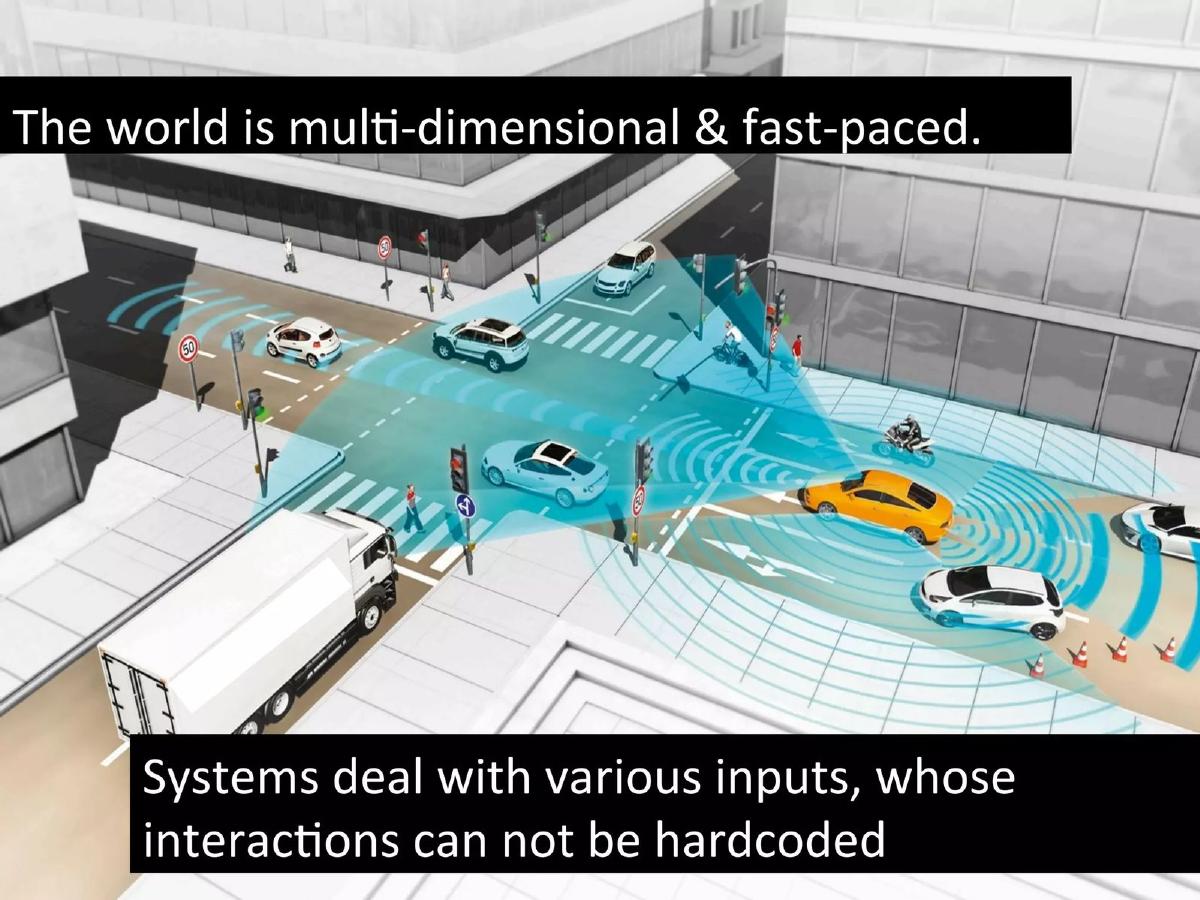
Aiseedo's pitch deck, dated September 2015, positions the company as a specialist in 'Real-time Machine Intelligence.' The deck focuses heavily on the technical challenges of managing time-series data and temporal context, which the founders argue are underserved by traditional systems. By leveraging recurrent networks and reinforcement learning, Aiseedo aims to provide a platform for predictive analytics, anomaly detection, and automated decision-making. The deck is notably technical, prioritizing architectural explanations and feature lists over market sizing or financial projections. While…
Key takeaways
- The company defines its core value proposition as solving the difficulty of dealing with asynchronous information and temporal context in the real world (Slide 3).
- Aiseedo utilizes deep learning, recurrent networks, and reinforcement learning to enable goal-directed behavior (Slide 4).
- The product is offered through two distinct integration methods: a cloud service or a local library (Slide 4).
- The technical architecture is described as a SaaS platform featuring streaming machine learning engines and data fusion capabilities (Slide 6).
- The system provides specific output types including suggested actions, forecasts, predictions, and anomaly detection (Slide 6).
- Aiseedo identifies a gap in current data management, stating that the 'time nature of data is rarely used' despite being critical (Slide 7).
- Users interact with the platform by setting up 'topics' which include selectors, statistics, and forecasts to analyze incoming data streams (Slide 8).
- The deck completely omits market size, business model details, team biographies, and financial requirements.
Introduction and The Problem of Time
Slide 1: Title Slide
The deck opens with a clear title: "AISEEDO: Real-time Machine Intelligence." It includes a date of September 8th, 2015, and names the presenters as Nic Greenway and Laure Andrieux. The subtitle "HUGUK goes startup" suggests this presentation may have been delivered at a Hadoop User Group (HUG) event in the UK, which explains the heavy technical focus of the subsequent slides.
Slide 2: The Context of Modern Systems
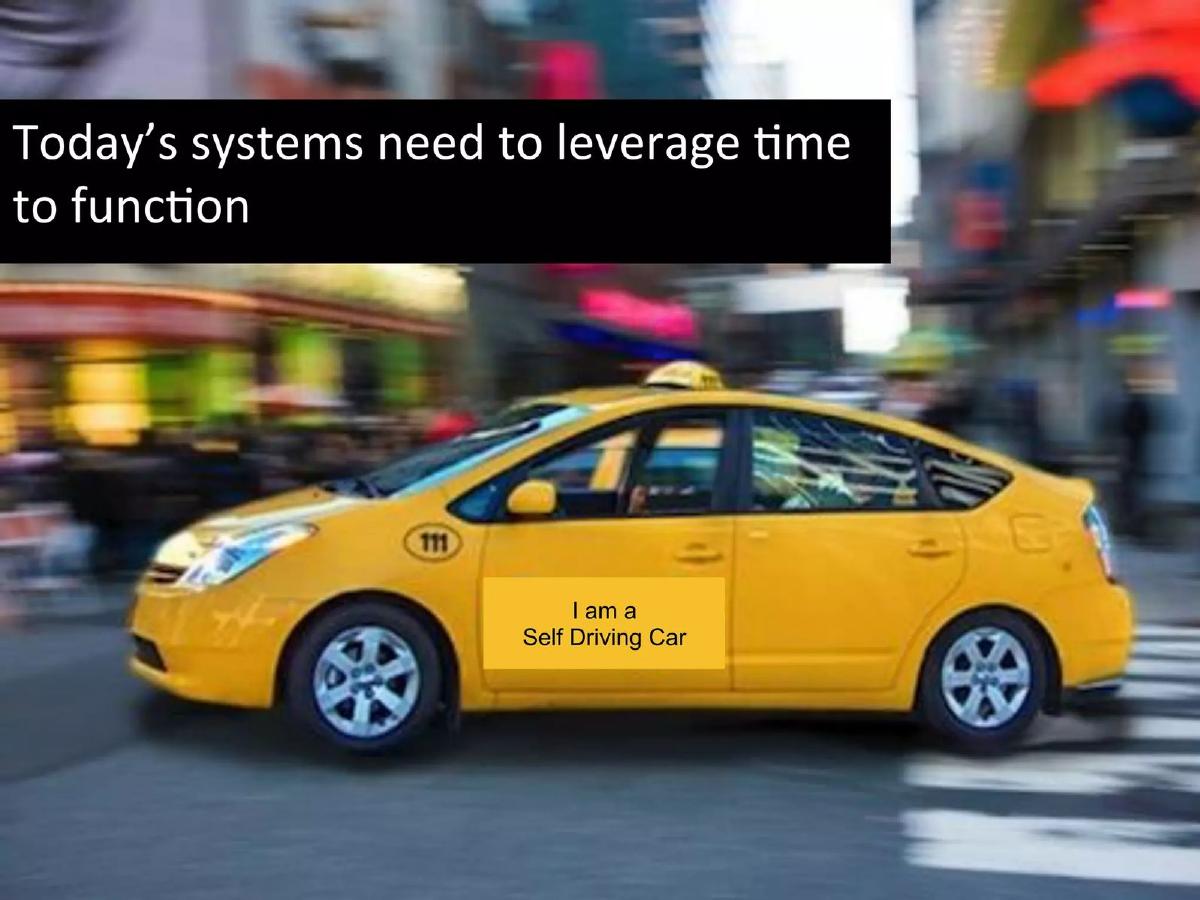
Slide 2 features a blurred image of a yellow taxi with a superimposed label: "I am a Self Driving Car." The text states, "Today’s systems need to leverage time to function." This serves as a high-level hook, using the burgeoning field of autonomous vehicles to illustrate the necessity of real-time processing, though it does not explicitly claim Aiseedo is built specifically for cars.
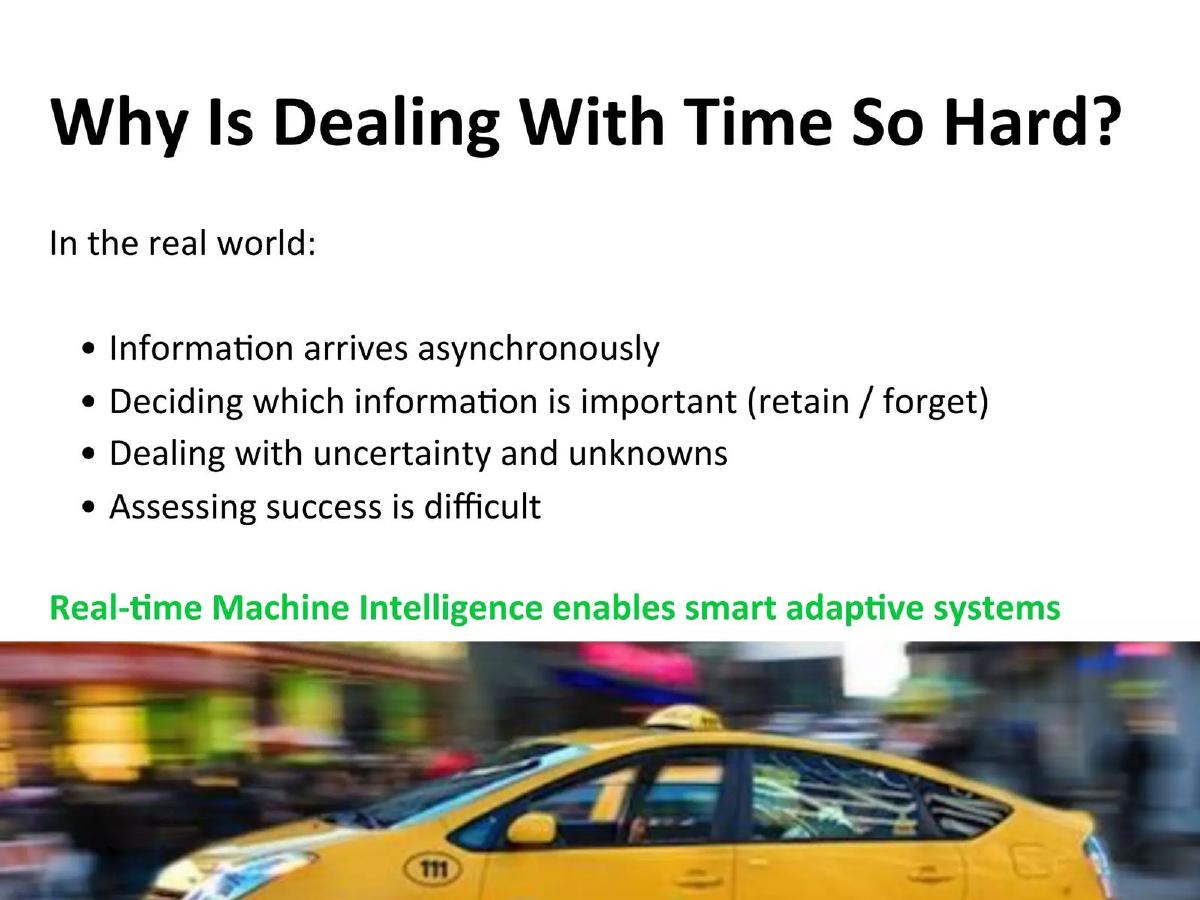
Slide 3: Why Is Dealing With Time So Hard?
This slide defines the problem space. It notes that in the real world, "Information arrives asynchronously." The founders identify four core difficulties: deciding which information to retain or forget, dealing with uncertainty, and the difficulty of assessing success. The slide concludes with a green-text thesis: "Real-time Machine Intelligence enables smart adaptive systems." This slide is crucial as it sets up the technical 'why' behind the company's existence.
The Aiseedo Solution
Slide 4: Aiseedo Elegantly Deals With Time
This slide introduces the solution by listing technical capabilities. It cites "Cutting-edge Deep Learning and Recurrent Networks" and "Reinforcement learning for goal-directed behaviour." The slide claims the system adapts to changes in data without starting from scratch and constantly predicts future events. Crucially, it mentions the delivery model: "Integration as a cloud service or local library," indicating a flexible go-to-market strategy for both startups and enterprise clients.
Slide 5: Brand Interstitial
Slide 5 is a visual transition slide featuring a blue background of digital code and the text: "Aiseedo Real-time Machine Intelligence. Delivered." It serves no informational purpose other than to reinforce the brand identity and the concept of 'delivery' of complex AI.
Slide 6: What’s Under The Hood?
This slide provides an architectural overview. It breaks the offering into three pillars: Architecture (Next generation neural networks, SAAS), The Tech (Streaming Machine learning engines, Data Fusion, real-time model updates), and Systems Integration . Under integration, it lists an "API / web interface" and "Streaming output feeding to end system." It also lists the types of insights provided: "Suggested action / next best action, forecast, prediction, anomaly detection." This is the most informative slide for a potential technical partner or investor.
Data Management and User Interaction
Slide 7: Streaming and Time-Series Data
Aiseedo returns to the problem of data management, stating "Temporal Context Is Tricky To Manage." It argues that the time-nature of data is rarely used in modern management. The slide lists requirements for effective management: preserving time-nature, re-constituting state, and handling heterogeneous feeds. It positions Aiseedo as the tool to "Automatically plug results into applications."
Slide 8: Analyse your Data via Topics
The final slide in the set explains the user experience. After uploading data, users set up "tasks" called "topics." The slide defines six topic types: Selector, Statistics, Forecast, Prediction, SuggestedAction, and Anomaly. This provides a concrete look at how a developer would actually interact with the Aiseedo platform to generate value from their data streams.
What Works in the Aiseedo Deck
The primary strength of this deck is its technical clarity . For an audience of engineers or data scientists—which the "HUGUK" reference suggests—the deck does an excellent job of identifying a specific technical bottleneck (temporal context in machine learning) and explaining how their specific stack (Recurrent Networks and Reinforcement Learning) addresses it. The distinction between a cloud service and a local library shows an understanding of different enterprise security needs.
The use of "Topics" on Slide 8 is a strong product-marketing move. It translates abstract machine learning concepts into functional categories that a business user or developer can understand. By categorizing outputs into 'Forecasts' or 'Suggested Actions,' Aiseedo makes the utility of their 'Real-time Machine Intelligence' tangible.
What is Missing from the Aiseedo Deck
As a fundraising tool, this deck is incomplete. It lacks several fundamental slides required for a standard venture capital pitch:
Market Size (TAM/SAM/SOM): There is no mention of how large the market for real-time AI was in 2015 or which industries (Finance, IoT, AdTech) they are targeting first. · Business Model: While they mention SaaS, there is no information on pricing tiers, seat costs, or volume-based data pricing. · Competition: The deck assumes a vacuum. It does not mention how Aiseedo compares to established cloud providers (AWS, Google Cloud) or other specialized AI startups of the era. · Team: While two names are on the cover, there are no biographies, past successes, or technical credentials listed to prove they can actually build what they describe. · Traction: There are no case studies, pilot program results, or user numbers. · The Ask: The deck does not state how much money is being raised or what the milestones for the next 18 months will be.
Founder Lessons: What to Copy and What to Avoid
What to Copy: Founders building deep-tech products should emulate the way Aiseedo defines the "Problem Space" (Slide 3). Instead of saying "AI is hard," they broke it down into specific issues like "asynchronous information" and "uncertainty." This builds credibility with technical investors. The "Under the Hood" slide (Slide 6) is also a great template for showing how a product fits into a customer's existing technical stack.
What to Avoid: Avoid the "Mystery Meat" approach to business. Aiseedo focuses so much on the 'how' that they forget the 'who' and the 'how much.' Even in a technical presentation, you must include a slide on the team's pedigree and a slide on the commercial opportunity. Without these, the deck feels like a university project rather than a high-growth startup. Additionally, avoid using generic stock photos (like the blurred taxi or the finger touching a glowing orb) that don't add specific value to the narrative.
Conclusion
The Aiseedo deck is a time capsule of 2015's AI landscape, focusing on the then-emerging importance of recurrent networks for time-series data. While it serves as a strong technical primer, its lack of commercial and operational data makes it a poor example of a standalone fundraising deck. It is best viewed as a supplemental technical appendix to a broader business pitch.
Frequently asked questions
- What specific problem does Aiseedo claim to solve?
- Aiseedo addresses the challenge of 'temporal context' in machine learning. According to Slide 3 and Slide 7, traditional systems struggle with information that arrives asynchronously and fail to effectively leverage the time-nature of data. The company aims to help systems retain important information, forget irrelevant data, and deal with uncertainty in real-time environments.
- What is the underlying technology mentioned in the deck?
- The deck highlights several advanced AI techniques on Slide 4 and Slide 6, including Deep Learning, Recurrent Networks (which are specialized for sequential/time-based data), and Reinforcement Learning for goal-directed behavior. The architecture is built around 'streaming machine learning engines' that allow for ongoing model updates rather than static training.
- How can a customer integrate Aiseedo into their existing systems?
- As stated on Slide 4 and Slide 6, Aiseedo offers flexibility in deployment. It can be integrated as a cloud-based SaaS through an API/web interface or as a local library for on-premise needs. The system is designed to feed streaming output directly into a customer's end system for automated application.
- What are the primary use cases or 'topics' supported by the platform?
- Slide 8 outlines six specific 'topics' or tasks: Selectors (monitoring specific data), Statistics (reporting on streams), Forecasts (predicting future numeric values), Prediction (anticipating future messages), SuggestedAction (optimizing outcomes), and Anomaly (identifying outliers). This suggests a broad application across finance, IoT, or logistics.
- Is there any information regarding the company's business model or traction?
- No. The provided slides are strictly technical and conceptual. There is no mention of pricing, customer acquisition costs, current revenue, or specific pilot partners. The deck functions more as a technical white paper or a product overview than a comprehensive investment pitch.