Tech Stack and Architecture Slide Examples: 12 Real Pitch
How startups show their technology architecture in a pitch deck: system diagrams, tech stacks and layered platforms.
Architecture Slide: Show Why Your Design Matters, Not Just How the Boxes Connect
Technical founders often include a diagram of how their system is built: boxes for the app, the cloud, the database and the outside services, joined by arrows. Most investors cannot judge the engineering from a diagram, and they do not try. What they look for is the reason the design matters: something it makes possible, cheaper or harder to copy. A diagram without that reason reads as filler, or worse, as a sign that the technology is ordinary. This guide compares thirteen real architecture slides, from Altana's federated learning design to a slide that shows a typical industry setup rather than the company's own.
TL;DR
Lead with what the design makes possible, then show the diagram as support. Altana's headline says its federated learning architecture "unlocks non-public data at scale". Deepgram says one model architecture can learn new languages "at 10X speed". DFS22 names the banks already running its stack. Cover Genius and Breakout show how their products sit on shared layers. Blockchain lists the vendors it uses, and AgriNation, DonkiDrive and Andi Games show diagrams that could describe almost any app. One slide is labelled "Typical Video Surveillance Architecture", not the company's own.
Architecture slides from real pitch decks
Each example shows the exact stored slide above its analysis and links to the full teardown. Slides that state why the design matters come first; generic and warning examples follow. Text is as shown on the slides; comments are ours.
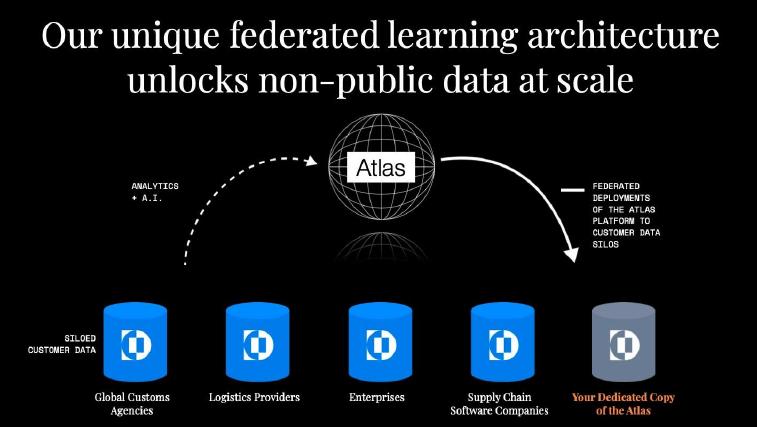
Altana technology slide — slide 8
Supply chain data and AI company.
Altana deck, slide 8. Exact stored slide matched to this analysis.
Our analysis: The design explains the advantage: the platform goes to the data instead of asking customers to hand data over.
Evidence and limitation: Company description of its design; no customer names or figures on this slide.
What a founder can adapt: State in your headline what your design makes possible that a standard design would not.
Supporting analysis
What the deck claims: Headline: "Our unique federated learning architecture unlocks non-public data at scale". A globe labelled "Atlas" sits above five data stores marked "Siloed customer data": "Global Customs Agencies", "Logistics Providers", "Enterprises", "Supply Chain Software Companies" and "Your Dedicated Copy of the Atlas". Arrows read "Analytics + A.I." and "Federated deployments of the Atlas platform to customer data silos".
Presentation choice: Investors immediately see why the architecture matters: it gives access to data competitors cannot collect.
When it does not fit: Leaving out how many customers already run the deployment shown.
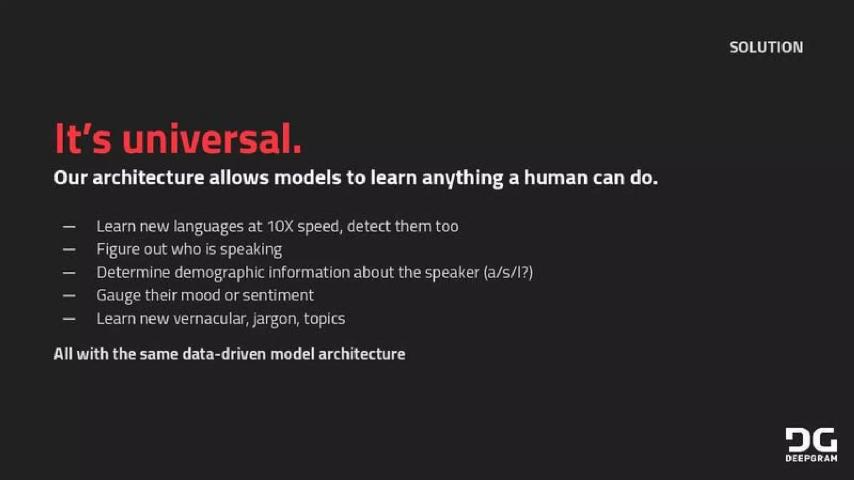
Deepgram deck, slide 8. Exact stored slide matched to this analysis.
Our analysis: No diagram at all: the slide describes what one design can do.
Evidence and limitation: Company claims. The 10X figure is not compared with anything named on the slide.
What a founder can adapt: Say what your speed or cost claim is measured against.
Supporting analysis
What the deck claims: "It's universal. Our architecture allows models to learn anything a human can do." "Learn new languages at 10X speed, detect them too"; "Figure out who is speaking"; "Gauge their mood or sentiment"; "Learn new vernacular, jargon, topics". "All with the same data-driven model architecture".
Presentation choice: It turns an engineering choice into a list of products the company can build without starting again.
When it does not fit: Broad claims such as "anything a human can do" without a figure to back them.
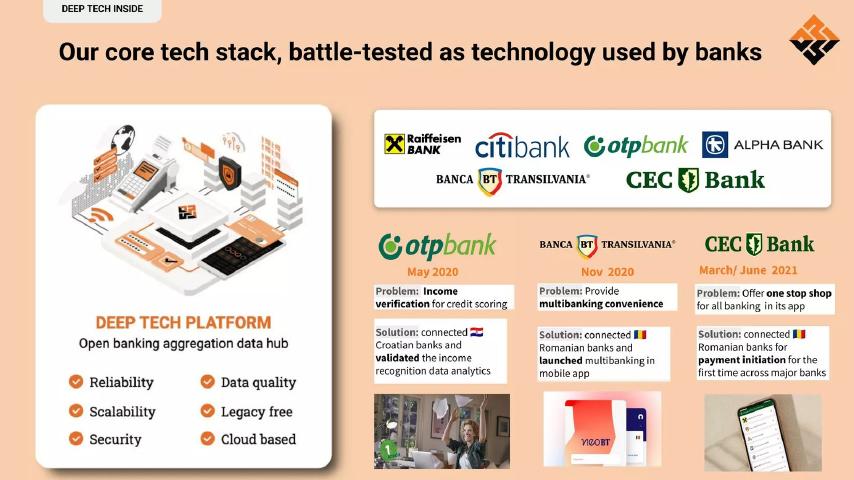
Open banking data company. Slide labelled "Deep tech inside".
DFS22 deck, slide 8. Exact stored slide matched to this analysis.
Our analysis: Instead of a diagram, the slide proves the technology works by naming where it already runs.
Evidence and limitation: Company-listed deployments with dates.
What a founder can adapt: If customers already run your system, show them on the technology slide.
Supporting analysis
What the deck claims: "Our core tech stack, battle-tested as technology used by banks". "Deep tech platform: Open banking aggregation data hub". Logos of Raiffeisen Bank, Citibank, OTP Bank, Alpha Bank, Banca Transilvania and CEC Bank. Three cases: OTP Bank (May 2020), Banca Transilvania (Nov 2020), CEC Bank (March/June 2021), each with a problem and solution.
Presentation choice: Named, dated bank deployments are stronger evidence of reliability than any diagram.
When it does not fit: Logos without saying what each customer actually uses.
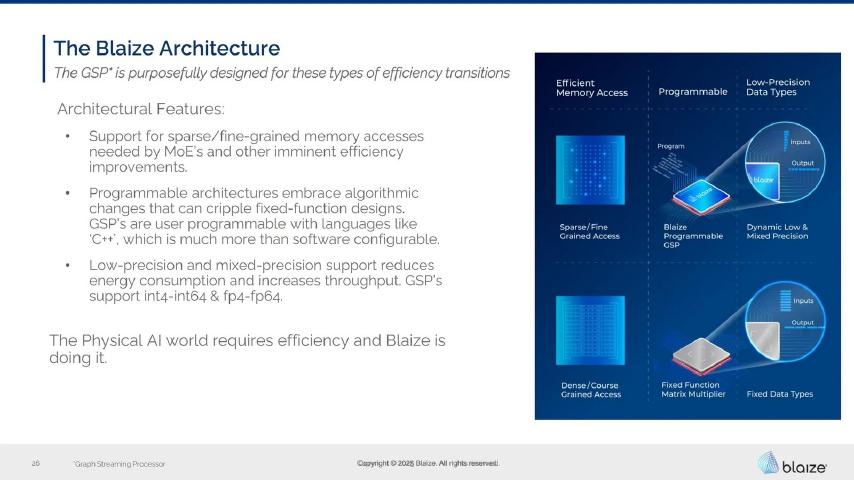
AI chip company. Slide titled "The Blaize Architecture".
Blaize deck, slide 26. Exact stored slide matched to this analysis.
Our analysis: Each feature is tied to a benefit (efficiency, flexibility, lower energy use) and contrasted with fixed-function chips.
Evidence and limitation: Company description; no performance figures on this slide.
What a founder can adapt: Name the alternative design and say why yours wins.
Supporting analysis
What the deck claims: "The GSP is purposefully designed for these types of efficiency transitions". Features: "Support for sparse/fine-grained memory accesses"; "Programmable architectures embrace algorithmic changes that can cripple fixed-function designs"; "Low-precision and mixed-precision support reduces energy consumption and increases throughput". "The Physical AI world requires efficiency and Blaize is doing it."
Presentation choice: Investors can see the bet: that AI models will keep changing, so a programmable chip beats a fixed one.
When it does not fit: Technical terms with no figure showing how much better.
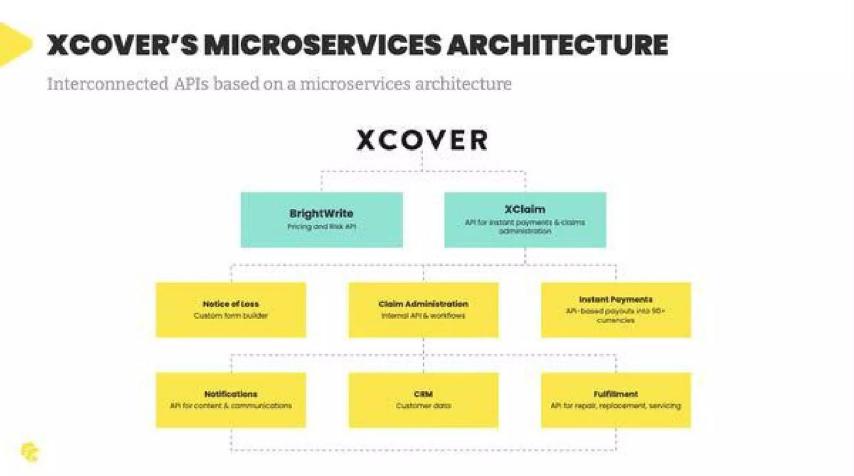
Cover Genius deck, slide 10. Exact stored slide matched to this analysis.
Our analysis: Shows that each part of the insurance process is a separate service partners can plug into.
Evidence and limitation: Company description.
What a founder can adapt: State the benefit in the headline, such as how fast a new partner goes live.
Supporting analysis
What the deck claims: "Interconnected APIs based on a microservices architecture". "XCover" above "BrightWrite" (pricing and risk API) and "XClaim" (API for instant payments & claims administration), then modules including "Notice of Loss", "Claim Administration", "Instant Payments", "Notifications", "CRM" and "Fulfillment".
Presentation choice: For a company selling through partners, separate APIs explain how it can integrate quickly with many of them.
When it does not fit: Labels too small to read at slide size.
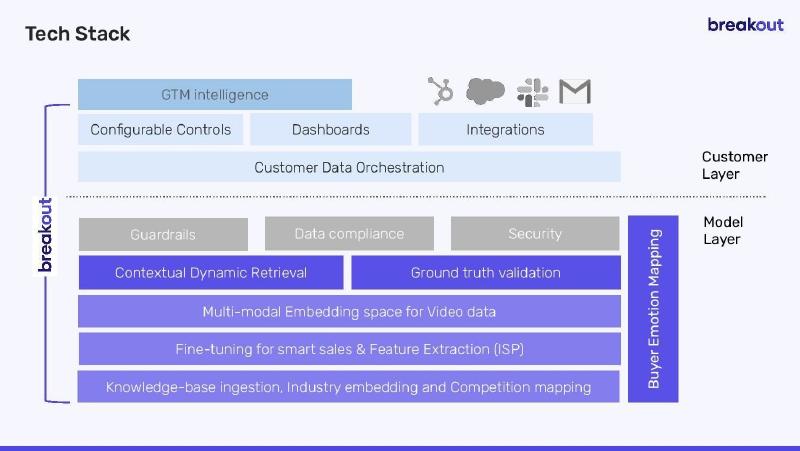
Breakout deck, slide 7. Exact stored slide matched to this analysis.
Our analysis: A layered view that separates what customers see from the model work underneath.
Evidence and limitation: Company description.
What a founder can adapt: Highlight the one or two layers that are hardest to copy.
Supporting analysis
What the deck claims: "Customer Layer": "GTM intelligence", "Configurable Controls", "Dashboards", "Integrations", "Customer Data Orchestration". "Model Layer": "Guardrails", "Data compliance", "Security", "Contextual Dynamic Retrieval", "Ground truth validation", "Multi-modal Embedding space for Video data", "Fine-tuning for smart sales & Feature Extraction (ISP)", "Knowledge-base ingestion, Industry embedding and Competition mapping", with "Buyer Emotion Mapping" alongside.
Presentation choice: It shows the company built more than a thin layer on someone else's model.
When it does not fit: Listing every component with equal weight.
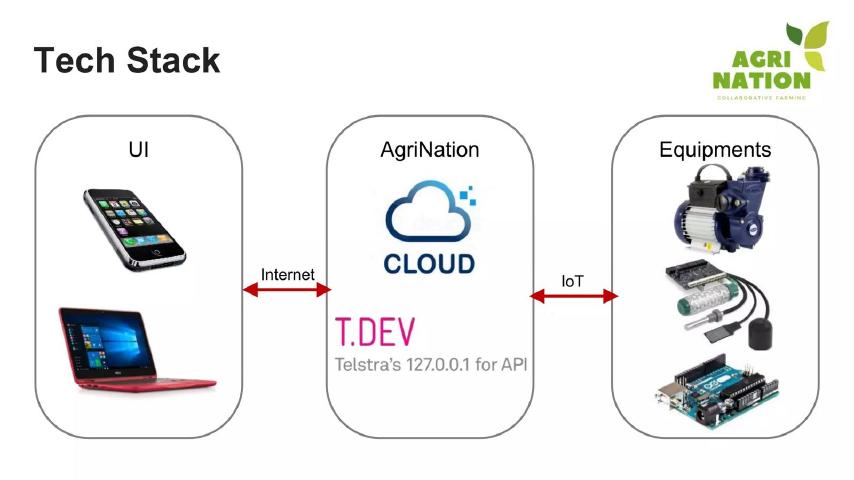
AgriNation deck, slide 7. Exact stored slide matched to this analysis.
Our analysis: A standard connected-device diagram.
Evidence and limitation: Company description.
What a founder can adapt: Say what is hard about connecting farm equipment and how you solved it.
Supporting analysis
What the deck claims: Three boxes: "UI" (phone and laptop), "AgriNation" (a cloud icon labelled "Cloud", with "T.DEV" and "Telstra's 127.0.0.1 for API") and "Equipments", joined by "Internet" and "IoT".
Presentation choice: Shown for contrast. It confirms the product exists but not what is distinctive.
When it does not fit: A diagram that would fit any connected-device startup.
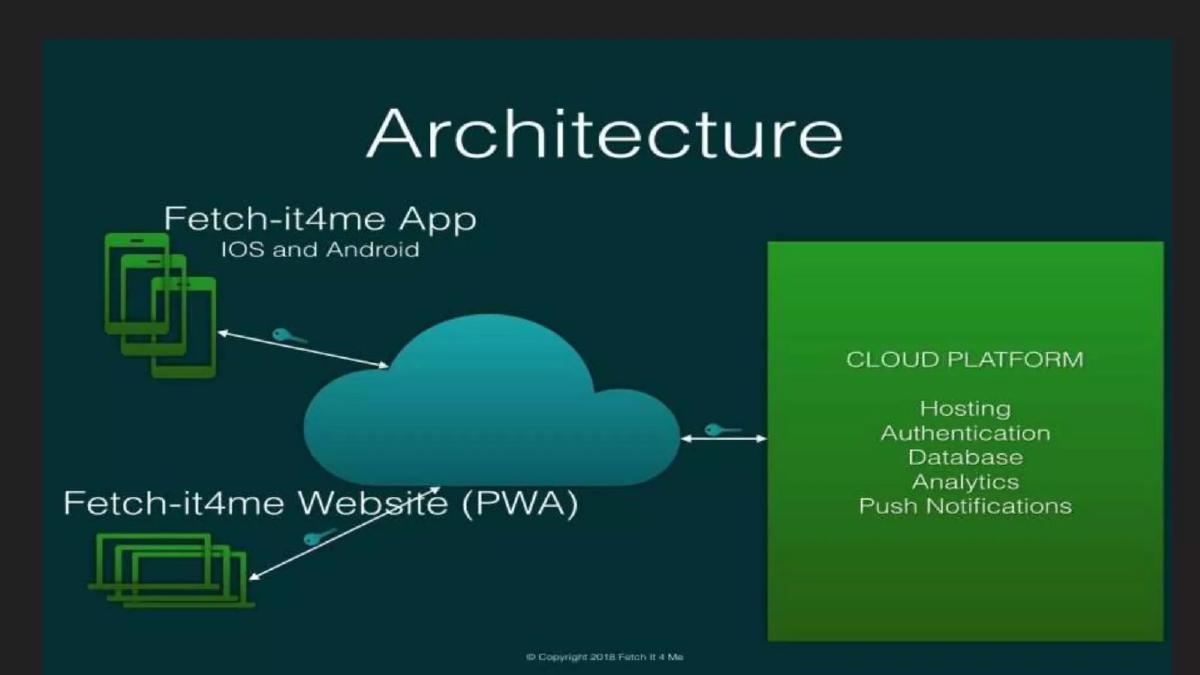
DonkiDrive deck, slide 6. Exact stored slide matched to this analysis.
Our analysis: A list of standard app services.
Evidence and limitation: Company description.
What a founder can adapt: If your technology is standard, cut the slide and use the space for traction.
Supporting analysis
What the deck claims: "Fetch-it4me App IOS and Android" and "Fetch-it4me Website (PWA)" connected to a "Cloud Platform": "Hosting", "Authentication", "Database", "Analytics", "Push Notifications".
Presentation choice: Shown for contrast. Every consumer app has these parts.
When it does not fit: Using an architecture slide to fill space.
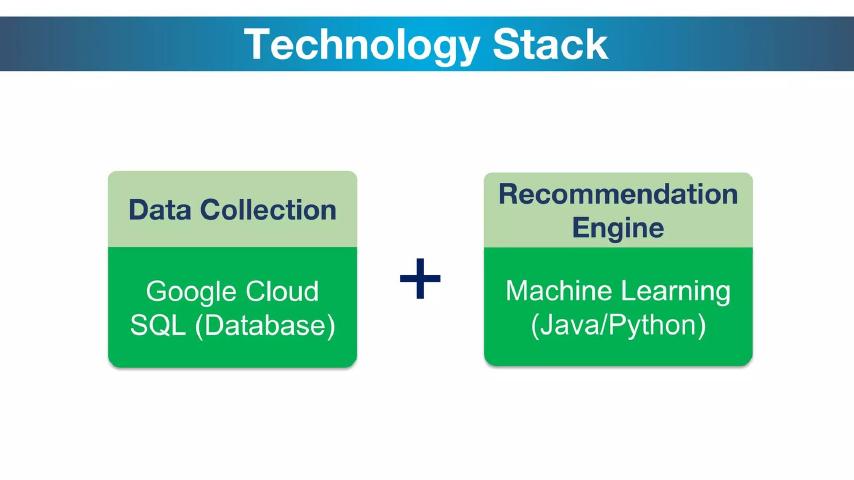
Andi Games deck, slide 7. Exact stored slide matched to this analysis.
Our analysis: Names a database and programming languages.
Evidence and limitation: Company description.
What a founder can adapt: Show what the engine recommends and how much it improves a measure such as retention.
Supporting analysis
What the deck claims: Two boxes joined by a plus sign: "Data Collection: Google Cloud SQL (Database)" and "Recommendation Engine: Machine Learning (Java/Python)".
Presentation choice: Shown for contrast. It tells investors almost nothing about what the recommendation engine does better.
When it does not fit: Listing tools and languages as if they were an advantage.
AI-Driven Large Space Security technology slide — slide 8
Video security startup. Slide titled "Product Architecture".
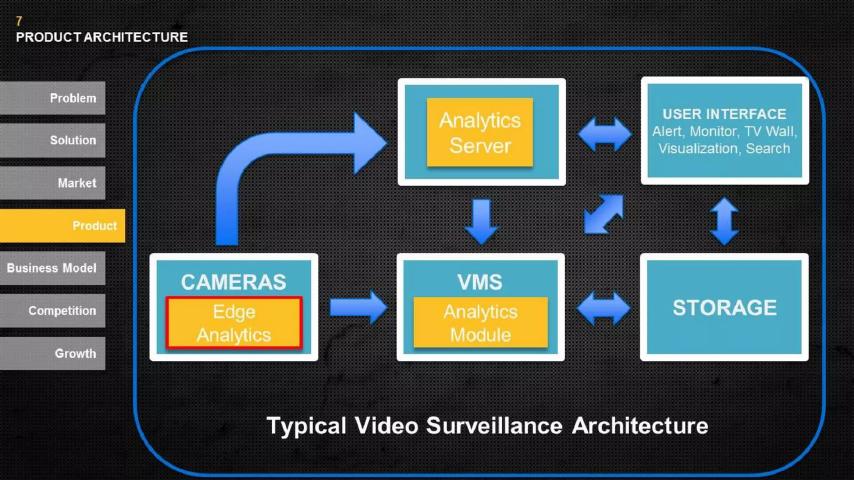
AI-Driven Large Space Security deck, slide 8. Exact stored slide matched to this analysis.
Our analysis: The slide shows a standard industry setup, not the company's own system.
Evidence and limitation: The caption describes the diagram as typical of the industry.
What a founder can adapt: Highlight your component on the standard diagram and say what it adds.
Supporting analysis
What the deck claims: Boxes for "Cameras" ("Edge Analytics"), "VMS" ("Analytics Module"), "Analytics Server", "User Interface" ("Alert, Monitor, TV Wall, Visualization, Search") and "Storage". Caption: "Typical Video Surveillance Architecture".
Presentation choice: Shown as a warning. Readers are left to guess which part the company built.
When it does not fit: Presenting an industry diagram as your product architecture.
After: Our on-device model processes video without uploading it, cutting bandwidth costs by 80% versus cloud analysis. Running at 40 sites today.
What improved: Our illustrative rewrite; all figures are invented for the example. It states the advantage, the comparison and the proof.
What this guide adds
The technology slide guide covers who owns the technology and how it differs from the product; the patents and data security guides cover protection. This guide covers the diagram itself: how startups show the way their system is built, and whether the slide tells investors why that matters.
How we read each slide
We read each stored slide image and quote the text on it. We have not tested any company's technology or checked its performance claims. Where a diagram is small, we quote only what we could read clearly.
What an architecture slide is for
An architecture slide answers one question: why is this hard to build, and why does building it this way help? The answer might be access to data others cannot reach, lower cost per customer, faster speed, or a platform that lets new products launch quickly.
If the honest answer is that the system uses standard parts, the slide is probably not needed. Investors in software companies expect a cloud, a database and an app. Showing those does not distinguish a company; showing what is different does.
What investors check
Is the advantage stated? Investors read the headline first. Altana and Deepgram put the benefit there; most slides title themselves "Architecture" or "Tech Stack" and leave the reader to work it out.
Is there proof? A claim that the design is faster or more reliable is easier to believe with a figure or a customer. DFS22 names bank deployments; Deepgram gives a speed claim without saying what it is compared with.
Is it theirs? A diagram of standard parts, or of a typical industry setup, suggests the company has not yet built anything distinctive.
Common mistakes on architecture slides
The most common is a generic diagram: app, cloud, database. AgriNation, DonkiDrive and Andi Games each show a version of this.
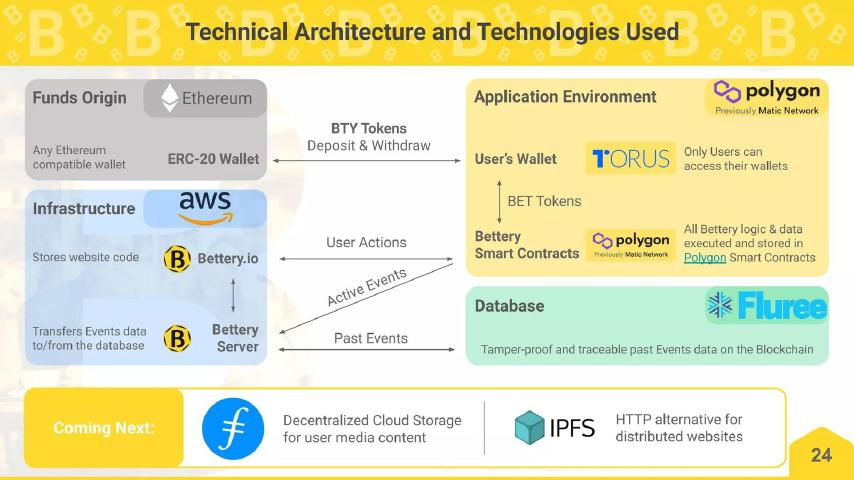
The second is a logo map. Blockchain's slide lists Ethereum, AWS, Polygon, Torus and Fluree, which tells investors which services it rents, not what it has built.
The third is showing someone else's architecture. A slide titled "Typical Video Surveillance Architecture" describes the industry, and leaves the reader asking which part the company built.
When to cut the slide
Many decks would be stronger without an architecture slide. If your system is built from standard cloud services and your advantage lies elsewhere, such as distribution, a partnership or a hard-won customer list, the slide spends attention on the least distinctive part of the business. Move the diagram to an appendix in case a technical investor asks, and use the space for traction or unit economics.
Keep the slide when the design itself is the reason you win. Examples from this guide: Altana's federated design reaches data others cannot, and Blaize's programmable chip is a bet on how AI models will change. In each case, removing the slide would remove part of the investment case.
Whatever you keep, label the diagram so an investor can tell what you built from what you bought. Mark your own components clearly, name the outside services you rely on (cloud provider, model provider, payment processor), and add one line on what would happen if one of them changed its price or terms. A diagram that shows only your own boxes hides the dependency an investor will ask about; one that shows everything at the same weight hides what is yours. If a part of the system is planned rather than running, say so on the slide, because diligence will check which boxes exist today. (General guidance, not drawn from the slides below.)
A useful test: read the headline alone. If it says only "Architecture" or "Tech Stack", rewrite it as a sentence about the advantage. If you cannot write that sentence, the slide probably belongs in the appendix.
Common mistakes
Generic diagram. App, cloud and database describe almost any startup.
Logo map. Vendor logos show what you rent, not what you built.
Someone else's architecture. A "typical" industry diagram leaves readers guessing.
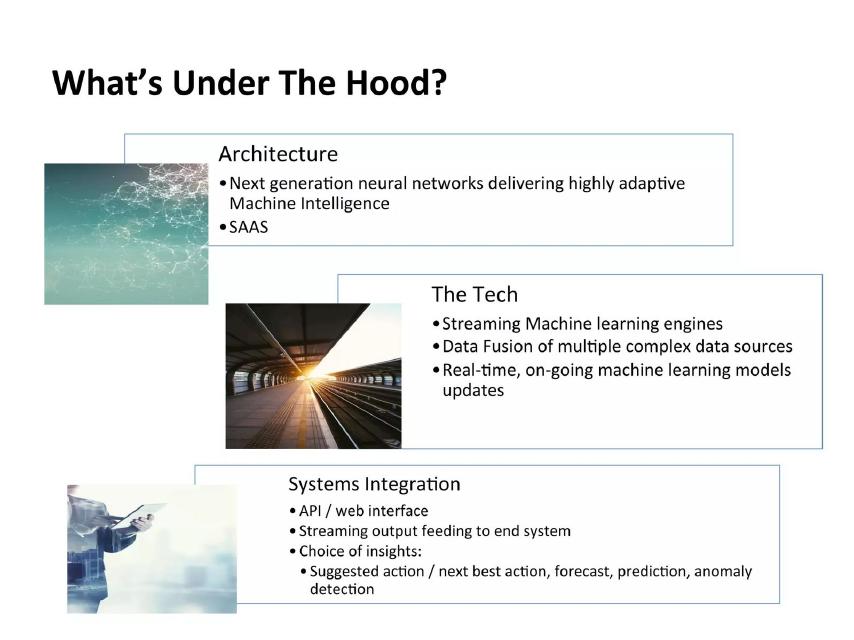
Adjectives, no figures. "Next generation" proves nothing.
Unreadable labels. If text cannot be read at slide size, cut it.
Benefit missing from headline. Title the slide with the advantage, not "Architecture".
Diagnostic checklist
Headline states what the design makes possible.
Shows the company's own system.
Marks which parts were built in-house.
Includes a figure or customer as proof.
Labels readable at slide size.
Cut entirely if the technology is standard.
Frequently asked questions
Should a pitch deck include a technology architecture slide?
Only if the design gives an advantage investors should know about. Altana's design reaches data competitors cannot; DonkiDrive's shows standard app services and could be cut.
What makes a good tech stack slide?
A headline stating the benefit, a diagram of the company's own parts, and proof such as customers or figures. DFS22 names the banks running its stack.
Should I list the tools and vendors I use?
Rarely. Tools such as AWS or Google Cloud are not an advantage. Bettery's slide is mostly vendor logos; Andi Games names a database and languages.
What mistakes do investors spot on architecture slides?
Generic diagrams, vendor logo maps, general adjectives without figures, and showing a typical industry setup instead of the company's own system.
How we chose these examples
Corpus: published pitch deck teardowns on StartupFundraising.com. Founder-uploaded private decks are excluded.
Selection (2026-10-01): we searched extracted slide text across the full corpus for slides whose title contains "tech stack", "technology stack" or "architecture". 135 matched. We shortlisted 16 unused pages from 16 companies, viewed 15 and kept 13; v2 (2026-10-05) removed BRD because a page of its deck carries a restriction notice, leaving 12.
Not used: Calix p33 (deck file unavailable), Bizday Finteum p10 and Airport Continuity p13 (text too small to read in the stored images).
Review: stored slide images were read on 2026-10-01 against company, deck and slide number (editorial model review). No person has yet completed an editorial review of this page. We did not test any company's technology or verify its claims, and we make no claim that any slide caused a fundraising outcome.