Data Privacy and Security in a Pitch Deck: 7 Real Slide
How to show SOC 2, HIPAA, GDPR and data handling in a pitch deck: what is audited, what is only claimed, what it unlocks and what is still to do.
Data Privacy and Security in a Pitch Deck: Showing What Is Audited, Claimed or Still to Do
Companies that handle customer, health or financial data are often asked about privacy and security before a buyer signs. The seven real slides below range from a one-line compliance badge to a slide that openly says expert advice is still needed. Read together, they show how different a stated audit, a self-declared "compliant", an architecture choice and a plan really are.
TL;DR
A privacy and security line in a deck is most useful when it says four things: which standard or law applies, its status (audit report received, self-assessed, in progress or planned, with a date), how the product handles data to meet it, and what it unlocks for the business. Asseta and Crossbeam state compliance in one line. Oxygen ties SOC 2 and PCI-DSS to direct Visa integrations and margin. Mako explains where data lives and what it will not be used for. Wellinks keeps its FDA device status apart from HIPAA data handling. MeshWorks lists "HIPAA certification" as a future milestone, and Dataastra says HIPAA details still need expert opinion. None of the seven names an auditor, a report date or a scope.
Privacy and security slides from real pitch decks
Ordered from a one-line claim to slides that explain data handling, business effect and open gaps. Each example shows the exact stored slide above its analysis and links to the full teardown. Text is quoted as shown. We describe only what each deck shows; we make no claim about any company's actual audit status.
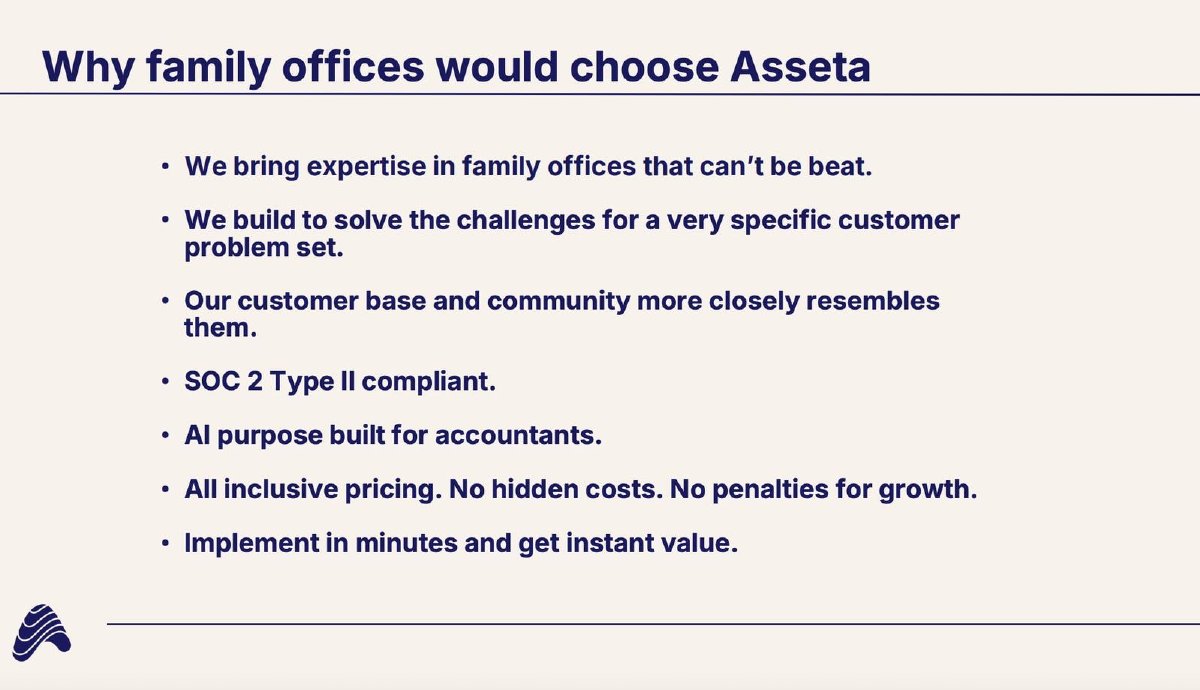
Asseta technology slide — slide 10
Accounting software for family offices, seed round.
Asseta deck, slide 10. Exact stored slide matched to this analysis.
Our analysis: It places the security claim among buying reasons, which is where a family office would weigh it, and names the stronger Type II form.
Evidence and limitation: The slide gives one line with no auditor, date or scope, set beside unmeasured claims such as expertise "that can't be beat". The slide does not show that an audit covering a period took place. Read it as the company's statement.
What a founder can adapt: Add the auditor, the report date and period, and the scope (which product and systems), so the claim can be checked.
Supporting analysis
What the deck claims: "Why family offices would choose Asseta": seven bullets, including "We bring expertise in family offices that can't be beat", "SOC 2 Type II compliant.", "AI purpose built for accountants." and "All inclusive pricing. No hidden costs. No penalties for growth."
Presentation choice: It places the security claim among buying reasons, which is where a family office would weigh it, and names the stronger Type II form.
When it does not fit: The slide gives one line with no auditor, date or scope, set beside unmeasured claims such as expertise "that can't be beat". The slide does not show that an audit covering a period took place. Read it as the company's statement.
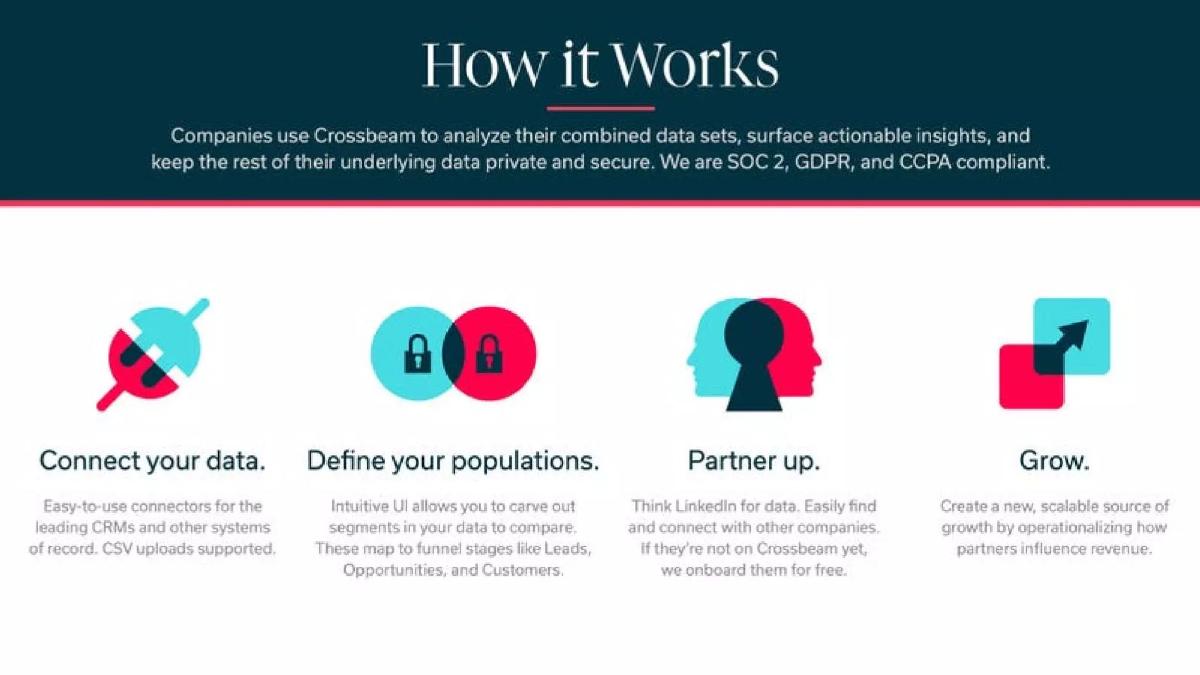
Software that lets companies compare customer lists with partners. The slide is the product's "How it Works" slide.
Crossbeam deck, slide 6. Exact stored slide matched to this analysis.
Our analysis: The privacy line sits in the product explanation because the product only works if companies trust it with each other's data. It connects the claim to the reason a buyer would ask.
Evidence and limitation: Three frameworks in one sentence, with no status, type (SOC 2 Type I or II) or date. The slide doesn't explain the mechanism behind "keep the rest ... private".
What a founder can adapt: When privacy is the reason the product can exist, say how the data is kept apart (what is shared, what never leaves the customer's account) as well as naming the standards.
Supporting analysis
What the deck claims: "Companies use Crossbeam to analyze their combined data sets, surface actionable insights, and keep the rest of their underlying data private and secure. We are SOC 2, GDPR, and CCPA compliant." Four steps: "Connect your data.", "Define your populations.", "Partner up.", "Grow."
Presentation choice: The privacy line sits in the product explanation because the product only works if companies trust it with each other's data. It connects the claim to the reason a buyer would ask.
When it does not fit: Three frameworks in one sentence, with no status, type (SOC 2 Type I or II) or date. The slide doesn't explain the mechanism behind "keep the rest ... private".
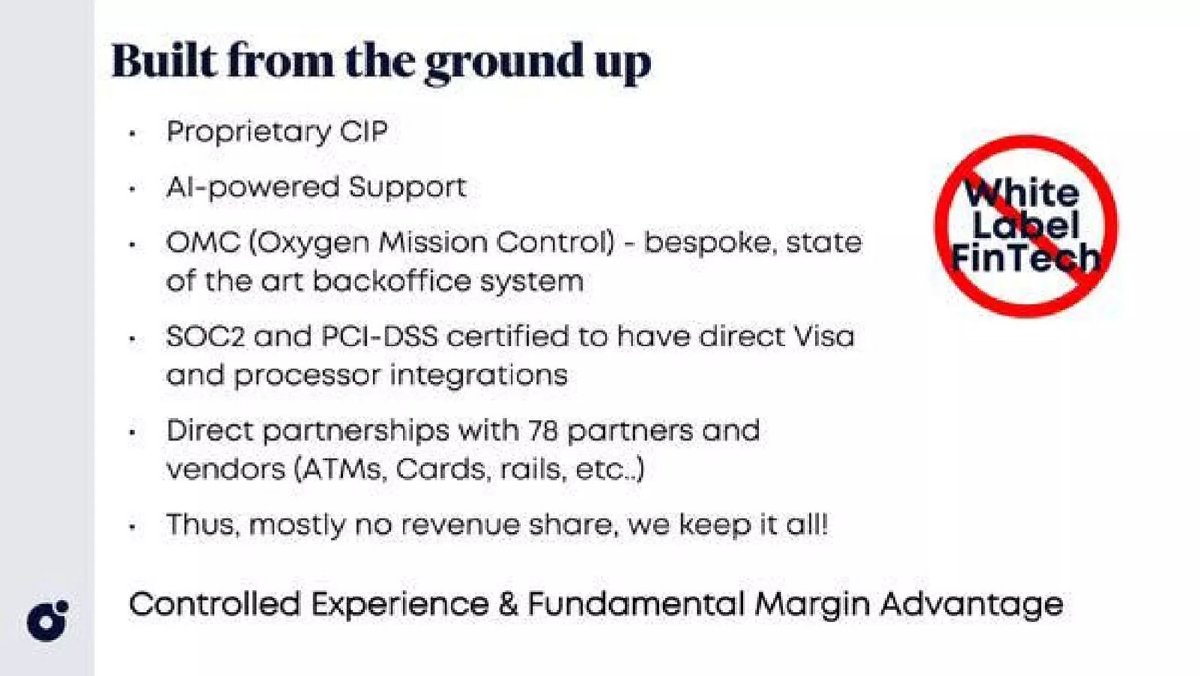
Consumer and small-business banking app. The slide argues it is not a white-label fintech.
Oxygen deck, slide 7. Exact stored slide matched to this analysis.
Our analysis: It is the only example that says what compliance unlocks: direct card-network and processor integrations, which the slide links to keeping revenue that a white-label provider would share.
Evidence and limitation: "Mostly no revenue share" and "margin advantage" have no figure. "SOC2 ... certified" uses certification language for what is an auditor's report, and PCI DSS status can rest on either an assessor's report or a self-assessment; say which, and when.
What a founder can adapt: Keep the chain from audit to access to economics, and put a number on the last step (the revenue share avoided).
Supporting analysis
What the deck claims: "Built from the ground up": "Proprietary CIP", "AI-powered Support", "OMC (Oxygen Mission Control) - bespoke, state of the art backoffice system", "SOC2 and PCI-DSS certified to have direct Visa and processor integrations", "Direct partnerships with 78 partners and vendors (ATMs, Cards, rails, etc..)", "Thus, mostly no revenue share, we keep it all!" Footer: "Controlled Experience & Fundamental Margin Advantage".
Presentation choice: It is the only example that says what compliance unlocks: direct card-network and processor integrations, which the slide links to keeping revenue that a white-label provider would share.
When it does not fit: "Mostly no revenue share" and "margin advantage" have no figure. "SOC2 ... certified" uses certification language for what is an auditor's report, and PCI DSS status can rest on either an assessor's report or a self-assessment; say which, and when.
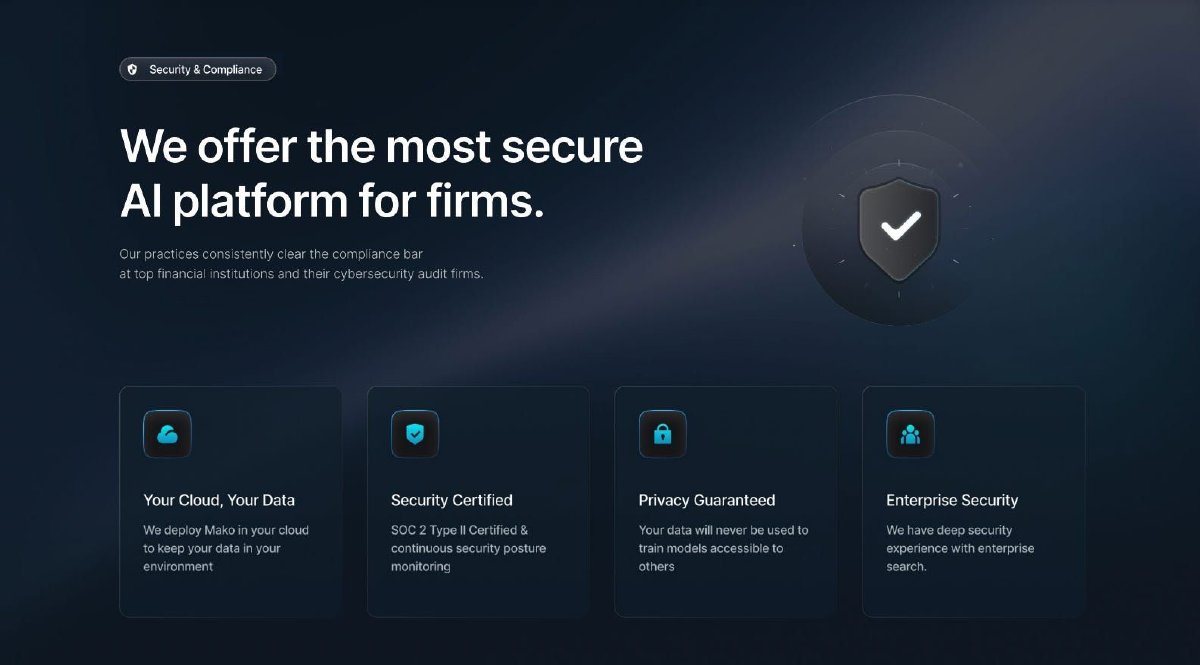
Mako deck, slide 8. Exact stored slide matched to this analysis.
Our analysis: It answers how data is handled, not only which badge exists: where the software runs and what the data will not be used for, the two questions an AI buyer in finance asks first.
Evidence and limitation: "Most secure" and "guaranteed" are unmeasured. The slide names no institution, auditor or date, so "consistently clear the compliance bar" is the company's claim.
What a founder can adapt: Keep the data-handling statements, and support "clear the compliance bar" with a count of security reviews passed or the named type of institution.
Supporting analysis
What the deck claims: "Security & Compliance". "We offer the most secure AI platform for firms." "Our practices consistently clear the compliance bar at top financial institutions and their cybersecurity audit firms." Four boxes: "Your Cloud, Your Data" ("We deploy Mako in your cloud to keep your data in your environment"); "Security Certified" ("SOC 2 Type II Certified & continuous security posture monitoring"); "Privacy Guaranteed" ("Your data will never be used to train models accessible to others"); "Enterprise Security".
Presentation choice: It answers how data is handled, not only which badge exists: where the software runs and what the data will not be used for, the two questions an AI buyer in finance asks first.
When it does not fit: "Most secure" and "guaranteed" are unmeasured. The slide names no institution, auditor or date, so "consistently clear the compliance bar" is the company's claim.
Connected orthopedic brace (scoliosis) with a patient app.
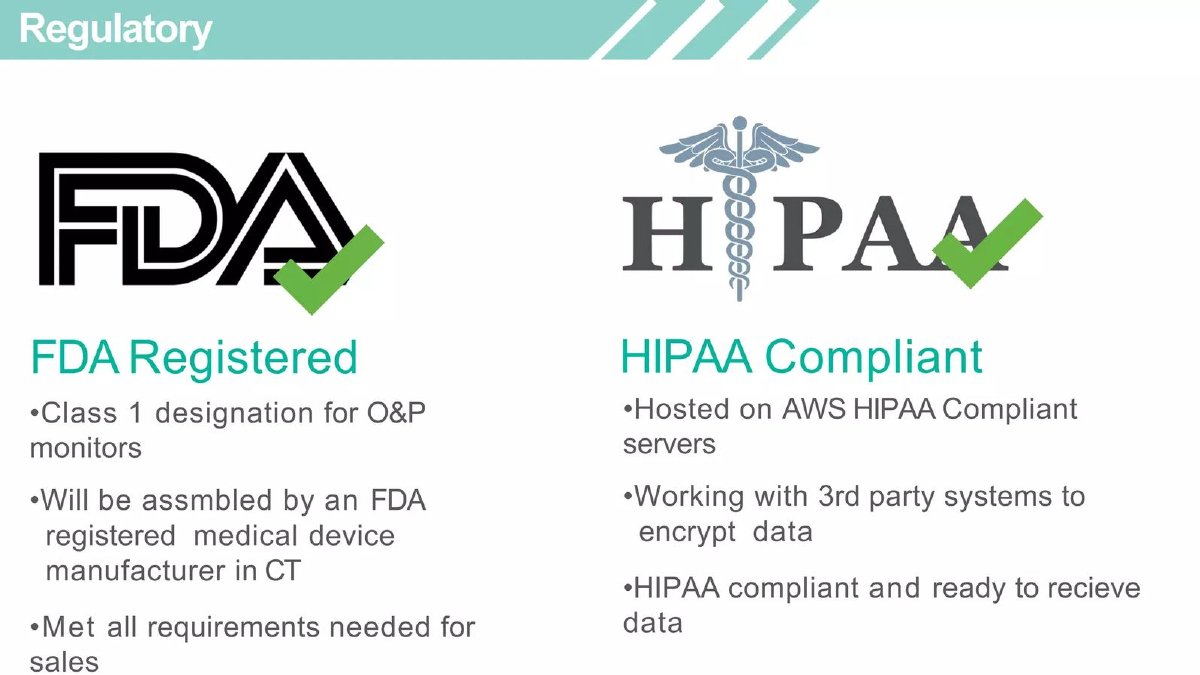
Wellinks deck, slide 15. Exact stored slide matched to this analysis.
Our analysis: It keeps two different questions apart: whether the device may be sold, and whether patient data is protected. Each column gives a basis for its claim.
Evidence and limitation: Hosting on HIPAA-eligible cloud servers does not by itself make a company compliant. FDA says registration and listing do not denote approval or clearance, so "FDA Registered" and "Met all requirements needed for sales" are the company's statements about its device status. "Ready to receive data" describes readiness before patient data flows, not an operating record, and "will be assembled" is a plan.
What a founder can adapt: Split your regulatory and data columns the same way, and for data name the concrete controls (hosting agreement, encryption, access logging).
Supporting analysis
What the deck claims: "Regulatory", two columns. "FDA Registered": "Class 1 designation for O&P monitors", "Will be assmbled by an FDA registered medical device manufacturer in CT", "Met all requirements needed for sales". "HIPAA Compliant": "Hosted on AWS HIPAA Compliant servers", "Working with 3rd party systems to encrypt data", "HIPAA compliant and ready to recieve data".
Presentation choice: It keeps two different questions apart: whether the device may be sold, and whether patient data is protected. Each column gives a basis for its claim.
When it does not fit: Hosting on HIPAA-eligible cloud servers does not by itself make a company compliant. FDA says registration and listing do not denote approval or clearance, so "FDA Registered" and "Met all requirements needed for sales" are the company's statements about its device status. "Ready to receive data" describes readiness before patient data flows, not an operating record, and "will be assembled" is a plan.
Interactive media company planning to add healthcare sales. The slide is a three-year plan.
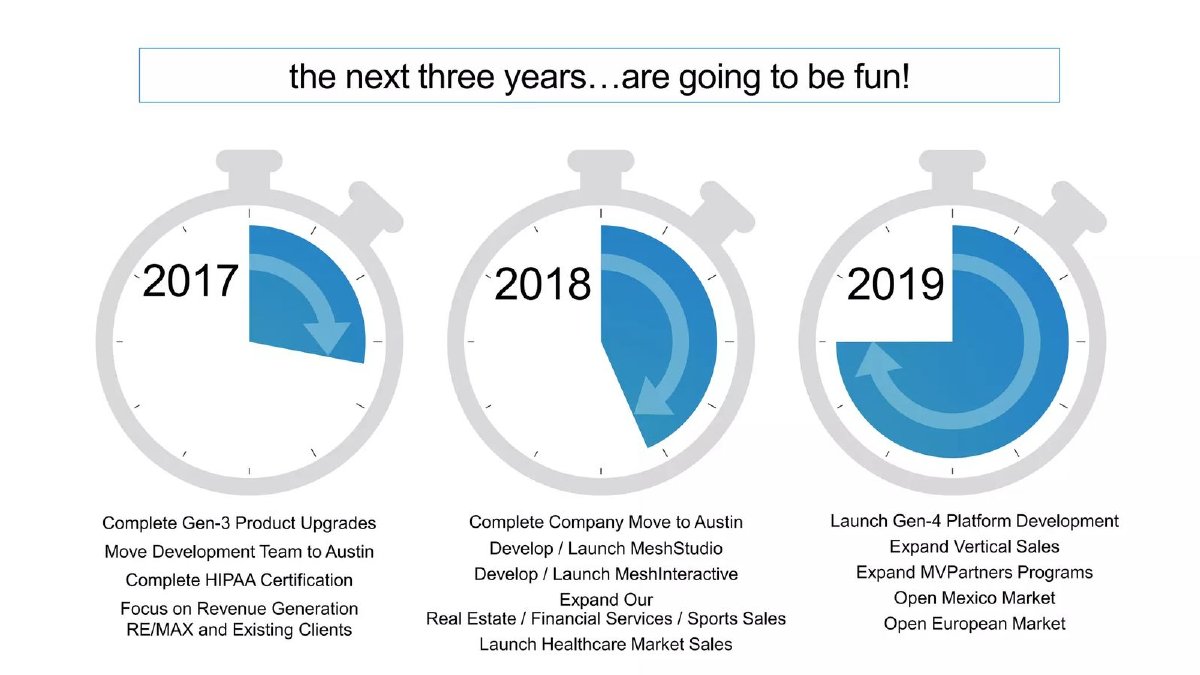
MeshWorks Media deck, slide 25. Exact stored slide matched to this analysis.
Our analysis: It places the compliance step before the healthcare launch that depends on it, which is the right order.
Evidence and limitation: HIPAA has no government certification and HHS does not recognise private ones, so the milestone has no official finish line as written. The slide doesn't say what healthcare customers will require.
What a founder can adapt: Replace "certification" with the concrete work (risk assessment, policies, business associate agreements, an outside assessment) and a quarter, so progress can be checked.
Supporting analysis
What the deck claims: "the next three years...are going to be fun!" 2017: "Complete Gen-3 Product Upgrades", "Move Development Team to Austin", "Complete HIPAA Certification", "Focus on Revenue Generation RE/MAX and Existing Clients". 2018 includes "Launch Healthcare Market Sales". 2019: "Open Mexico Market", "Open European Market".
Presentation choice: It places the compliance step before the healthcare launch that depends on it, which is the right order.
When it does not fit: HIPAA has no government certification and HHS does not recognise private ones, so the milestone has no official finish line as written. The slide doesn't say what healthcare customers will require.
Voice AI company (Data Astra Voice Pvt Ltd). The slide is a text-only page near the end of the deck.
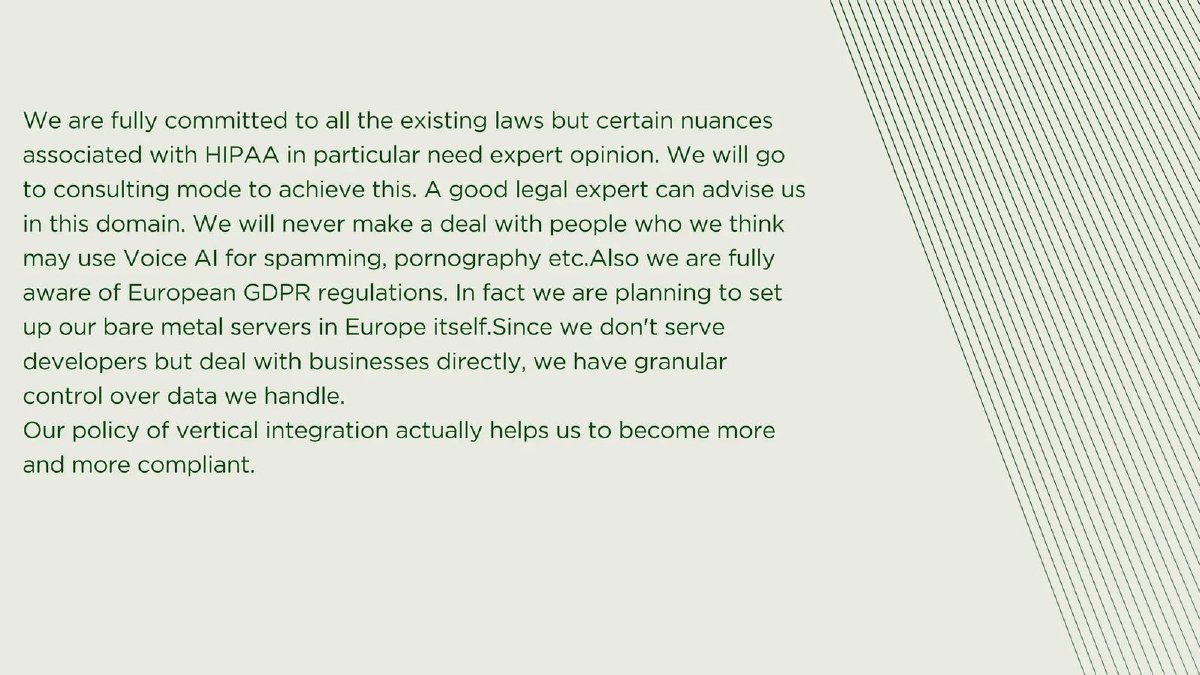
Dataastra deck, slide 23. Exact stored slide matched to this analysis.
Our analysis: It is the only example that admits an open gap and names a response (legal advice, European servers), which is more credible than an unexplained "compliant".
Evidence and limitation: No date, owner or budget is given for the legal review or the European servers, and "fully committed" and "fully aware" are not controls.
What a founder can adapt: Turn each intention into a dated step with an owner: which adviser, by when, and which servers in which country.
Supporting analysis
What the deck claims: "We are fully committed to all the existing laws but certain nuances associated with HIPAA in particular need expert opinion. We will go to consulting mode to achieve this. A good legal expert can advise us in this domain. We will never make a deal with people who we think may use Voice AI for spamming, pornography etc. Also we are fully aware of European GDPR regulations. In fact we are planning to set up our bare metal servers in Europe itself. Since we don't serve developers but deal with businesses directly, we have granular control over data we handle."
Presentation choice: It is the only example that admits an open gap and names a response (legal advice, European servers), which is more credible than an unexplained "compliant".
When it does not fit: No date, owner or budget is given for the legal review or the European servers, and "fully committed" and "fully aware" are not controls.
"Yes" means the slide states it; it does not mean an audit or control was verified.
Example
Standard named
Status stated
Data handling explained
Business effect
Asseta
SOC 2 Type II
"Compliant", no auditor or date
No
Buying reason
Crossbeam
SOC 2, GDPR, CCPA
"Compliant", no type or date
In general terms
Product depends on trust
Oxygen
SOC 2, PCI-DSS
"Certified", no date
No
Direct Visa integrations, margin
Mako
SOC 2 Type II
"Certified", no auditor or date
Yes: your cloud, no training use
Clears bank reviews (claimed)
Wellinks
HIPAA (plus FDA)
"Compliant and ready"
Hosting and encryption
Says sales requirements met (FDA column)
MeshWorks Media
HIPAA
Planned for 2017
No
Precedes healthcare sales
Dataastra
HIPAA, GDPR
Open, advice needed
EU servers planned
No
Key Takeaways
State the status, not only the badge. "SOC 2 Type II compliant" (Asseta) doesn't say who audited it, when, or what systems were covered.
Tie privacy to why the product needs the data. Crossbeam puts its compliance line in the sentence explaining that partners' data is combined but kept private.
Say what compliance unlocks. Oxygen links SOC 2 and PCI-DSS to direct Visa and processor integrations, and those to keeping revenue without a share.
Explain the data handling. Mako's deploy-in-your-cloud and no-training promise answers a buyer's first question more directly than a badge does.
Keep product regulation and data rules apart. Wellinks puts FDA registration and HIPAA in separate columns with separate evidence.
Use the right word for the framework. HHS does not recognise private HIPAA "certifications", so MeshWorks' "Complete HIPAA Certification" needs a concrete step behind it.
An open gap stated plainly is better than a vague claim. Dataastra names what it doesn't yet know about HIPAA and how it will get advice.
Write your privacy and security line
One row per standard or law your buyers ask about.
Standard. Which standard or law, and which type (SOC 2 Type I or II, ISO 27001, PCI-DSS level, HIPAA, GDPR)?
Status. Report received (auditor, date, period, scope), self-assessed, in progress, or planned (by when)?
Data handling. Where is data stored, who can access it, is it encrypted, is it used for training, which subprocessors hold it?
Unlocks. Which customers, partners or integrations require it, and how many deals depend on it?
Copyable framework: [Standard]: [status, auditor, date]. Data is [stored where], [encrypted], [never used for X]. Required by [customer type]; [n] deals in pipeline depend on it. Next: [step] by [date].
Illustrative example 1 — written by us
Before: SOC 2 compliant.
After: SOC 2 Type I report received in March; Type II audit period runs to September. Customer data stays in the customer's cloud and is never used for training. Required by 4 of our 6 bank pilots.
What improved: Our illustrative rewrite, not any company's text or figures. It turns a badge into a dated status, a data-handling statement and a business reason.
What this guide adds
The cybersecurity guides cover companies whose product is security; the cybersecurity traction guide shows Portnox's SOC 2 badge as buyer trust evidence. The regulatory guide covers approvals and pathways for regulated products. The technology guide separates owned, licensed, granted and pending intellectual property. None of them explains how a company whose product is not security should show its privacy and security position: which standard, what status, how data is handled and what it enables. That is the question here.
Four things a privacy and security line can state
This is our editorial framework, not something any one slide below contains in full. Standard or law: SOC 2 (Type I or Type II), ISO 27001, PCI-DSS, HIPAA, GDPR, CCPA or a sector rule. Status: an independent audit report received (with auditor and date), a self-assessment, an audit in progress, or a plan with a date. Data handling: where data is stored, who can access it, whether it is encrypted, whether it is used to train models, and which subprocessors hold it. What it unlocks: the customers, partners or integrations that require it.
Words matter. A SOC 2 engagement produces an independent auditor's report, not a certificate: Type I covers the design of controls at a point in time, Type II also covers how they operated over a stated period. ISO 27001 certificates are issued by certification bodies. PCI DSS compliance is validated either by an assessor's Report on Compliance or, where the card brands allow it, by the company's own Self-Assessment Questionnaire and Attestation of Compliance; the PCI Security Standards Council does not certify companies. HIPAA is a US law with no government certification; HHS says it does not recognise private organisations' HIPAA "certifications". GDPR allows voluntary approved certification schemes (Article 42), but such a certificate does not by itself establish compliance. FDA registration and device listing are not FDA approval or clearance. "Compliant" or "certified" on a slide is the company's own statement unless the slide names the audit, assessor or scheme.
What the slides here leave out
None of the seven names an auditor, a report date, the audit scope or the period a Type II report covers. None says which customers asked for the audit or how many deals it affected. If you have these, they are what turns a badge into evidence.
Common mistakes
A badge with no status. "Compliant" without auditor, date or scope is a claim, not evidence.
Certification language for laws. HIPAA has no government certification and a GDPR certificate alone does not prove compliance; say what you did.
Hosting treated as compliance. A compliant cloud provider covers its part, not yours.
Superlatives instead of controls. "Most secure" and "guaranteed" say nothing an investor can check.
No link to revenue. Say which customers or integrations require the audit.
Diagnostic checklist
Each standard or law is named, with its type.
Status is stated: report received (auditor, date, scope), in progress or planned (date).
Data storage, access and use are explained in one or two lines.
Product regulation and data rules are kept separate.
What compliance unlocks is stated, with a number if possible.
Open gaps are named with the next step and a date.
Frequently asked questions
How we chose these examples
Corpus: published pitch deck teardowns on StartupFundraising.com. Founder-uploaded private decks are excluded.
Selection (2026-09-29): we searched saved slide text and the private research text index for SOC 2, HIPAA, GDPR and ISO 27001 paired with status words (compliant, certified, audit, in progress), excluding decks from companies whose product is security or privacy, which the cybersecurity guides cover. From the matches we inspected the original pages for Asseta (10), Crossbeam (6), Oxygen (7), Mako (8), Wellinks (15), MeshWorks Media (25) and Dataastra (23).
Images: all seven pages come from the original public deck files, whose checksums matched our saved records (Asseta 11 pages, Crossbeam 22, Oxygen 16, Mako 9, Wellinks 21, MeshWorks Media 29, Dataastra 25), and were matched to company and page on 2026-09-29 (editorial model review). Crossbeam's stored image already existed and was compared with the original page. No person has yet completed an editorial review of this page.
AI editorial review (2026-09-30, not a human review): each HIPAA, GDPR, SOC 2, PCI DSS and FDA statement was checked against the exact slide wording and against the regulator or standards body sources listed below. Corrections: PCI DSS can be validated by self-assessment; GDPR has voluntary Article 42 certification; FDA registration is not approval; Wellinks' sales readiness is shown as its own claim; SOC 2 wording now says what Type I and Type II cover.
The four-part framework and the notes on audit terminology are our editorial template. We make no claim about any company's actual audit or compliance status beyond what its slide states.