Crossbeam's Series A deck is a masterclass in category creation and narrative framing. The company identifies a specific friction point in B2B collaboration—the 'Prisoner's Dilemma' of data sharing—and proposes a technical solution: a secure escrow platform. With 22 slides, the deck moves from high-level game theory to granular product mechanics and impressive early traction. Despite being only two quarters post-launch at the time of the Q2 2019 overview, the deck demonstrates a 90% reduction in onboarding time and a rapidly growing funnel of 65 all-time registrants. The team's pedigree, feat…
Key takeaways
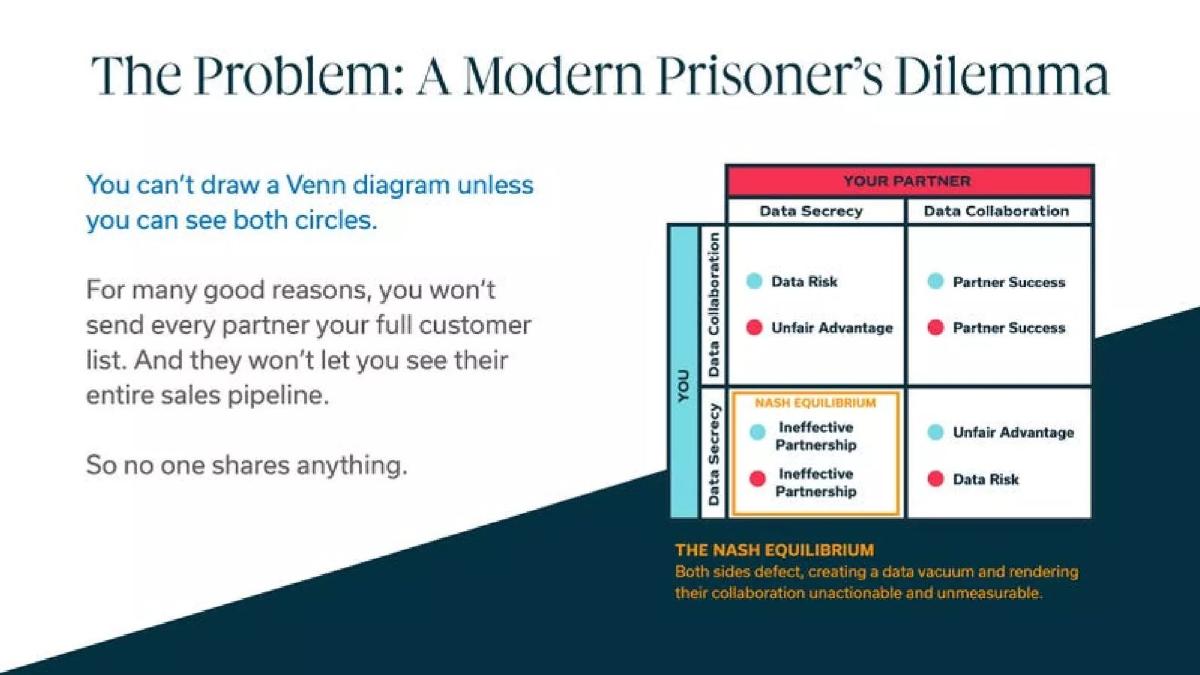
- The deck uses game theory to frame the problem as a 'Modern Prisoner's Dilemma' where data secrecy leads to ineffective partnerships (Slide 3).
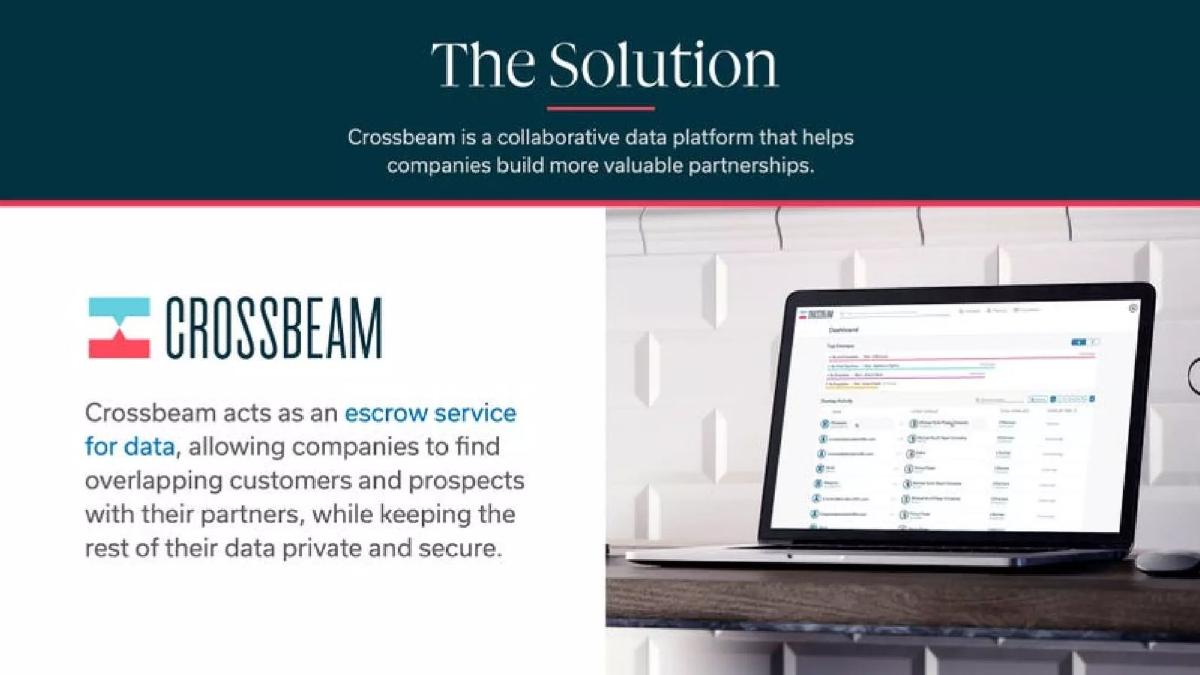
- Crossbeam positions itself as an 'escrow service for data,' allowing companies to find overlapping customers without exposing full lists (Slide 5).
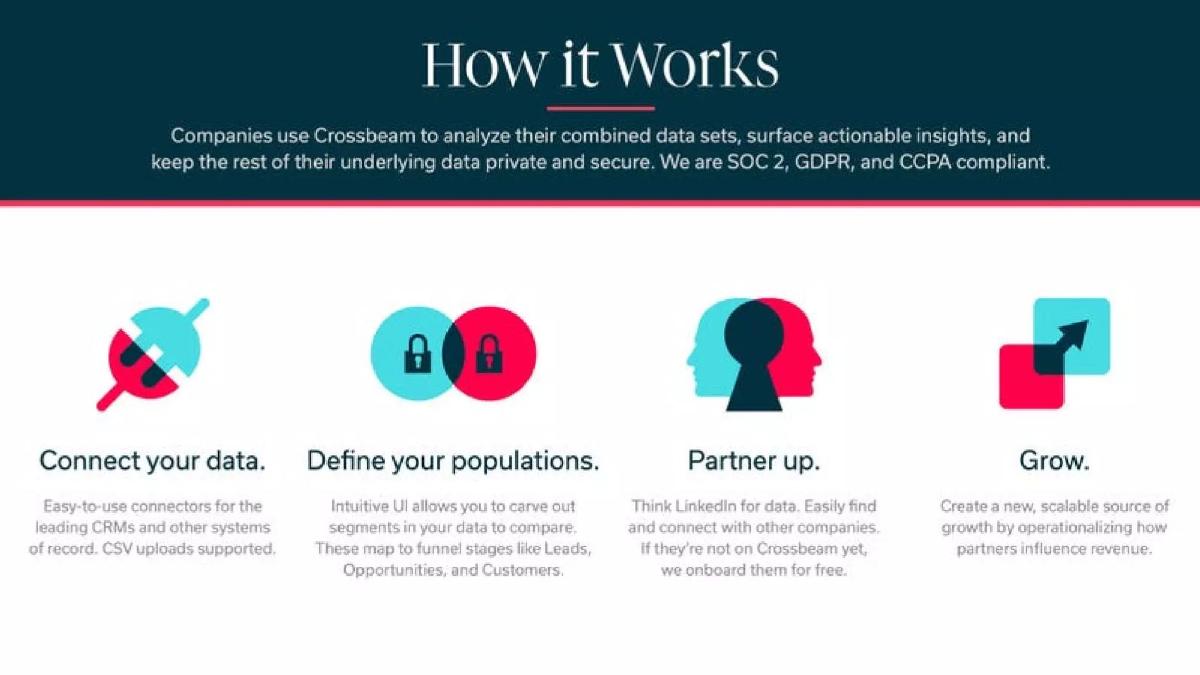
- The platform is SOC 2, GDPR, and CCPA compliant, addressing the primary hurdle of enterprise data security (Slide 6).
- The 'Why Now' slide cites the maturity of the API economy and the saturation of previous-generation sales enablement tools as key drivers (Slide 9).
- Crossbeam distinguishes itself from traditional Partner Relationship Management (PRM) by focusing on data-driven 'Partner Success' (Slide 12).
- Early traction shows 'Actual' signups significantly exceeding 'Goal' projections by Q2 2019 (Slide 17).
- Onboarding efficiency improved by over 90% between Q4 2018 and Q2 2019 (Slide 18).
- The funnel analysis reveals a 48% conversion rate from registration to data connection (Slide 19).
The Narrative of Data Escrow
Crossbeam’s Series A deck is a clinical example of how to frame a technical solution within a broader economic and psychological context. By the time the reader reaches the product slides, the 'Prisoner's Dilemma' of data sharing has been established as a multi-billion dollar friction point. The deck, dated as a Q2 2019 Overview, serves as the foundation for their $12.5M raise in 2020. It is structured to move from abstract theory to concrete utility, ending with the proof that the market is responding to this new category of 'Partner Success' software.
The Problem and Economic Cost (Slides 1-4)
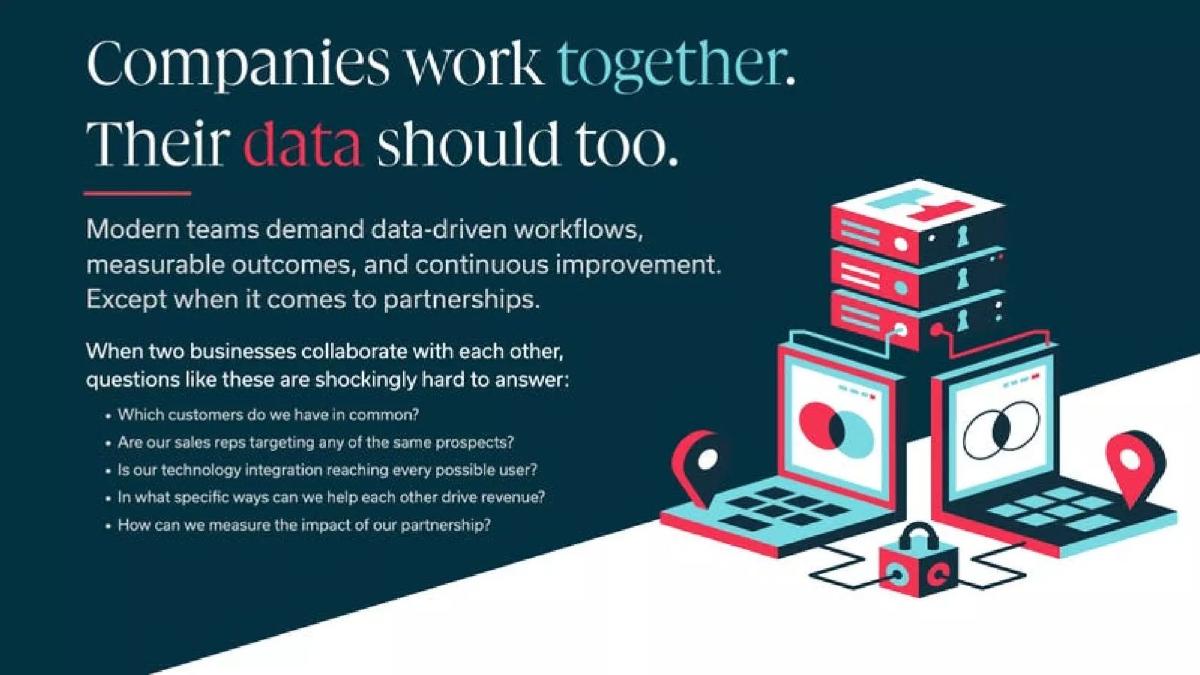
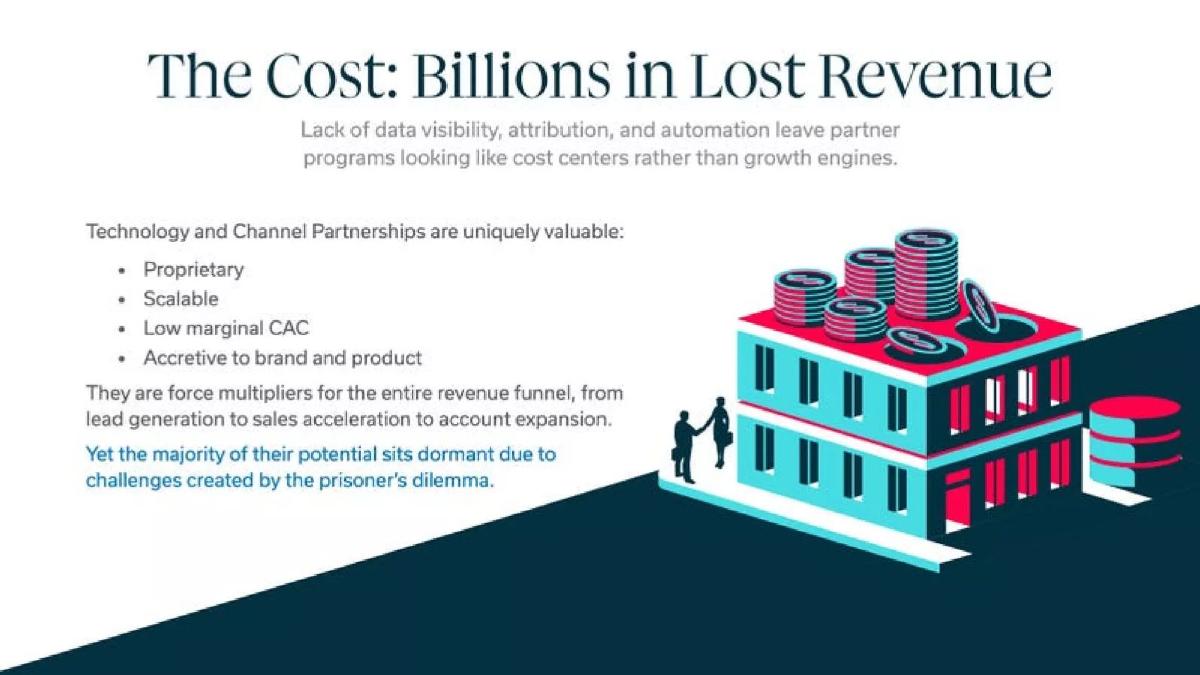
The deck opens with a high-concept cover slide featuring an isometric city connected by data lines. Slide 2 immediately hits the value proposition: 'Companies work together. Their data should too.' It lists five 'shockingly hard to answer' questions regarding common customers, prospect targeting, and revenue impact. This sets the stage for Slide 3, which is perhaps the most famous slide in the deck. It uses a 2x2 matrix to illustrate 'The Problem: A Modern Prisoner's Dilemma.' It argues that because companies fear 'Data Risk' or giving an 'Unfair Advantage,' they default to 'Data Secrecy,' resulting in an 'Ineffective Partnership.' This is the Nash Equilibrium they aim to break. Slide 4 quantifies this as 'Billions in Lost Revenue,' noting that partnerships are currently seen as cost centers rather than growth engines due to a lack of visibility.
The Solution and Product Mechanics (Slides 5-8)
Slide 5 introduces Crossbeam as an 'escrow service for data.' This is a powerful analogy because it implies safety, neutrality, and a specific transaction. The slide includes a laptop mockup showing the dashboard. Slide 6, 'How it Works,' outlines a four-step process: Connect data, Define populations, Partner up, and Grow. Crucially, it mentions SOC 2, GDPR, and CCPA compliance in the sub-header—a non-negotiable for enterprise data tools. Slide 7 details common use cases: Partner Qualified Leads, Account Mapping, and Channel Conflict Avoidance. These are the 'jobs to be done' that justify the software's seat in the revenue stack. Slide 8 is a simple transition slide to the Market Landscape section.
Market Strategy and Category Creation (Slides 9-13)
Slide 9, 'Why Now,' uses a Venn diagram to show the intersection of product trends (API economy, cloud warehousing) and market trends (SaaS adoption, compliance scrutiny). Slide 10 defines the user personas, ranging from VP-level buyers to line-level dealmakers. Slide 11 maps the 'Addressable Market,' starting with a core focus on B2B SaaS (tens of thousands of companies) and radiating out to B2C Tech and vertical markets like healthcare (millions of companies). Slide 12 is a classic 'Us vs. Them' slide, distinguishing Crossbeam from traditional PRM (Partner Relationship Management). It positions PRM as manual and 'forms driven,' while Crossbeam is 'data driven' and automated. Slide 13, 'Thought Leadership Opportunity,' outlines their 'Category Creation Playbook,' which includes leveraging CEO Bob Moore’s resume and building microsites like PartnerBase.io.
Traction and Operational Progress (Slides 14-20)
Slide 14 transitions into 'Company Progress.' Slide 15 lists Mission, Vision, and Values, established in July 2018. Slide 16 highlights that the platform launched in January 2019 and is 'First-of-its-Kind,' listing features like an ETL layer and Salesforce integration. Slide 17 shows a 'Company Signups' chart where the 'Actual' red line is steeply outperforming the 'Goal' blue bars, reaching 100 companies by Q2 2019. Slide 18, 'Onboarding Acceleration,' is a standout traction slide. It shows that the average onboarding time dropped by over 90% from Q4 2018 to Q2 2019, proving the product is becoming more self-service and scalable. Slide 19 breaks down the 'Key Funnel Stages,' showing 65 all-time registrants and a high 85% conversion from 'Partnership Established' to 'Data Shared.' Slide 20 attributes growth to 'Inbound Growth & Network Effects,' showing that network effects are already their second-largest source of new opportunities.
Team and Contact (Slides 21-22)
Slide 21, 'A Team Built to Scale,' features five key members. The pedigree is high: CEO Bob Moore and CTO Buck Ryan were both previously at RJMetrics (acquired by Magento) and Stitch Data (acquired by Talend). This history of building and exiting data-centric startups is a major de-risking factor for investors. The deck concludes on Slide 22 with contact information and a final isometric graphic of the product's data-crunching capabilities.
What Works
The 'Escrow' Analogy: By calling themselves an escrow service, Crossbeam bypasses a long explanation of their security architecture. It immediately communicates the value: 'We hold the data so you don't have to trust each other; you only have to trust us.' · The Nash Equilibrium Frame: Using game theory to describe a business problem makes the solution feel inevitable and intellectually grounded. It elevates the pitch from a 'tool' to a 'structural necessity.' · Onboarding Velocity: Showing a 90% reduction in onboarding time (Slide 18) is a powerful way to demonstrate product maturity and operational excellence in a short period. · Network Effect Proof: Slide 20 explicitly charts 'Crossbeam Network Effects' as a lead source, proving that the platform becomes more valuable (and easier to sell) as more companies join.
What is Missing
Pricing and Business Model: The deck is entirely silent on how Crossbeam makes money. While common in early-stage 'land and expand' plays, a Series A deck usually hints at the monetization strategy (e.g., seat-based, volume-based, or freemium). · Competitor Names: While Slide 12 differentiates the company from the PRM category, it does not name specific competitors or address other emerging 'account mapping' tools that existed at the time. · Financial Projections: There are no slides detailing burn rate, revenue targets, or how the $12.5M will be allocated. The 'Ask' is also missing from the slides themselves.
What a Founder Should Copy
The Funnel Conversion Slide (Slide 19): This is an exceptionally clear way to show where users drop off. By showing high conversion rates in the middle and bottom of the funnel, they prove that once a company 'gets' the value, they stay. · The 'Why Now' Slide (Slide 9): Instead of just listing market size, Crossbeam explains the technical and regulatory shifts (GDPR, API maturity) that made their specific product possible only recently. · The Category Creation Playbook (Slide 13): For founders building in a new space, explicitly stating how you will win the 'thought leadership' battle is a great way to show strategic depth beyond just building features.
Frequently asked questions
- What is the core problem Crossbeam solves according to the deck?
- Crossbeam addresses the 'Prisoner's Dilemma' of data sharing in B2B partnerships. Companies want to collaborate but fear the risk of exposing proprietary customer lists or pipelines. This lack of transparency results in 'Billions in Lost Revenue' because partnerships remain unmeasurable and unactionable. Crossbeam acts as a neutral third party to find data overlaps safely.
- How does Crossbeam differentiate itself from PRM software?
- According to slide 12, traditional PRM (Partner Relationship Management) is forms-driven, focused on contact management, and manual lead registration. Crossbeam defines its category as 'Partner Success,' which is data-driven, automated, and focused on attribution, measurement, and discovery through direct data integration rather than manual entry.
- What metrics does the deck use to prove product-market fit?
- The deck focuses on 'Company Signups' and 'Onboarding Acceleration.' Slide 17 shows they reached 100 registered companies by Q2 2019, far exceeding their goal of approximately 35. Slide 18 highlights a 90% reduction in onboarding time, and slide 19 shows a healthy funnel where 22 out of 65 registrants have reached the 'Data Shared' stage.
- Who are the target users for the Crossbeam platform?
- Slide 10 identifies three personas: the 'Buyer and Owner' (Partnership Org Leaders), 'Champions' (Revenue Team Leaders in Sales/Marketing), and 'End Users' (Dealmakers/Line-level reps). The addressable market starts with B2B SaaS but expands to B2C Tech and vertical markets like healthcare and manufacturing (Slide 11).
- What is the 'Category Creation Playbook' mentioned in the deck?
- Slide 13 outlines a strategy to fill the 'thought leadership void' in partnerships. This includes building a captive audience, developing a specific point of view, leveraging CEO Bob Moore's reputation, using microsites like PartnerBase.io for SEO, and gaining strategic guidance from advisors like Gainsight CEO Nick Mehta.