Crowd Equity Capital’s introduction deck outlines a strategy to capitalize on the post-2008 funding gap by merging digital equity crowdfunding with physical co-working incubators. The presentation relies heavily on macro-market data from 2009 to 2015, citing a $1.2 trillion addressable market opportunity identified by Goldman Sachs. While the deck establishes strong founder credibility through Daryl Greco’s extensive financial career dating back to the 1970s and Dario Zaccagnini’s IT background, it lacks critical operational details. There are no slides detailing unit economics, specific geog…
Key takeaways
- The company identifies a $1.2 trillion addressable market for crowdfunding based on a 2015 Goldman Sachs report (Slide 2).
- The business model is a hybrid of a digital equity platform and physical co-working incubator spaces (Slide 3).
- Founders claim a competitive advantage through ownership of a licensed EU financial services company (Slide 2).
- The deck explicitly acknowledges risks including a 'crowded' landscape and a potential real estate asset bubble (Slide 4).
- Founder Dario Zaccagnini is credited with founding a digital advertising company in 2000 to support the platform's tech needs (Slide 5).
- Leader Daryl Greco has a financial career spanning back to the 1970s at the Toronto Stock Exchange (Slide 6).
- The deck lacks a specific funding ask, revenue projections, or a product roadmap (Omitted).
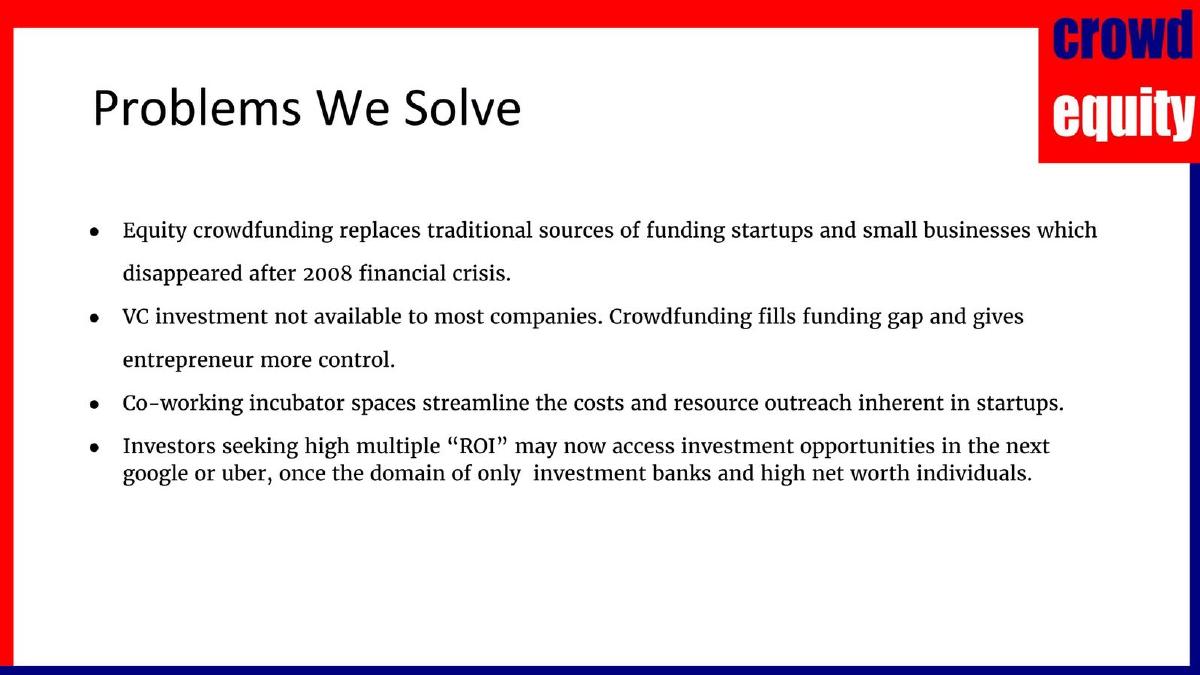
- The strategy targets the 'funding gap' left by traditional banks and VCs for small businesses after 2008 (Slide 3).
Introduction and Vision
Crowd Equity Capital LLC positions itself at the intersection of two major trends: the democratization of venture investing via crowdfunding and the rise of co-working spaces as startup hubs. The title slide introduces the company with the tagline, "The space where entrepreneurs capitalize and investors monetize." This suggests a two-sided marketplace approach, serving both the capital-seekers and the capital-providers.
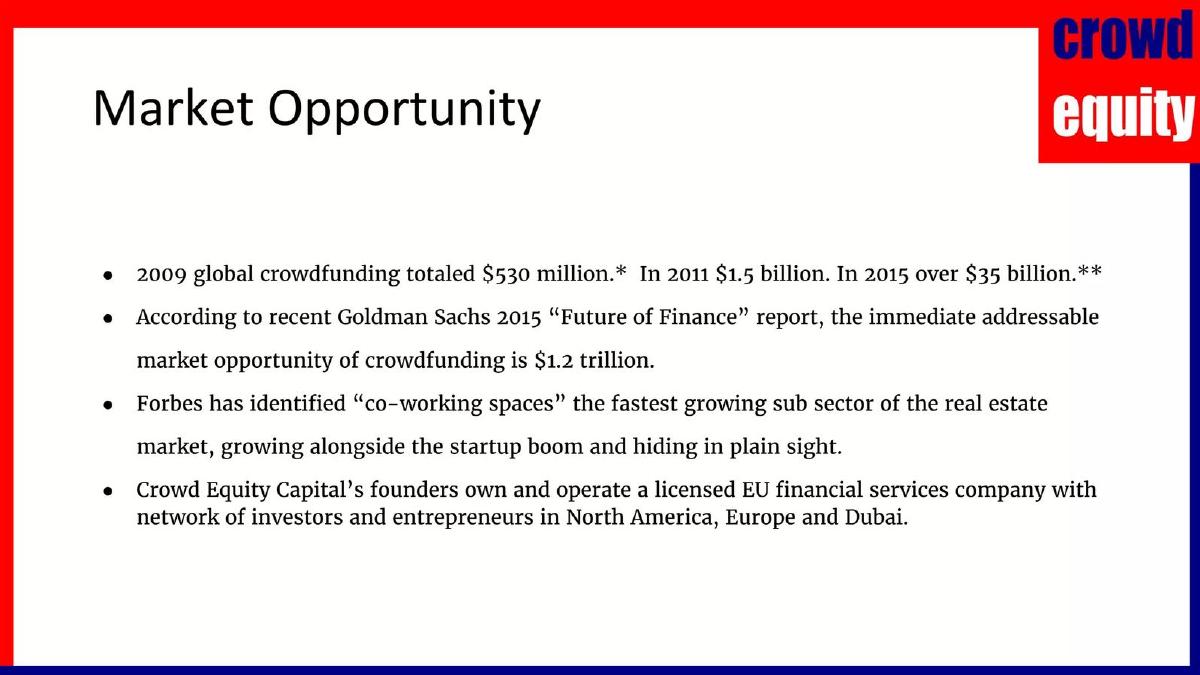
Slide 2: Market Opportunity
This slide focuses on the macro-economic tailwinds supporting the business. It cites specific growth figures: global crowdfunding totaled $530 million in 2009, $1.5 billion in 2011, and over $35 billion in 2015. The slide leverages institutional credibility by quoting a Goldman Sachs 2015 "Future of Finance" report, which estimates the immediate addressable market at $1.2 trillion . Additionally, it references Forbes to validate co-working as the fastest-growing sub-sector of real estate. Crucially, the final bullet point mentions that the founders already operate a licensed EU financial services company with networks in North America, Europe, and Dubai, which serves as the foundation for their global ambitions.
Slide 3: Problems We Solve
The company frames its existence as a response to the 2008 financial crisis. They argue that traditional funding for startups and small businesses disappeared during this period. The slide identifies three specific pain points: the lack of VC availability for most companies, the high costs and resource outreach challenges for startups (solved by co-working incubators), and the restricted access to high-ROI opportunities like "the next google or uber" for non-institutional investors. By positioning crowdfunding as a replacement for traditional banking, they frame the platform as a necessity rather than a luxury.
Slide 4: Risks
In a rare move for an introductory deck, the company includes a dedicated Risks slide. They acknowledge that the equity crowdfunding landscape is "becoming crowded" and that finding quality investors is a larger challenge than finding startups. They also note that a "Real estate asset bubble could effect location expansion plan," acknowledging the capital-intensive nature of their co-working model. Finally, they mention the "reputational risk posed by unsuccessful campaigns," which is a significant concern for any platform that curated investment opportunities.
Slide 5: Competitive Advantage
The competitive advantage slide leans heavily on founder experience and regulatory positioning. The deck reiterates that the founders operate a "licensed EU financial services firm" and have a "global reach" due to their time working in North America, the EU, and Dubai. The slide also introduces Dario Zaccagnini, noting his background as an IT professional who founded a digital advertising company in 2000. This is intended to show that the company has both the financial regulatory expertise and the technical capability to build a digital platform.
Slide 6: Leaders - Daryl Greco
This slide provides a deep dive into the profile of Daryl Greco. His resume includes roles in private equity, equities and debt, and as a securities trader. Notably, he is listed as a "money laundering reporting officer (MLRO)," a critical role for a regulated financial platform. His career began at the Toronto Stock Exchange in the 1970s , and he has worked in major financial hubs including London, Amsterdam, Madrid, and Dublin. A quote at the bottom of the slide emphasizes his personal commitment to the project, describing a "sea change in the global macro" over the past decade.
What Crowd Equity Capital Does Well
The deck is exceptionally strong at establishing regulatory credibility . In the world of equity crowdfunding, the legal right to facilitate trades is the highest barrier to entry. By repeatedly mentioning their licensed EU financial services firm, the founders signal to investors that they have already cleared the most difficult hurdle. The inclusion of a Risks slide also demonstrates a level of maturity and transparency that is often missing in early-stage pitches.
Furthermore, the deck does a good job of contextualizing the market . By using 2015-era data from Goldman Sachs and Forbes, the founders align themselves with the prevailing institutional sentiment of that time, making the business case feel like an inevitable evolution of finance rather than a speculative bet.
What is Missing from the Deck
Despite the strong founder bios, the deck is missing several critical components for a successful fundraise:
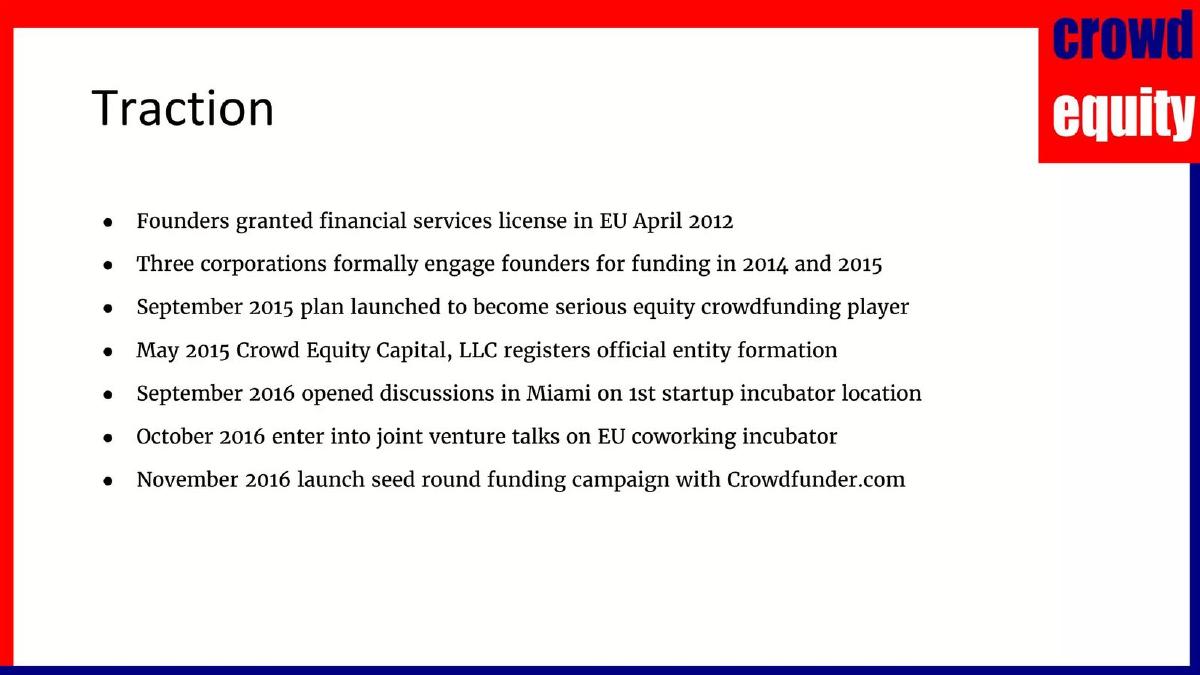
The Ask: There is no mention of how much capital is being raised, the valuation, or the intended use of funds. · Unit Economics: The deck mentions co-working spaces and a digital platform but does not explain the revenue model. Is it a percentage of funds raised? A monthly membership fee for the co-working space? A carry on the investments? · Product Visuals: For a company claiming a "digital platform" as a competitive advantage, there are no screenshots or mockups of the user interface. · Traction: While the founders have a background in finance, the deck does not list any current startups in their pipeline or any successful crowdfunding campaigns already completed under this specific brand. · The Rest of the Team: While Daryl Greco gets a full slide, the other founder, Dario Zaccagnini, is only mentioned in passing on the Competitive Advantage slide. A full team slide would provide a more balanced view of the leadership.
Founder Takeaways
Leverage your licenses: If your business operates in a regulated space (FinTech, MedTech, etc.), make your regulatory status a centerpiece of your pitch. Crowd Equity Capital does this effectively by mentioning their EU license on multiple slides.
Address macro shifts: The deck successfully ties the business model to a larger historical event (the 2008 crisis). This helps investors understand the "Why Now?" of the business.
Don't hide from risks: Including a risk slide can actually build trust with sophisticated investors. It shows you understand the market and are not just selling hype. However, always follow a risk slide with a slide or point on how you intend to mitigate those specific risks.
Balance macro and micro: While macro data (like the $1.2 trillion market) is good for setting the stage, investors need to see the micro-level execution plan. Ensure your deck moves quickly from "the world is changing" to "here is exactly how we make money tomorrow."
Frequently asked questions
- What is the primary business model of Crowd Equity Capital?
- Crowd Equity Capital operates a hybrid model. It combines a digital equity crowdfunding platform, which allows investors to access startup deals previously reserved for high-net-worth individuals, with physical co-working incubator spaces designed to streamline costs for the startups within their ecosystem.
- What regulatory advantages do the founders claim?
- According to Slide 2 and Slide 5, the founders own and operate a licensed EU financial services company. This is presented as a primary competitive advantage, as it provides the regulatory framework necessary to facilitate global equity transactions across North America, Europe, and Dubai.
- How does the deck define the market opportunity?
- The deck uses historical growth data, noting that global crowdfunding grew from $530 million in 2009 to over $35 billion in 2015. It further cites a Goldman Sachs 'Future of Finance' report claiming a $1.2 trillion immediate addressable market for the sector.
- Who are the key leaders mentioned in the deck?
- The deck highlights two leaders: Daryl Greco, a Managing Director with a background in private equity and debt dating back to the 1970s, and Dario Zaccagnini, an IT professional who founded a digital advertising company in 2000. Greco is also noted as a Money Laundering Reporting Officer (MLRO).
- What major risks does the company identify?
- The company identifies four main risks on Slide 4: a crowded equity crowdfunding landscape, the difficulty of engaging quality investors despite a growing startup pipeline, potential real estate bubbles affecting their co-working expansion, and reputational risks from unsuccessful campaigns.