Selectty Global Foods USA presents a roadmap for Mangoozers, a line of organic and conventional mango-based squeezable fruit pouches. The deck highlights a transition from private label roots in 2015 to a branded presence in retailers like HEB and Costco by 2019. While the brand identifies a clear market gap—moving beyond apple-based pouches to address 'sugar as the #1 enemy for moms'—the financials reveal significant headwinds. With negative gross profits across 2017, 2018, and 2019, the company sought a $500,000 investment for a 20% stock option. The deck serves as a case study in the high…
Key takeaways
- The company evolved from a private label business to its own brand, Mangoozers, starting in 2015 (Slide 2).
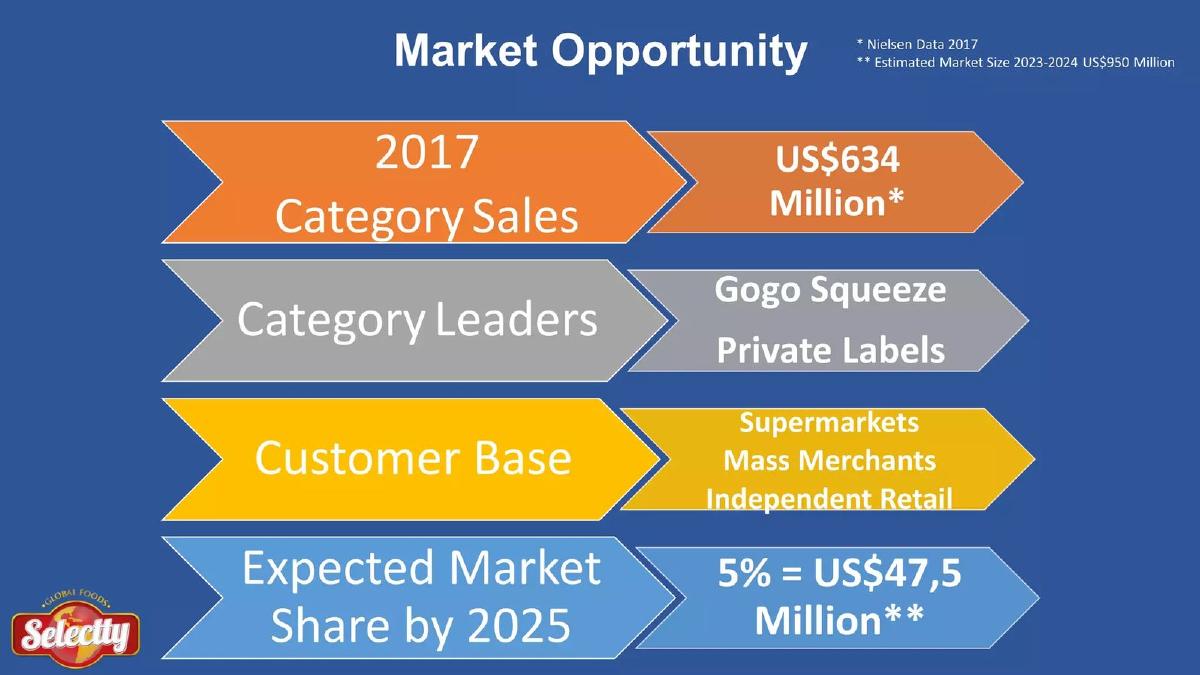
- Selectty targets a $634 million category, aiming for a 5% market share worth $47.5 million by 2025 (Slide 3).
- Strategic alliances are central to their model, citing CEA for mango puree and Fruselva for pouch co-packing (Slide 2).
- The product line includes both Organic and Conventional mango blends, featuring 'No Added Sugar' and 'Non-GMO' certifications (Slide 5).
- Financials show a declining revenue trend from $139,114.10 in 2018 to $75,529.97 in 2019 (Slide 7).
- The company operated with negative gross margins for three consecutive years, losing $134,463.75 on $75,529.97 of income in 2019 (Slide 7).
- The investment ask is $500,000 for a 20% stock option, implying a $2.5 million post-money valuation (Slide 9).
- The expansion strategy relies on a regional-to-national rollout, targeting Publix, Whole Foods, and Walmart by 2022 (Slide 6).
Selectty Pitch Deck Teardown
Selectty Global Foods USA presents a specialized entry into the Consumer Packaged Goods (CPG) space with Mangoozers. This teardown examines their 10-slide presentation, which focuses on the transition from a private label background to a branded retail contender in the fruit pouch category. The deck is notable for its transparency regarding early-stage financial struggles and its heavy reliance on third-party strategic partnerships.
Slide 1: Title and Branding
The cover slide features the Selectty Global Foods logo: a red and gold emblem set against a blue background with a globe graphic. The branding is traditional for the food industry, evoking a sense of established distribution rather than a modern 'direct-to-consumer' startup aesthetic. There is no tagline or mission statement on this slide, only the logo.
Slide 2: Our Journey So Far
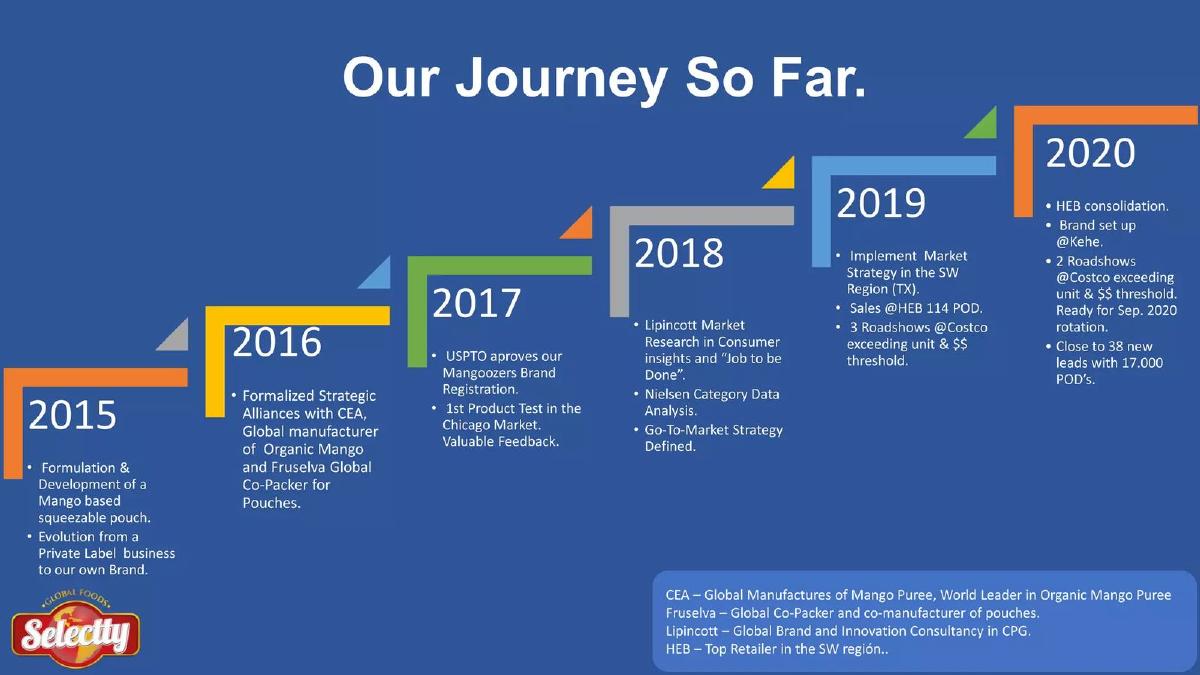
This slide uses a staircase graphic to detail the company's history from 2015 to 2020. Key milestones include:
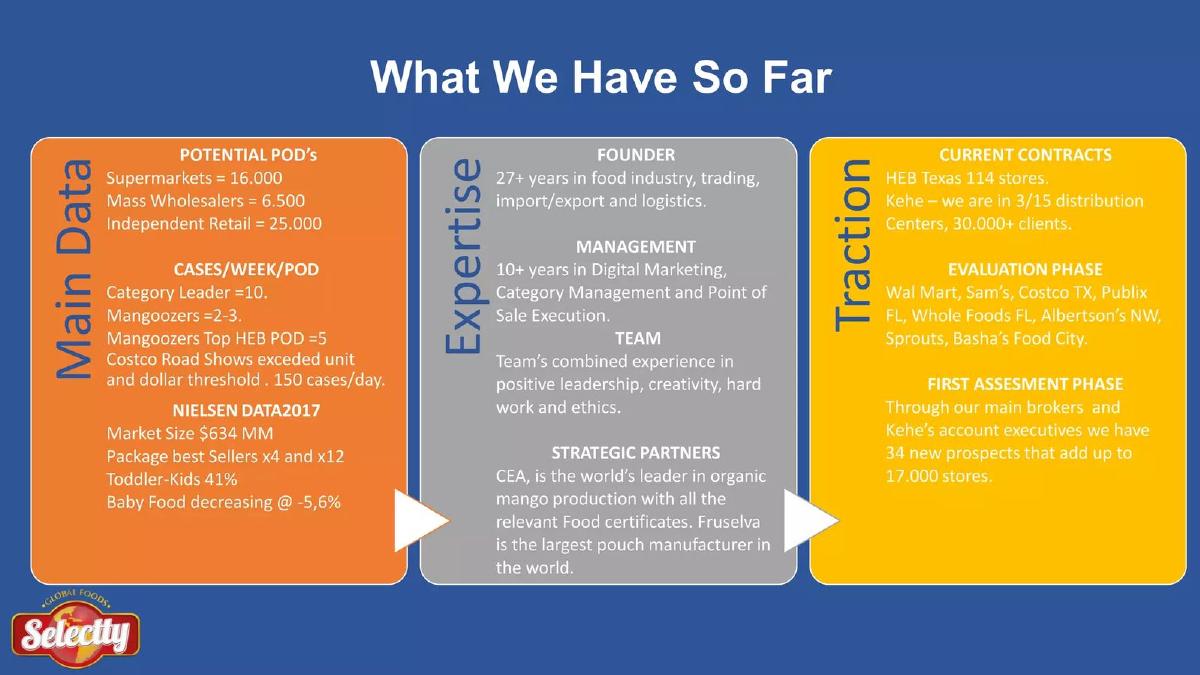
2015: Formulation of the mango pouch and evolution from private label to a proprietary brand. · 2016: Formalized strategic alliances with CEA (mango puree manufacturer) and Fruselva (co-packer). · 2017: USPTO approval for the Mangoozers brand and initial testing in the Chicago market. · 2018: Market research with Lippincott and Nielsen data analysis. · 2019: Launch in the Southwest region with sales at 114 HEB points of distribution (POD) and roadshows at Costco. · 2020: Brand setup at KeHE (distributor) and closing 38 new leads with 17,000 PODs.
The footnotes define their partners, positioning CEA as a 'World Leader in Organic Mango Puree' and HEB as a 'Top Retailer in the SW region.'
Slide 3: Market Opportunity
Selectty defines the market using 2017 Nielsen data. The category sales are listed at US$634 Million . They identify Gogo Squeeze and Private Labels as the leaders. The slide sets a target of 5% market share by 2025 , which they estimate to be worth US$47.5 Million . This calculation is based on an estimated total market size of $950 Million by 2023-2024. The customer base is segmented into Supermarkets, Mass Merchants, and Independent Retail.
Slide 4: Consumer Insights
This slide addresses the 'Why now?' and 'Problem' aspects of the pitch. It lists six key insights:
Flavor combinations are currently limited, with apple being the dominant base. · Sugar is the '#1 enemy for moms' due to health concerns. · Buyers want more dynamic, exciting offers to break up routines. · Mango consumption is growing and has become mainstream in the U.S. · Snacks are used by parents to introduce new flavors and educate children on healthy choices.
The slide effectively positions Mangoozers as the solution to 'apple fatigue' and sugar anxiety in the toddler and child snacking category.
Slide 5: Our Brand, Our Promise
This slide showcases the product lineup. It visualizes two 'Organic' pouches (Mango & Apple, Mango & Banana) and three 'Conventional' pouches (Mango, Mango & Banana, Mango & Apple). The packaging design is bright and child-friendly. Below the products, five badges emphasize their certifications: Gluten Free, No Added Sugar, 100% Real Fruit, USDA Organic, and Non-GMO Project Verified. This slide serves as the 'Solution' and 'Product' evidence.
Slide 6: Market Approach & Strategy
2019-2020: Go-to-market in TX, LA, AZ, OK. · 2020-2021: Expand to NE, SE, and West regions; target Walmart and Sam's Club. · 2021-2022: Nationwide presence, adding Publix and Whole Foods; new product development. · 2022-2023: Consolidate regions, add Kroger and SEG; launch a second brand/product. · 2023-2024: Reach 5% market share.
This is an aggressive retail expansion plan that assumes successful slotting and velocity in major national chains within a three-year window.
Slide 7: Financials
This is the most critical slide for an analyst. It provides a Profit and Loss (P&L) statement for 2017, 2018, and 2019. 2019 Figures:
Total Income: $75,529.97 · Total Cost of Goods Sold: $209,993.72 · Gross Profit: -$134,463.75 · Total Expenses: $167,834.52 · Net Income: -$302,298.27
The data shows that the company is losing money on every unit sold (negative gross margin). Furthermore, revenue dropped significantly from 2018 ($139k) to 2019 ($75k). The deck does not provide an explanation for this revenue decline or the unsustainable COGS-to-Income ratio, which is a major red flag for investors.
Slide 8: Financials Primary Investment Uses
The company breaks down where capital will be deployed across four pillars:
Consulting ($320,000): Lippincott, Nielsen, Upside, and Booster Club. · Product/Brand ($105,000): Formulation, packaging, and brand narrative. · Sales Structure ($310,000): Trade shows, brokers, and distribution. · Inventory ($560,000): Raw materials and manufacturing.
There is a mathematical discrepancy here: the total of these items is $1,295,000 , but the actual ask on the following slide is only $500,000. This suggests the $500,000 is intended to cover only a portion of these needs or that the 'Investment Uses' slide represents a larger budget than the current round.
Slide 9: Investment Opportunity
The 'Ask' slide is simple: 20% Stock Option @ US $500,000 . It notes that 'All resources will be used as cash flow.' This implies a post-money valuation of $2.5 million. Given the negative gross margins and declining revenue shown on Slide 7, this valuation would require significant justification regarding the value of the 17,000 PODs mentioned in the 2020 roadmap.
Slide 10: Thank You
The final slide provides contact information for Luis Castro and Jack Swart. It includes two phone numbers, two email addresses (one a company domain, one an Earthlink address), and the product website. The Mangoozers logo is prominently displayed.
What Works
Clear Category Positioning: The deck identifies a specific gap in the market (mango-based variety vs. apple dominance) and backs it up with consumer insights about sugar and flavor exploration. · Strategic Partnerships: Naming specific partners like CEA and Fruselva gives the company more credibility than a startup claiming they will 'find a manufacturer' later. · Retail Roadmap: The expansion plan is specific, naming target retailers like HEB, Costco, and Walmart, which shows an understanding of the CPG ladder.
What is Missing
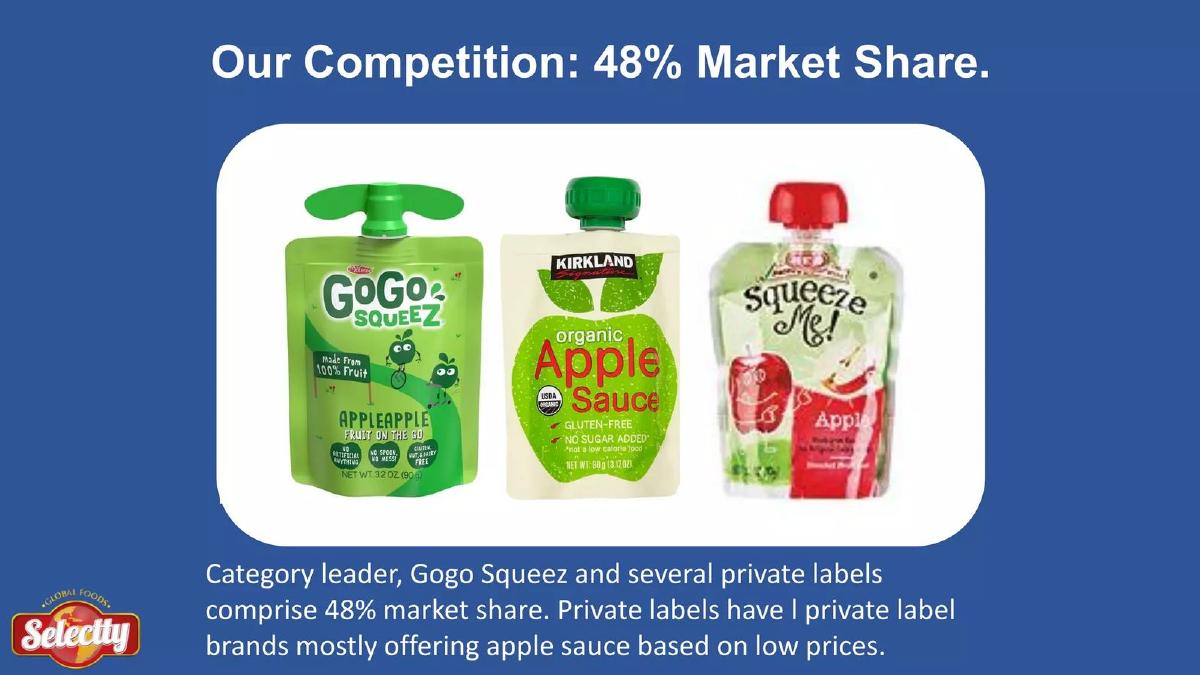
Unit Economics: While the P&L is provided, there is no breakdown of the cost per pouch versus the wholesale price. Given the negative gross profit, explaining the path to a positive contribution margin is essential. · Team Slide: The deck lacks a dedicated team slide. While contact names are on the final slide, there is no information on the founders' backgrounds, CPG experience, or previous successes. · Competitive Matrix: Slide 3 mentions Gogo Squeeze, but a detailed comparison of price points, nutritional facts, or shelf placement is missing. · Explanation of Revenue Drop: Revenue fell by nearly 50% between 2018 and 2019. Without a narrative explaining this (e.g., a pivot, a supply chain issue, or a change in accounting), it looks like a failing business.
Founder Takeaways
Be careful with P&L transparency. While honesty is required, presenting three years of negative gross margins without a 'Path to Profitability' slide is risky. If your COGS is higher than your revenue, you must explain how scale or manufacturing changes will fix it. Align your 'Use of Funds' with your 'Ask.' Selectty listed $1.2M in needs but only asked for $500k. This creates confusion about whether the $500k is sufficient to reach the next milestone. Leverage your 'Roadshow' success. The mention of exceeding thresholds at Costco (Slide 2) is a strong signal. Founders should highlight 'velocity' metrics (units sold per store per week) to prove that consumers actually want the product once it hits the shelf.
Frequently asked questions
- What is the primary product offered by Selectty?
- Selectty produces 'Mangoozers,' which are all-natural mango-based squeezable fruit pouches. According to Slide 5, the product line includes both organic and conventional versions with flavor combinations like Mango & Apple and Mango & Banana. The brand emphasizes 'No Added Sugar,' '100% Real Fruit,' and 'Gluten Free' attributes to appeal to health-conscious parents.
- Who are the main competitors identified in the deck?
- Slide 3 identifies the category leaders as Gogo Squeeze and various Private Labels. Selectty positions itself against these incumbents by offering flavor variety, specifically focusing on mango as a mainstream fruit, whereas they claim the current market is dominated by limited apple-based combinations.
- What does the financial performance look like for 2017-2019?
- The financials on Slide 7 show significant challenges. Total income peaked in 2018 at $139,114.10 but fell to $75,529.97 in 2019. More critically, the Cost of Goods Sold (COGS) exceeded income every year, resulting in negative gross profits. In 2019, the net income loss was $302,298.27.
- How does Selectty plan to use the $500,000 investment?
- Slide 8 breaks down the primary investment uses into four categories: $320,000 for Consulting (Nielsen, Lippincott, etc.), $105,000 for Product/Brand development, $310,000 for Sales Structure (trade shows and brokers), and $560,000 for Inventory. Note that these specific allocations total $1,295,000, which exceeds the $500,000 ask on Slide 9.
- What is the retail expansion strategy?
- Slide 6 outlines a five-year growth plan. It started with a 2019-2020 go-to-market in the Southwest (TX, LA, AZ, OK). The plan scales to national accounts like Walmart and Sam's Club in 2020-2021, followed by Publix and Whole Foods in 2021-2022, eventually reaching a 5% market share by 2024.