Crowdbotics' Series A deck is a data-heavy presentation that prioritizes financial performance and market positioning over traditional storytelling. By highlighting a 73% gross blended margin and a low $5.5K CAC against a $30K average deal value, the company demonstrated a highly efficient growth engine. The deck effectively identifies the 'black box' nature of existing low-code tools as a primary pain point for SMEs needing auditable code. While the deck lacks a dedicated team slide or a detailed competitive landscape beyond broad categories, its focus on 'real code' modules and a $450B targ…
Key takeaways
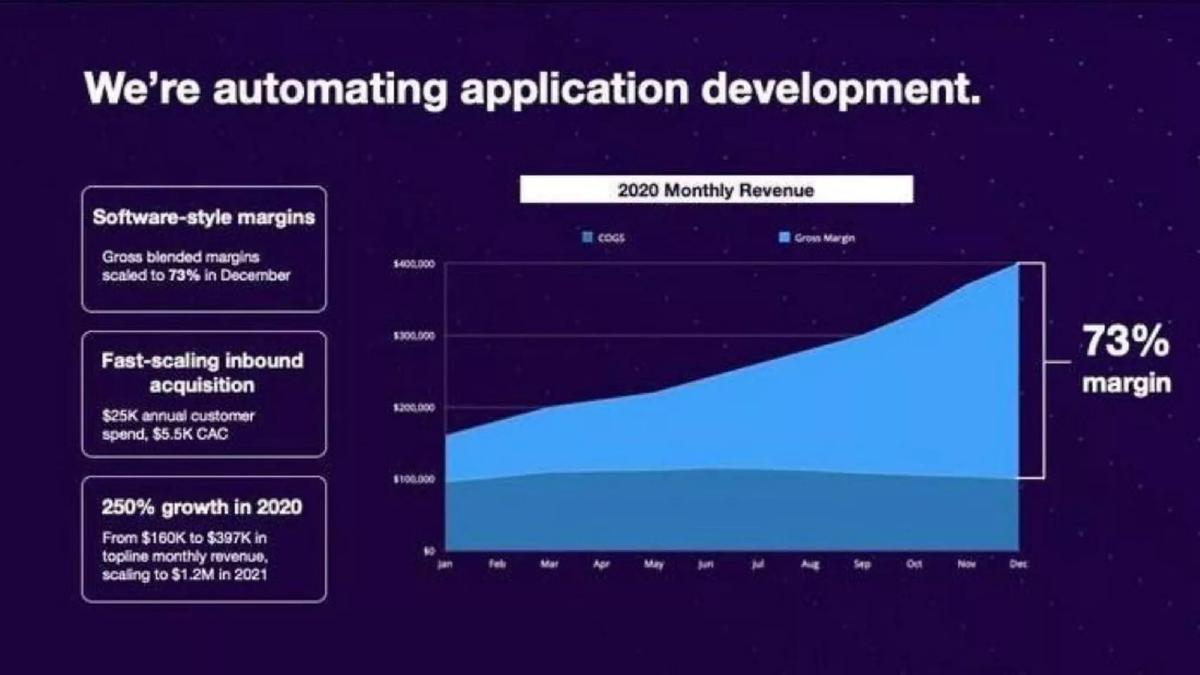
- The company reported a 250% growth rate in 2020, scaling topline monthly revenue from $160K to $397K (Slide 2).
- Crowdbotics achieved a 73% gross blended margin by December 2020, positioning itself as a high-efficiency software business (Slide 2).
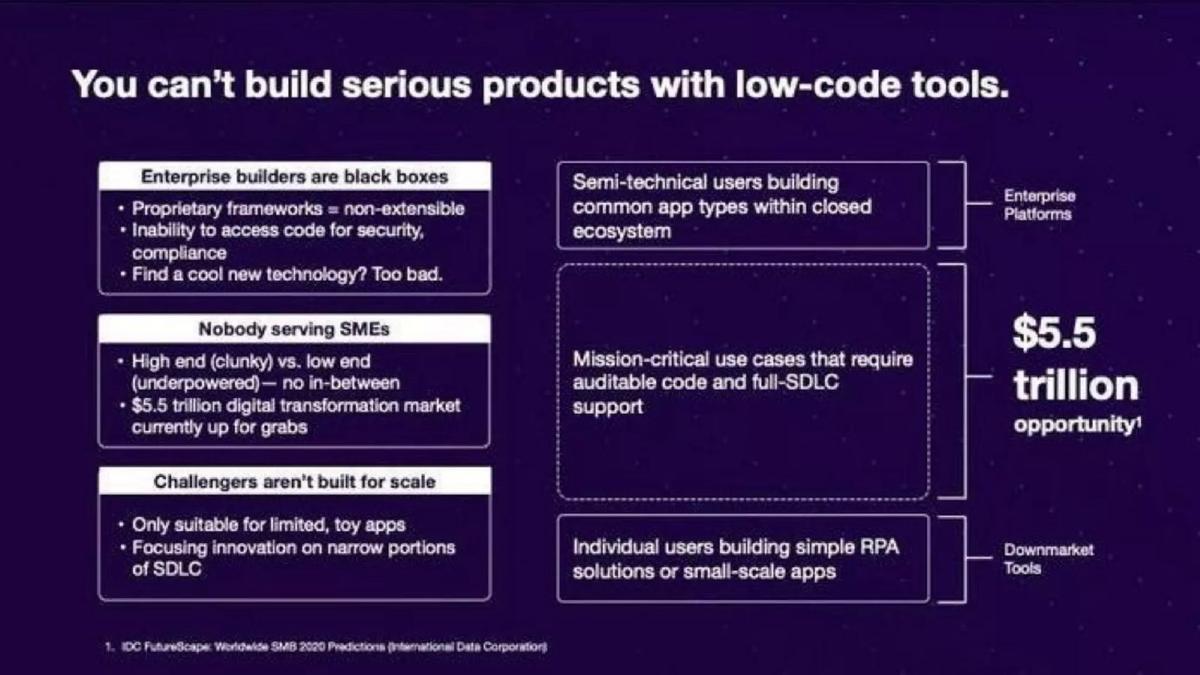
- The deck identifies a $5.5 trillion digital transformation market opportunity, specifically targeting the gap between 'clunky' high-end and 'underpowered' low-end tools (Slide 3).
- Unit economics are a focal point, with a stated $5.5K Customer Acquisition Cost (CAC) against a $25K-$30K average annual customer spend (Slide 2, Slide 9).
- The platform differentiates itself by providing 'real code' and 'auditable' outputs, addressing the 'black box' limitation of traditional low-code platforms (Slide 3, Slide 6).
- Revenue is projected to scale to $1.2M monthly in 2021, supported by a $10M raise intended to reach $15M in annual revenue (Slide 2, Slide 8).
- The deck completely omits a team slide, failing to showcase the founders' backgrounds or technical expertise within the slides themselves.
- A 'Professional Services Network' is integrated into the platform, utilizing an API built on Upwork to support mid-market custom deploys (Slide 6, Slide 7).
Introduction
Crowdbotics entered the Series A market in 2022 with a clear mission: to bridge the gap between simple low-code tools and complex custom software development. Their deck, which helped secure $22M in funding, is a masterclass in using data to validate a technical value proposition. Rather than relying on abstract visions of the future of work, Crowdbotics focuses heavily on the financial mechanics of their business—specifically their margins and acquisition efficiency.
Slide 1: Title Slide
The deck opens with a simple, dark-themed title slide. The tagline, "A New Way to Build Software," is supported by a sub-headline: "Create scalable software products fast using modules of real code." This immediately establishes their primary differentiator—the use of "real code" rather than proprietary, locked-down frameworks. The slide identifies Anand Kulkarni as the CEO of Crowdbotics Corporation.
Slide 2: We're automating application development
Crowdbotics chooses to lead with traction rather than the problem. This slide is a high-impact summary of their 2020 performance. It features a revenue chart showing a steady climb in gross margin (shaded in light blue) against COGS (dark blue). Key figures include a 250% growth rate in 2020, moving from $160K to $397K in topline monthly revenue. Most impressively, they highlight "Software-style margins," noting that gross blended margins scaled to 73% by December. They also introduce their unit economics here: a $25K annual customer spend against a $5.5K CAC.
Slide 3: You can't build serious products with low-code tools
This is the problem slide. It categorizes the competition into two failing camps: "Enterprise builders" which are described as "black boxes" with non-extensible proprietary frameworks, and "Downmarket Tools" which are only suitable for "toy apps." Crowdbotics identifies a massive middle ground for "mission-critical use cases that require auditable code." They cite a $5.5 trillion digital transformation opportunity, positioning themselves as the only solution for SMEs needing full-SDLC (Software Development Life Cycle) support.
Slide 4: Market Opportunity & Targets
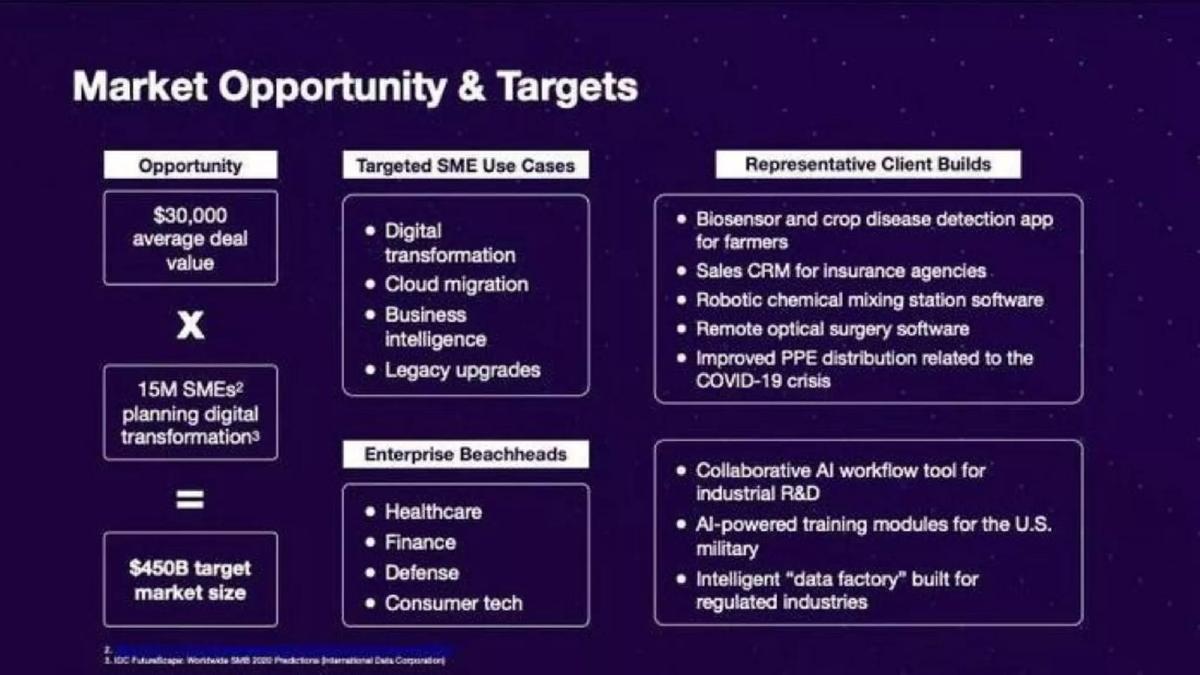
Slide 4 provides a breakdown of their Total Addressable Market (TAM). They use a simple equation: $30,000 average deal value multiplied by 15 million SMEs planning digital transformations equals a $450B target market. The slide also lists "Enterprise Beachheads" like Healthcare, Finance, and Defense. To ground these numbers, they list representative client builds, such as "Remote optical surgery software" and "AI-powered training modules for the U.S. military."
Slide 5: 250% growth in 2020, 300% coming in 2021
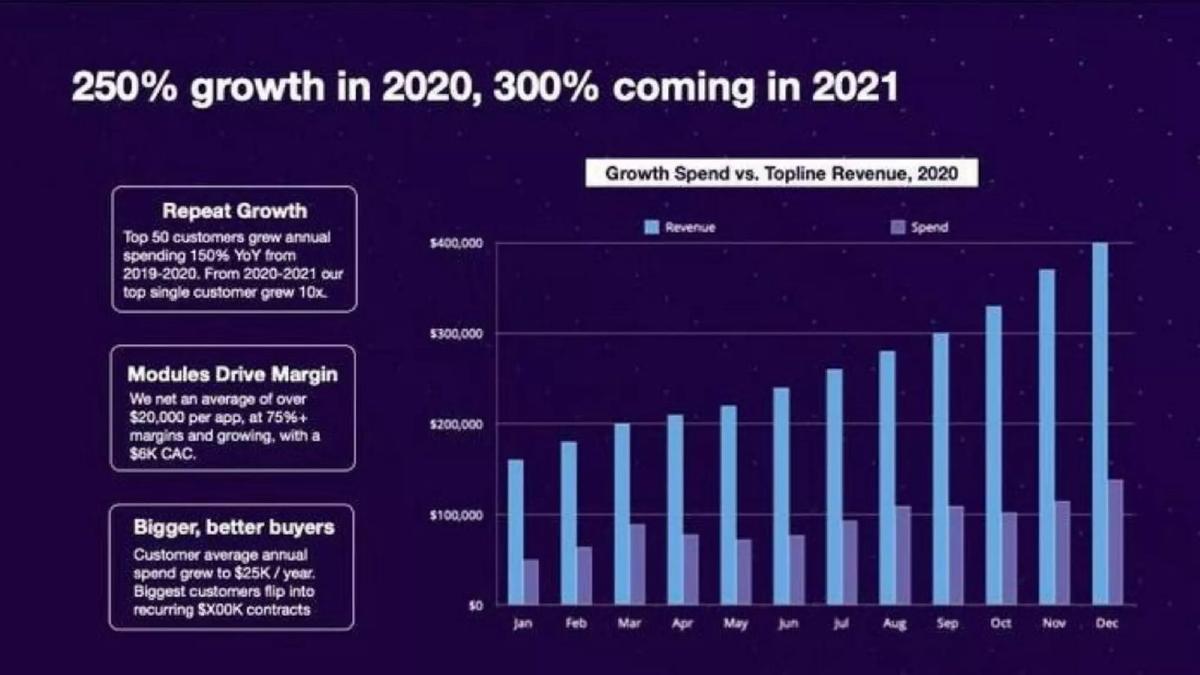
This slide doubles down on the growth narrative. It shows a bar chart of "Growth Spend vs. Topline Revenue" for 2020. The data indicates that revenue (light blue) consistently outpaces spend (purple). A key takeaway on this slide is "Repeat Growth," noting that their top 50 customers grew annual spending by 150% YoY. They also mention that their biggest customers are flipping into recurring contracts worth hundreds of thousands of dollars ("$X00K").
Slide 6: A low-code platform product teams can love
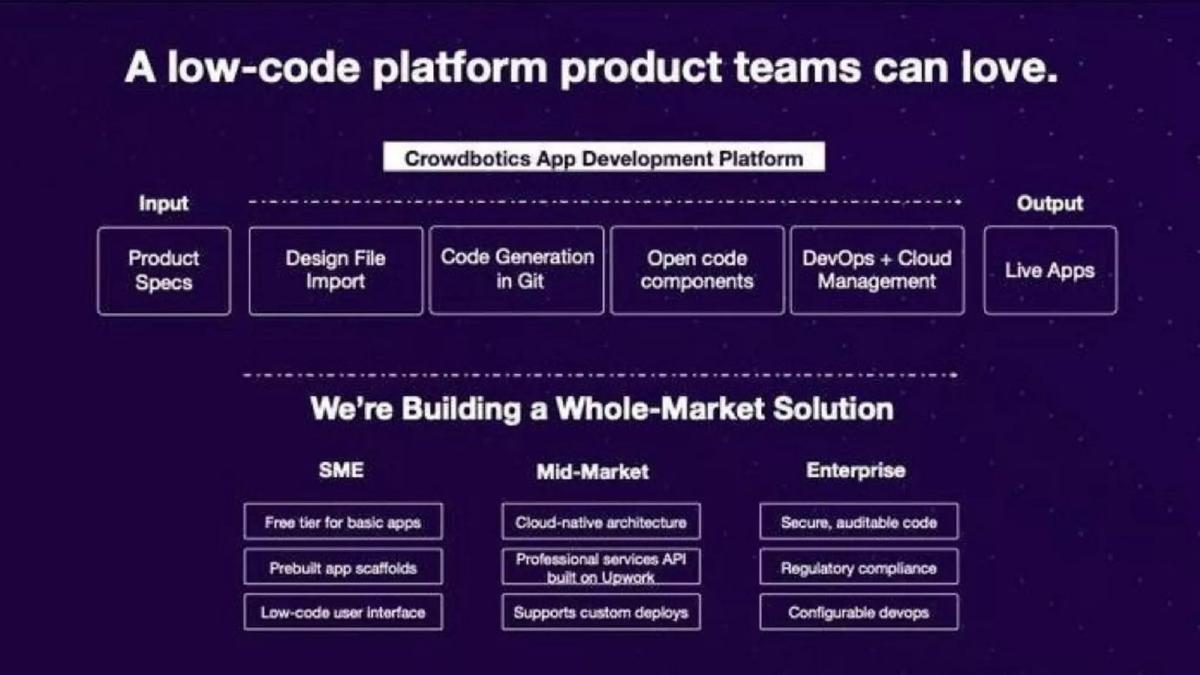
This is the product architecture slide. It visualizes the flow from "Product Specs" to "Live Apps." The process includes design file import, code generation in Git, open code components, and DevOps management. Below this, they segment their offering by customer tier: SMEs get a free tier and prebuilt scaffolds; Mid-Market gets cloud-native architecture and a professional services API; Enterprise gets secure, auditable code and regulatory compliance.
Slide 7: Visual Builder and Expert Community
Slide 7 provides social and visual proof of the platform in action. It shows screenshots of the "Visual Builder," a library of "Crowdsourced Code" templates, and the "Professional Services Network." The latter is particularly interesting as it showcases profiles of experts, suggesting a hybrid model where the platform facilitates human-led development alongside automated tools.
Slide 8: Raising $10M to scale to $15M annual revenue
The "Ask" slide is highly specific. While the catalogue facts state they eventually raised $22M, this slide shows they were initially seeking $10M. They plan to spend $6M of that on acquisition. The slide includes a month-by-month projection for 2021, showing revenue climbing toward $1.2M monthly. It also lists a detailed hiring roadmap for Q1 through Q3, covering everything from "Developer Evangelists" to "DevOps Managers."
Slide 9: Scalable Inbound Growth with Strong Economics
The final slide returns to unit economics. It explains their "Freemium Funnel," claiming a 22% PQL-to-close rate. The chart compares "Average Deal Value" to "Cost Per New Subscriber" throughout 2020. In almost every month, the deal value is 4x to 5x the acquisition cost. They also clarify their pricing model: $5K-$100K per app on variable usage fees, plus a $199-$2K monthly subscription fee per app.
What Crowdbotics Does Well
The Crowdbotics deck is exceptionally strong in its financial transparency. Most Series A decks hide their CAC or blended margins behind vague percentages, but Crowdbotics puts hard dollar amounts ($5.5K CAC, $30K deal value) front and center. This builds immediate trust with investors who are looking for a repeatable, scalable sales engine.
Furthermore, their positioning against the "black box" nature of low-code is brilliant. By emphasizing "real code" and "Git integration," they appeal to the technical buyer (CTOs and VCs with engineering backgrounds) who are usually skeptical of no-code platforms. They aren't just selling a builder; they are selling a professional development environment that happens to be automated.
What is Missing from the Deck
The most glaring omission is a Team Slide . In the provided 9 slides, there is no mention of the founders' pedigree, previous exits, or technical credentials. For a Series A, investors usually want to see why this specific team is qualified to build a complex code-generation engine.
Additionally, the Competitive Landscape is handled very broadly. While they categorize competitors into "Enterprise" and "Downmarket," they don't name specific rivals like Mendix, OutSystems, or Bubble. A more detailed competitive matrix would have helped clarify their specific feature-set advantages beyond just "open code."
Founder Takeaways
Lead with your strongest lever. If your unit economics are incredible, don't wait until slide 10 to show them. Crowdbotics put their 73% margin and growth chart on slide 2, setting a high-bar tone for the rest of the presentation.
Define your niche through technical limitations. Instead of saying "we are better," Crowdbotics said "others are black boxes." By identifying a specific technical frustration (lack of code access for compliance), they made their solution feel like a logical necessity rather than just another tool.
Show the 'Whole-Market' strategy. Founders often struggle to show how they will move from small users to big enterprises. Crowdbotics solved this by showing a tiered product features list (Slide 6) that clearly explained what changed as a customer scaled from a free SME user to a regulated Enterprise client.
Frequently asked questions
- What is the core problem Crowdbotics aims to solve?
- Crowdbotics targets the limitations of existing low-code tools, which they describe as 'black boxes.' According to slide 3, these tools often use proprietary frameworks that are non-extensible and prevent users from accessing code for security and compliance. They argue that while downmarket tools are only for 'toy apps,' enterprise platforms are too closed, leaving a massive gap for mission-critical SME applications that require auditable code.
- How does Crowdbotics justify its market size?
- The deck uses a bottom-up calculation on slide 4 to arrive at a $450B target market. They multiply a $30,000 average deal value by 15 million SMEs currently planning digital transformations. This is nested within a larger $5.5 trillion global digital transformation opportunity cited from IDC research on slide 3.
- What are the specific unit economics mentioned in the deck?
- The deck highlights very healthy ratios. On slide 9, they report a $5.5K CAC and a 22% 'Product Qualified Lead (PQL) to close' rate. Average deal values are cited at $30K (Slide 4), with customers spending between $5K and $100K per app based on variable usage fees and monthly subscriptions ranging from $199 to $2K per month.
- What is the 'Professional Services Network' mentioned in the solution?
- Unlike pure SaaS plays, Crowdbotics integrates human expertise. Slide 6 and 7 show a 'Professional Services API built on Upwork' and an 'Expert Community.' This allows the platform to offer a 'whole-market solution' where SMEs get low-code interfaces, while mid-market and enterprise clients get custom deploys and auditable code supported by professional services.
- How does the company plan to use the $10M mentioned in the ask?
- Slide 8 outlines a plan to spend $6M on acquisition to reach $15M in annual revenue. The remaining funds are earmarked for 'Product/Ops Spending,' including key hires across marketing, growth, UX, and engineering. Specific roles listed include a Developer Evangelist, Revenue Ops, and multiple Product Managers scheduled for hire throughout Q1-Q3.