Crosby Health's 2024 pre-seed deck is a masterclass in brevity and technical positioning. Raising $2.2M on just eight slides, the company addresses the growing crisis of AI-driven insurance denials by healthcare payors. The narrative arc is simple: payors are using AI to deny claims, providers are losing billions fighting back, and Crosby’s proprietary 'Apollo' LLM is the superior weapon for the counter-offensive. The deck relies heavily on a single technical benchmark—outperforming Google's Med-PaLM 2 on the MedQA exam—to establish credibility. While it lacks traditional slides for business…
Key takeaways
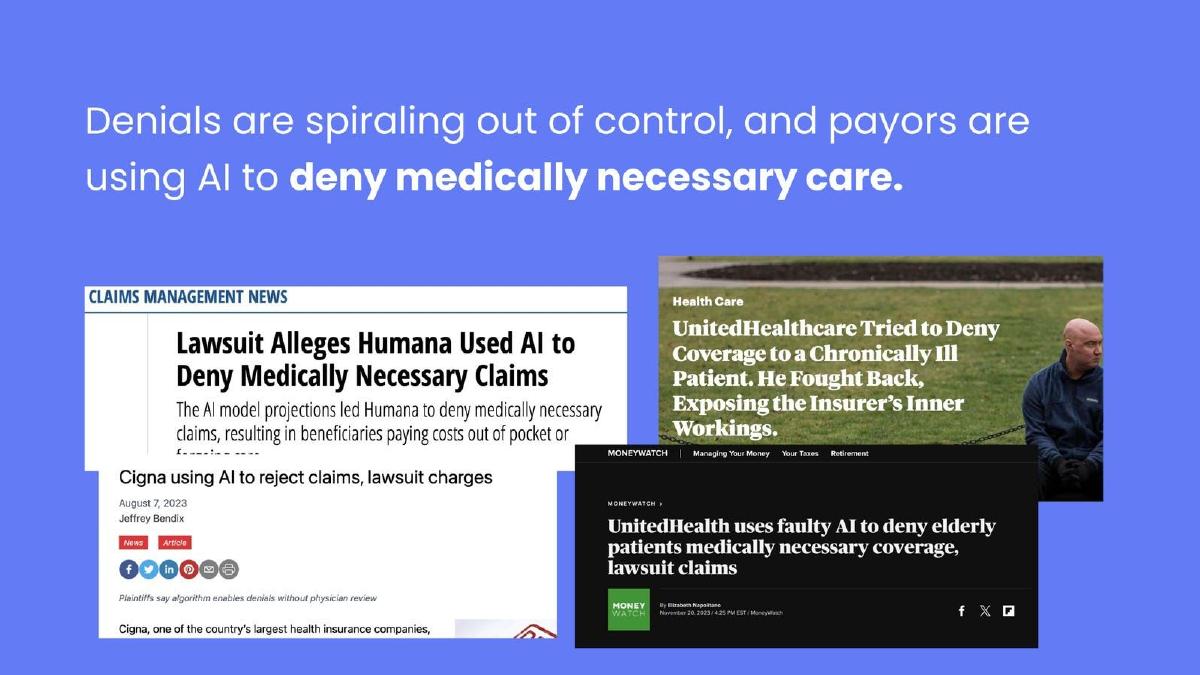
- The deck uses a 'fight fire with fire' narrative, highlighting how insurers use AI to deny claims on slide 2.
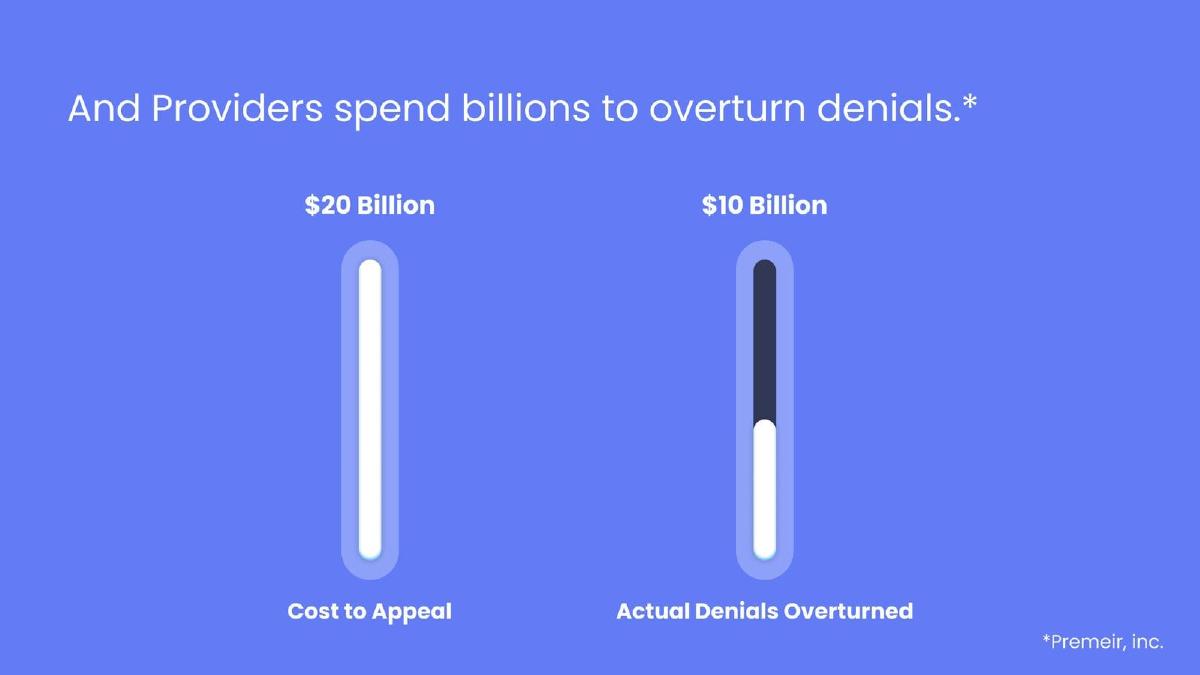
- Market pain is quantified by a $20 billion cost to appeal denials, with only $10 billion successfully overturned, per slide 3.
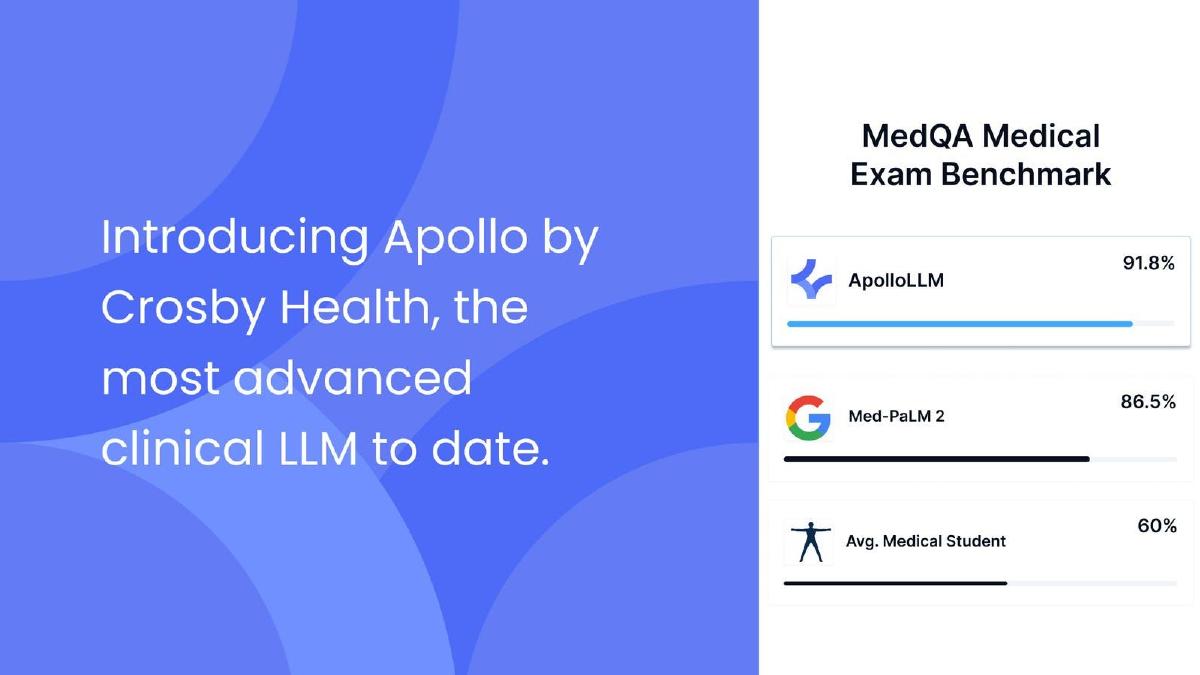
- Technical superiority is claimed via the MedQA Medical Exam Benchmark, where ApolloLLM scores 91.8% compared to Med-PaLM 2's 86.5% on slide 4.
- The product vision extends beyond appeals to include medical coding and chart audits, according to slide 7.
- The founding team features deep domain expertise, including 4+ years in RCM and experience at Meta and Labcorp on slide 8.
- The deck completely omits a financial ask, use of funds, or business model slide.
- There is no mention of existing customer traction, pilot programs, or revenue figures in the 8-slide sequence.
- The deck was used to raise $2.2M in a 2024 pre-seed round as reported by Business Insider.
The 'AI Arms Race' Narrative
Crosby Health entered the market at a time when the healthcare industry was reeling from reports of insurance companies using automated algorithms to mass-deny claims. Their pitch deck, consisting of only eight slides, leverages this specific news cycle to create immediate urgency. By framing the problem as an AI-driven attack on providers, Crosby positions its own AI as the necessary defensive tool. This teardown examines how they used technical benchmarks and a lean structure to secure $2.2M in pre-seed funding.
Slide 1: Title Slide
The deck opens with a minimalist title slide featuring the Crosby Health logo and name against a solid blue background. There is no tagline or mission statement present here. It is a standard, clean entry point that establishes the brand's visual identity—professional, clinical, and tech-forward.
Slide 2: The Problem - AI-Driven Denials
Slide 2 sets the stage by highlighting a predatory trend in the healthcare industry. The headline states: "Denials are spiraling out of control, and payors are using AI to deny medically necessary care." To validate this claim, the slide features three news clippings from reputable sources like MoneyWatch and Claims Management News. The headlines specifically call out major insurers—Humana, Cigna, and UnitedHealthcare—for using AI to reject claims. This is a highly effective 'Why Now?' slide. It doesn't just describe a general problem; it points to a specific, escalating conflict where technology is being used against the target customer (healthcare providers).
Slide 3: The Economic Impact
Slide 3 quantifies the pain for providers. It uses two vertical bar charts to show the inefficiency of the current manual appeal process. According to the slide, the "Cost to Appeal" is $20 Billion , while the "Actual Denials Overturned" is only $10 Billion . A footnote attributes this data to "Premeir, inc." (sic). The implication is clear: providers are spending twice as much money fighting denials as they are actually recovering. This creates a massive, multi-billion dollar opportunity for a solution that can lower the cost of the appeal process through automation.
Slide 4: The Technical Moat - Apollo LLM
This is the 'hero' slide of the deck. Instead of just claiming to have 'better AI,' Crosby Health provides a specific benchmark. They introduce "Apollo by Crosby Health, the most advanced clinical LLM to date." The right side of the slide shows the "MedQA Medical Exam Benchmark," where ApolloLLM is credited with a 91.8% score. This is compared against Med-PaLM 2 (Google's medical LLM) at 86.5% and the Avg. Medical Student at 60% . For a pre-seed company, outperforming a Google-backed model on a standardized medical exam is a powerful way to establish technical credibility and a competitive moat.
Slide 5: Product Interface
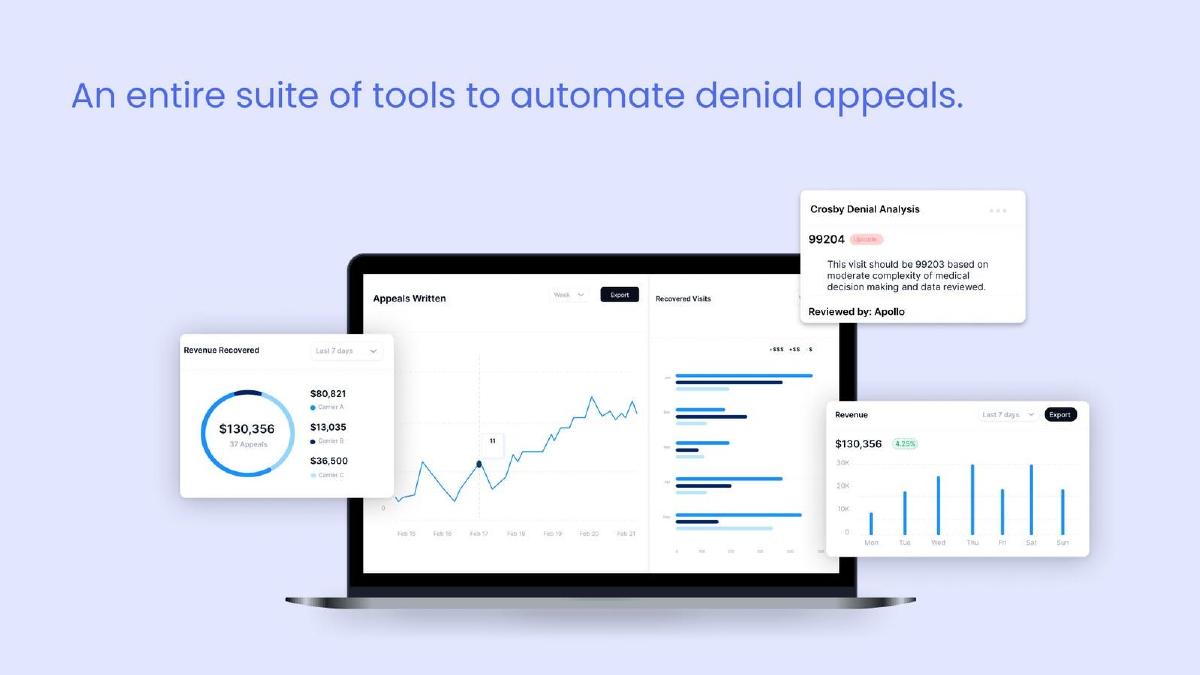
Slide 5 provides a glimpse into the software. The headline reads, "An entire suite of tools to automate denial appeals." The slide shows a laptop screen and several floating UI elements. Key metrics visible in the mockups include "Revenue Recovered: $130,356" and "37 Appeals." One specific callout box labeled "Crosby Denial Analysis" shows the AI's reasoning: "This visit should be 99203 based on moderate complexity of medical decision making and data reviewed. Reviewed by: Apollo." This demonstrates that the AI isn't just a black box; it provides the clinical rationale required to overturn a denial.
Slide 6: Value Proposition and Efficiency
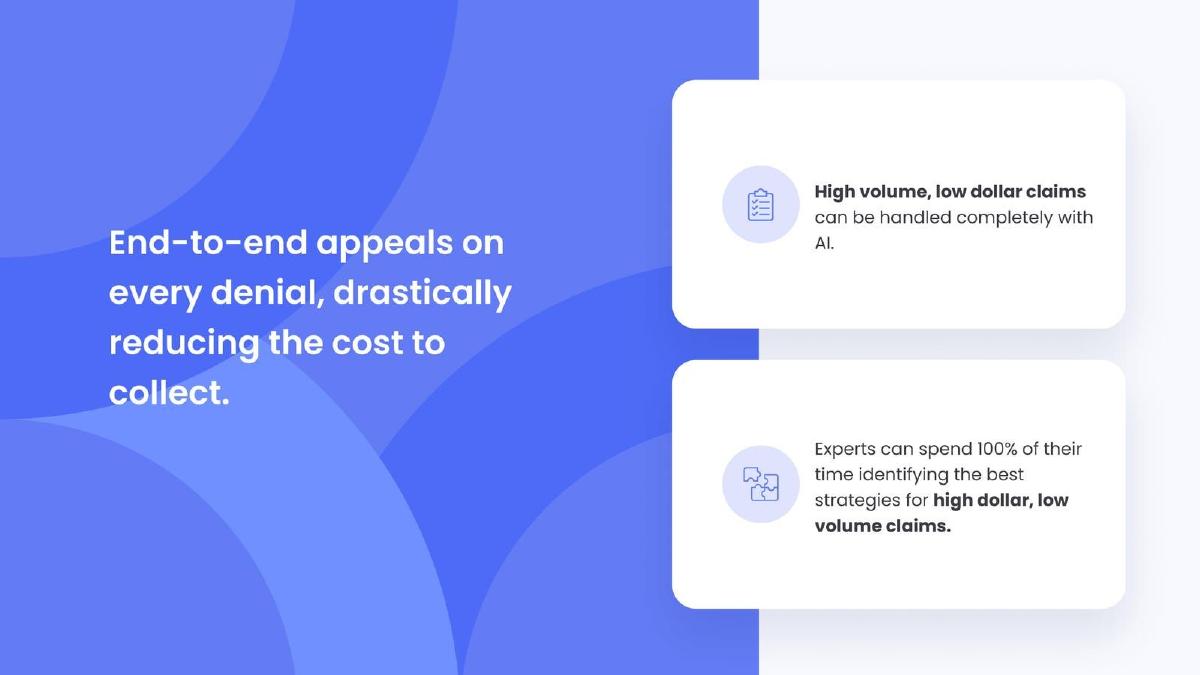
Slide 6 explains the operational impact of the software. The headline is "End-to-end appeals on every denial, drastically reducing the cost to collect." It breaks the workload into two categories:
High volume, low dollar claims can be handled completely with AI. · Experts can spend 100% of their time identifying the best strategies for high dollar, low volume claims.
This slide addresses a common concern in AI implementation: human-in-the-loop. By automating the 'grunt work' of low-value claims, Crosby allows expensive human billing experts to focus on the cases with the highest ROI.
Slide 7: The Vision and Roadmap
Slide 7 expands the scope of the company beyond just insurance appeals. The headline "And it doesn't stop there..." leads into a diagram showing the Crosby logo pointing toward three pillars: Medical Coding, Chart Audits, and Appeals/Denials. The text at the bottom states: "We've trained Apollo to automate the billions spent on revenue cycle, text-based tasks." This slide tells investors that Crosby isn't just a 'feature' for appeals; it is a platform for the entire Revenue Cycle Management (RCM) industry.
Slide 8: The Founding Team
The final slide introduces the three founders, all of whom share an NYU pedigree.
Rishi Gowda (CEO): 4+ years running RCM, Former 0-1 at Primer, NYU Econ/CS. · Louis Ciano (CTO): Ex Bioinformatics at Labcorp, Ex TPM at Meta, NYU Computer Eng. · Suhas Nandiraju (VP, AI/ML): ML Research at Kyron Learning, 3+ Years Quant Finance, NYU Applied Math.
The team composition covers the three essential bases for this specific startup: deep domain knowledge in RCM (Gowda), high-scale engineering and bioinformatics (Ciano), and advanced machine learning/mathematics (Nandiraju).
What Works in the Crosby Health Deck
The most successful element of this deck is its narrow focus . By spending the first three slides solely on the 'AI vs. AI' conflict in insurance denials, the founders create a high-stakes environment where their product feels like a mandatory purchase rather than a 'nice-to-have.' The use of the MedQA benchmark on slide 4 is a brilliant move for a pre-seed company. It provides a quantitative 'proof of tech' that offsets the lack of revenue or traction data. Furthermore, the clear segmentation of labor on slide 6 (AI for low-value, humans for high-value) shows a sophisticated understanding of how healthcare administrative workflows actually function.
What is Missing from the Crosby Health Deck
Despite its success in raising $2.2M, the deck leaves several critical questions unanswered. There is no business model slide ; it is unclear if they charge per appeal, a percentage of recovered revenue, or a flat SaaS fee. There is also no competition slide . The RCM space is crowded with legacy players and other AI startups, yet Crosby does not position itself against them, only against Google's LLM. Most notably, the deck lacks a traction slide . There are no mentions of pilot programs, hospital partnerships, or current revenue. Finally, the omission of the 'Ask' (how much they are raising and what they will do with it) suggests this version of the deck may have been intended for a specific stage of the conversation or was scrubbed for public release.
Founder Takeaway: The Power of Vertical Benchmarking
For founders building in the 'Vertical AI' space, Crosby Health provides a blueprint for technical validation. If you are building an LLM for a specific industry (law, medicine, engineering), don't just say your model is 'better.' Find the industry-standard exam or benchmark and show how you perform against the general-purpose giants like OpenAI or Google. This 8-slide deck proves that if your team pedigree is strong and your technical benchmark is impressive, you don't need a 20-slide deck to close a multi-million dollar pre-seed round.
Frequently asked questions
- How much did Crosby Health raise with this deck?
- As reported by Business Insider, Crosby Health raised $2.2 million in a pre-seed round in 2024. The deck itself does not state the amount being raised or the valuation, which is common for decks shared publicly after a round closes.
- What is the core technology behind Crosby Health?
- The core technology is a proprietary clinical large language model (LLM) named Apollo. According to slide 4, this model achieved a 91.8% score on the MedQA Medical Exam Benchmark, outperforming both Google’s Med-PaLM 2 and the average medical student.
- What specific problem does the company solve?
- Crosby Health targets the 'Revenue Cycle Management' (RCM) space. Specifically, they address the issue of insurance companies using AI to deny claims. Slide 3 notes that providers spend $20 billion attempting to appeal these denials but only recover $10 billion.
- Who are the founders of Crosby Health?
- The founding team consists of Rishi Gowda (CEO), who has 4+ years in RCM; Louis Ciano (CTO), formerly of Meta and Labcorp; and Suhas Nandiraju (VP, AI/ML), who has a background in quant finance and ML research. All three founders are NYU alumni.
- Is there a roadmap for future products in the deck?
- Yes, slide 7 outlines a product expansion strategy. While the current focus is on appeals and denials, the company plans to apply its Apollo LLM to medical coding and chart audits to automate 'billions spent on revenue cycle, text-based tasks.'