Kewazo’s 14-slide Series A teaser deck is a focused exercise in identifying a high-friction industrial problem and presenting a hardware-software solution with clear ROI. By targeting the $50 billion scaffolding industry as its first application (Slide 2), Kewazo avoids the 'robotics for everything' trap that plagues many hardware startups. The deck claims a significant 70% reduction in man-hour costs (Slide 6) and highlights a transition from pure hardware to digital services (Slide 8). While the provided visuals redact specific traction figures and team details, the narrative structure succ…
Key takeaways
- The company identifies scaffolding as a $50 billion industry and its primary 'low-hanging fruit' for automation (Slide 2, 4).
- Kewazo claims its Liftbot V1.2 can save up to 70% of labor costs through man-hour savings and reduced schedules (Slide 6).
- The solution addresses labor shortages by allowing 2-3 scaffolders to do the work of 7 or more (Slide 6).
- The deck emphasizes safety and ergonomics, noting that the robot decreases human wear and tear (Slide 6).
- Kewazo positions itself as more than hardware, mentioning digital services enabled via on-site robotics (Slide 8).
- The market strategy extends beyond construction into industrial, oil & gas, and maritime sectors (Slide 9).
- Future application areas for the technology include insulation, equipment transport, and offshore operations (Slide 13).
- The company reported having raised $9M in VC capital prior to this Series A teaser (Slide 2).
Slide-by-Slide Analysis
Slide 1: Title and Positioning
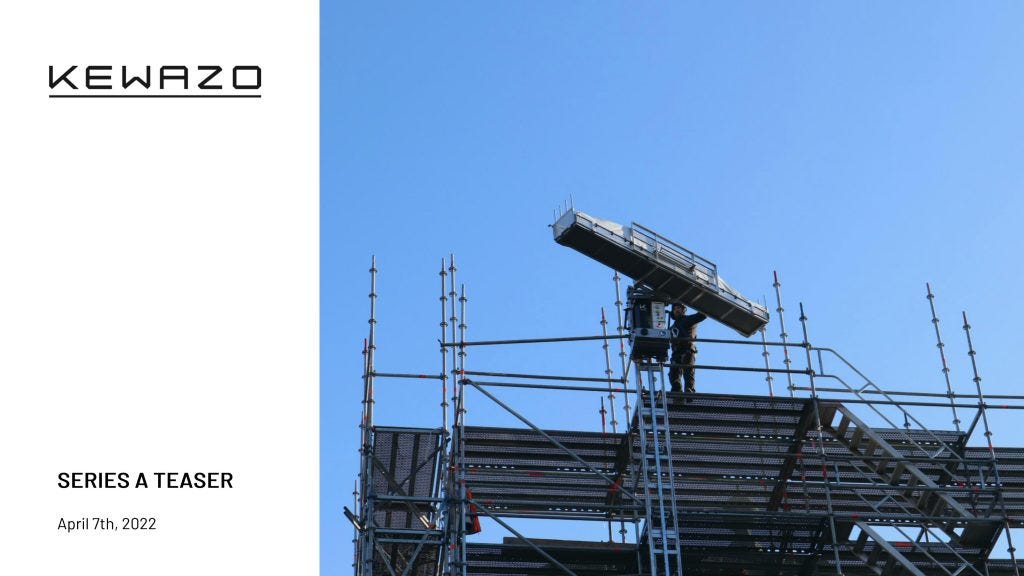
The deck opens with a clean, minimalist title slide. It identifies the document as a 'Series A Teaser' dated April 7th, 2022. The hero image features the Liftbot in a real-world environment, immediately establishing that this is a functional hardware company rather than a conceptual one. The branding is professional, utilizing a high-contrast black-and-white logo.
Slide 2: The Executive Summary
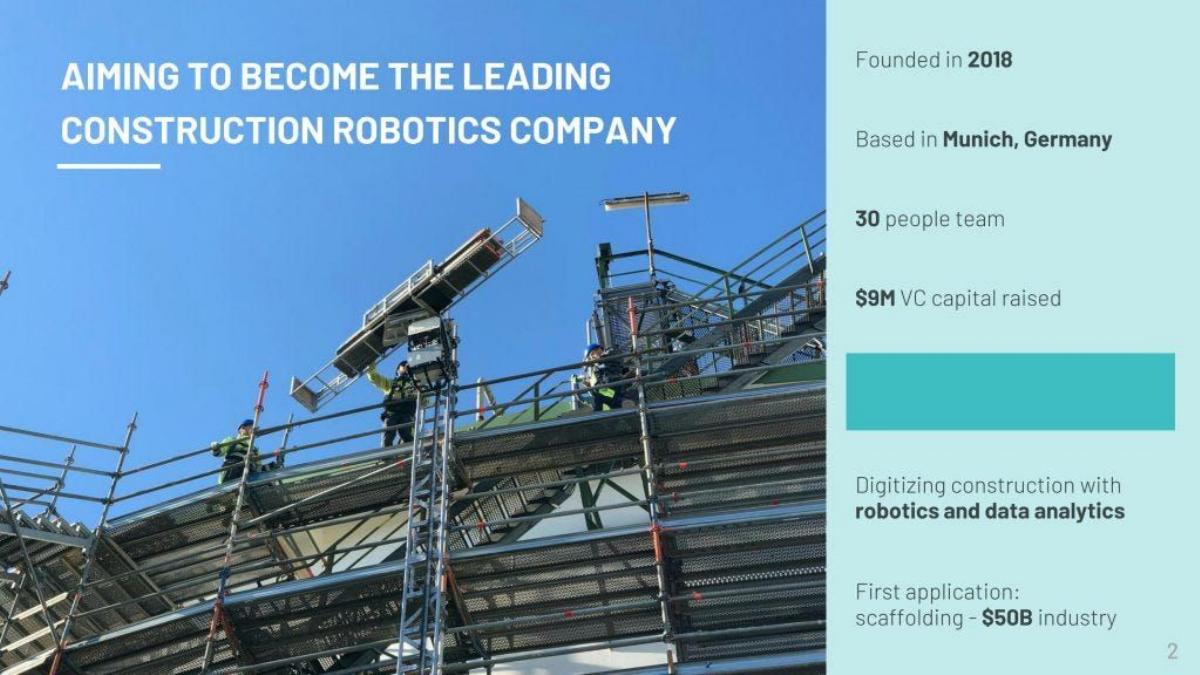
Slide 2 is a high-density summary that hits the most important investor metrics immediately. It states the company was founded in 2018, is based in Munich, and has a 30-person team. Crucially, it mentions $9M in VC capital already raised, which provides social proof. The mission is clearly stated: 'Digitizing construction with robotics and data analytics.' It also defines the beachhead market: scaffolding, a $50B industry. This slide is excellent because it answers 'Who, What, Where, and How Big' in under thirty seconds.
Slide 3: The Vision
This slide reinforces the ambition: 'Aiming to become the leading construction robotics company.' While visionary, it is grounded by the previous slide's specific market focus. It sets the stage for a platform play rather than a single-tool product.
Slide 4 & 5: The Problem Context
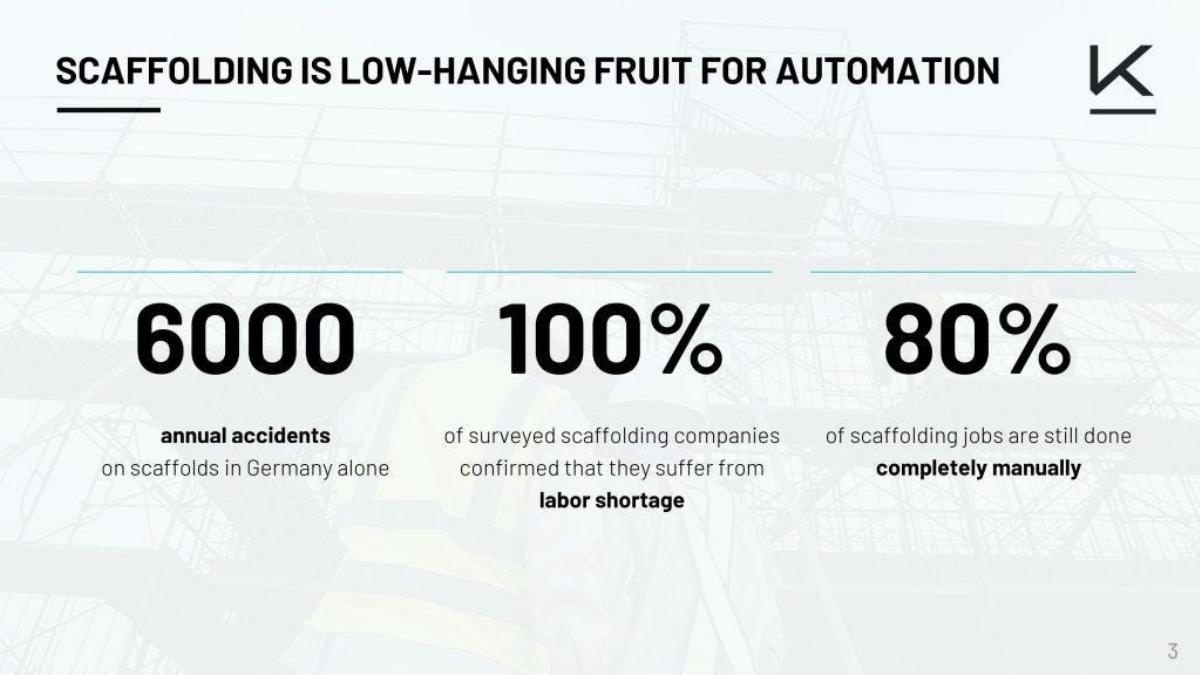
Slide 4 identifies scaffolding as 'low-hanging fruit for automation.' Slide 5 provides a visual of the status quo: a large crew of workers manually passing heavy poles and planks up multiple levels of a building. This visual effectively communicates the inefficiency, labor intensity, and inherent danger of the current manual process without needing a single word of text.
Slide 6: The Solution (Liftbot V1.2)
This is the core product slide. It lists three massive value drivers: Up to 70% man-hour savings , a solution to labor shortages (reducing crew size from 7+ to 2-3), and improved safety/ergonomics . The inclusion of CE and TUV SUD certifications is a critical detail for industrial investors, as it proves the hardware meets rigorous European safety and regulatory standards.
Slide 7: Economic Impact
The text for Slide 7 reiterates the 70% labor cost saving. In a Series A deck, this is the 'magic number.' If a robot can replace four to five salaries on a job site, the ROI for the subcontractor becomes undeniable. This slide focuses purely on the bottom-line impact for the customer.
Slide 8: The Software Layer
Kewazo introduces 'Digital services enabled via on-site robotics.' This is a strategic move to show investors that they aren't just a 'metal-bending' hardware company. By capturing data on-site, they can offer project management insights that manual labor cannot. This hints at higher-margin revenue streams and stickier customer relationships.
Slide 9 & 10: Market Expansion
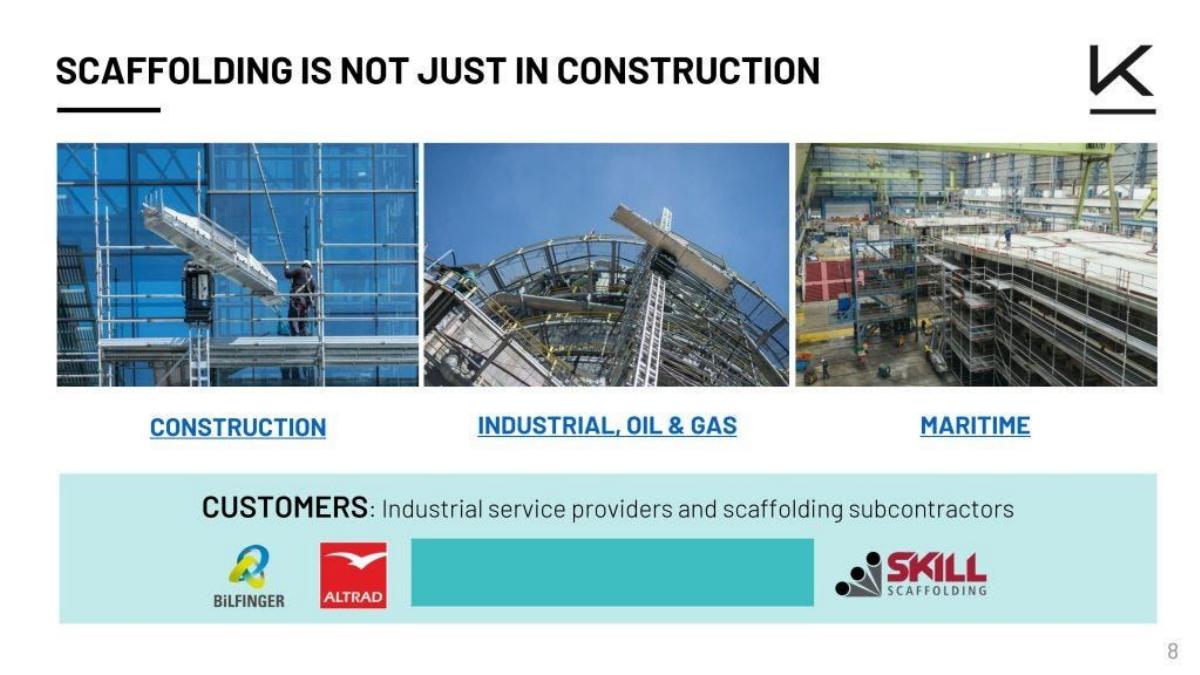
Slide 9 argues that 'Scaffolding is not just in construction,' showing applications in Industrial, Oil & Gas, and Maritime sectors. It lists major customers like Bilfinger and Altrad. Slide 10 calls this a 'massive untapped opportunity.' This transition is vital for a Series A; it shows that while they are starting with scaffolding, the technology is a horizontal platform for any vertical material transport.
Slide 11: Traction
The traction slide in the provided version is a placeholder/redacted block. However, the presence of a dedicated traction slide at this stage of the deck suggests that the company has moved past the pilot phase and is reporting actual revenue, units deployed, or contract values. For a $10M raise, investors would expect to see significant MoM growth or a strong pipeline of signed LOIs.
Slide 12 & 14: The Team
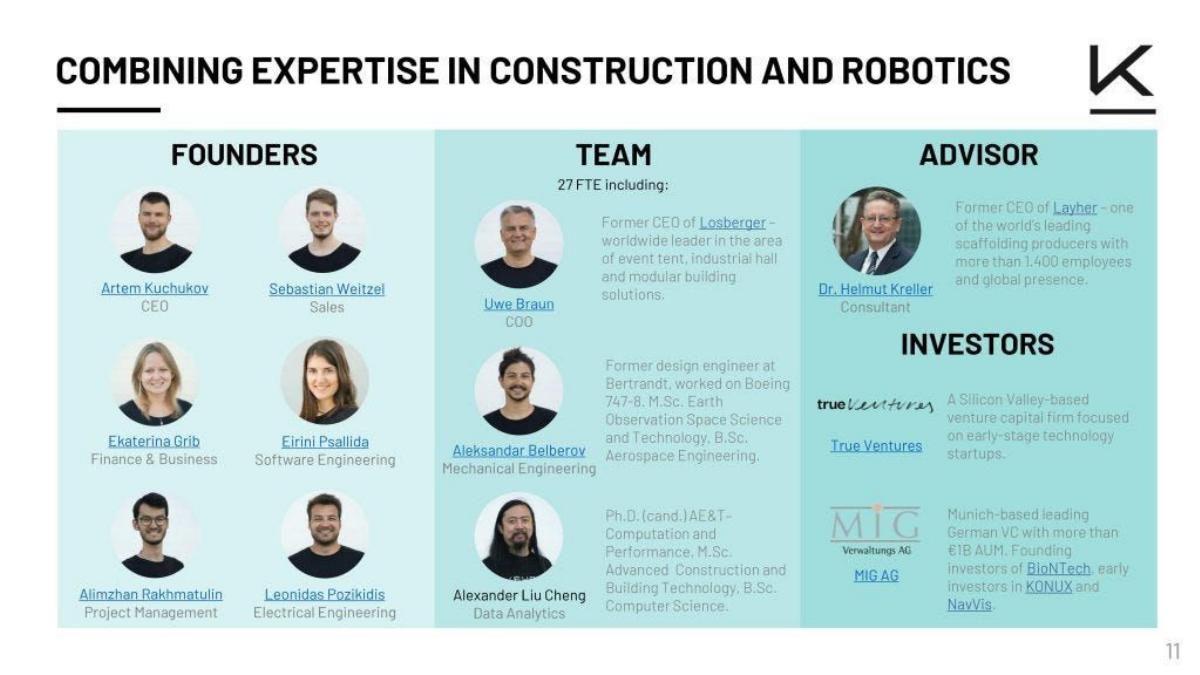
The deck concludes with the team, advisors, and investors. Mentioning the team twice (Slide 12 and 14) emphasizes the human capital behind the robotics. For a Munich-based startup, the team likely includes deep technical expertise in mechanical engineering and computer science, which is a prerequisite for success in the 'hard tech' space.
Slide 13: Future Roadmap
The 'Further Application Areas' slide shows the Liftbot (or derivatives) handling insulation, general equipment, and offshore transport. This slide is designed to answer the 'What's next?' question, showing a clear path to a multi-billion dollar TAM (Total Addressable Market) beyond the initial scaffolding niche.
What Kewazo Does Exceptionally Well
Specific Beachhead Market: Many robotics startups fail by trying to build a 'humanoid' that does everything. Kewazo picked one of the most repetitive, dangerous, and expensive tasks in construction—moving scaffolding—and solved it. This makes their go-to-market strategy highly believable.
Quantifiable ROI: The claim of 70% labor savings is the strongest part of the deck. In an industry plagued by labor shortages and rising wages, a tool that allows a 3-person crew to do the work of 7 people is an easy sell for both customers and investors.
Regulatory Readiness: Including the TUV and CE logos on the product slide (Slide 6) removes a major hurdle for industrial investors. It signals that the product is not a lab prototype but a commercial-ready machine that can be deployed on active job sites immediately.
What is Missing from the Deck
Unit Economics: While the deck mentions labor savings for the customer, it does not detail the unit economics for Kewazo. Investors need to know the cost to build a Liftbot versus the RaaS (Robot-as-a-Service) or sales price. High hardware margins are essential for a successful Series A in this sector.
Competitive Landscape: The deck does not mention other construction robotics firms or traditional hoist manufacturers. Acknowledging the competition and explaining why Liftbot is superior (e.g., ease of setup, data integration) would strengthen the case.
The Ask: As a teaser deck, the specific amount being raised and the milestones it will fund are omitted. While common for a teaser, the final pitch would need a clear breakdown of how the $10M will be allocated between R&D, sales, and manufacturing scaling.
Lessons for Founders
Lead with the 'Why Now': The labor shortage in construction is a global crisis. Kewazo leans into this by showing how their robot directly compensates for a lack of human workers. · Visual Overload is Good for Hardware: Using photos of the robot on actual job sites (Slides 1, 2, 6, 9) is far more effective than 3D renders. It proves the technology works in the 'dirt and dust' of the real world. · Don't Forget the Data: Even if you are a hardware company, find the software angle. Investors value software multiples more than hardware multiples. Kewazo’s mention of 'digital services' (Slide 8) is a smart play to increase the company's valuation ceiling. · Bridge the Gap: Show how your niche solution (scaffolding) leads to a massive platform (industrial material flow). This allows you to be 'focused' and 'ambitious' at the same time.
Frequently asked questions
- What is the primary value proposition of Kewazo's Liftbot?
- The primary value proposition is a 70% reduction in labor costs. By automating the vertical and horizontal transport of scaffolding components, the Liftbot allows a crew of 2-3 people to accomplish what typically requires 7 or more workers. This directly addresses the chronic labor shortage in the construction industry while improving worker safety and reducing physical strain.
- How does Kewazo plan to expand beyond the scaffolding market?
- Kewazo views scaffolding as an entry point. Slide 13 outlines 'Further Application Areas' including insulation, general equipment transport, and offshore energy projects. By proving the technology in the high-friction scaffolding niche, they aim to become a general-purpose material flow platform for complex industrial environments like oil refineries and shipyards.
- What role does data play in Kewazo's business model?
- Slide 8 highlights 'Digital services enabled via on-site robotics.' This suggests that the Liftbot acts as a data collection node on the job site. By digitizing material flow, Kewazo can provide analytics on project progress, inventory management, and worker productivity, potentially moving the company toward a high-margin software-as-a-service (SaaS) or Data-as-a-Service revenue stream.
- Who are Kewazo's target customers according to the deck?
- The deck specifically names industrial service providers and scaffolding subcontractors as the primary customers. Slide 9 features logos for major industry players like Bilfinger, Altrad, and Skill Scaffolding, indicating that the company is targeting large-scale enterprise partners rather than small residential contractors.
- Is the investment ask clearly defined in the slides?
- No, the provided slides do not include a specific 'Ask' or 'Use of Funds' slide. As this is labeled a 'Series A Teaser' (Slide 1), it is likely intended to generate interest and secure first meetings where the specific financial terms and growth milestones would be discussed in detail.