Kero Sports utilized a concise 6-slide deck to secure a $1M Seed round in 2024. The deck avoids traditional filler, moving immediately from a generational problem statement to a detailed product walkthrough. By positioning their technology as a whitelabel SDK, they address the monetization needs of teams, leagues, and sportsbooks simultaneously. The narrative hinges on 'micro-betting'—algorithmically curated bets offered every 30 seconds—designed to compete with short-form social media for fan attention. While the deck lacks a formal 'Ask' slide or financial projections, it leans heavily on t…
Key takeaways
- The deck identifies a specific generational shift, claiming current sports betting products will be 'rejected by the next generation' on Slide 1.
- Kero Sports positions itself as a whitelabel SDK rather than a standalone consumer app, as noted on Slide 2.
- The product generates algorithmically curated in-game bets every 30 seconds using proprietary ML models (Slide 2).
- The user interface utilizes a 'Tinder-style' swipe mechanic for betting, shown in the step-by-step walkthrough on Slide 3.
- The business model supports both real-money wagering and Free-to-Play (FTP) modes with leaderboard points (Slide 3).
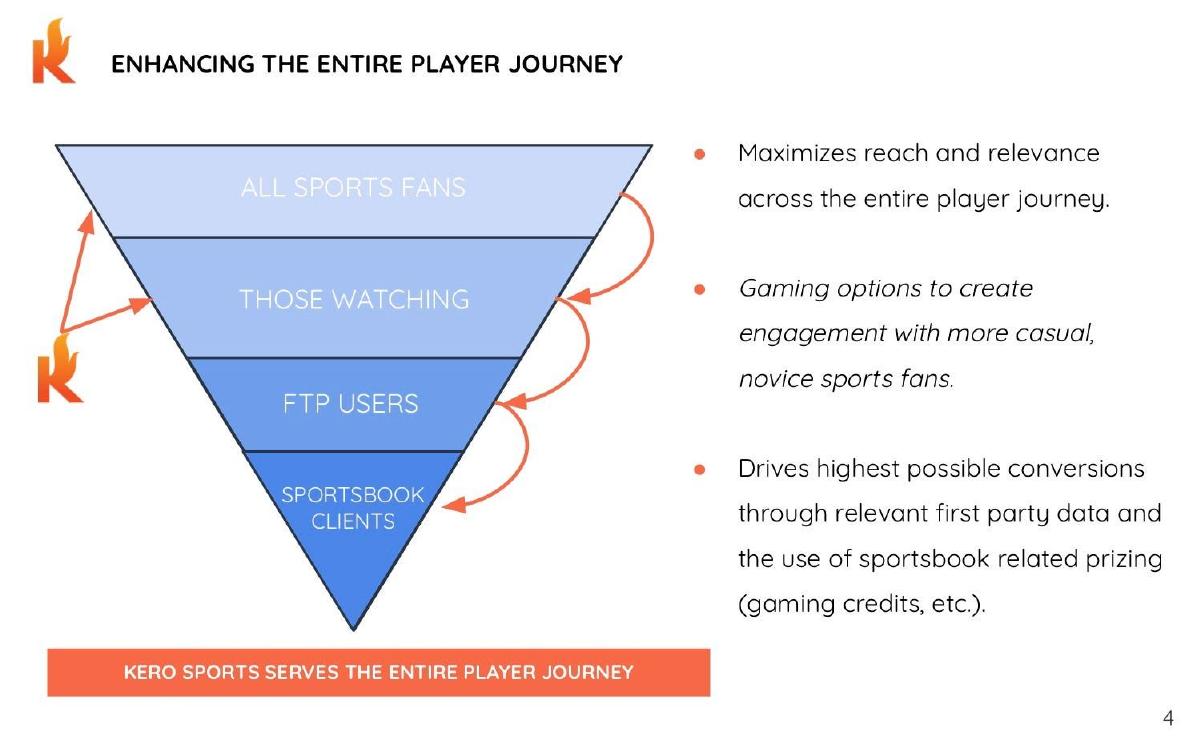
- The company targets a full-funnel conversion strategy, moving users from casual fans to 'Sportsbook Clients' (Slide 4).
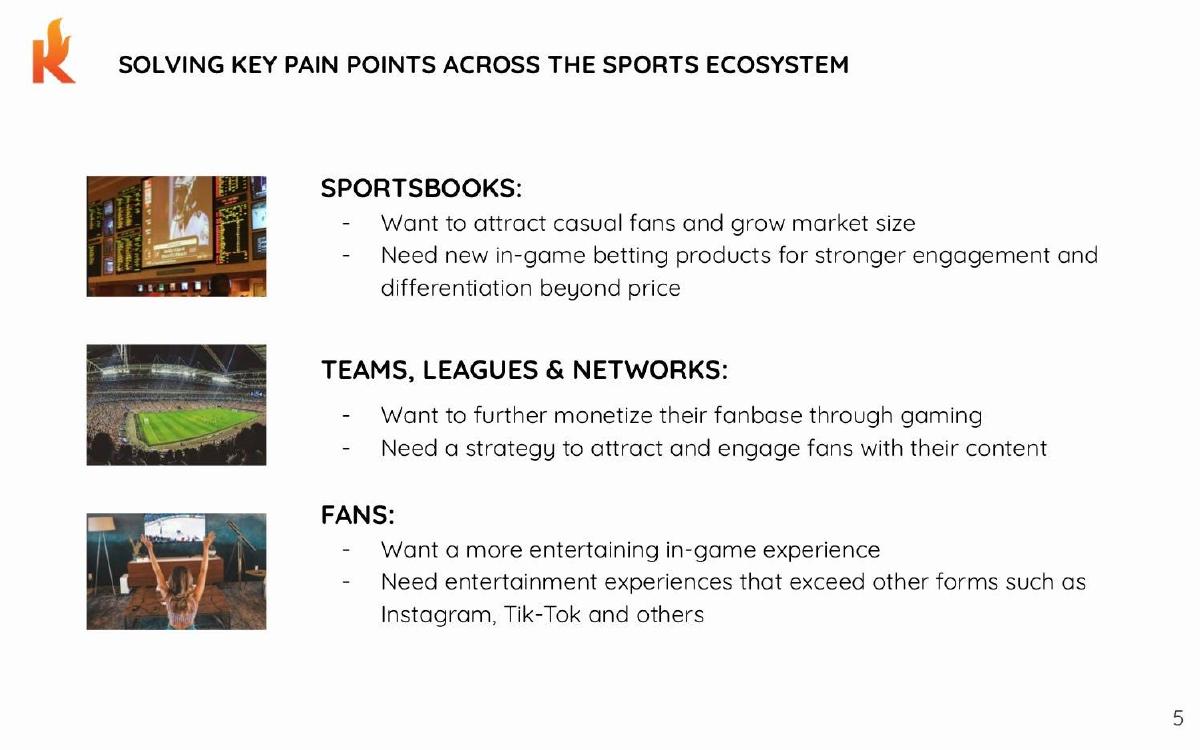
- The deck addresses three distinct customer pain points: Sportsbooks, Teams/Leagues, and Fans (Slide 5).
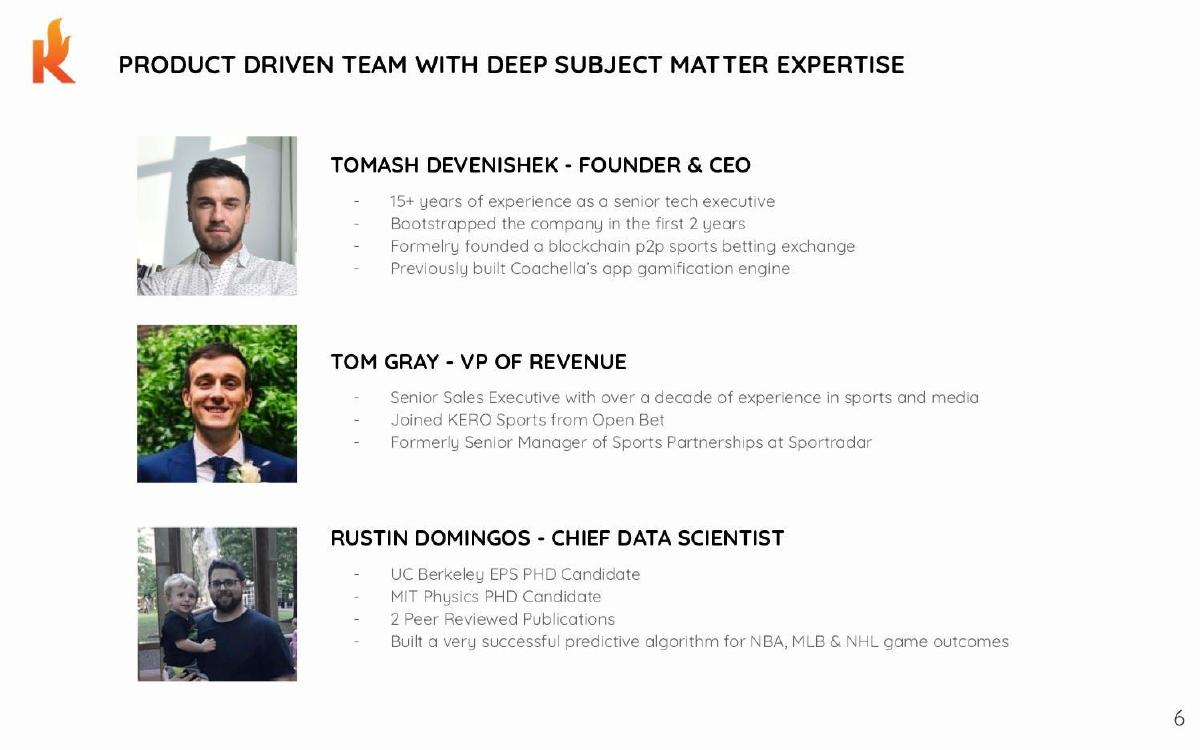
- The team slide emphasizes technical depth, featuring a Chief Data Scientist with PhD candidacy at both UC Berkeley and MIT (Slide 6).
The 6-Slide Seed Deck: Kero Sports' Minimalist Approach
Kero Sports raised $1M in 2024 (as reported by Business Insider) using a deck that is remarkably brief. At only six slides, it defies the conventional wisdom that a Seed deck must be 12-15 pages covering everything from TAM to exit multiples. Instead, Kero Sports focuses on a singular narrative: the gamification of the live sports viewing experience through high-frequency micro-betting.
Slide 1: The Thesis
The deck opens with a bold, text-only provocation: "TODAY’S SPORTS BETTING PRODUCTS WILL BE REJECTED BY THE NEXT GENERATION." This slide serves as a 'Why Now' and 'Problem' slide combined. It suggests that the current state of the industry—likely referring to static odds and complex spreadsheets of betting lines—is incompatible with the consumption habits of younger fans who are accustomed to short-form, interactive content like TikTok.
Slide 2: The Future of Betting
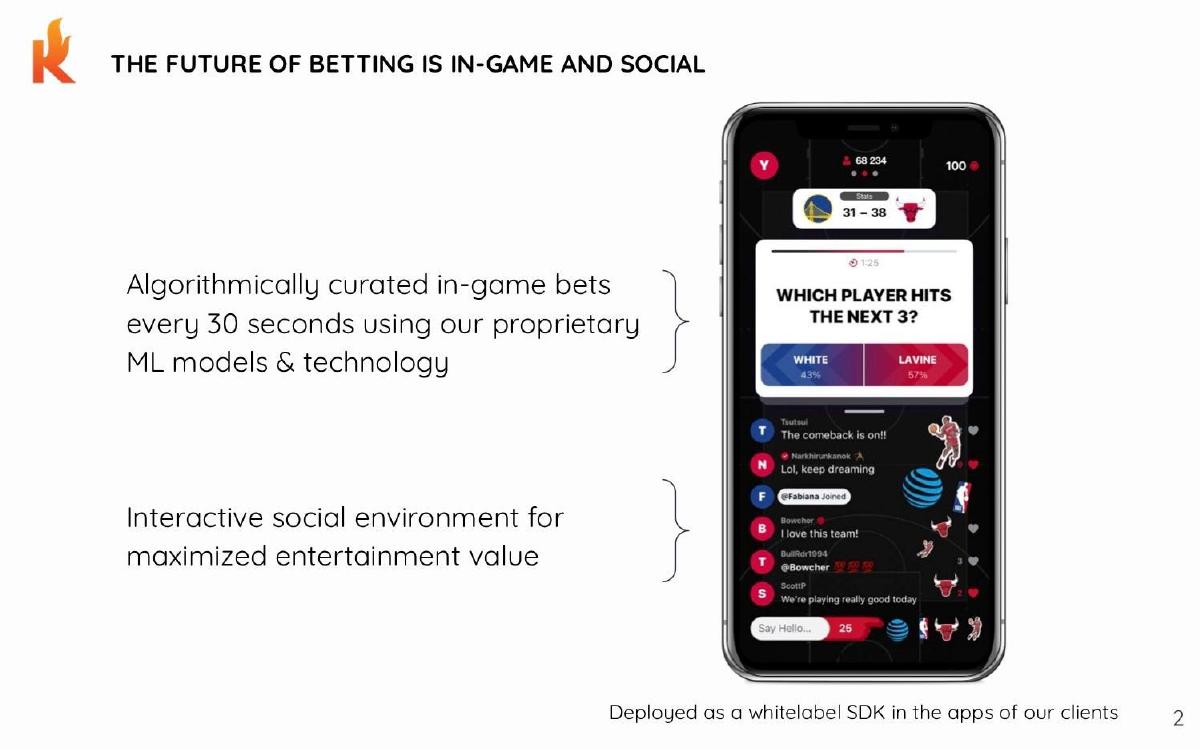
Slide 2 introduces the solution and the delivery mechanism. It defines the future as "IN-GAME AND SOCIAL." Crucially, a small note at the bottom of the slide reveals the business model: "Deployed as a whitelabel SDK in the apps of our clients." This is a vital distinction for investors. Kero is not building a standalone app that requires millions in CAC (Customer Acquisition Cost) to compete with DraftKings; they are building a component that teams and leagues can plug into their own apps to increase engagement.
The slide also introduces the technical moat: "Algorithmically curated in-game bets every 30 seconds using our proprietary ML models & technology." This sets the stage for a product that is as much a data science play as it is a gaming play.
Slide 3: The User Experience (How It Works)
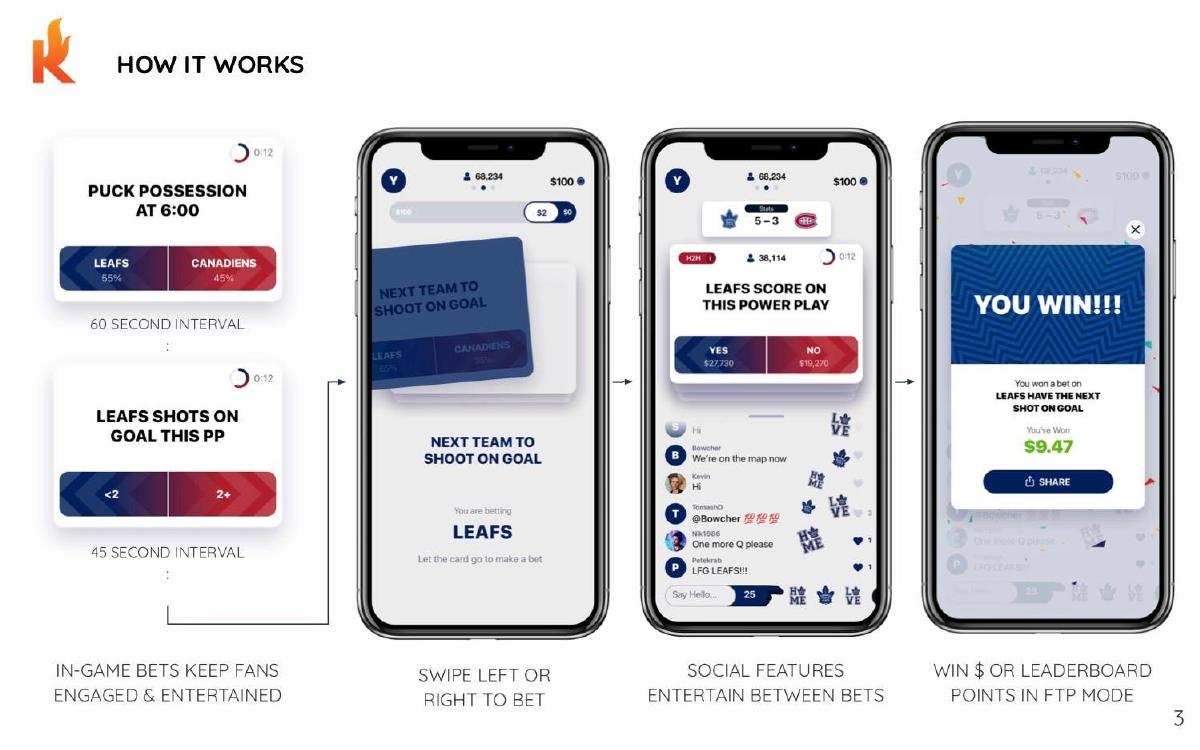
This slide provides a visual walkthrough of the product. It shows a four-step process: 60-second intervals for puck possession, a "SWIPE LEFT OR RIGHT TO BET" mechanic (reminiscent of dating apps), social features like chat and emojis to "ENTERTAIN BETWEEN BETS," and finally, the win screen. The win screen notes that users can "WIN $ OR LEADERBOARD POINTS IN FTP MODE," showing the flexibility of the platform to operate in both regulated betting markets and non-betting engagement scenarios.
Slide 4: The Player Journey
Slide 4 uses an inverted pyramid to explain the conversion funnel. It starts with "ALL SPORTS FANS" at the top and narrows down to "SPORTSBOOK CLIENTS" at the bottom. The text explains that the platform "maximizes reach" by offering gaming options for "casual, novice sports fans." The ultimate goal is to drive "highest possible conversions through relevant first party data." This slide is the closest the deck gets to a business strategy, explaining how Kero creates value for the enterprise clients who buy their SDK.
Slide 5: The Ecosystem Pain Points
This slide breaks down the value proposition for three key stakeholders:
Sportsbooks: Need to attract casual fans and differentiate beyond price. · Teams, Leagues & Networks: Want to monetize their fanbase and keep them engaged with their content. · Fans: Want an experience that exceeds other forms of entertainment like Instagram and TikTok.
By addressing all three, Kero positions itself as a 'rising tide' solution that helps every player in the sports ecosystem rather than a disruptor trying to kill off the incumbents.
Slide 6: The Team
The final slide focuses on technical and industry expertise. Tomash Devenishek (CEO) is noted for having 15+ years of experience and previously building a blockchain betting exchange. Tom Gray (VP of Revenue) brings industry connections from Open Bet and Sportradar. The most notable entry is Rustin Domingos (Chief Data Scientist) , who is listed as a PhD candidate at both UC Berkeley and MIT, with a history of building predictive algorithms for the NBA, MLB, and NHL. This validates the 'proprietary ML' claims made earlier in the deck.
What Works in the Kero Sports Deck
1. Extreme Focus: The deck does not waste time on market size slides that every investor already knows (e.g., 'The sports betting market is huge'). It assumes the investor knows the market and focuses entirely on why Kero's specific approach is better.
2. The SDK Strategy: By explicitly stating they are a whitelabel SDK, they solve the 'distribution' question immediately. Investors often fear the high marketing costs of consumer betting apps; Kero sidesteps this by piggybacking on the existing audiences of professional sports teams.
3. Visual Product Walkthrough: Slide 3 is excellent. It shows the 'swipe to bet' mechanic, which immediately communicates how the product feels. It looks like a social media app, not a financial trading platform, which reinforces the 'next generation' thesis from Slide 1.
4. Technical Credibility: In a space crowded with 'idea' founders, having a Chief Data Scientist with MIT and Berkeley credentials building the actual algorithms provides a significant moat against copycats.
What is Missing from the Kero Sports Deck
1. The Ask: There is no slide stating how much money they are raising, the terms, or what the milestones for the next 18 months are. While this information is often omitted from public versions of decks, its absence in a 6-slide deck makes the presentation feel like a teaser rather than a full pitch.
2. Traction and Case Studies: The deck mentions they are 'deployed' in the apps of clients, but it doesn't name them or provide metrics. How many users? What is the engagement rate? How much has the 'swipe' mechanic increased betting volume? Without these numbers, the 'proprietary ML' remains a theoretical benefit.
3. Competition: The micro-betting space is becoming crowded (e.g., nVenue, Simplebet). The deck makes no effort to explain why Kero's algorithms or user interface are superior to these well-funded competitors.
4. Unit Economics: There is no mention of the revenue model. Is it a SaaS fee for the SDK? A rev-share on the bets? A per-user engagement fee? For a Seed round, investors need to know how the company actually turns engagement into cash.
Founder's Guide: What to Copy
The 'Stakeholder Slide': Slide 5 is a perfect example of how to pitch a B2B2C product. If your startup serves multiple masters (e.g., a marketplace or an integration), you must show that you understand the incentives of every party involved. Kero clearly articulates what the Sportsbook wants vs. what the Team wants.
The 'Swipe' Visualization: If your product has a unique UI/UX that is central to your value prop, show it in a step-by-step flow like Slide 3. Don't just say 'it's easy to use'; show the user's thumb moving across the screen.
The Thesis-Driven Opening: Starting with a 'Why Now' statement that challenges the status quo (Slide 1) is a great way to frame the rest of the conversation. It forces the investor to either agree with your worldview or argue against it, both of which lead to a more engaged meeting.
Lean Team Profiles: Slide 6 avoids the 'fluff' of listing every minor award. It focuses on the specific experiences that qualify these three people to build this specific company . The mention of building Coachella’s gamification engine is a great 'analogous experience' that proves the founder can handle high-scale live events.
Frequently asked questions
- How does Kero Sports differentiate itself from traditional sportsbooks?
- According to Slide 2 and 5, Kero Sports differentiates by focusing on high-frequency, in-game micro-bets (every 30 seconds) and a social environment. Unlike traditional sportsbooks that focus on pre-game or simple live odds, Kero uses proprietary ML to create a 'TikTok-like' interactive experience designed to attract casual fans who might find standard betting interfaces unappealing.
- What is the primary distribution strategy for Kero Sports?
- As stated on Slide 2, the product is 'deployed as a whitelabel SDK in the apps of our clients.' This means Kero Sports does not necessarily compete for direct consumer downloads; instead, they integrate their gaming engine into the existing mobile applications of professional sports teams, leagues, and media networks.
- What specific technology powers the Kero Sports platform?
- Slide 2 and Slide 6 highlight the use of proprietary Machine Learning (ML) models. The team includes a Chief Data Scientist who previously built predictive algorithms for NBA, MLB, and NHL outcomes. This technical stack allows the platform to generate real-time betting markets, such as 'Next team to shoot on goal,' within seconds of game action.
- How does the platform handle users who cannot or will not bet real money?
- Slide 3 and Slide 4 clarify that the platform includes a 'Free-to-Play' (FTP) mode. In this mode, users win leaderboard points instead of cash. This serves as a top-of-funnel engagement tool to convert casual fans into eventual sportsbook clients through the use of 'sportsbook related prizing' like gaming credits.
- Is there a clear exit strategy or financial goal mentioned in the deck?
- No. The 6-slide deck is strictly focused on the problem, product, and team. It omits financial projections, current revenue metrics, and an exit strategy. This suggests the deck was likely used as a visual aid for a conversation where those details were handled in a separate data room or verbal pitch.