Kasa Living’s 2020 Series B deck is a masterclass in positioning a hospitality brand during a period of extreme market volatility. The company raised $30 million by emphasizing an asset-light model that partners with multifamily and boutique hotel owners rather than owning real estate directly. The deck highlights a 50% growth in units under management between December 2019 and September 2020, even as the broader travel industry stalled. By focusing on technology-driven efficiency—such as contactless check-in and automated guest screening—Kasa demonstrated a 20-50% increase in Net Operating I…
Key takeaways
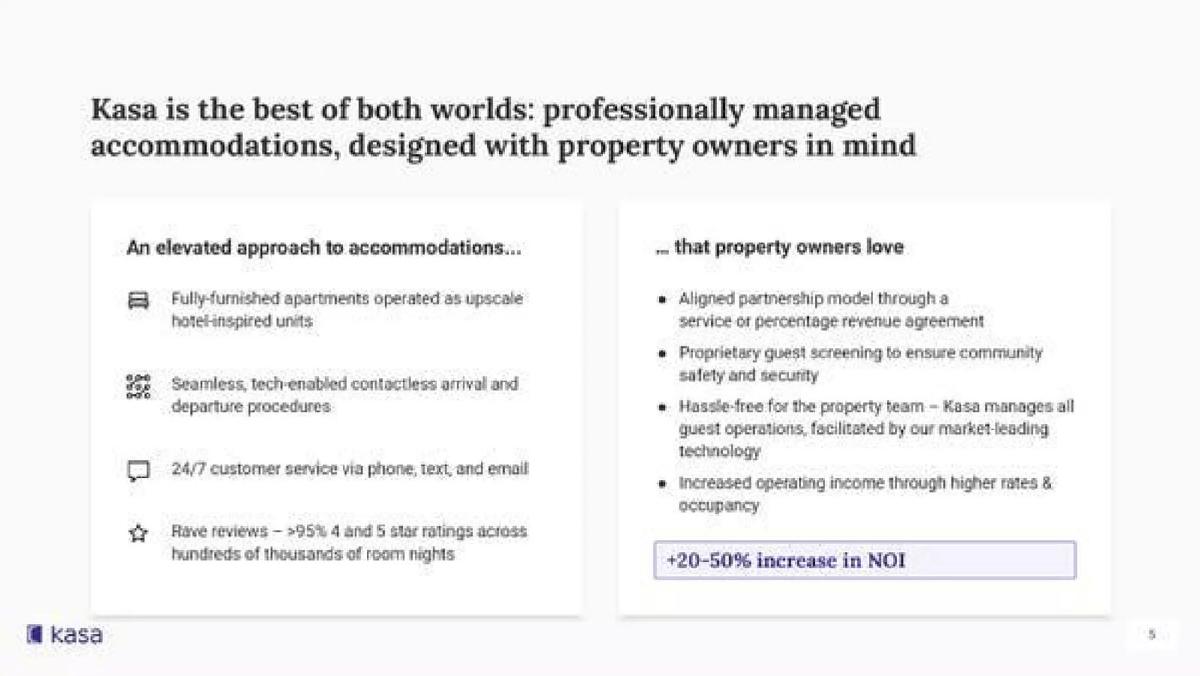
- The deck claims Kasa provides a 20-50% increase in Net Operating Income (NOI) for property owners (Slide 5).
- Kasa achieved 50% unit growth between December 2019 and September 2020, shifting entirely to service agreements (Slide 17).
- The business model is highly flexible, allowing management of anything from a few individual apartments to full buildings (Slide 7).
- Technology is used to replace traditional hotel staff, featuring contactless arrival and 24/7 digital customer service (Slide 5).
- The Series B round closed in August 2020 for $30 million, led by Ribbit Capital (Slide 21).
- Enterprise value increased by 300% between the Seed and Series A rounds, and by 100% between Series A and Series B (Slide 21).
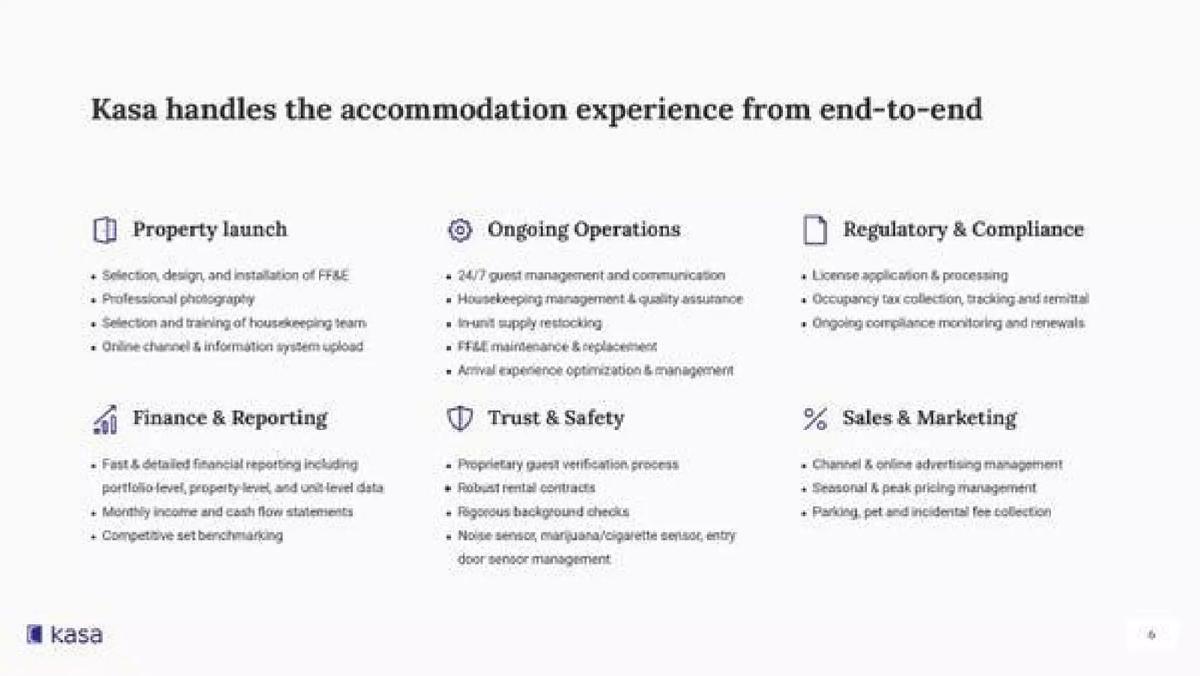
- Safety and trust are automated through noise sensors, smoking sensors, and background checks (Slide 23).
- The leadership team includes alumni from KKR, Citadel, BCG, and Airbnb, signaling deep institutional expertise (Slide 19).
The Asset-Light Hospitality Playbook
Kasa Living’s Series B deck arrived at a pivotal moment for the hospitality industry. Founded in 2016, the company spent its early years refining a model that sat between Airbnb and traditional hotels. By the time they raised their $30 million Series B in August 2020, the world had changed. This deck is a clinical example of how to pitch growth and stability when the surrounding macro environment is in chaos. Instead of focusing on the 'romance' of travel, Kasa focused on the 'rigor' of real estate operations.
The Problem and The Kasa Solution
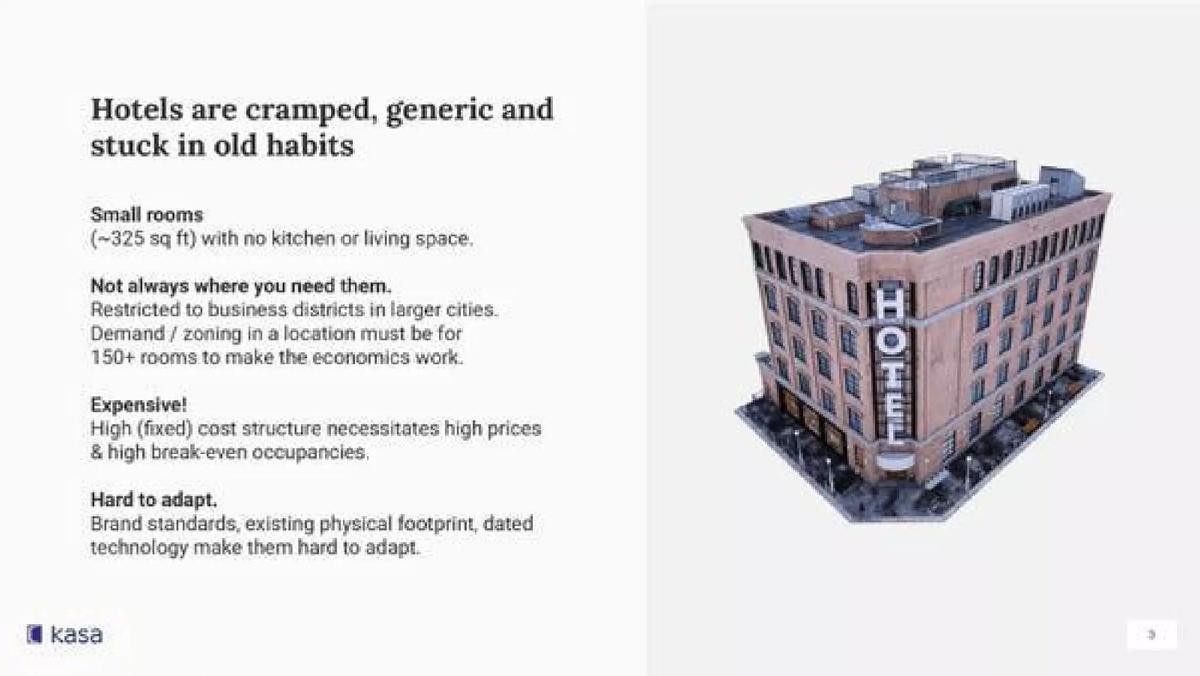
Slide 3 sets the stage by attacking the traditional hotel model. It characterizes hotels as 'cramped, generic and stuck in old habits.' The slide specifically notes that hotels require 150+ rooms to make economics work and suffer from high fixed cost structures. This is a classic 'David vs. Goliath' setup, where the incumbent is portrayed as too rigid to survive modern shifts.
Slide 5 introduces the Kasa alternative. It splits the value proposition into two distinct categories: what guests get and what property owners get. For guests, it is about 'upscale hotel-inspired units' and 'contactless arrival.' For owners, the hook is a '20-50% increase in NOI' (Net Operating Income). This is the most important figure in the deck for a Series B investor, as it proves the business isn't just a lifestyle brand, but a financial optimization tool for real estate holders.
Scalability and Flexibility
Slide 7 uses a simple Lego-style graphic to explain their flexibility. Kasa doesn't need to take over an entire building to be profitable. They can manage 'Individual' units (a few apartments), 'Partial buildings' (one or more floors), or 'Full buildings.' This modularity is a key differentiator from traditional hotel brands that require total control of a physical asset. It allows Kasa to land and expand within a single property developer's portfolio.
Slide 9 and 11 focus on the brand aesthetic and the digital interface. The photography is high-end, emphasizing 'elevated accommodations.' Slide 11 shows the booking interface on mobile and tablet, reinforcing the 'tech-enabled' nature of the business. By keeping the booking and check-in process entirely digital, Kasa removes the need for a front desk, which is one of the largest overhead costs in hospitality.
Performance During Crisis
Slide 13 and 15 address the 2020 performance update. Slide 15 is particularly dense with strategic proof points. It mentions that their 'geographic diversity' across 'drive-to markets' stabilized results during the recession. They also highlight 'capital efficiency,' which ensured sufficient runway. This slide is designed to de-risk the investment by showing that the model has already been 'proven out' under the worst possible market conditions.
Slide 17 provides the 'hockey stick' moment. It shows 50% unit growth since the end of 2019. Crucially, it notes that 'all new units are service agreements.' This indicates a shift away from master leases (where the startup takes the rent risk) toward a pure management model (where the startup takes a fee). This is a much more attractive, lower-risk profile for venture capitalists. The slide also identifies the '300K units built / yr' in new developments as their primary growth engine.
Team and Funding History
Slide 19 presents the leadership team. It is a 'pedigree' slide, featuring logos from KKR, Citadel, BCG, Airbnb, and Wharton. For a Series B, investors want to see that the founders have surrounded themselves with 'operators' who have scaled large organizations. The recent additions from companies like Uber and Salesforce suggest a focus on scaling the technology and operations rather than just the real estate footprint.
Slide 21 is a transparent look at their funding history. It shows a steady climb in capital raised and enterprise value. The fact that their Series B was led by Ribbit Capital—a firm known for fintech—suggests that investors view Kasa as much as a financial platform as a hospitality company. The slide also notes that all major previous investors (Zigg Capital, FirstMark, etc.) participated pro-rata, which is a strong signal of internal confidence.
Safety and Final Value Prop
Slide 23 dives into the 'Trust and Safety' stack. In a post-COVID world, and in the context of multifamily residential buildings, safety is a major hurdle. Kasa lists 'Noise sensors,' 'Cigarette + marijuana sensors,' and 'Federal and local background checks.' This technology replaces the physical security guard and gives property owners peace of mind that short-term guests won't disrupt long-term residents.
Slide 25 concludes with a summary of the 'unparalleled flexibility.' It reiterates the core message: Kasa helps guests stay for a few days or a few months, and helps property partners turn vacancy into cash flow. It frames the service as an 'amenity for existing neighbors,' further softening the perceived friction of bringing short-term rentals into residential buildings.
What Works in This Deck
Financial Focus: By leading with the 20-50% NOI increase, Kasa speaks the language of their true customers: property owners. · Resilience Narrative: The deck successfully turns the 2020 pandemic from a threat into a proof point, showing that their model thrives when traditional hotels fail. · Asset-Light Transition: Clearly stating that all new growth comes from service agreements shows a path to high-margin, scalable revenue. · Tech-Operational Balance: The deck balances 'soft' brand elements (interior design) with 'hard' operational tech (sensors and screening).
What Is Missing
Unit Economics Detail: While they mention NOI increases for owners, the deck lacks a slide showing Kasa's own unit economics—specifically their CAC (Customer Acquisition Cost) vs. LTV (Lifetime Value) for guests. · Competitive Landscape: There is no mention of direct competitors like Sonder or Mint House. Investors at the Series B level usually want to see how a company differentiates itself from other well-funded players in the same niche. · Retention Data: The deck mentions 'rave reviews,' but lacks data on repeat guest rates or the length of stay distribution, which is critical for understanding the stability of their demand.
What a Founder Should Copy
The 'Lego' Slide: If your business has a modular service offering, use a simple visual like Slide 7 to show how you can start small and scale within a client's organization. · The Funding Table: Slide 21 is an excellent way to show momentum. Including the '% increase in enterprise value' between rounds is a bold way to signal that the company is getting more valuable, not just larger. · The 'Proven Out' Slide: If you are raising during a downturn, dedicate a slide (like Slide 15) to explaining exactly why your specific model is resilient to the current macro pressures.
Frequently asked questions
- What is Kasa Living's core business model?
- Kasa operates as a technology-enabled hospitality manager. Instead of owning buildings, they partner with multifamily and boutique hotel owners through service or percentage revenue agreements. They transform these units into furnished, short-term accommodations for business and leisure travelers, handling all operations, marketing, and guest services digitally to maximize the owner's Net Operating Income.
- How did Kasa perform during the 2020 pandemic?
- According to Slide 17, Kasa saw 50% growth in units under management from the end of 2019 through September 2020. They pivoted to focus on 'drive-to' markets and utilized their capital-efficient model to maintain runway. Their ability to take over vacant furnished units quickly allowed them to capture demand from owners seeking flexibility during market uncertainty.
- What specific technology does Kasa use to manage properties?
- The deck highlights several tech-driven features: contactless arrival/departure, 24/7 digital customer service (Slide 5), and proprietary guest screening. For physical property management, they deploy noise sensors, cigarette/marijuana sensors, and automated federal/local background checks to ensure community safety without needing on-site security staff (Slide 23).
- Who are the lead investors in Kasa Living?
- Slide 21 details the funding history. The Series Seed ($6.3M) was led by Zigg Capital, BoxGroup, and Founder Collective. The Series A (~$21M) was led by FirstMark Capital and RET Ventures. The Series B ($30M) was led by Ribbit Capital, with pro-rata participation from all previous major investors.
- What is the value proposition for property owners?
- For owners, Kasa promises a 20-50% increase in NOI (Slide 5). They offer a 'hassle-free' experience where Kasa manages all guest operations. Owners benefit from diversified risk, as Kasa can flex the number of units managed up or down based on occupancy needs, effectively turning vacant apartments into cash-flowing hospitality assets (Slide 25).