Kangarootime’s 18-slide Series B deck is a masterclass in product-led storytelling for a multi-sided marketplace. By segmenting the value proposition for parents, educators, and directors, the company demonstrates a deep understanding of the childcare ecosystem's operational friction. The deck successfully identifies a $70B U.S. market opportunity and highlights a strategic shift toward mid-market and enterprise clients, who represent 17% of the 110,000 available 'rooftops.' However, for a Series B round, the deck is notably silent on hard performance data. There are no slides dedicated to AR…
Key takeaways
- The company identifies a $70B U.S. early childhood education market and a $13.7B Australian market on Slide 3.
- Kangarootime explicitly targets the mid-market and enterprise segment, which accounts for 17% of the 110,000 total rooftops, as stated on Slide 3.
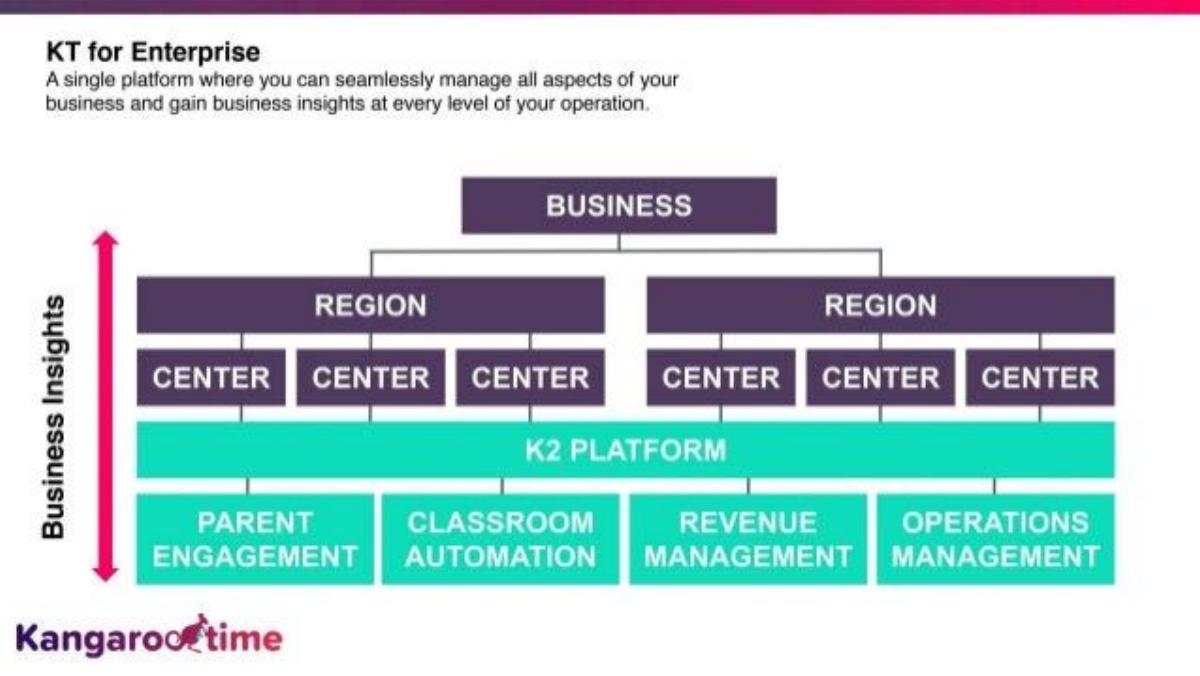
- The 'K2 Platform' architecture on Slide 4 visualizes how business insights flow from individual centers up to regional and business-level management.
- Product value is segmented into four distinct experiences: Parent, Educator, Director, and Enterprise, spanning Slides 7 through 13.
- The Parent Experience includes integrated features like in-app payments, daily reports, and QR code check-ins, shown on Slides 8 and 9.
- Customer support is positioned as a core product feature on Slide 14, offering 24-hour response times and dedicated success reps.
- The deck lacks any mention of revenue, growth rates, or unit economics, which are standard for a Series B presentation.
- There is no team slide, leaving the background and expertise of the founders and executives to the investor's imagination.
Kangarootime: A Product-First Approach to Childcare Scaling
Kangarootime’s Series B pitch deck is a highly visual, feature-forward presentation that aims to position the company as the operating system for the childcare industry. With 18 slides, the deck moves quickly from market opportunity to a deep dive into the user interface. While it successfully argues for the necessity of a unified platform in a fragmented market, it relies heavily on the product's aesthetics and functionality rather than the financial engine behind the business.
Slides 1-2: The Introduction and Hook
Slide 1 serves as the cover, featuring the company logo and the tagline: "The most sophisticated childcare management software." As noted in the editorial context, this tagline is descriptive but lacks a compelling emotional or financial hook. The imagery of children and teachers in a classroom setting immediately establishes the sector, but the slide misses an opportunity to signal the scale of the company’s ambition.
Slide 2 is a transition slide titled "Who is Kangarootime?" It features a placeholder for a video link. In a live pitch, this is where the narrative would likely be established. For a static deck, however, this slide provides zero information, forcing the reader to click away to understand the company's 'why.'
Slide 3: Market Overview and Strategic Focus
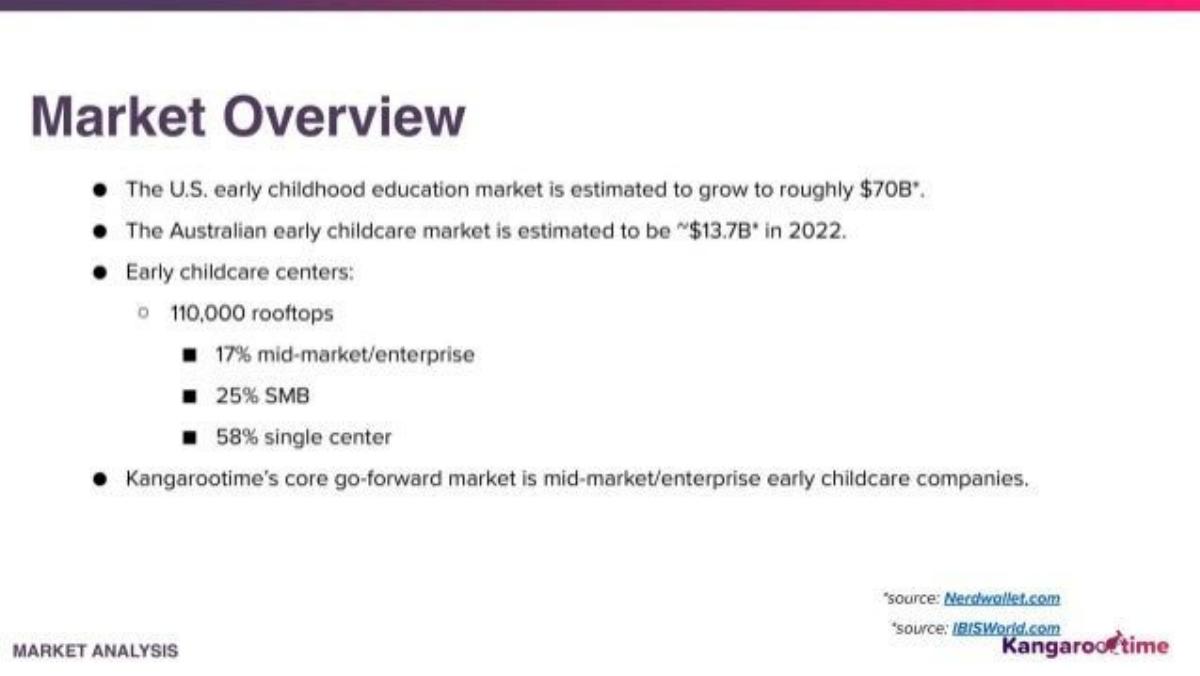
Slide 3 is one of the most informative slides in the deck. It provides a clear breakdown of the market opportunity, citing a $70B U.S. market and a $13.7B Australian market. Crucially, it segments the 110,000 U.S. 'rooftops' (childcare centers) into three categories: 17% mid-market/enterprise, 25% SMB, and 58% single center. The slide explicitly states that Kangarootime’s "core go-forward market" is the mid-market and enterprise segment. This is a vital signal to Series B investors that the company is moving upmarket to capture higher contract values and better retention.
Slides 4-6: Platform Architecture and Overview
Slide 4 introduces the "KT for Enterprise" model. It uses a hierarchical diagram to show how the "K2 Platform" sits beneath the business, regional, and center levels. This visualizes the flow of "Business Insights" across parent engagement, classroom automation, revenue management, and operations management. It effectively communicates that Kangarootime is not just a point solution for one school, but a management layer for large-scale organizations.
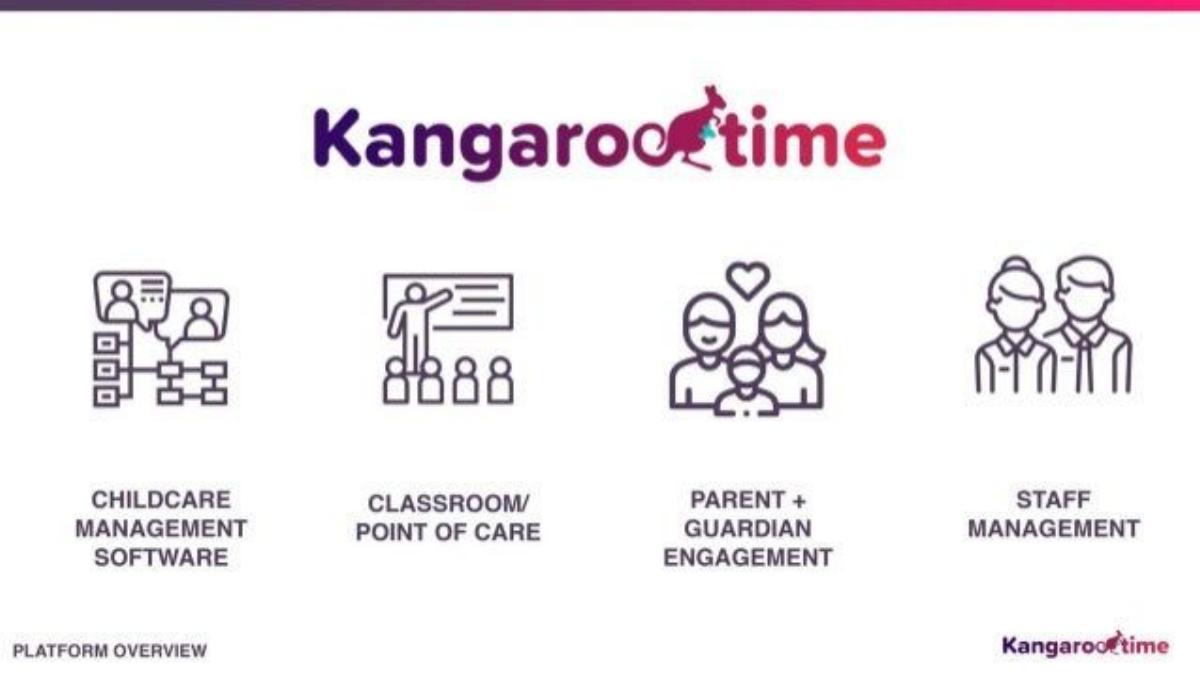
Slide 5 provides a high-level "Platform Overview" using four icons: Childcare Management Software, Classroom/Point of Care, Parent + Guardian Engagement, and Staff Management. This slide acts as a table of contents for the product deep dive that follows.
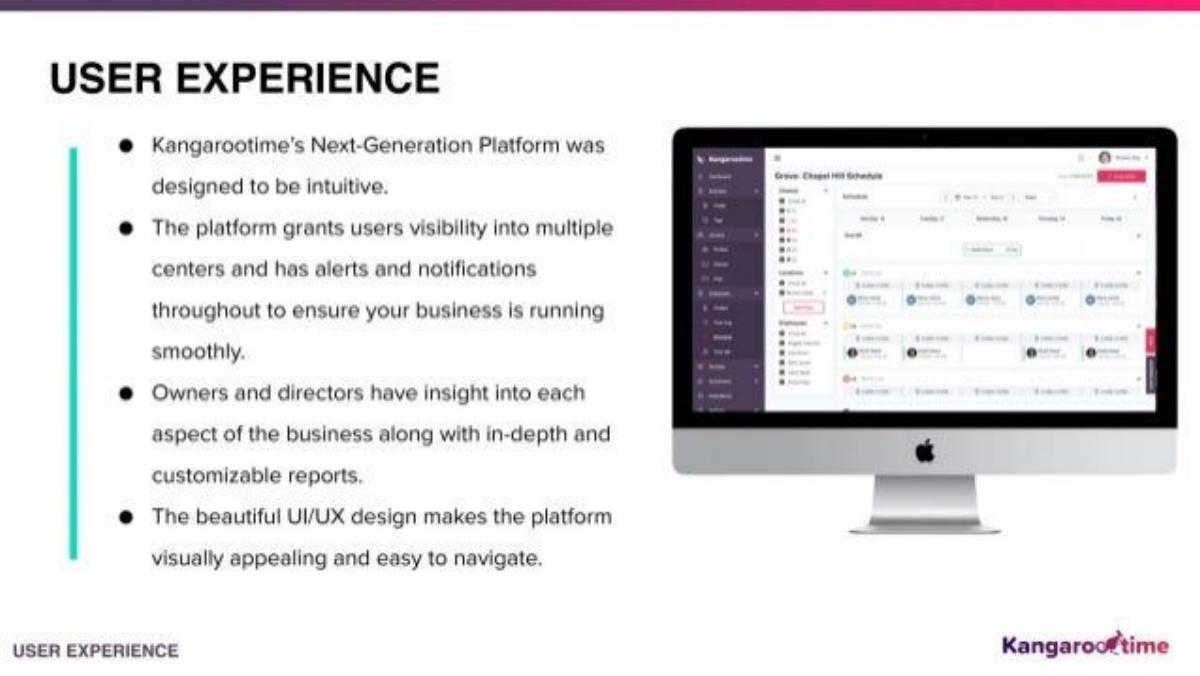
Slide 6 focuses on "User Experience," asserting that the platform is "designed to be intuitive." It highlights visibility into multiple centers and customizable reports. The inclusion of an iMac mockup showing the dashboard reinforces the professional, enterprise-grade nature of the software.
Slides 7-10: The Parent Experience
Slide 7 lists the features of the "Parent Experience," including daily reports, photos/videos, portfolios, and in-app payments. Slide 8 and Slide 9 use mobile mockups to show these features in action, specifically highlighting the "Gallery Feed" and "QR Code Child Check-in." Slide 10 shows the "Kiosk" interface, which is the physical touchpoint for parents at the center. By dedicating four slides to the parent, Kangarootime emphasizes the B2C aspect of their B2B2C model, suggesting that parent satisfaction is a key driver of center adoption.
Slides 11-13: Educator, Director, and Enterprise Experiences
Slide 11 covers the "Educator Experience," listing tactical classroom tools like "Name-to-face recognition" and "Daily health checks." Slide 12 pivots to the "Director Experience," focusing on administrative burdens like "Ratio Management" and "Billing Management." Slide 13 concludes the product section with "Enterprise Tools," which include franchise oversight and the ability to oversee unit revenue and profitability. This progression shows that Kangarootime has built a comprehensive ecosystem that solves pain points for every stakeholder in a childcare business.
Slides 14-17: Support and Social Proof
Slide 14 highlights "Best-in-Class Customer Support." In the crowded SaaS space, support is often a differentiator. The slide lists phone, email, and chat availability from 6 a.m. to 8 p.m. EST and promises a 24-hour response time. This is intended to de-risk the investment by showing the company can successfully onboard and retain non-technical users.
Slides 15, 16, and 17 are dedicated to customer testimonials from "The Academy," "Care-a-lot," and "Prairie Hills Child Care Center." While these provide social proof, having three separate slides for quotes is arguably redundant. These could have been condensed to make room for the missing financial data.
Slide 18: Use of Funds
Slide 18 outlines how the Series B capital will be deployed. The focus is almost entirely on human capital: hiring Key Executives, a VP of Marketing, a VP of Engineering, Data Scientists, and Sales Development Representatives. While it mentions "increasing sales and marketing efforts" and "gaining more market share," it lacks specific targets or a breakdown of how the $26M (as noted in the catalogue) will be allocated across these departments.
What Kangarootime Does Well
The deck is exceptionally clear about who the product is for and what it does . By breaking the platform down into four distinct user experiences, Kangarootime demonstrates a nuanced understanding of the childcare industry's operations. The market segmentation on Slide 3 is also a highlight; it shows that the founders aren't just chasing every childcare center, but have a specific, high-value target in the enterprise segment. The visual design is clean, consistent, and professional, which aligns with their "sophisticated" branding.
What is Missing from the Deck
For a Series B deck, the omissions are significant. There is no mention of revenue. Investors at this stage typically expect to see a "Traction" slide showing ARR growth, logo retention, and net dollar retention. There is also no competitive landscape . Childcare management is a competitive space with players like Brightwheel and HiMama; failing to address how Kangarootime wins against them is a major gap. Finally, the absence of a Team slide is unusual. At the Series B level, the pedigree and experience of the leadership team are often as important as the product itself.
Founder's Playbook: What to Copy
Segment your value proposition: If your software has multiple user types (e.g., admins, employees, end customers), follow Kangarootime's lead and give each their own slide. It proves you understand the workflow of the entire organization. · Define your 'Go-Forward' market: Don't just show a massive TAM. Show the specific slice of the market you are prioritizing and explain why (e.g., Slide 3’s focus on enterprise rooftops). · Use high-fidelity mockups: The screenshots on Slides 6, 8, and 12 are clear and professional. They make the product feel real and ready for scale. · Position support as a feature: If you are selling into a traditional industry (like childcare or construction), showing that you have a robust support and onboarding system (Slide 14) can be a major selling point for investors worried about churn.
Frequently asked questions
- What is the primary business model of Kangarootime?
- Based on the deck and catalogue facts, Kangarootime operates as a B2C and B2B2C software platform. It provides a sophisticated childcare management system that centers use to manage operations, while also offering a mobile app for parents to handle payments, communication, and daily reporting. The catalogue listing identifies the business model specifically as an 'App' within the Familytech and EdTech sectors.
- How does Kangarootime differentiate its product for different users?
- The deck uses a segmented approach to demonstrate value. For parents (Slides 7-10), it emphasizes engagement and payments. For educators (Slide 11), it focuses on classroom automation like attendance and health checks. For directors (Slide 12), it highlights administrative tasks like enrollment and billing. Finally, for enterprise users (Slide 13), it offers franchise oversight and unit profitability tools.
- What market size does Kangarootime claim to address?
- On Slide 3, Kangarootime cites two major markets: the U.S. early childhood education market, estimated to grow to roughly $70 billion, and the Australian early childcare market, estimated at approximately $13.7 billion in 2022. They further break down the U.S. market into 110,000 'rooftops,' with their primary focus being the 17% that fall into the mid-market/enterprise category.
- What is missing from the Kangarootime Series B deck?
- The deck omits several critical Series B components: a team slide, a competition slide, and all financial metrics. There is no mention of Annual Recurring Revenue (ARR), Net Revenue Retention (NRR), or customer acquisition costs. Additionally, while the catalogue facts state they raised $26M, the 'Use of Funds' slide (Slide 18) does not specify the target raise amount or the valuation sought.
- Who are the target customers for Kangarootime?
- While the software serves single centers (which make up 58% of the market according to Slide 3), the deck explicitly states that Kangarootime's 'core go-forward market' is mid-market and enterprise early childcare companies. This strategic focus is reinforced by the inclusion of specific 'Enterprise Tools' on Slide 13, such as franchise oversight and flexible permissions.