KarmaCheck’s 2022 Series A deck is a masterclass in using founder-market fit and business model innovation to disrupt a legacy industry. Led by a LinkedIn co-founder and a former Checkr architect, the company addresses the inefficiencies of traditional background checks. The deck’s core strength lies in its financial metrics, specifically a 179% net revenue retention and a 5.6 LTV-CAC ratio. By pivoting the industry from a transactional 'pay-as-you-go' model to a predictable SaaS subscription, KarmaCheck positions itself as a 'winner takes all' trust layer. While the deck is light on specific…
Key takeaways
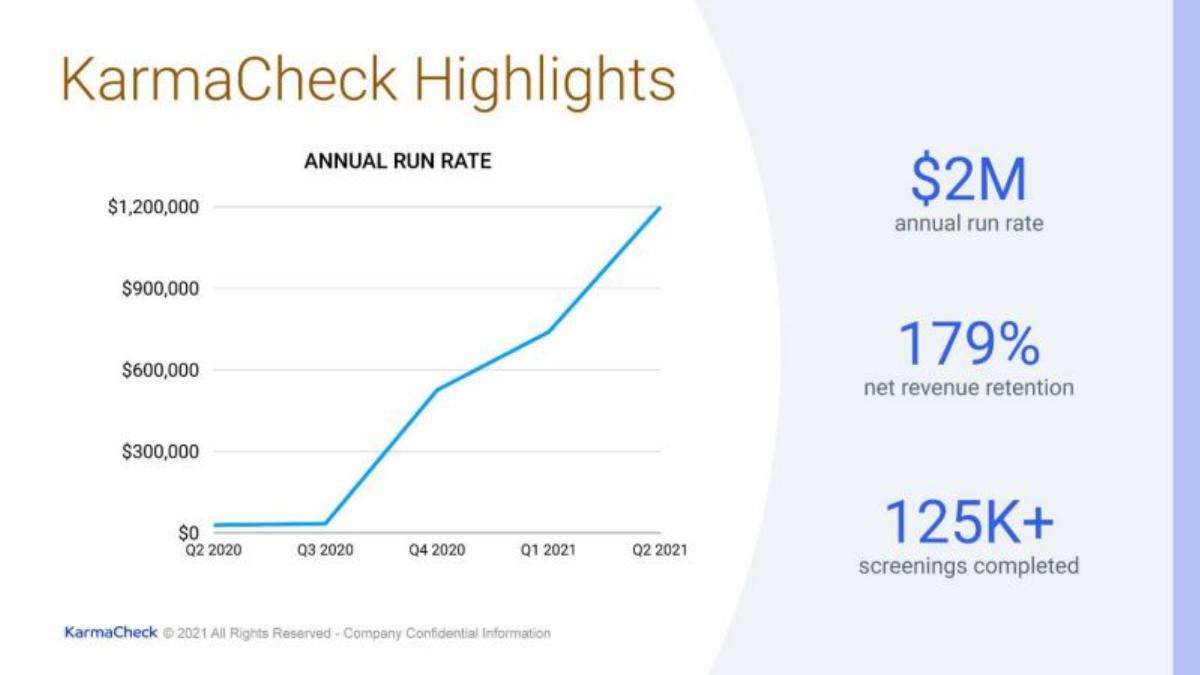
- The company achieved a $2M annual run rate and 179% net revenue retention by Q2 2021 (Slide 3).
- Leadership includes Eric Ly, a LinkedIn Co-Founder, and Shaunak Mali, an original architect at Checkr (Slide 2).
- KarmaCheck claims to be the first in the industry to offer a subscription-based pricing model for background checks (Slide 13).
- The platform has completed over 125,000 screenings for more than 100 customers (Slides 3 and 4).
- The self-serve funnel boasts a $113 CAC and a $563 LTV, resulting in 65% gross margins (Slide 15).
- The deck identifies a $13B total addressable market for background screenings and a $23B market for Consumer Identity Access Management (Slide 11).
- Competitive analysis benchmarks KarmaCheck against multi-billion dollar players like Sterling ($7.7B valuation) and Checkr ($4.6B valuation) (Slide 7).
- The 'Why Now' slide cites a 113% increase in identity theft reports in 2020 as a key driver for better verification (Slide 9).
Introduction and Founder Pedigree
Slide 1: Title Slide
The deck opens with a clean, minimalist title slide featuring the KarmaCheck logo and the tagline: "Background Checks Reimagined." The illustration shows two professionals—one wearing a headset and working on a laptop, the other using a magnifying glass to inspect a tablet—symbolizing the blend of human-centric service and digital verification.
Slide 2: Beginnings of KarmaCheck
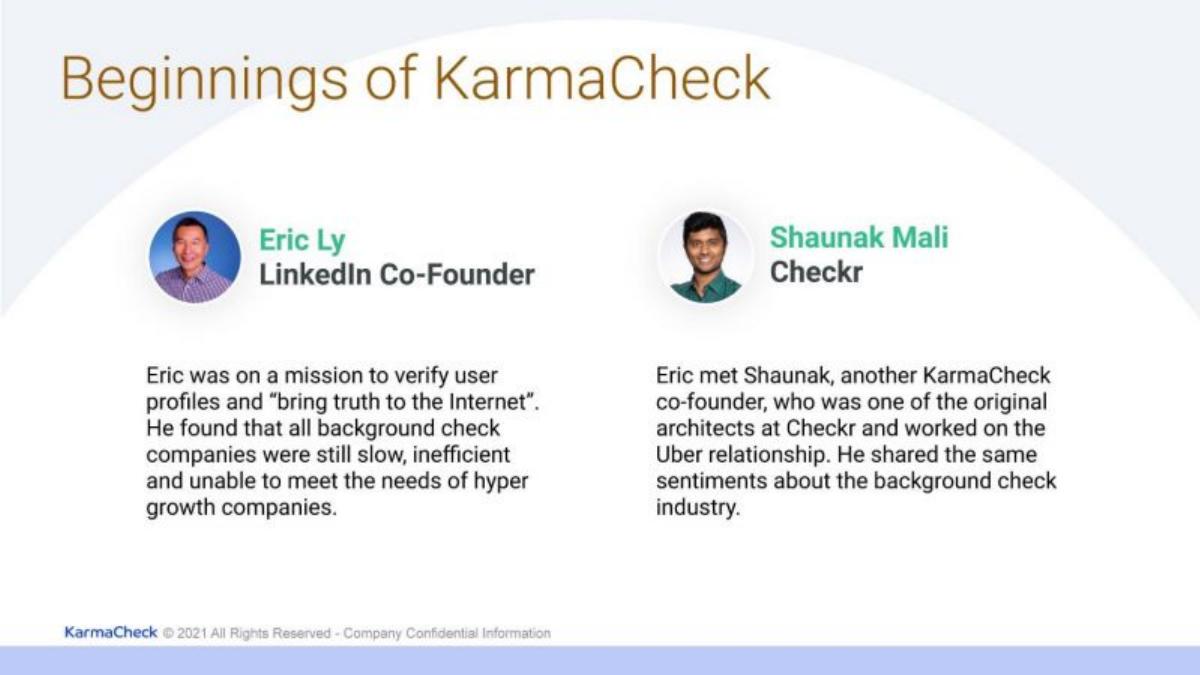
This slide establishes the "Why" through the lens of the founders. It features Eric Ly, a LinkedIn Co-Founder, and Shaunak Mali, an original architect at Checkr. The narrative states that Ly was on a mission to "bring truth to the Internet" but found existing background check companies slow and inefficient. Mali, having worked on the Uber relationship at Checkr, shared these sentiments. This slide is critical for establishing founder-market fit, showing that the team has both the vision and the technical experience to disrupt the space.
Traction and Social Proof
Slide 3: KarmaCheck Highlights
KarmaCheck presents its growth metrics early. The slide features a line graph showing a sharp increase in Annual Run Rate (ARR) starting in Q3 2020 and reaching $1.2M by Q2 2021. To the right, three key figures are highlighted: a $2M annual run rate (presumably projected or current at the time of the pitch), 179% net revenue retention, and over 125,000 screenings completed. The 179% retention figure is particularly high for the industry, suggesting that once customers start using the platform, they expand their usage significantly.
Slide 4: 100+ Satisfied Customers
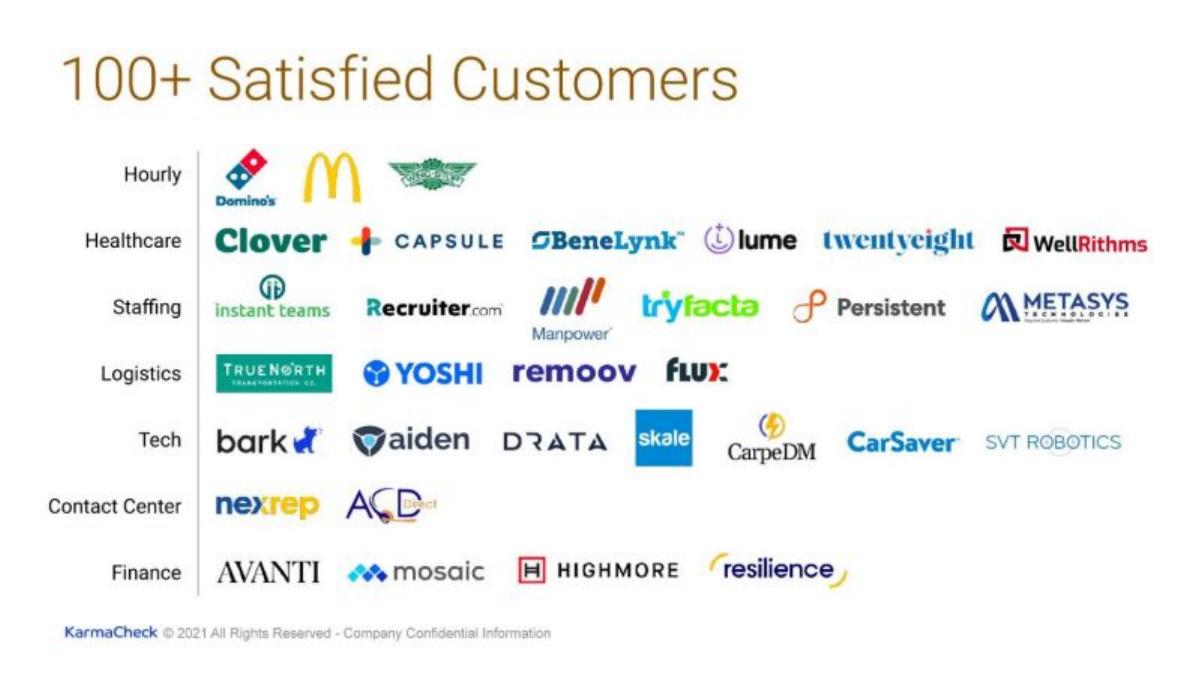
This is a classic "logo slide" categorized by industry. It demonstrates broad market applicability. Notable logos include Domino’s, McDonald’s, and Wingstop in the Hourly segment; Clover and Capsule in Healthcare; and Manpower in Staffing. Other categories include Logistics, Tech (Drata, Skale), Contact Center, and Finance. The sheer volume and variety of logos suggest that KarmaCheck has moved past the early-adopter phase and is ready for enterprise scaling.
Slide 5: What Customers Are Saying
Social proof is reinforced with five testimonials. Lisa Hill (Resilience) mentions speed and transparency; Erica McMannes (Instant Teams) notes that county checks were reduced from weeks to hours; Chris Carlisle (NexRep) claims candidate drop-offs were reduced to "only 1 in 5." These quotes specifically address the pain points of speed and conversion mentioned in the problem statement.
The Team and Market Landscape
Slide 6: Experienced Leadership
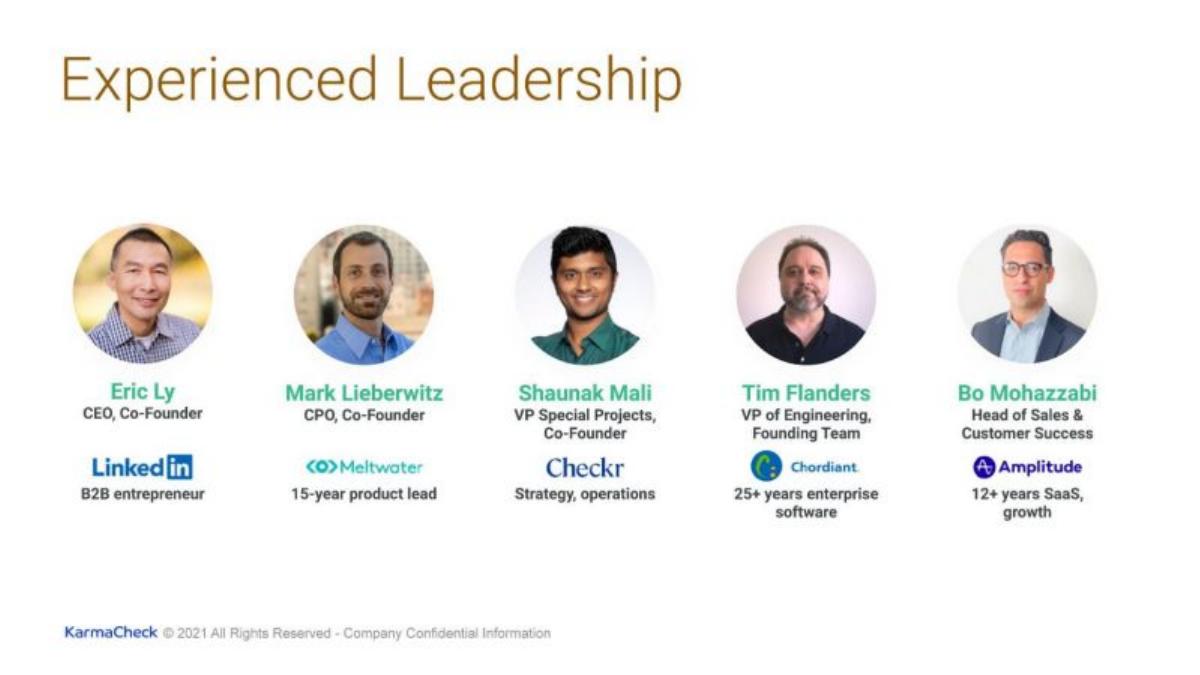
This slide expands on the team beyond the two founders. It includes Mark Lieberwitz (CPO, 15-year product lead at Meltwater), Tim Flanders (VP Engineering, 25+ years in enterprise software), and Bo Mohazzabi (Head of Sales & Customer Success, 12+ years in SaaS). The logos of LinkedIn, Meltwater, Checkr, Chordiant, and Amplitude provide a strong pedigree of high-growth tech experience.
Slide 7: Relevant Companies
KarmaCheck provides a competitive landscape table comparing itself (implicitly) against Vetty, Checkr, Certn, Truework, HireRight, First Advantage, and Sterling. The table includes Company Stage, Valuation, Revenue, Target Segment, and Revenue Model. It highlights that most competitors use a "Pay-as-you-go" model. It also shows the massive valuations in the space, such as Sterling at $7.7B and Checkr at $4.6B, indicating a large exit potential for a successful disruptor.
The Thesis and Market Opportunity
Slide 8: Thesis
The company’s thesis is broken into three points: 1) The need for identity and credentialing is accelerating. 2) Existing processes are inefficient in speed, accuracy, and cost. 3) User-centric identity access will create a disruptive "winner takes all" trust layer for the Internet. This slide transitions the deck from a simple background check tool to a broader identity platform play.
Slide 9: Why Now
This slide provides macro-economic and regulatory justification for the business. It cites that 25-30% of the US workforce are contingent workers and that the gig economy is expected to grow to $455B by 2023. It also mentions a 113% increase in identity theft reports in 2020 and the rise of regulations like FCRA, CCPA, and GDPR. These factors create a sense of urgency for automated, compliant verification.
Slide 10: What is KarmaCheck
This slide defines the product. Key features include a mobile-first experience, a candidate dashboard, and "One API to rule them all" covering OHS, IDV, MVR, licenses, and credit checks. It also mentions the "industry first and only subscription packaging." A laptop and smartphone mockup show the user interface, which appears clean and dashboard-driven.
Slide 11: Relevant Total Addressable Markets
The market size is split into two circles. Background Screenings is valued at $13B (with $6B current spend). Consumer Identity Access Management (CIAM) is valued at $23B (with $7B current spend). By including CIAM, KarmaCheck is signaling that its ambitions extend beyond HR departments into broader financial and healthcare onboarding.
The Business Model and Unit Economics
Slide 12: Go-To-Market For "Winner Takes All"
The GTM strategy is visualized as a cycle of three components: SaaS Subscriptions, Aggressive Pricing, and a Self-Serve Funnel. The goal is to build "Data Re-Use" quickly. This is a strategic pivot; instead of just selling a check, they are selling access to a verified data pool.
Slide 13: SaaS Subscriptions
This slide explains the benefits of their subscription model. It claims to promote exclusivity and solve the "multiple provider problem" common in pay-as-you-go models. Metrics on the right show a 179% net revenue retention, a 5.6 LTV-CAC ratio, and a 3-month sales cycle. These are top-tier SaaS metrics that would be highly attractive to Series A investors.
Slide 14: Aggressive Pricing
KarmaCheck leans into being the low-cost provider to gain market share. They claim to be 20% cheaper than existing automations and 40-50% cheaper in their self-serve funnel. They state that their pricing is optimized for "future profits" while competitors are stuck in the "margin & mark-up game." They project 14-16 months to profit based on CAC.
Slide 15: Self-Serve Funnel
The final data slide focuses on the efficiency of their customer acquisition. It lists a $113 CAC and a $563 LTV. It also notes 65% gross margins. The slide emphasizes "instant account provisioning," which they claim is an industry first, allowing for higher conversion rates compared to the multi-day onboarding of competitors.
Slide 16: Closing Quote
The deck ends with a strong testimonial from Richard Keske, a General Manager at a Domino’s Pizza franchise, calling KarmaCheck a "game-changer" and "hands down more efficient." This brings the focus back to the end-user benefit.
What Works, What is Missing, and What to Copy
What Works
Founder-Market Fit: Having a LinkedIn co-founder and a Checkr architect is a powerful combination. It tells investors that the team understands both the network effects of identity and the technical hurdles of background checks.
Business Model Innovation: The shift from transactional to subscription revenue is the core of the pitch. The deck successfully argues that this model leads to better retention and more predictable growth, backed by a 179% NRR figure.
Clear Competitive Benchmarking: Slide 7 is excellent. It doesn't just list names; it lists valuations and revenue models, showing exactly where the "white space" is for a subscription-based player.
What is Missing
The Ask: The deck does not explicitly state how much they are raising or what the specific use of funds will be. While this is common in leaked decks, it is a critical component of a live pitch.
Technical Deep Dive: While they mention "One API" and "Data Re-Use," there is very little detail on how they actually achieve faster turnaround times. Investors might want to know if they have proprietary data integrations or if they are simply better at automating the scraping of public records.
International Strategy: Slide 11 mentions "international opportunities" as part of a $7B whitespace, but the deck doesn't explain how they plan to navigate the complex legal landscapes of background checks outside the US.
What a Founder Should Copy
The "Why Now" Slide: Slide 9 is a perfect example of how to use external data (identity theft rates, gig economy growth) to create a sense of inevitability for your product.
Unit Economics Transparency: Providing specific CAC and LTV figures (Slide 15) for a specific acquisition channel (Self-Serve Funnel) shows a level of operational maturity that investors love at the Series A stage.
Categorized Logo Slide: Instead of a random jumble of logos, Slide 4 categorizes them by industry. This proves to an investor that you have a repeatable sales motion in multiple distinct verticals.
Frequently asked questions
- What is KarmaCheck's primary business model innovation?
- According to slide 13, KarmaCheck pioneered the industry's first and only subscription model for background checks. This shifts the revenue structure from a transactional 'pay-as-you-go' model, which often suffers from low retention and unpredictable revenue, to a SaaS model that optimizes for Net Revenue Retention and LTV-CAC ratios.
- Who are the key people behind KarmaCheck?
- The leadership team is highly experienced in the sector. Slide 6 lists Eric Ly (CEO and LinkedIn Co-founder), Mark Lieberwitz (CPO and former Meltwater lead), and Shaunak Mali (VP Special Projects and former Checkr architect). This combination of social networking and background check expertise provides significant founder-market fit.
- How does KarmaCheck compare its pricing to competitors?
- Slide 14 states that KarmaCheck's pricing is at least 20% cheaper than existing automations and 40-50% cheaper through their self-serve funnel. They use this aggressive pricing strategy to acquire data quickly, aiming to build a 'Data Re-Use' advantage that disrupts the traditional margin-heavy pay-as-you-go market.
- What market segments does KarmaCheck target?
- Slide 4 shows a diverse customer base across Hourly (Domino's, McDonald's), Healthcare (Clover, Capsule), Staffing (Manpower), Logistics, Tech, Contact Centers, and Finance. Slide 11 further defines their target as the $13B background screening market and the $23B Consumer Identity Access Management (CIAM) market.
- What are the key growth metrics mentioned in the deck?
- As of Q2 2021, the deck reports a $2M annual run rate, 179% net revenue retention, and over 125,000 screenings completed (Slide 3). Additionally, their self-serve funnel metrics include a $113 CAC, a $563 LTV, and a 5.6 LTV-CAC ratio (Slides 13 and 15).