Keeper’s pre-seed deck presents a compelling case for the 'marriage-tech' sector, moving away from the gamified swiping of Tinder and Bumble toward high-intent matchmaking. By highlighting a massive organic signup count of 1.5 million users (Slide 8) and a high conversion rate of dates to engagements (Slide 2), the company positions itself as a data-driven solution to the declining marriage rates in America. The deck leans heavily on academic credibility, featuring researchers from Stanford and Cambridge (Slide 11), and a clear business model that targets a $1.5 billion existing matchmaking m…
Key takeaways
- The company claims a high success rate, stating that 1 in 10 first dates lead to an engagement (Slide 2).
- Keeper targets the $1.5B global matchmaking market, where 100,000 singles currently spend an average of $15,000 annually (Slide 3).
- The startup has achieved significant top-of-funnel traction with 1.5M organic signups (Slide 8).
- The product utilizes LLMs and vision models to automate the evaluation of pairs, aiming for a 'soulmate on the first match' (Slide 5, Slide 18).
- The team leverages high-profile academic advisors from Stanford and Cambridge to validate their psychometric and matching algorithms (Slide 11).
- The deck identifies a massive market gap: 80% of young singles want to marry, but only 40% are projected to do so (Slide 15).
- The current matchmaking market is highly fragmented, with the largest player, Tawkify, holding only a 2.5% revenue share (Slide 17).
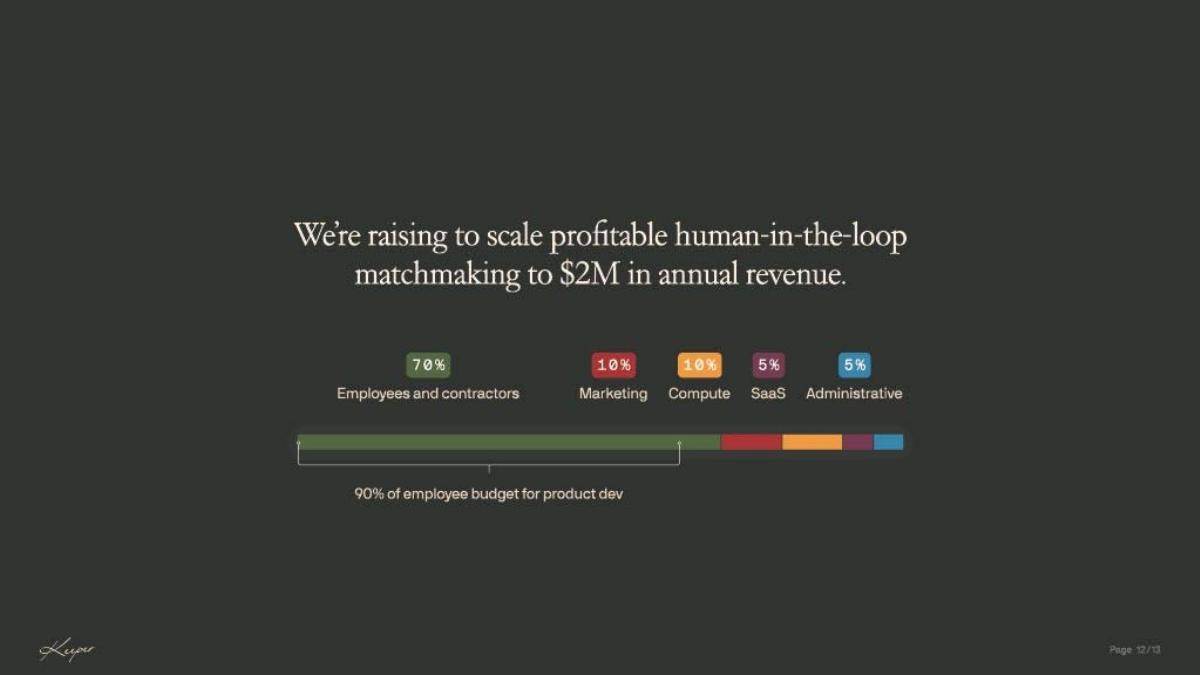
- The fundraising goal is specifically tied to scaling 'human-in-the-loop' operations to reach $2M in annual revenue (Slide 12).
The Vision: Marriage as a Service
Keeper’s pitch deck is a masterclass in narrative-driven fundraising. Instead of starting with a standard problem/solution framework, it begins with a bold claim about outcomes. The aesthetic of the deck—using classical art and serif fonts—immediately separates it from the neon-colored, gamified aesthetic of modern dating apps. This is a deliberate choice to signal 'seriousness' and 'tradition' in a market that is increasingly frustrated with casual dating culture.
Slides 1-2: The Hook and the Proof
Slide 1 introduces the brand as 'The world's most accurate matchmaker, powered by AI.' It sets a high bar for the technology. Slide 2 follows up with a staggering statistic: '1 in 10 Keeper first dates have led to an engagement.' In the world of venture capital, this is a 'wow' metric. While the sample size isn't disclosed on this slide, the implication is that their algorithm is significantly more effective at identifying long-term compatibility than the industry standard.
Slides 3-5: Market Opportunity and Product Promise
Slide 3 defines the market not as 'dating apps' but as 'Matchmaking.' It notes a $1.5B global revenue market where 100,000 singles spend an average of $15,000. This is a crucial distinction; Keeper is positioning itself to capture high-margin revenue from a smaller, more committed user base rather than fighting for $15/month subscriptions from millions of casual swipers. Slide 5 introduces the product interface, showing 'Photo feedback' and an AI chat interface named 'Selene.' The promise is bold: to introduce you to your soulmate on the first match.
Slides 6-7: Traction and Social Proof
Slide 6 reiterates that 'Dates convert to marriage,' while Slide 7 provides a collage of social proof. This includes mentions in major news outlets like the Daily Mail, New York Post, and CNN Business. Interestingly, it includes a quote from the 'Head of San Francisco Rationalists for Love,' suggesting the product has found a niche within specific intellectual communities. The inclusion of a screenshot showing Elon Musk liked a post adds a layer of 'tech-elite' validation that often appeals to Silicon Valley investors.
Slides 8-9: The Growth Engine
Slide 8 is perhaps the most important for a pre-seed or seed investor: '1.5M signups — 100% organically.' Achieving this level of top-of-funnel interest without a marketing budget suggests a massive 'product-market-pull.' Slide 9 explains the 'True network-effect'—better matches lead to more users, which leads to richer data, creating a virtuous cycle that the founders believe will lead to a monopoly.
Slides 10-11: The Team and The Brain Trust
Slide 10 introduces CEO Jake Kozloski, a repeat founder with 8 years of startup experience. Slide 11 is a 'heavy hitter' slide, listing researchers from Stanford and Cambridge. Michal Kosinski and Geoffrey Miller are well-known names in the fields of psychometrics and evolutionary psychology. Having these individuals 'on their side' gives Keeper a level of scientific credibility that most dating startups lack.
Slide 12: The Ask
The deck concludes its main narrative on Slide 12, stating they are raising to 'scale profitable human-in-the-loop matchmaking to $2M in annual revenue.' This is a grounded, specific goal. It tells investors exactly what the milestone for the next round will be: hitting a $2M ARR run rate while maintaining profitability on a per-user basis.
Slides 15-20: The Appendix and Deep Dives
The appendix slides provide the 'why now' and technical depth. Slide 15 highlights a social crisis: 80% of young singles want to marry, but only 40% will. Slide 17 shows a fragmented market where the '2,000+ others' category makes up 83% of the revenue, suggesting a market ripe for consolidation by a tech-enabled player. Slide 19 breaks down the 'most accurate process in the world,' which includes in-depth preference collection (74 questions), trait measurement (IQ and body fat), and AI evaluation of pairs.
What Works in This Deck
Outcome-Oriented Metrics: By focusing on 'engagements' rather than 'swipes' or 'active users,' Keeper aligns its success directly with the user's ultimate goal. This makes the value proposition much stickier than a standard dating app.
Academic Credibility: The inclusion of PhDs from Stanford and Cambridge who specialize in 'mate choice' and 'psychometrics' provides a moat. It suggests that their AI isn't just a basic LLM wrapper, but is built on established psychological frameworks.
Organic Traction: 1.5 million signups is a massive number for a pre-seed company. It proves that the 'problem' (finding a spouse) is painful enough that people are actively seeking alternatives to the status quo.
What is Missing
Unit Economics: While Slide 12 mentions 'profitable' matchmaking, the deck does not provide the Customer Acquisition Cost (CAC) or the Lifetime Value (LTV). Since they are currently 100% organic, the CAC is effectively zero, but investors would want to know how those numbers look once they start paying for growth.
The 'Human' Cost: The deck mentions 'human-in-the-loop.' It is unclear how many matchmakers are needed per 1,000 users. If the human element is too high, the 'monopoly' and 'scale' arguments on Slide 9 become harder to defend.
Demographic Specifics: The publisher notes the app currently focuses on heterosexual relationships. The deck doesn't explicitly address how the algorithm adapts to different cultural or demographic nuances, which could be a limitation for global scaling.
Founder Takeaways
Sell the 'Why Now': Keeper uses the decline of marriage rates (Slide 15) and the failure of current dating apps (Slide 16) to create a sense of urgency. Founders should always anchor their product in a broader societal shift.
Leverage the Appendix: Keeper keeps the main deck punchy and narrative-driven, pushing the dense charts and technical process explanations to the appendix. This allows the initial pitch to be emotional and high-level while still having the data available for the Q&A session.
Visual Identity Matters: The use of classical art is a brilliant branding move. It signals that this is not just another tech app, but a return to a more 'human' and 'timeless' way of meeting. Founders should consider how their deck's visual style reinforces their market positioning.
Frequently asked questions
- How does Keeper differentiate itself from Tinder or Hinge?
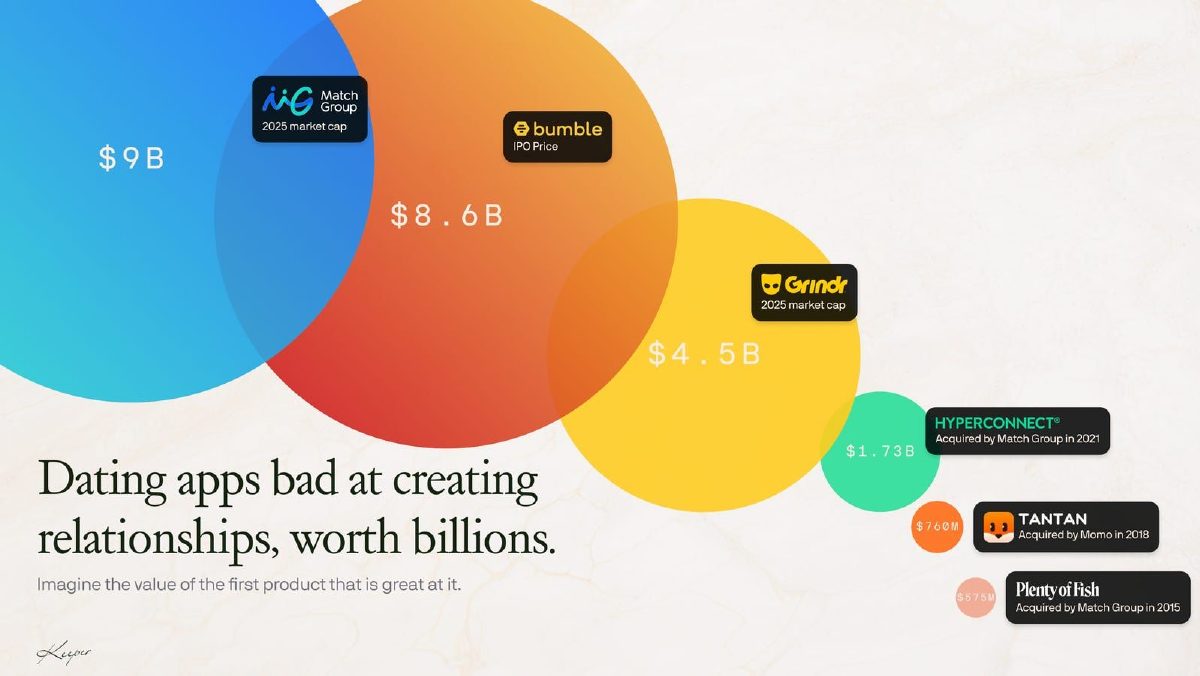
- Keeper positions itself against 'dating apps' by focusing on marriage outcomes rather than casual dating. Slide 16 explicitly states that dating apps are 'bad at creating relationships.' Keeper uses AI to filter for long-term compatibility and high-intent users, aiming to provide the 'soulmate on the first match' rather than a continuous stream of low-quality swipes.
- What is the primary technology behind Keeper?
- According to Slide 18, Keeper utilizes Large Language Models (LLMs) and computer vision models. These tools are used to analyze user preferences, physical attraction (via photo feedback on Slide 5), and personality traits like the 'Big 5' to automate the matchmaking process that was previously done manually by expensive human matchmakers.
- Is the matchmaking process fully automated?
- No. Slide 12 describes the model as 'profitable human-in-the-loop matchmaking.' This suggests that while AI handles the heavy lifting of data analysis and initial pairing, human oversight remains a component of the service to ensure quality and maintain the premium feel of traditional matchmaking.
- How has Keeper acquired its users so far?
- Keeper claims 100% organic growth, reaching 1.5 million signups without paid advertising (Slide 8). The deck also shows significant earned media coverage from outlets like Fox News, The New York Post, and CNN Business, as well as viral social media traction (Slide 7).
- What are the key metrics for success mentioned in the deck?
- The primary success metric is the engagement rate, which Keeper claims is 10% for first dates (Slide 2). They also track signups (1.5M) and have a target to reach $2M in annual revenue with the funds raised in this round (Slide 12).