Kerv’s 7-slide deck is a highly technical, product-focused presentation used to secure a $12M growth round in 2024. Rather than relying on traditional narrative structures like 'Problem' or 'Market Size,' the deck centers on the company’s patented AI and machine learning capabilities. It specifically emphasizes 'pixel-edge precision,' claiming the ability to identify objects at a granular level—such as individual parts of an eye—to drive video engagement. The deck serves as a visual gallery of Kerv’s integrations with major platforms like TikTok and OTT services, showcasing how their 'Radius'…
Key takeaways
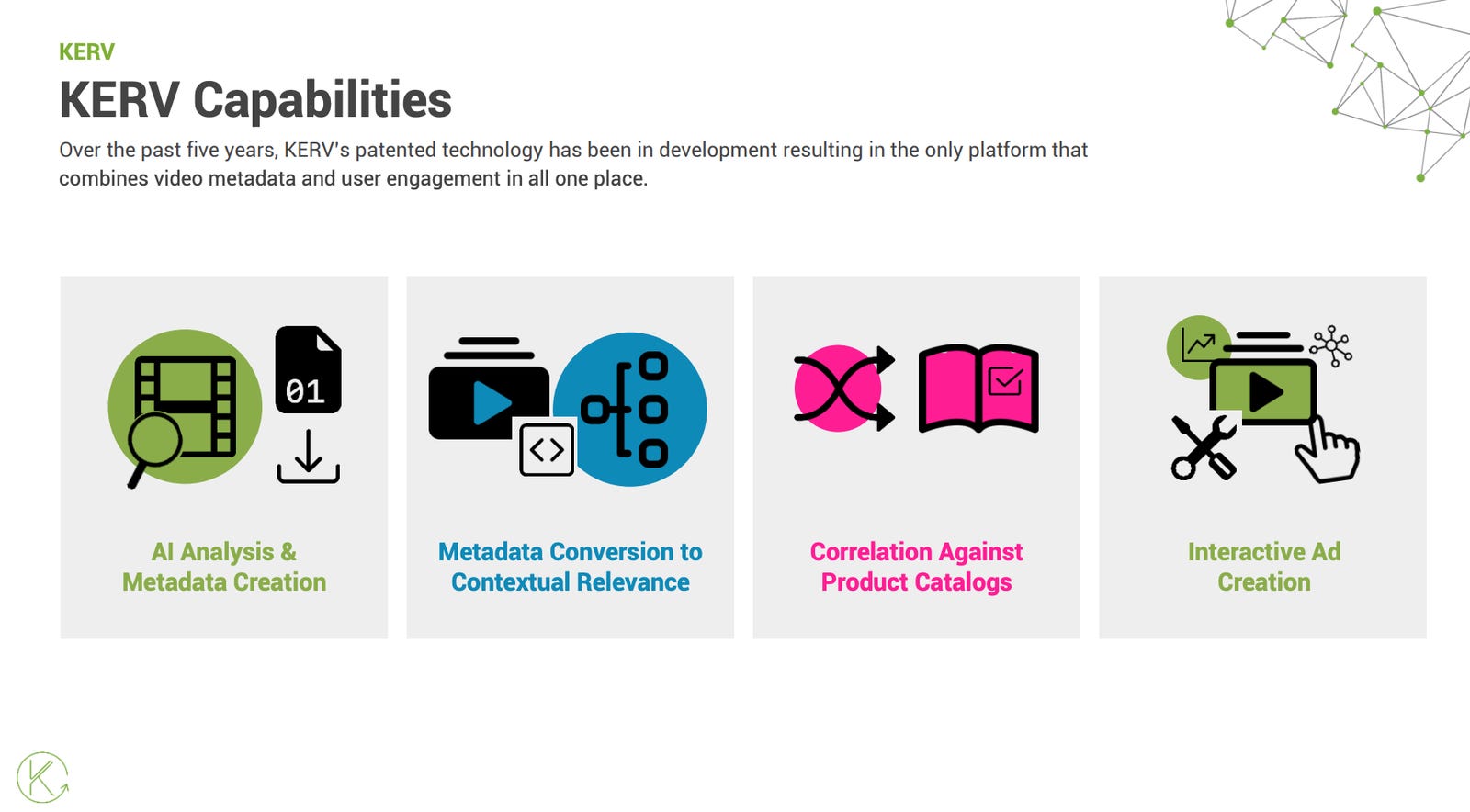
- The deck highlights a five-year development period for its patented technology that combines video metadata and user engagement (Slide 1).
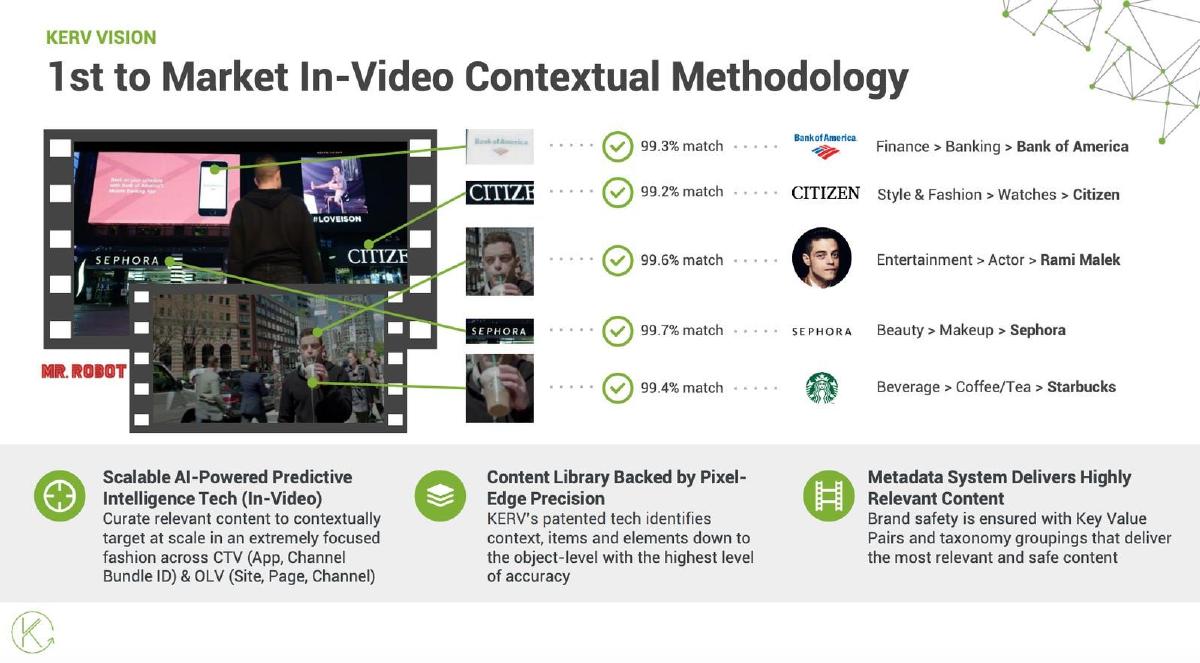
- Kerv claims a '1st to Market' position for in-video contextual methodology, boasting match rates as high as 99.7% for brands like Sephora (Slide 2).
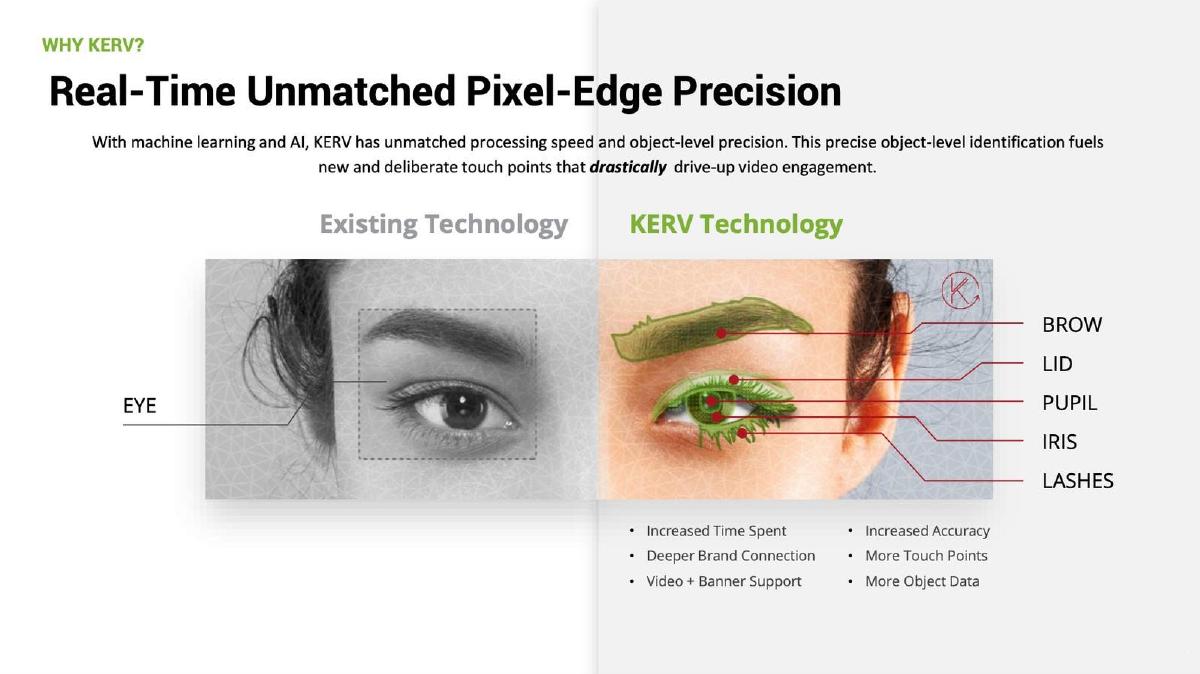
- Technical differentiation is centered on 'pixel-edge precision,' which identifies objects down to the brow, lid, and lashes of an eye (Slide 3).
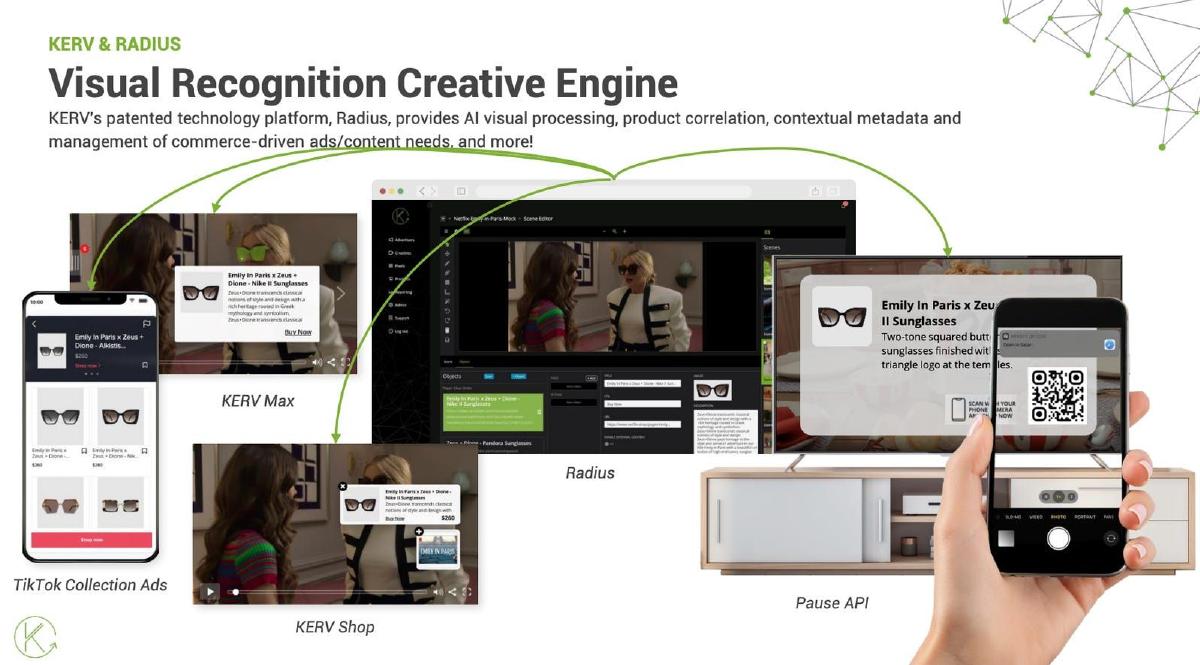
- The 'Radius' creative engine is presented as the core platform for AI visual processing and product correlation (Slide 4).
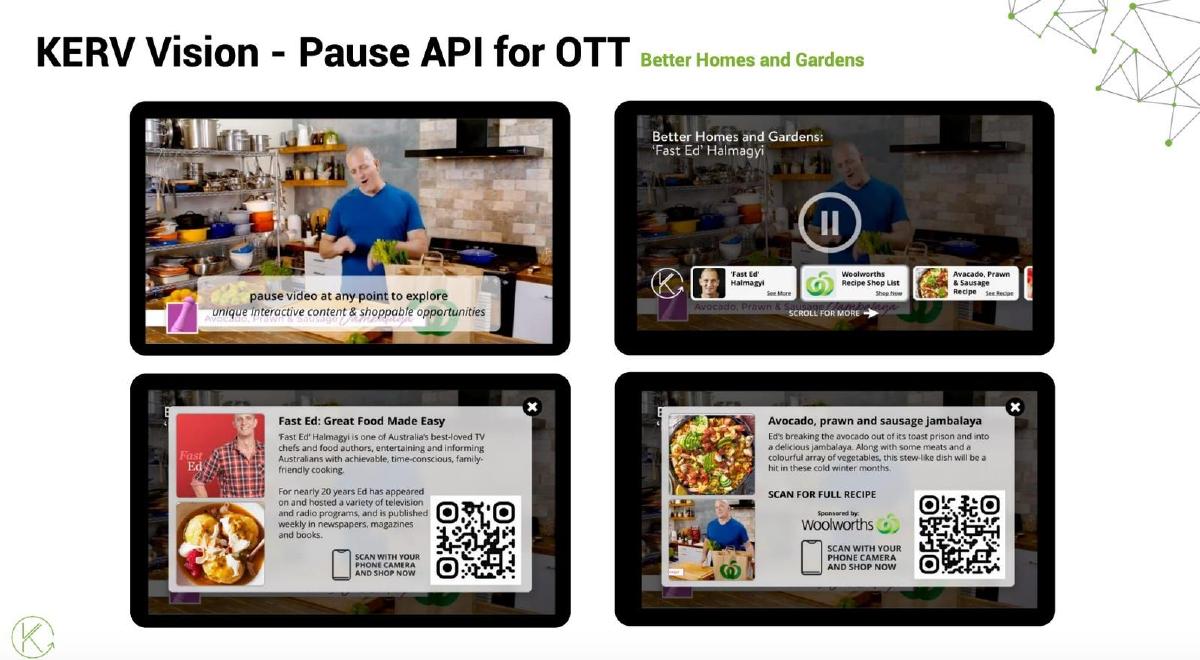
- The deck showcases a 'Pause API' for OTT, allowing users to scan QR codes for recipes or products when a video is paused (Slide 5).
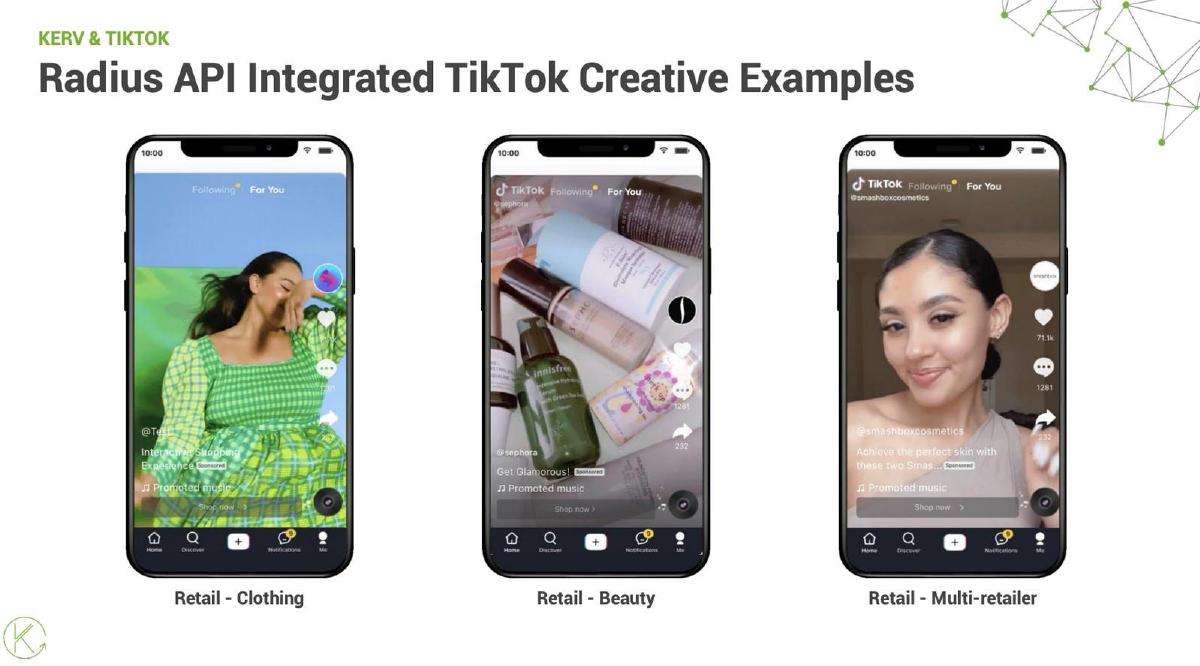
- Integration with TikTok is a primary use case, featuring examples across clothing, beauty, and multi-retailer categories (Slide 6).
- The platform supports a 'Multi-Retailer' strategy, allowing a single creative to link to Walmart, Amazon, and Target simultaneously (Slide 7).
- As reported by Business Insider, this deck supported a $12M growth round in 2024 for the North American-based advertising firm.
Kerv Pitch Deck Analysis
Kerv’s 7-slide deck, used for their 2024 $12M growth round as reported by Business Insider, is a masterclass in technical positioning. In the advertising technology (AdTech) space, where 'AI' is often used as a buzzword, Kerv uses this deck to provide visual proof of their machine learning's granularity. The deck is less of a story and more of a technical demonstration, focusing heavily on the 'how' of their shoppable video technology.
Slide 1: Kerv Capabilities
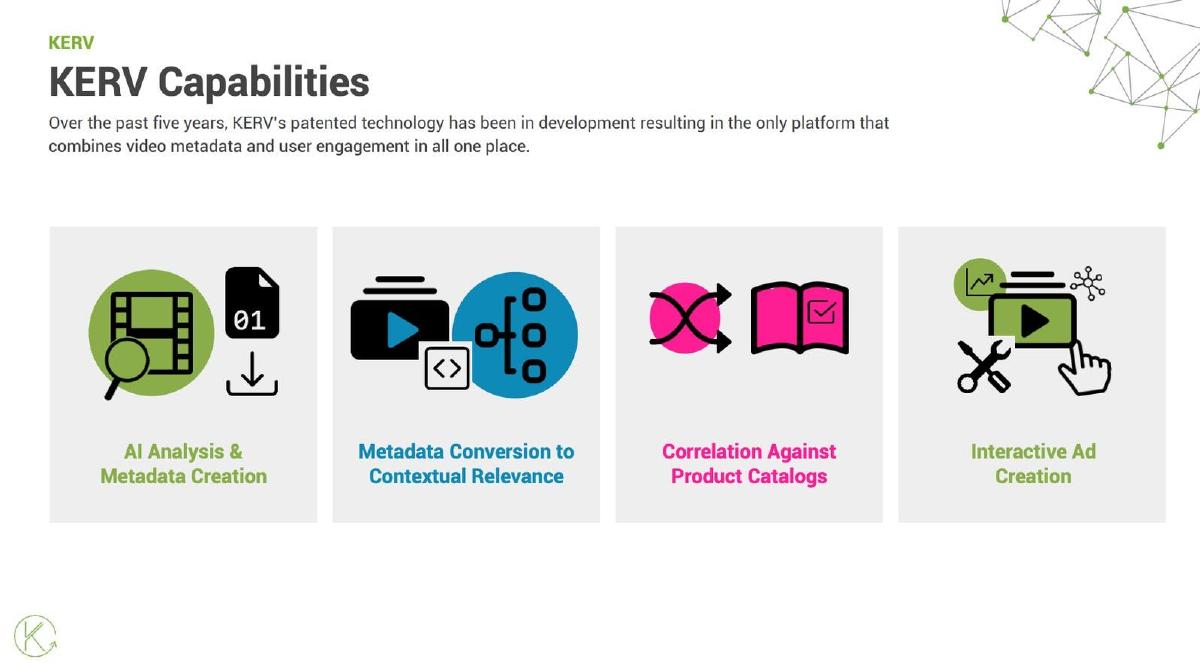
The opening slide establishes the company's technical foundation. It states that Kerv’s patented technology has been in development for five years. The core claim here is that Kerv is the 'only platform that combines video metadata and user engagement in all one place.' The slide breaks down the process into four distinct pillars: AI Analysis & Metadata Creation, Metadata Conversion to Contextual Relevance, Correlation Against Product Catalogs, and Interactive Ad Creation. By starting with the 'five years of development' claim, Kerv is signaling to investors that they have a significant head start and a defensive moat built on R&D.
Slide 2: 1st to Market In-Video Contextual Methodology
Slide 2 moves from abstract capabilities to specific accuracy metrics. Using a still from the show 'Mr. Robot,' Kerv demonstrates its ability to identify multiple brands and objects within a single frame. The slide lists high-precision match rates: 99.3% for Bank of America, 99.2% for Citizen, 99.6% for actor Rami Malek, 99.7% for Sephora, and 99.4% for Starbucks. This slide is critical because it addresses the 'brand safety' and 'accuracy' concerns that plague automated advertising. By showing that the AI can distinguish between a 'Beverage > Coffee/Tea > Starbucks' and 'Beauty > Makeup > Sephora' with near-perfect accuracy, Kerv positions itself as a reliable partner for high-end brands.
Slide 3: Real-Time Unmatched Pixel-Edge Precision
This is arguably the most important slide in the deck for a technical investor. It provides a side-by-side comparison between 'Existing Technology' and 'KERV Technology.' The visual shows a human eye; while the competitor identifies the whole eye as a single block, Kerv’s AI identifies the brow, lid, pupil, iris, and lashes as separate data points. The slide claims this precision leads to 'Increased Time Spent,' 'Deeper Brand Connection,' and 'More Object Data.' This visual metaphor effectively communicates the concept of 'pixel-edge precision' without requiring the viewer to understand the underlying code.
Slide 4: Visual Recognition Creative Engine
Slide 4 introduces 'Radius,' the name of Kerv’s patented technology platform. This slide functions as a product ecosystem map. It shows how Radius feeds into various outputs: Kerv Max, TikTok Collection Ads, Kerv Shop, and the Pause API. The central screenshot of the Radius interface shows a 'Scene Editor' where objects (like sunglasses from the show 'Emily in Paris') are tagged and linked to purchase URLs. This slide proves that the technology isn't just a backend algorithm but a functional, user-facing tool for creators and advertisers to manage commerce-driven content.
Slide 5: Pause API for OTT
Focusing on the growing Connected TV (CTV) and Over-the-Top (OTT) market, Slide 5 demonstrates the 'Pause API.' Using a cooking show ('Better Homes and Gardens') as an example, the slide shows that when a user pauses the video, an interactive overlay appears. This overlay includes a QR code that viewers can scan to get a 'Woolworths Recipe Shop List' or purchase ingredients for 'Avocado, prawn and sausage jambalaya.' This is a direct response to the industry-wide challenge of making 'lean-back' TV viewing 'lean-forward' and transactional.
Slide 6: Radius API Integrated TikTok Creative Examples
Slide 6 applies the technology to the most relevant social platform for modern commerce: TikTok. It shows three mockups: Retail - Clothing, Retail - Beauty, and Retail - Multi-retailer. The slide demonstrates how the Radius API can take standard TikTok video content and layer on 'Shop now' buttons and interactive product carousels. This highlights the platform-agnostic nature of Kerv’s tech, showing it works just as well on a vertical mobile screen as it does on a horizontal television screen.
Slide 7: Multi-Retailer KERV SHOP!
The final slide addresses the logistical side of e-commerce: where the user actually buys the product. Kerv showcases a 'Multiple Retailer Strategy in a Single Creative.' The example shows an ad for Huggies diapers that allows the user to choose between shopping at Walmart, Amazon, or Target. This is a sophisticated feature for brands that don't want to alienate specific retail partners. It also shows 'Feed Clean' ads for Nutro dog food, emphasizing that Kerv can 'Easily create multiple versions that each link to unique retailer product pages.' This slide speaks to the scalability and flexibility of the platform for large-scale enterprise brands.
What Kerv Does Well
Kerv excels at visual proof. In an industry where many companies claim to have 'proprietary AI,' Kerv actually shows the AI at work. The eye-tracking comparison on Slide 3 and the brand match percentages on Slide 2 provide tangible evidence of their technical superiority. Furthermore, the deck is highly focused on use cases. By showing exactly how the tech looks on TikTok and OTT, they make it easy for an investor to visualize the revenue potential.
What is Missing from the Kerv Deck
This deck is notably incomplete by traditional fundraising standards. There is no Team Slide , which is usually a requirement for a $12M growth round to show the pedigree of the engineers and executives. There are no Financials or Traction Metrics ; while we see match percentages, we don't see revenue growth, churn rates, or Customer Acquisition Cost (CAC). There is no Market Size (TAM/SAM/SOM) slide to justify a growth-stage valuation. Finally, there is no Ask Slide detailing how the $12M will be spent (e.g., sales expansion vs. R&D). It is highly likely that this was a supplemental deck used alongside a more traditional business presentation.
What Founders Should Copy
Founders building technical products should copy Kerv’s 'Side-by-Side' comparison method (Slide 3). Instead of just saying your product is 'better' or 'faster,' show a visual representation of the granularity or speed difference. Additionally, the use of recognizable brands (Starbucks, Sephora, Walmart) in mockups adds immediate credibility. Even if those aren't all active paying clients, showing how the tech would work for a household name helps bridge the gap between a complex algorithm and a profitable business application.
Frequently asked questions
- What is Kerv's core value proposition?
- Kerv uses patented AI and machine learning to identify specific objects within video content with 'pixel-edge precision.' By recognizing these items, the platform automatically inserts interactive, shoppable links or QR codes, allowing viewers to purchase products seen on screen across CTV, social media, and web video.
- How does Kerv differentiate itself from existing video ad tech?
- According to Slide 3, Kerv differentiates through its level of granularity. While 'Existing Technology' might identify a general area like an 'Eye,' Kerv's technology identifies sub-elements like the brow, lid, pupil, iris, and lashes. This leads to more object data and more touch points for engagement.
- What platforms does Kerv support?
- The deck explicitly showcases integrations with TikTok (Slide 6), OTT/CTV services via a Pause API (Slide 5), and general web video. It also highlights the ability to link to major retailers including Amazon, Walmart, and Target within a single ad creative (Slide 7).
- What metrics does the deck use to prove efficacy?
- The deck focuses on technical accuracy metrics rather than financial ones. Slide 2 lists specific match percentages for brand recognition: 99.3% for Bank of America, 99.2% for Citizen, 99.6% for actor Rami Malek, 99.7% for Sephora, and 99.4% for Starbucks.
- Is this a complete pitch deck?
- No. This 7-slide set is likely a technical appendix or a product-focused leave-behind. It lacks a team slide, a business model slide, financial history, a competitive landscape, and a slide detailing the $12M raise mentioned in publisher reports.