Ideon Technologies' 13-slide Series A deck is a masterclass in vertical SaaS positioning for a deep-tech hardware product. By framing their subsurface mapping technology as a way to 'Drill Less, Discover More,' they address the mining industry's primary pain point: geological uncertainty. The deck highlights a significant partnership with BHP, the world's largest mining company, moving from a blind trial to three active deployments in 24 months. With a reported $16M raised in 2024, the company leverages a 'Solution-as-a-Service' model to manage the complexity of hardware, AI, and geosciences…
Key takeaways
- The company frames its problem through a specific case study of 38 boreholes where 81.5% failed to hit mineralization (Slide 5).
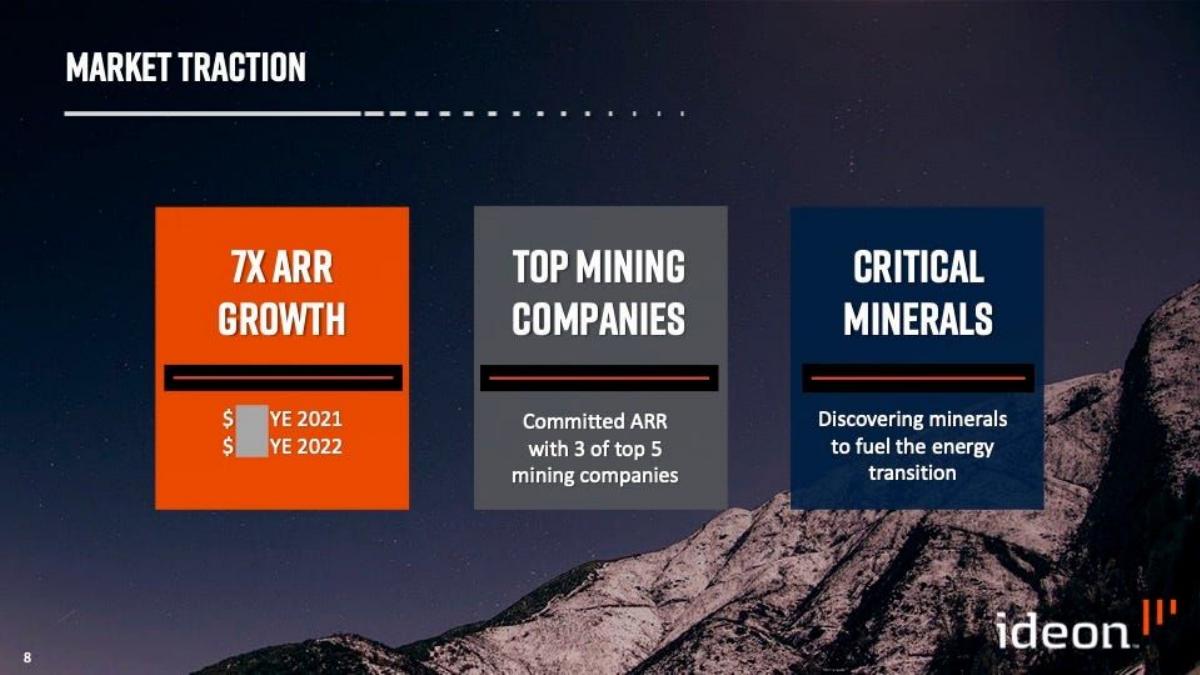
- Ideon reports having ARR with 3 of the top 5 mining companies, with BHP as their flagship customer (Slide 3).
- The business model is defined as 'Solution-as-a-Service,' integrating hardware, AI, and geosciences into a single platform (Slide 7).
- The technology claims to reduce drilling by 10x and deliver over 95% certainty in subsurface discovery (Slide 7).
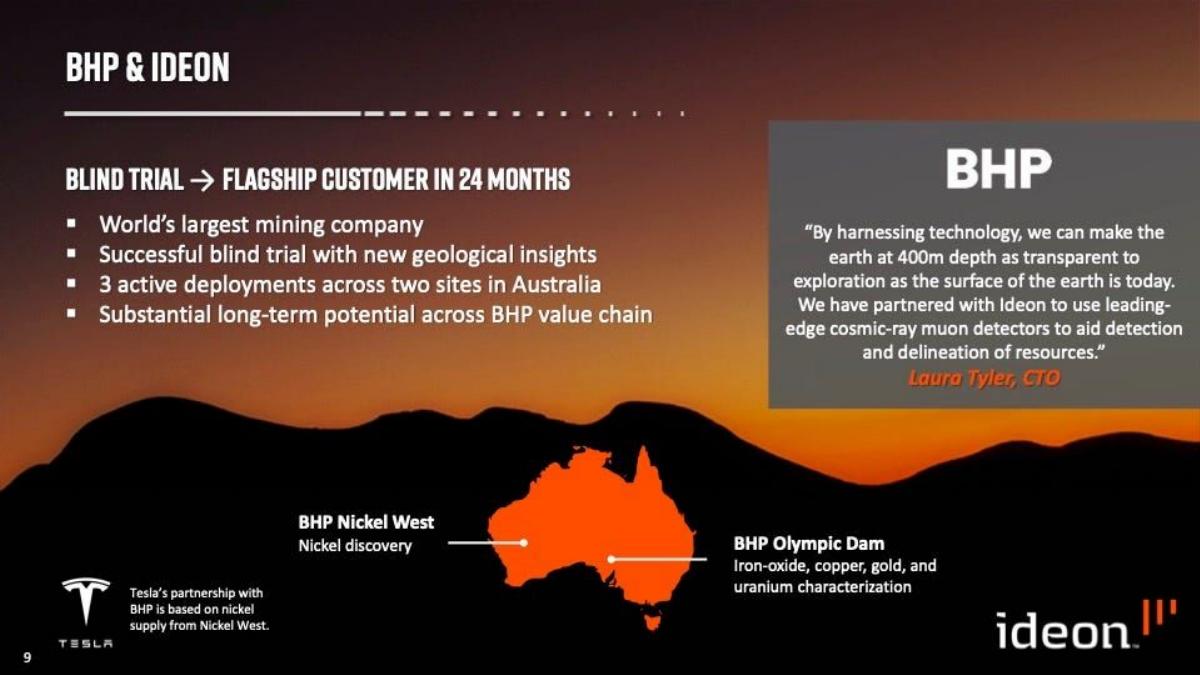
- A quote from BHP's CTO, Laura Tyler, validates the technology's ability to make the earth at 400m depth 'transparent' (Slide 9).
- The deck identifies a $11B Total Addressable Market (TAM) specifically within the mining sector (Slide 3).
- Ideon uses a 10x carbon reduction claim as a core pillar of their 'Environmental Advantage' (Slide 13).
- The deck omits a dedicated team slide with individual bios, though it mentions an 'Experienced leadership team' on Slide 3.
Introduction: The High Stakes of Subsurface Exploration
Ideon Technologies operates at the intersection of deep-tech physics and industrial data analytics. Their Series A deck, which reportedly helped secure $16M in 2024, targets a massive and traditionally slow-moving industry: mining. The narrative of the deck is built around solving 'Geological Uncertainty,' a problem that costs the industry billions in failed exploration projects. By utilizing cosmic-ray muon tomography, Ideon promises to turn the opaque earth into a transparent map, significantly reducing the environmental and financial cost of finding critical minerals.
Slide 1-2: Branding and Vision
The deck opens with high-quality, atmospheric imagery of a cave illuminated by a single beam of light. This visual metaphor for 'discovery' and 'seeing into the dark' aligns perfectly with their tagline: Transforming Subsurface Discovery . The branding is professional and minimalist, signaling a company that deals in high-stakes industrial applications rather than consumer software.
Slide 3: The Executive Summary (Market Traction)
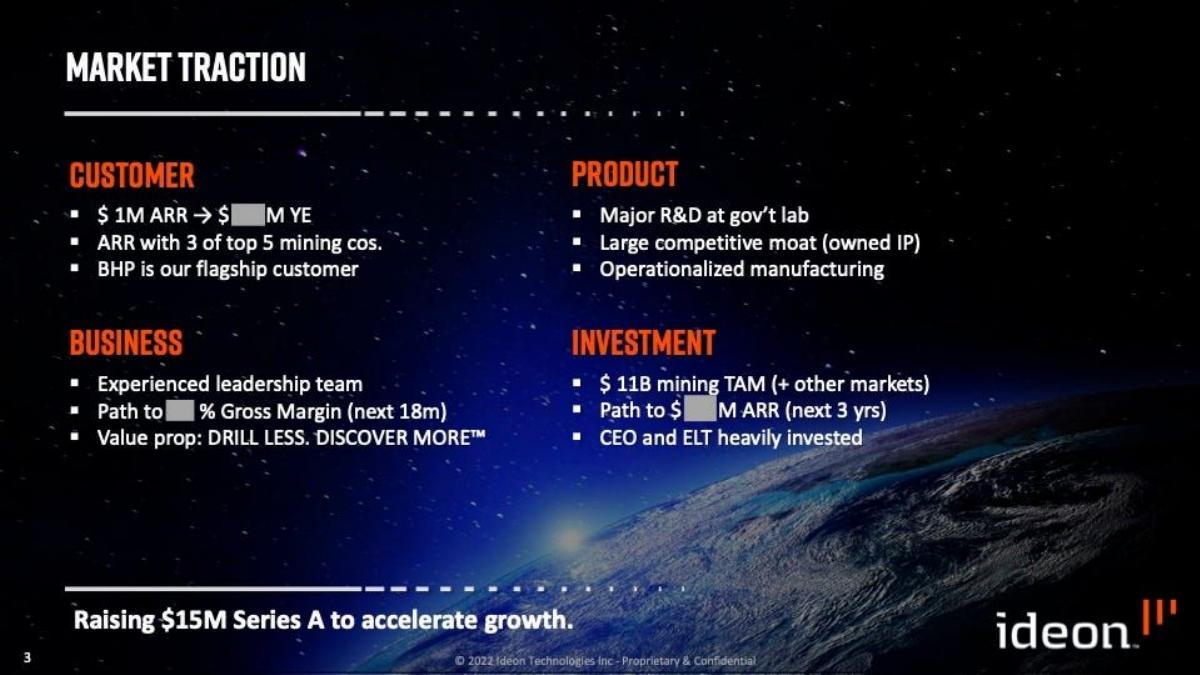
Slide 3 serves as a 'teaser' or summary slide, which is an excellent practice for Series A decks. It breaks down the company's status into four quadrants: Customer, Product, Business, and Investment. Key data points include:
Customer: Growth from $1M ARR to a redacted year-end target. They explicitly state they have ARR with 3 of the top 5 mining companies, naming BHP as their flagship. · Product: Mention of 'Major R&D at gov’t lab' and 'owned IP,' establishing a competitive moat. · Business: A focus on gross margin expansion over the next 18 months and the core value prop: DRILL LESS. DISCOVER MORE. · Investment: A $11B mining TAM and a path to a redacted ARR target within 3 years.
Crucially, the bottom of the slide states they are Raising $15M Series A to accelerate growth . (Note: Publisher reports indicate they closed $16M).
Slide 4: Transition
This slide is a simple visual placeholder, maintaining the 'subsurface' theme and keeping the focus on the upcoming problem statement.
Slide 5: The Problem - Geological Uncertainty
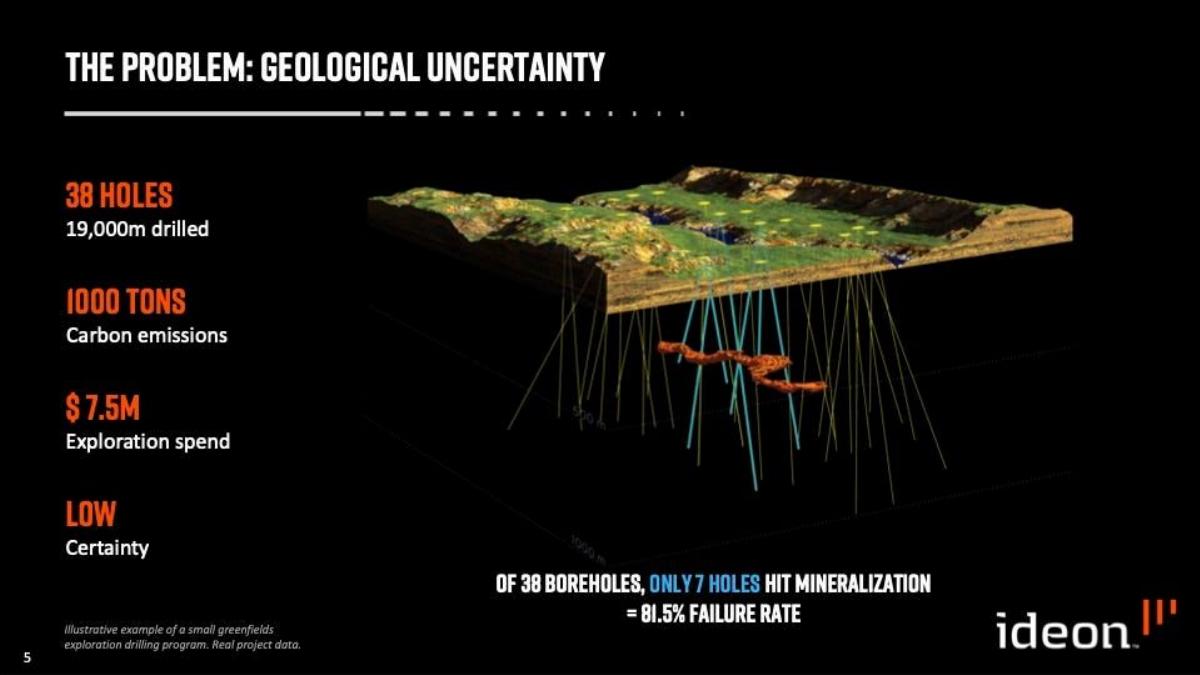
This is one of the strongest slides in the deck. Instead of using abstract terms, Ideon uses 'Real project data' from a 'small greenfields exploration drilling program.' The metrics are staggering:
38 holes drilled (19,000m total). · 1,000 tons of carbon emissions. · $7.5M in exploration spend. · 81.5% Failure Rate: Only 7 of the 38 boreholes hit mineralization.
By quantifying the failure, Ideon makes the 'Low Certainty' of current methods feel like an unacceptable financial and environmental risk.
Slide 6: Visualizing the Solution
Another transition slide that likely accompanied a verbal explanation of how muon tomography works—using subatomic particles to 'X-ray' the earth.
Slide 7: A New Breed of Science-Based SaaS
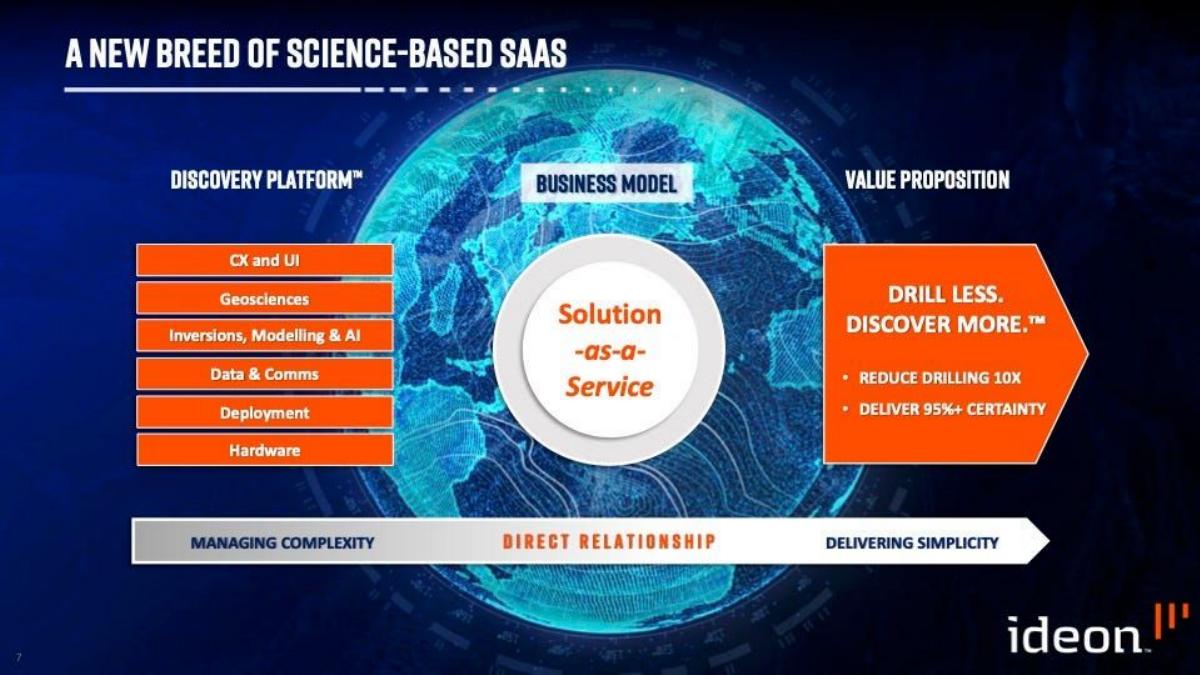
Ideon positions itself as 'Solution-as-a-Service.' This is a strategic move to avoid being labeled as a 'hardware company,' which often carries lower valuation multiples. The slide shows a stack that includes Hardware, Deployment, Data & Comms, AI, Geosciences, and UI. By 'Managing Complexity' on the back end, they 'Deliver Simplicity' to the customer. The promised outcomes are bold: Reduce drilling 10x and Deliver 95%+ certainty .
Slide 8: Transition to Traction
A visual break before diving into their most significant case study.
Slide 9: The BHP Case Study
For an industrial startup, a partnership with a market leader is the ultimate validation. Ideon details their 24-month journey with BHP, the world's largest mining company. The slide highlights:
A successful blind trial that provided new geological insights. · 3 active deployments across two sites in Australia (Nickel West and Olympic Dam). · A direct quote from Laura Tyler, CTO of BHP , stating that Ideon's technology makes the earth at 400m depth 'as transparent to exploration as the surface of the earth is today.'
The inclusion of the Tesla logo in the corner, noting that Tesla's partnership with BHP is based on nickel supply from the very site Ideon is mapping, connects Ideon to the broader EV and green energy macro-trend.
Slide 10: Visualizing Impact
A transition slide showing the rugged terrain where these technologies are deployed, reinforcing the 'real-world' nature of the business.
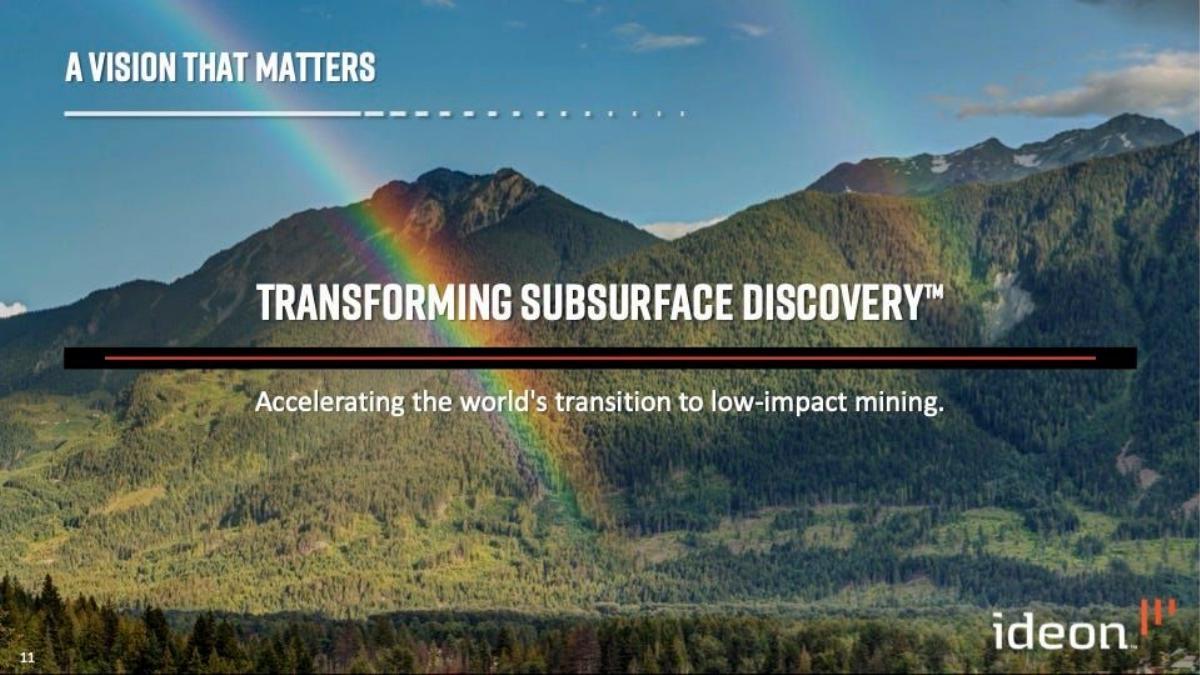
Slide 11: A Vision That Matters
This slide pivots to the ESG (Environmental, Social, and Governance) narrative. It frames Ideon not just as a mining tool, but as a catalyst for 'low-impact mining.' This is critical for attracting institutional capital that is increasingly mandate-bound to invest in sustainable technologies.
Slide 12: Transition to Conclusion
A final atmospheric shot of a cave, returning to the core theme of 'seeing the unseen.'
Slide 13: The Summary Recap
The final slide summarizes the four pillars of the investment thesis:
Massive Market: $11B Mining TAM. · Disruptive Tech: Proven science and strong IP. · Team & Traction: Experienced leaders and market momentum. · Environmental Advantage: 10x carbon reduction.
What Ideon Technologies Does Well
Quantifying the Pain: Slide 5 is a masterclass in problem definition. By showing that a $7.5M spend resulted in an 81.5% failure rate, they make the need for their solution feel urgent and logical. Investors love 'burning platform' problems where the cost of doing nothing is clearly higher than the cost of the solution.
Strategic Positioning: Calling themselves 'Solution-as-a-Service' (Slide 7) allows them to capture the high-touch value of their hardware while maintaining the recurring revenue narrative of SaaS. They emphasize that they handle the 'complexity' so the customer only sees the 'simplicity.'
Validation by Authority: The BHP slide (Slide 9) is incredibly powerful. Having the CTO of the world's largest mining company give a testimonial about 'transparency' at 400m depth removes almost all technical risk in the eyes of an investor. The 'blind trial' mention is also key—it proves the tech works when the answer isn't already known.
What is Missing from the Deck
Detailed Team Slide: While Slide 3 mentions an 'Experienced leadership team,' there is no dedicated slide showing the founders' backgrounds, their technical expertise in physics or geosciences, or their previous exits. In deep-tech, the 'who' is often as important as the 'what.'
Unit Economics: The deck mentions 'Path to [Redacted]% Gross Margin,' but it doesn't explain the cost of the hardware, the length of the sales cycle, or the LTV (Lifetime Value) of a customer like BHP. For a Series A, investors usually want to see the 'machine' of the business, not just the 'science' of the product.
Competitive Landscape: There is no slide addressing competitors. Whether it's traditional seismic surveys, other muon startups, or satellite-based mineral mapping, investors need to know why Ideon wins against the alternatives.
Use of Proceeds: While they state they are raising $15M to 'accelerate growth,' they don't specify how that money will be spent. Will it go toward manufacturing more sensors, hiring a global sales team, or further R&D into deeper mapping capabilities?
Founder Takeaways: Copy These Moves
The 'Teaser' Slide: Start your deck with a summary of your traction (like Slide 3). It sets the tone and ensures that even if an investor only looks at three slides, they see your biggest wins immediately.
The 'Real Data' Problem Slide: If you are solving a technical problem, don't just say 'it's hard.' Show a specific instance of failure in the current market. Use real numbers—dollars spent, hours wasted, or carbon emitted—to make the problem visceral.
The 'Complexity vs. Simplicity' Framework: If your product is technically complex (AI, hardware, biotech), use a slide like Slide 7 to show that you are shielding the customer from that complexity. Investors are often wary of 'science projects' that require the customer to be a genius to use the product. Show that you deliver the answer, not just the data.
Macro-Trend Alignment: Ideon cleverly links their mining tech to the EV revolution by mentioning the BHP-Tesla connection. Always find a way to link your niche solution to a massive, unstoppable global trend.
Frequently asked questions
- What is the core technology behind Ideon Technologies?
- Ideon uses cosmic-ray muon tomography to create 3D maps of the subsurface. As described on Slide 9, this technology allows mining companies to 'see' through the earth down to 400 meters, identifying mineral deposits without the need for extensive, speculative drilling.
- How does Ideon make money?
- They utilize a 'Solution-as-a-Service' model. According to Slide 7, they manage the entire stack—hardware, deployment, data communications, AI modeling, and the user interface—to provide a direct relationship and simplified output for the customer.
- Who are Ideon's primary customers?
- The deck focuses heavily on the mining industry. Slide 3 notes they have ARR with three of the top five mining companies, and Slide 9 details their extensive work with BHP, specifically at the Nickel West and Olympic Dam sites.
- What is the environmental impact of Ideon's solution?
- Ideon claims a 10x reduction in carbon emissions compared to traditional exploration methods. Slide 5 illustrates that a typical small greenfields program can produce 1,000 tons of carbon emissions; by reducing drilling 10x, Ideon significantly lowers this footprint.
- Is there a detailed breakdown of the management team in the deck?
- No. While Slide 3 mentions an 'Experienced leadership team' and that the 'CEO and ELT are heavily invested,' the provided slides do not include a traditional team slide with names, photos, or specific career histories.