Ignite! Reading’s 9-slide pitch deck is a masterclass in aligning a product with massive regulatory and social shifts. The company, which provides one-on-one virtual reading tutoring for K-8 students, raised $10M in a 2024 Series A round. The deck avoids traditional startup tropes like complex financial projections or competitive matrices, instead focusing on the 'Science of Reading' and the $122 billion in K-12 ARPA funding available for learning recovery. By highlighting a 2.4x acceleration in reading progress and a model that bypasses the need for certified teachers as tutors, Ignite! Read…
Key takeaways
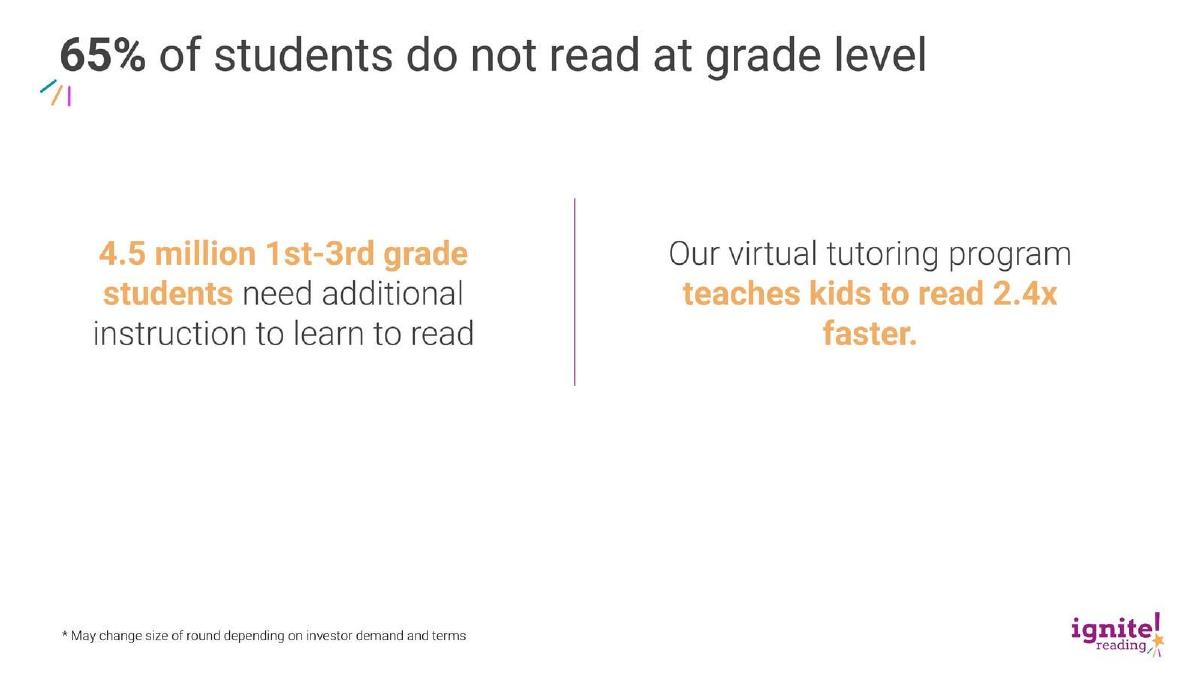
- The deck identifies a massive market gap: 65% of students do not read at grade level, affecting 4.5 million 1st-3rd graders (Slide 2).
- Ignite! Reading claims their virtual tutoring program teaches kids to read 2.4x faster than traditional methods (Slide 2).
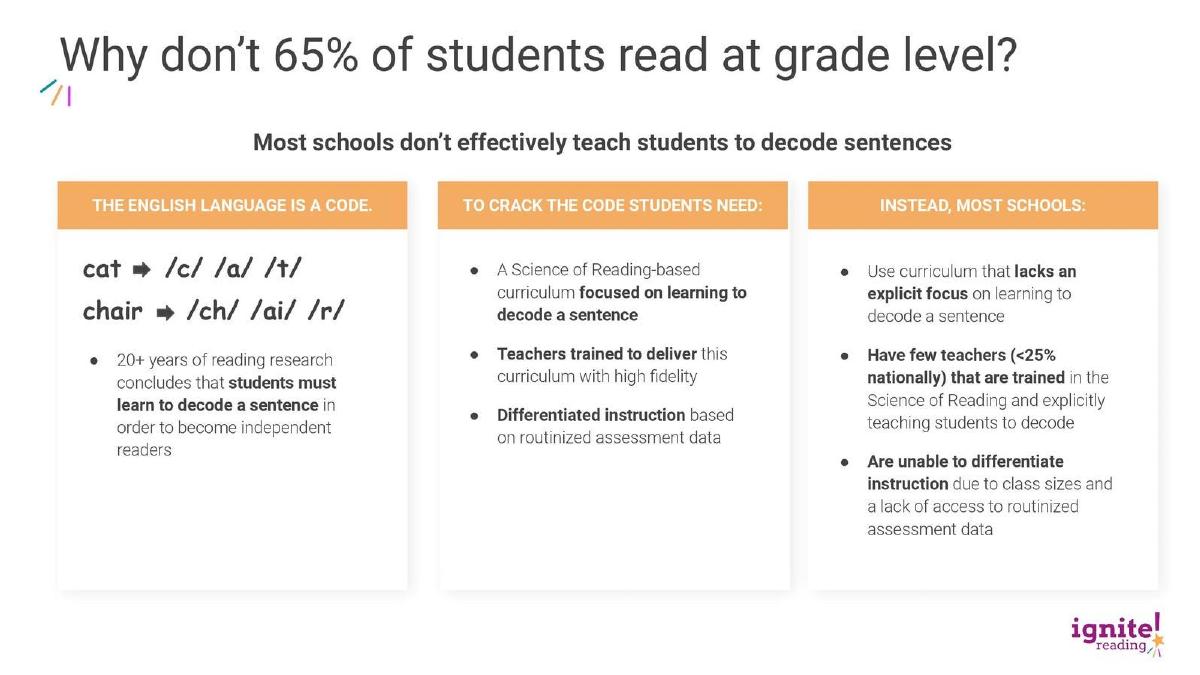
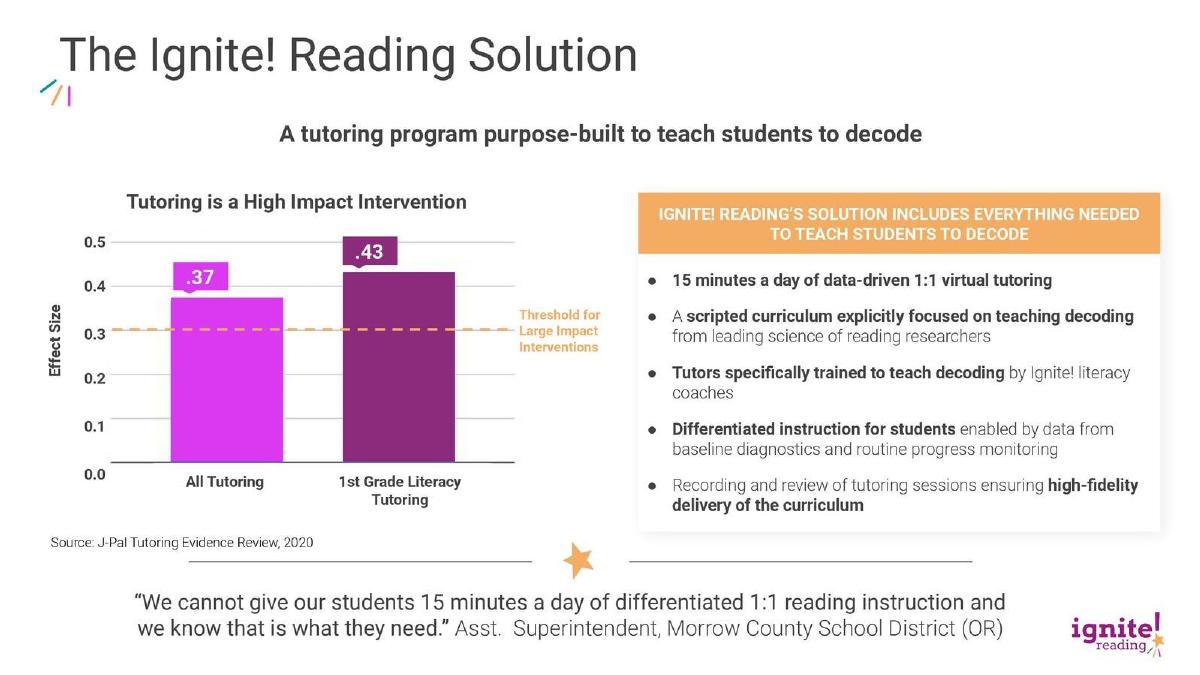
- The solution is built on a 'Science of Reading' curriculum, addressing the fact that less than 25% of teachers are trained in decoding (Slide 3).
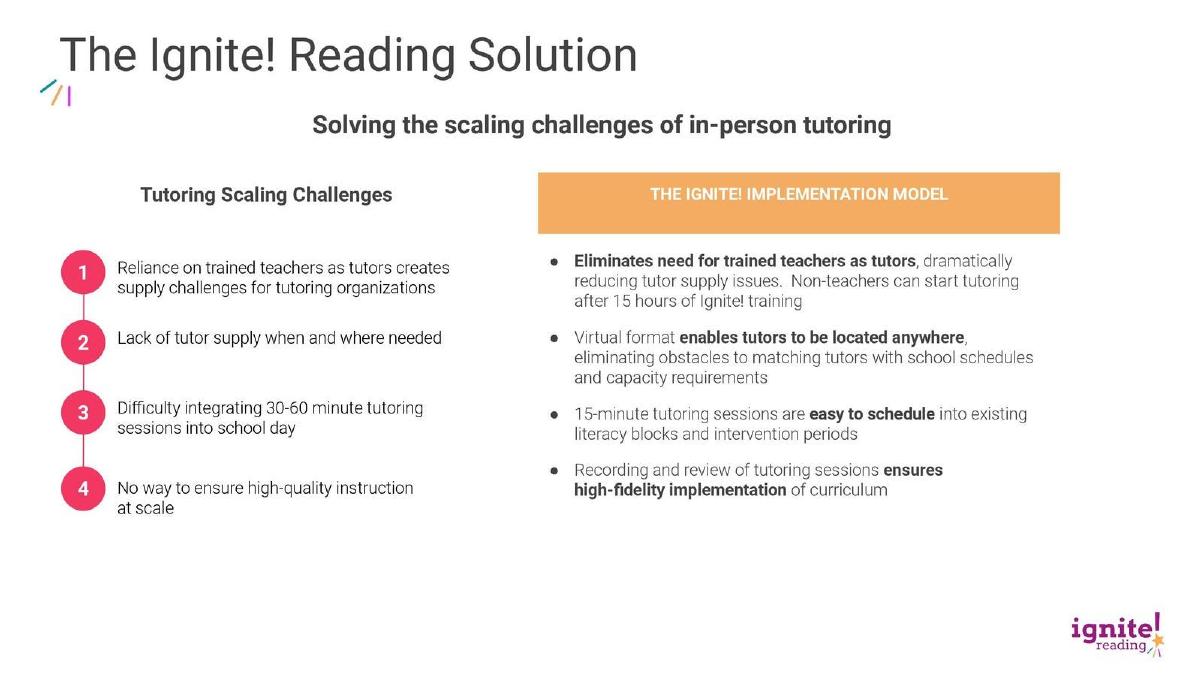
- Scalability is achieved by using non-teachers who can start tutoring after just 15 hours of training, solving the national teacher shortage (Slide 5).
- Efficacy is backed by a 60 Tutor Net Promoter Score and a 64 Educator Net Promoter Score (Slide 7).
- The 'Why Now' slide cites $122 billion in K-12 ARPA funding and state-mandated tutoring initiatives in Texas, Tennessee, and Rhode Island (Slide 8).
- The founding team has significant pedigree, including a CEO who scaled Open Up Resources to 3,000 districts and a co-founder who impacted 43 million students at EducationSuperHighway (Slide 9).
- The deck completely omits a business model slide, financial projections, and a specific 'Ask' for the round amount.
The Strategy of Efficacy: Ignite! Reading’s Series A Teardown
Ignite! Reading’s 9-slide deck is a focused, evidence-based presentation that prioritizes pedagogical outcomes and market tailwinds over traditional financial metrics. In an industry like EdTech, where sales cycles are long and efficacy is the primary barrier to entry, this deck serves as a blueprint for how to sell a mission-driven startup to institutional investors. As reported by Business Insider, this deck supported a $10M Series A raise in 2024.
Slide 1: Title and Mission
The deck opens with a simple, high-contrast title slide. The tagline, "Ensuring every student learns to read on time," immediately establishes the social impact and the specific problem space. The imagery of a young student reading reinforces the target demographic without cluttering the slide with unnecessary branding.
Slide 2: The Problem and The Promise
Slide 2 is a classic 'Problem/Solution' split. It states that "65% of students do not read at grade level," and quantifies the immediate market as "4.5 million 1st-3rd grade students" who need additional instruction. The right side of the slide offers the counter-metric: "Our virtual tutoring program teaches kids to read 2.4x faster." This is a bold claim that sets the stage for the efficacy data to follow. A small disclaimer at the bottom notes that the round size may change, indicating this deck was used during active negotiations.
Slide 3: The Root Cause Analysis
This slide dives into the 'Why.' It argues that most schools fail because they don't teach students to "decode sentences." By breaking down the word 'cat' into phonemes (/c/ /a/ /t/), the deck educates the investor on the "Science of Reading." It identifies three systemic failures in schools: lack of explicit decoding focus, fewer than 25% of teachers being trained in this science, and an inability to differentiate instruction due to class sizes. This slide is critical because it frames the problem not just as a lack of resources, but as a lack of specific expertise that Ignite! Reading provides.
Slide 4: The Solution Framework
Slide 4 introduces the Ignite! Reading Solution as a "tutoring program purpose-built to teach students to decode." It uses a bar chart from a 2020 J-Pal Tutoring Evidence Review to show that literacy tutoring has an 'Effect Size' of .43, well above the threshold for "Large Impact Interventions." The slide lists five key components of their solution, including "15 minutes a day of data-driven 1:1 virtual tutoring" and "scripted curriculum." A quote from an Assistant Superintendent in Oregon provides immediate social proof that schools recognize they cannot provide this level of differentiation on their own.
Slide 5: Solving for Scale
One of the most significant hurdles in tutoring is the labor supply. Slide 5 addresses this head-on. It lists four scaling challenges, most notably the "reliance on trained teachers as tutors." Ignite! Reading’s model "eliminates need for trained teachers as tutors," claiming that non-teachers can start after "15 hours of Ignite! training." This is the 'moat' and the 'margin' slide; by decoupling the service from the expensive and scarce labor of certified teachers, the company demonstrates a path to massive scale and lower operational costs.
Slide 6: Qualitative Validation
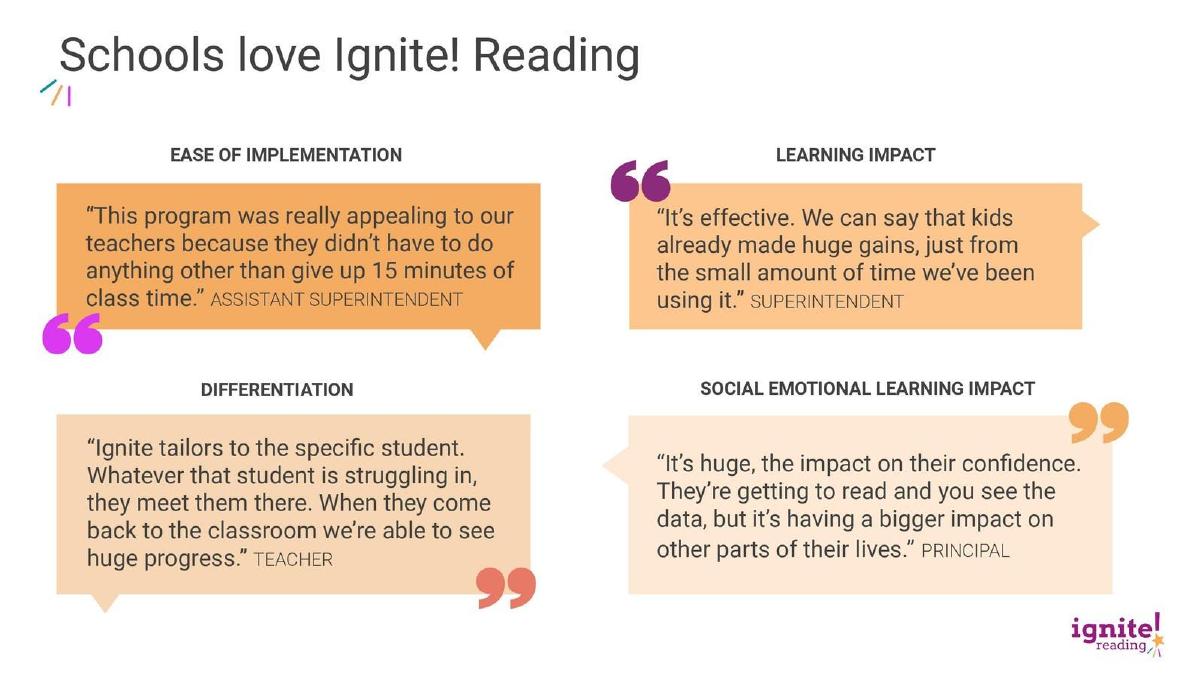
Slide 6 is dedicated to testimonials. It categorizes feedback into four areas: Ease of Implementation, Learning Impact, Differentiation, and Social Emotional Learning Impact. Quotes from an Assistant Superintendent, a Superintendent, a Teacher, and a Principal cover the entire decision-making unit (DMU) of a school district. This shows that the product satisfies every stakeholder in the purchasing process.
Slide 7: Quantitative Results
Slide 7 returns to hard data. It reiterates the "2.4 weeks of reading progress for every week in the program" and notes that these results are equal for students of color and those with IEPs. The slide also introduces Net Promoter Scores (NPS): 60 for Tutors and 64 for Educators. In the world of SaaS and EdTech, an NPS above 50 is considered excellent, signaling high retention and referral potential. A quote from a KIPP School Leader mentions a goal of "100% of students... growing 1.5 years by June 2022," which dates this specific data set but proves historical performance.
Slide 8: The 'Why Now' (Macro Tailwinds)
This is arguably the strongest slide for a VC. It identifies three massive shifts: 1) The Science of Reading being embraced by 29 states in law, 2) $122 billion in ARPA funding for schools, and 3) Unprecedented teacher shortages (77% of districts struggling to hire). By citing specific state mandates in Texas, Tennessee, and Rhode Island, the deck proves that there is a 'budget mandate' for their specific solution. It transforms the product from a 'nice-to-have' to a 'must-have' funded by federal and state dollars.
Slide 9: The Founding Team
The deck concludes with the team. Jessica Sliwerski brings 18 years of K-12 experience and a track record of reaching 3,000 districts. Evan Marwell is presented as a veteran entrepreneur who has already impacted 43 million students through EducationSuperHighway. This slide answers the 'Why You' question by showing a combination of deep pedagogical expertise and proven ability to scale infrastructure in the education sector.
What Ignite! Reading Does Well
The deck is exceptionally disciplined. It focuses on efficacy and scalability , the two things that matter most in EdTech. By leaning into the 'Science of Reading' movement, they aren't just selling tutoring; they are selling a solution to a regulatory shift. The use of third-party research (J-Pal) to validate their category and their own internal data to validate their specific product creates a high level of trust. Furthermore, addressing the labor supply issue (Slide 5) shows they understand the unit economics of their business, even without a dedicated slide for it.
What is Missing from the Deck
Despite raising $10M, the deck omits several standard venture components. There is no business model slide explaining how they charge districts (per student, per school, or per hour). There is no competitive landscape ; while they mention 'in-person tutoring,' they don't name other virtual competitors like Paper or Remind. Most notably, there is no financial slide showing current ARR, burn, or projections. Finally, there is no 'Ask' slide detailing how much they are raising and what the milestones for the next 18 months will be. These were likely handled in a separate data room or during the verbal pitch.
Founder's Playbook: Lessons to Copy
Align with Policy: If your industry is being disrupted by new laws or massive government grants (like ARPA), make that the center of your 'Why Now' slide. It proves the money is already there. · Solve the Labor Bottleneck: If your business relies on humans, show how you make those humans replaceable or more efficient. Ignite! Reading’s 15-hour training for non-teachers is a brilliant scalability argument. · Use the 'Effect Size' Language: In education and healthcare, 'Effect Size' is the gold standard. Using academic metrics rather than just 'user growth' proves your product actually works. · Target the DMU: Use testimonials that address the specific pain points of every person who has to say 'yes' to a sale—from the teacher in the classroom to the superintendent signing the check.
Frequently asked questions
- How does Ignite! Reading solve the teacher shortage?
- According to Slide 5, Ignite! Reading eliminates the need for trained teachers as tutors. Their model allows non-teachers to begin tutoring after only 15 hours of proprietary training. This dramatically reduces supply chain issues and allows the company to scale without competing for the limited pool of certified educators.
- What specific metrics does the deck use to prove success?
- Slide 7 highlights three core metrics: students achieve 2.4 weeks of reading progress for every week in the program, a Tutor Net Promoter Score (NPS) of 60, and an Educator NPS of 64. They also note that these results are consistent across students of color, multilingual learners, and students with IEPs.
- What is the 'Science of Reading' mentioned in the deck?
- Slide 3 defines the Science of Reading as a curriculum focused on learning to 'decode' sentences. It argues that the English language is a code and that most schools fail because they lack an explicit focus on decoding, which 20+ years of research suggests is essential for independent reading.
- How does the company plan to fund its growth?
- Slide 8 points to massive government funding as a primary driver. It cites $122 billion in K-12 ARPA funding, with at least $25 billion earmarked for learning loss recovery. By aligning with state mandates in places like Texas and Tennessee, Ignite! Reading positions itself to capture these public funds.
- Who are the founders of Ignite! Reading?
- Slide 9 introduces Jessica Sliwerski and Evan Marwell. Sliwerski previously led Open Up Resources to 3,000 districts and co-founded Lightsail. Marwell is the CEO of EducationSuperHighway, which upgraded broadband in 9,000 districts, and is a four-time entrepreneur across multiple industries.