iGrow’s 2014 pitch deck is a masterclass in simplifying a complex, multi-sided marketplace. Operating in the Indonesian agricultural sector, iGrow identifies three core stakeholders: farmers with skills but no land, landowners with idle property, and investors with capital as low as $100. The deck moves quickly from the conceptual 'problem-solution' fit to hard proof of execution, citing 1,600 tons of peanuts harvested and a 24% ROI for backers. With $1.2M in GMV and a 20% gross profit margin achieved within 19 months, the deck effectively balances social impact with financial viability. Whil…
Key takeaways
- The marketplace model connects three distinct groups: Farmers (skills), Landowners (land), and Investors (capital starting at $100) as shown on Slide 3.
- iGrow achieved $1.2 million in Gross Merchandise Volume (GMV) within its first 19 months of operation (Slide 9).
- The platform maintains a 20% gross profit margin, demonstrating a sustainable business model beyond simple brokerage (Slide 9).
- Traction is evidenced by a network of over 2,200 farmers and more than 3,000 acres of managed land (Slide 10).
- The 'Peanut' case study shows a 24% ROI for investors, with an impressive 99% reinvestment rate (Slide 8).
- The market opportunity in Indonesia is massive, with 27 million acres of under-utilized land and a $130 billion food agro market (Slide 11).
- The founding team combines serial tech entrepreneurship with 10 years of farming industry experience and 15 years in finance (Slide 12).
- The deck omits a specific funding 'Ask' or a breakdown of how the $175,000 would be utilized (Omitted).
Introduction: The Marketplace for Earth
iGrow’s 2014 pitch deck represents a pivotal moment in Southeast Asian AgTech. At a time when 'Uber for X' was the dominant pitch narrative, iGrow successfully applied the marketplace model to one of the world's oldest industries: farming. The deck is lean, consisting of only 13 slides, and relies heavily on visual storytelling and high-level traction metrics to make its case. Based in Jawa Barat, Indonesia, the company sought to solve the fragmentation of agricultural resources by digitizing the connection between labor, land, and capital.
The Vision and the Stakeholders (Slides 1-4)
Slide 1: Title Slide The deck opens with a bold claim: "The World’s Largest Organic Farm." This is a classic 'North Star' statement. It positions iGrow not just as a software company, but as a global agricultural powerhouse. The branding is clean, using greens and earth tones to reinforce the organic mission.
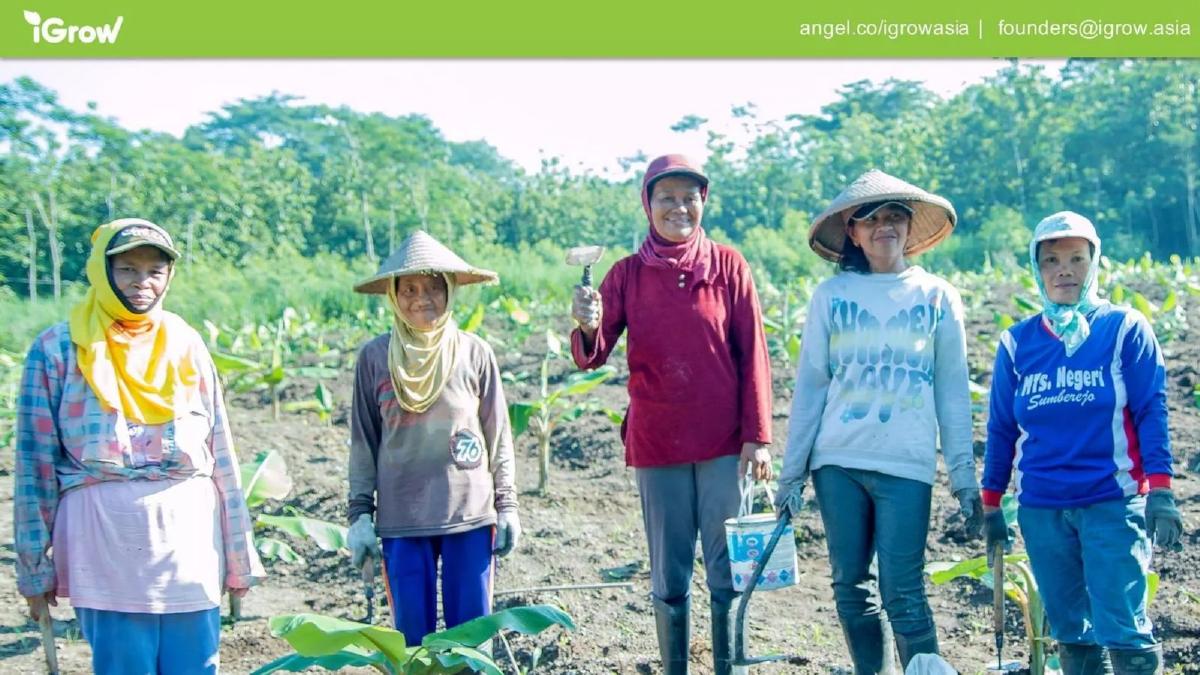
Slide 2: The Human Element Slide 2 is a full-bleed photograph of Indonesian farmers. This is a strategic choice. Before talking about software or ROI, iGrow grounds the pitch in the real-world impact on people. It humanizes the 'under-employed farmers' mentioned in their mission statement.
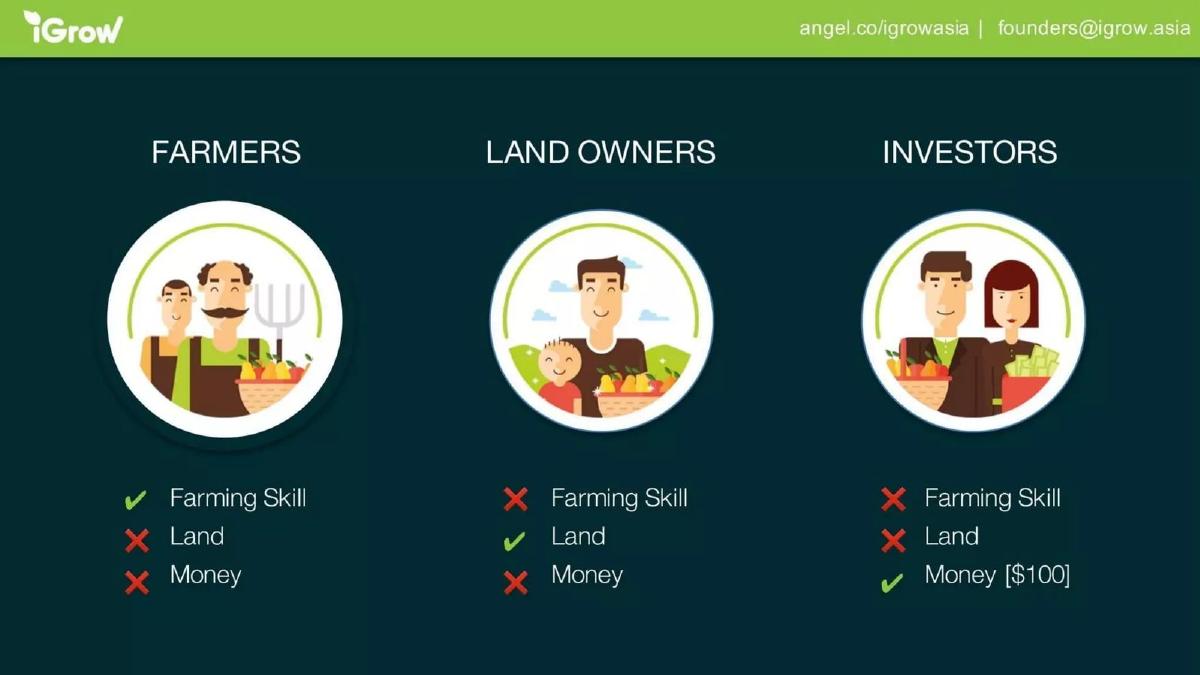
Slide 3: The Three-Sided Marketplace This is the most important conceptual slide in the deck. It breaks down the 'haves' and 'have-nots' for three groups:
Farmers: Have skills, lack land and money. · Land Owners: Have land, lack skills and money. · Investors: Have money ($100 minimum), lack skills and land.
By showing these three profiles side-by-side, iGrow makes the solution obvious: they are the glue that connects these three missing pieces.
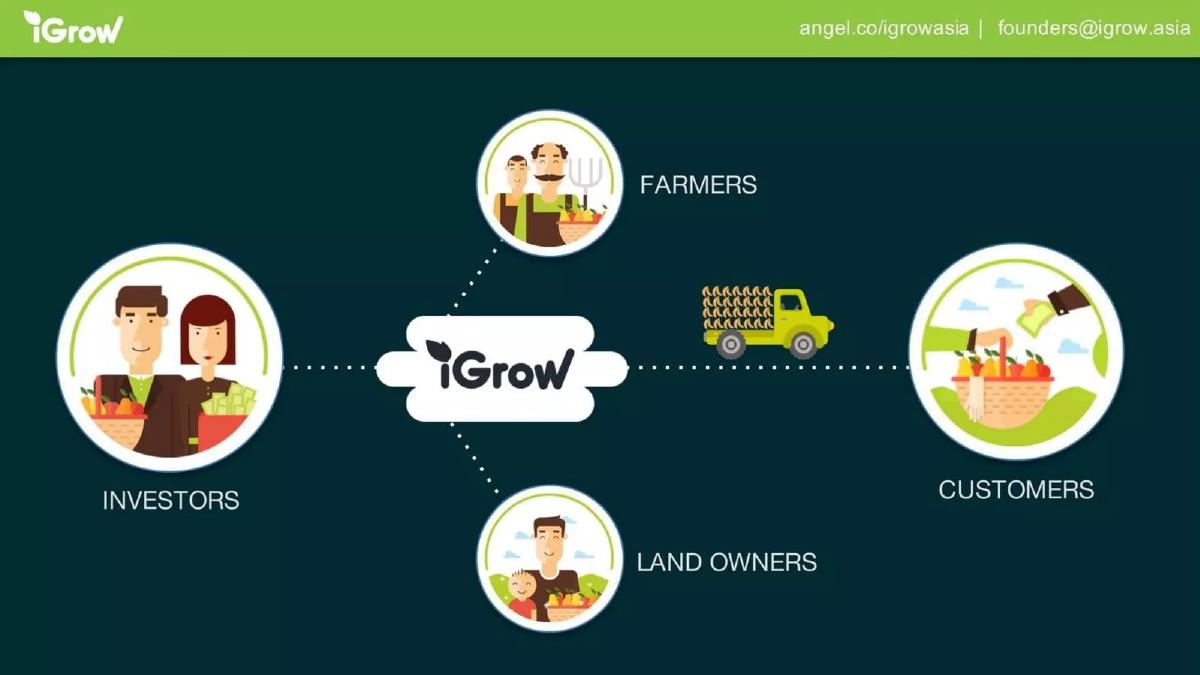
Slide 4: The Ecosystem Map This slide illustrates the flow of the marketplace. It shows iGrow at the center, connecting Investors, Farmers, and Land Owners, with a final arrow pointing toward 'Customers' receiving the harvested goods. It clarifies that iGrow isn't just a funding platform; it's a full-cycle supply chain manager.
Product and Proof of Concept (Slides 5-8)
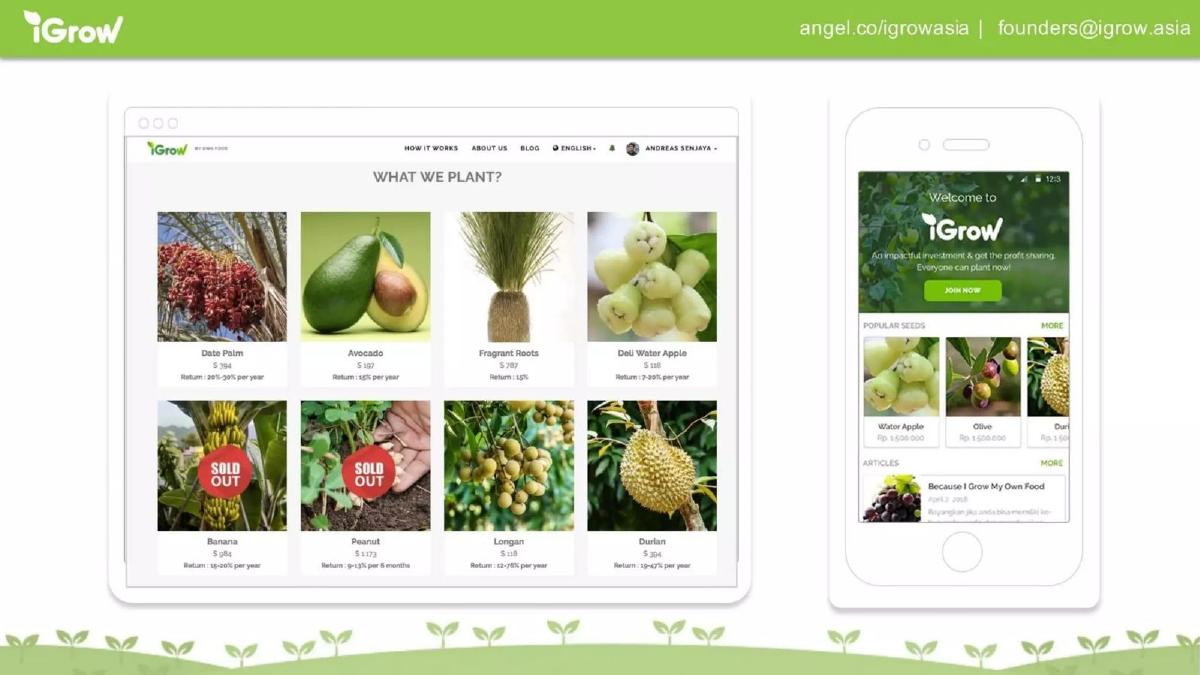
Slide 5: The Digital Storefront iGrow shows its interface across desktop and mobile. The 'What We Plant?' screen is effectively an e-commerce catalog for agriculture. It lists specific crops with their investment costs and projected returns:
Date Palm: $394 cost, 20-30% return per year. · Avocado: $197 cost, 15% return per year. · Durian: $394 cost, 19-47% return per year.
The 'Sold Out' badges on Banana and Peanut crops are a subtle but powerful indicator of existing demand.
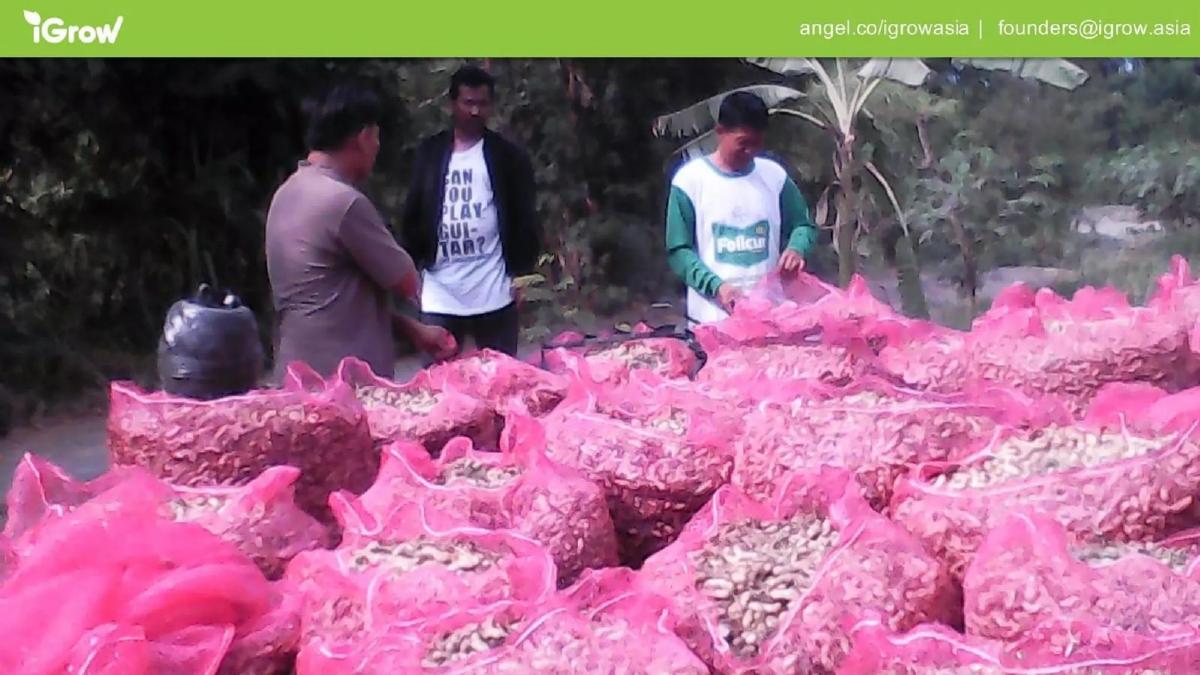
Slide 6: Real-World Operations Similar to Slide 2, this is a photo of the harvest in progress. It shows large sacks of peanuts and workers on the ground. For an AgTech company, proving that you can actually get your hands dirty is vital for investor trust.
Slide 7: The Peanut Case Study This slide provides a specific 'unit of success.' It reports 1,600 tons of harvested peanuts. More importantly, it shows the investor outcome: a $1,000 investment turned into $1,240 (a 24% ROI). The most impressive stat here is the "99% reinvested" figure, which suggests extremely high customer retention and satisfaction among the 'Backers.'
Traction and Market Opportunity (Slides 8-11)
Slide 8: Financial Traction iGrow presents its 19-month scorecard. The headline numbers are $1.2 million in GMV and a 20% gross profit. For a 2014 startup in this sector, these are strong figures. It proves that the marketplace isn't just moving money around—it's generating a healthy margin for the platform itself.
Slide 9: Scale of Operations This slide focuses on the supply side. With 2,200+ farmers and 3,000+ acres, iGrow demonstrates that it has moved past the pilot phase. The use of a smiling farmer in the background reinforces the social impact narrative that often accompanies AgTech investments.
Slide 10: The Pipeline and TAM iGrow looks toward the future. They identify a 'Pipeline' of 24,000 acres, which is an 8x increase over their current 3,000 acres. They frame the Total Addressable Market (TAM) within Indonesia: 27 million acres of under-utilized land and a $130 billion food agro market. This slide answers the 'Why now?' and 'How big?' questions simultaneously.
The Team and Closing (Slides 11-13)
Slide 11: The Team The team slide is concise, featuring three key leaders:
Andreas (CEO): Described as a serial tech entrepreneur with a portfolio of 150+ tech products. · Iqbal (COO): Brings the domain expertise with 10 years in the farming industry and 15 years in finance. · Jim (CBDO): Focuses on the real estate aspect with 4 years in land partnership and managed property.
This is a well-balanced trio covering tech, finance/farming, and land acquisition.
Slide 12: The Vision Reiteration A simple, high-impact image of a field with a mountain in the background, overlaid with the text: "We’re building the world’s largest organic farm." It serves as a bookend to the title slide, leaving the investor with a sense of scale and purpose.
Slide 13: Call to Action The final slide provides the website URL ( and contact information. It is clean and professional, though it lacks a specific 'Ask' for the $175,000 mentioned in the catalogue facts.
What Works in This Deck
Clarity of Stakeholders: The breakdown on Slide 3 is the deck's strongest asset. It immediately explains why the marketplace needs to exist by identifying the specific deficiencies of each party (Farmers, Landowners, Investors) and how iGrow fills them. This eliminates the need for a long, winding 'Problem' section.
Proof of ROI: By showing a 24% ROI and a 99% reinvestment rate (Slide 7), iGrow addresses the primary concern of any marketplace investor: 'Does it work for the participants?' The reinvestment rate is a proxy for Product-Market Fit.
Visual Balance: The deck alternates between clean, icon-based infographics and high-quality photography of actual farm operations. This prevents the pitch from feeling too 'software-heavy' or too 'operationally-manual.' It strikes the right balance for an AgTech play.
What Is Missing
The Financial Ask: While we know from catalogue facts that they raised $175,000, that information is nowhere in the deck. A standard pitch deck should include a slide detailing the amount being raised, the valuation (or cap), and the specific milestones that the capital will help achieve.
Competitive Landscape: The deck assumes iGrow is operating in a vacuum. There is no mention of traditional agricultural financing, government programs, or other emerging AgTech competitors in Southeast Asia. Investors need to know why iGrow’s model is superior to existing alternatives.
Unit Economics: While the 20% gross profit is mentioned, the deck doesn't explain the 'Take Rate' or the breakdown of how revenue is distributed between the farmer, the landowner, the investor, and iGrow. Understanding the split is crucial for assessing long-term scalability.
What a Founder Should Copy
The 'Missing Pieces' Slide: If you are building a multi-sided marketplace, copy Slide 3. Use checkmarks and 'X' marks to show exactly what each user group brings to the table and what they are missing. It is the fastest way to communicate value proposition.
The High-Trust Case Study: Don't just say you have traction; show a specific transaction. Slide 7’s peanut case study is effective because it uses a single, relatable example to prove the financial viability of the entire platform.
Humanizing the Impact: If your startup has a social or environmental component, use real photography. iGrow’s use of farmer photos (Slides 2 and 9) makes the mission feel tangible and urgent, which can be a powerful emotional hook for investors looking for 'Impact' alongside 'Returns.'
Frequently asked questions
- What is iGrow's core business model?
- iGrow operates as a three-sided marketplace. It identifies under-utilized land and pairs it with under-employed farmers. To fund the planting and maintenance, it allows retail investors to 'sponsor' crops for as little as $100. Once the crops are harvested and sold to customers, the revenue is shared among the stakeholders, with investors typically seeing returns between 13-24%.
- How much traction did iGrow have at the time of this deck?
- At the time of the 2014 deck, iGrow had been operating for 19 months. In that period, they generated $1.2 million in GMV, managed over 3,000 acres of land, and worked with a network of 2,200+ farmers. They also highlighted a specific success metric of harvesting 1,600 tons of peanuts.
- Who are the target investors for the iGrow platform?
- The platform targets retail investors, referred to as 'Backers.' Slide 3 specifies that the entry point for these investors is as low as $100. This low barrier to entry suggests a crowdfunding or fractional investment approach to agricultural financing.
- What crops does iGrow focus on?
- Slide 5 shows a diverse portfolio of crops available for investment, including Date Palm, Avocado, Fragrant Roots, Deli Water Apple, Banana, Peanut, Longan, and Durian. Each crop has a different investment cost and projected annual return.
- What is missing from the iGrow pitch deck?
- The deck is notably missing a 'The Ask' slide, which would typically detail how much capital is being raised and how it will be spent. It also lacks a competitive landscape analysis, detailed unit economics per crop beyond ROI, and a clear roadmap for future expansion beyond the current 'pipeline' of 24,000 acres.