Ignilife’s 2014 pitch deck is a lean, visually-driven presentation that positions the company at the intersection of digital health and corporate wellness. The deck relies heavily on high-level problem statistics—citing 1.5 billion overweight adults and 600 million hypertension sufferers—to justify its existence. It outlines a B2B2C distribution strategy targeting insurance companies and healthcare providers to reach end consumers. While the deck claims a current user base of 50,000 with an aggressive target of 1.6 million by Q1 2015, it is remarkably light on business fundamentals. There are…
Key takeaways
- The problem slide uses massive global health statistics, including 1 billion smokers and 450 million people with stress, to establish market need (Slide 2).
- The solution claims that lifestyle changes can reduce the risk of chronic disease by 80% (Slide 3).
- The product is described as a combination of data analysis, content, rewards, and social experience (Slide 4).
- Content depth is highlighted by the inclusion of 300 exercise videos within the platform (Slide 5).
- The business model is B2B2C, targeting insurance companies and healthcare providers to manage risk and improve customer relationships (Slide 6).
- The company reported 50,000 users at the time of the deck, with a projection to reach 1.6 million by Q1 2015 (Slide 7).
- The team consists of three co-founders (CEO, CTO, CMO) and an Art Director, but lacks professional biographies or past achievements (Slide 8).
- The deck completely omits a financial plan, competition analysis, and a specific funding 'ask' (Slides 1-9).
Ignilife Pitch Deck Analysis
The Ignilife pitch deck from 2014 is a brief, 9-slide presentation that prioritizes visual clarity over data density. Originating from Luxembourg, the company positions itself as a digital health platform designed to mitigate chronic disease through lifestyle intervention. The deck follows a standard problem-solution-product flow but stops short of providing the operational and financial details typically expected by venture capital investors.
Slide 1: Title Slide
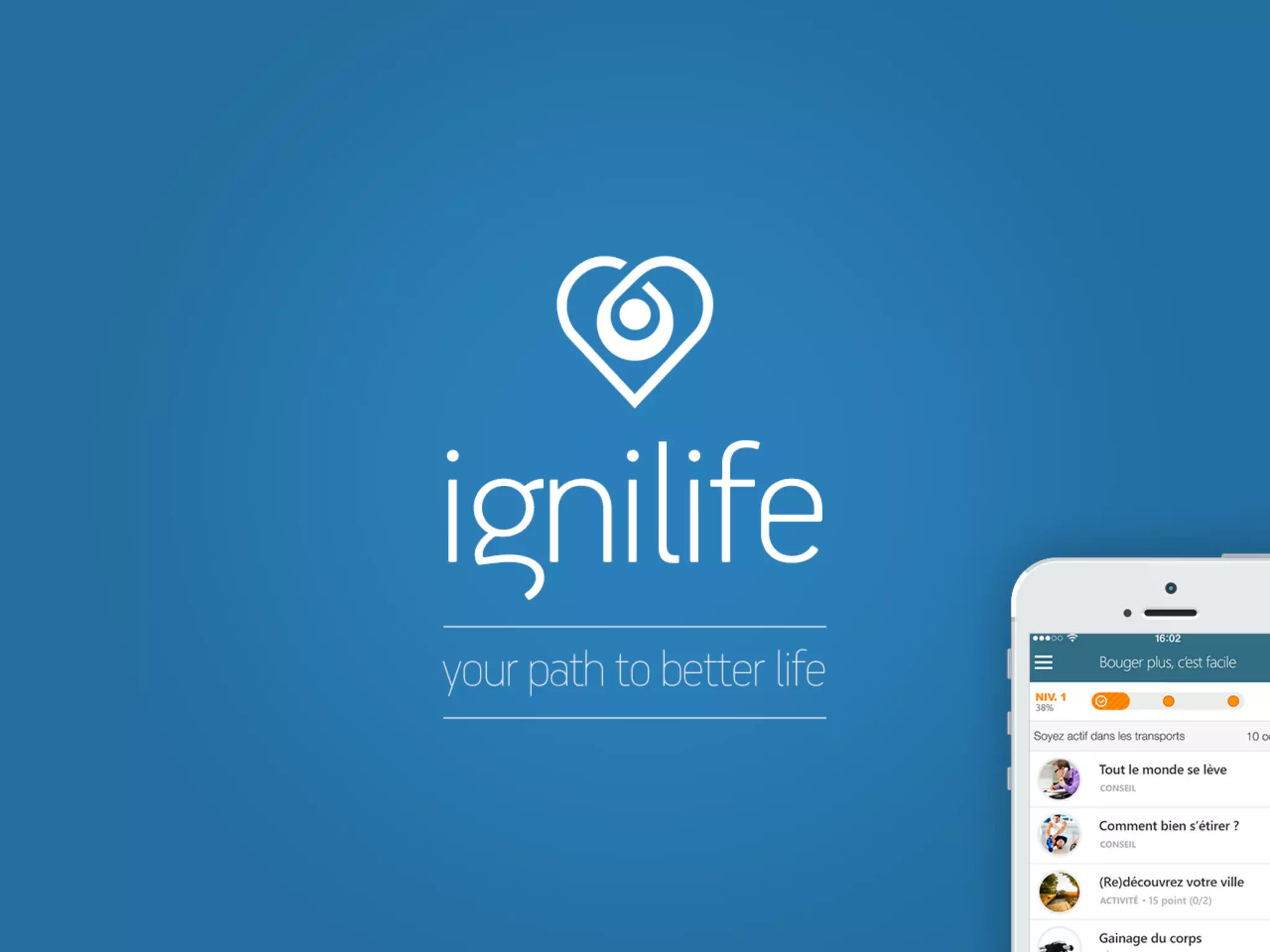
The cover slide features the Ignilife logo—a heart containing a stylized 'i' or flame—and the tagline "your path to better life." A partial image of a smartphone displaying the app interface is visible on the right. The branding is clean and professional, establishing a health-tech aesthetic immediately. No mention of the specific funding round or date is present on the slide itself.
Slide 2: The Global Health Problem
Ignilife uses a series of large-scale statistics to define its market opportunity. The slide lists 1.5 billion overweight adults, 600 million people with hypertension, 1 billion smokers, and 450 million individuals suffering from stress and anxiety. It also notes that 31% of adults do not work out enough and 37% have sleep disorders. By aggregating these diverse health issues, the company defines its Total Addressable Market (TAM) as essentially the entire global adult population.
Slide 3: The Lifestyle Solution
This slide introduces the core thesis of the company: "Lifestyle can slash risk of chronical disease by 80% ." It uses a simple iconographic style to show a human figure connected to four speech bubbles: Health, Fitness, Nutrition, and Emotion. This indicates that the Ignilife solution is holistic, rather than focusing on a single vertical like weight loss or smoking cessation.
Slide 4: Product Overview
Slide 4 provides a high-level definition of the platform. It states that "Ignilife is simple consumer experience combined with data analysis, great contents, rewards and social experience." A hand is shown holding a smartphone with the app interface visible. The interface, which is in French, shows tasks like "Tout le monde se lève" (Everyone gets up) and points systems, suggesting a gamified approach to health habits.
Slide 5: Platform Features and Content
This slide showcases the multi-device capability of the platform, showing the interface on a laptop, desktop, tablet, and smartphone. Key features highlighted include:
Personalized and evidence-based programs · Dashboard compatible with connected devices (indicating IoT/wearable integration) · Health Score (a proprietary metric for user wellness) · Rich Contents (specifically citing 300 videos of exercise)
The mention of 300 videos suggests a significant investment in proprietary content, which is a key differentiator in the wellness space.
Slide 6: The B2B2C Business Model
Slide 6 clarifies the distribution strategy. Instead of a direct-to-consumer (DTC) approach, Ignilife targets "Insurance, Company, [and] Health Care Provider[s]." The slide illustrates an arrow moving from the corporate entity to the customer. The stated benefits for the B2B clients are:
Stand out as an innovative company · Increase relationship with your customers · Risk management (Data analysis)
This suggests the revenue likely comes from licensing fees or per-user subscriptions paid by the insurer or employer to reduce long-term healthcare costs.
Slide 7: Traction and Targets
The traction slide is minimalist. It features a map of Europe with France and Switzerland highlighted. It claims 50,000 users at the time of the deck and sets a target of 1.6 million users by Q1 2015 . While the 50,000 figure is a solid starting point, the jump to 1.6 million is an aggressive 3,100% increase. The deck does not explain if these users are signed via a specific large-scale insurance contract or if they are projected 'leads.'
Slide 8: The Team
Fabrice Pakin: CEO/Co-Founder · David Bessoudo: CTO/Co-Founder · Elisabeth Virginio: CMO/Co-Founder · Nicolas Aubert: Art Director
The slide uses stylized, color-coded illustrations of the team members. Notably, there are no descriptions of their backgrounds, previous companies, or specific expertise. In a seed or Series A deck, the lack of founder pedigree is a significant omission.
Slide 9: Contact Information
The final slide provides the company website (www.ignilife.com) and direct contact details for Fabrice Pakin, including a French phone number and email address. There is no closing statement or summary of the investment opportunity.
What Ignilife Does Well
The deck excels at visual simplicity . In an era where pitch decks were often cluttered with text, Ignilife used a consistent color palette and clear iconography to tell a story. The B2B2C positioning is also very clear; the founders understood that the real money in preventative health in 2014 was in risk management for insurers, not in charging individuals $9.99 a month.
The inclusion of specific content metrics (300 videos) and device compatibility (connected devices) shows that the product was not just a concept but a functional platform with a content moat. The Health Score mentioned on Slide 5 is a classic 'sticky' metric that encourages long-term user retention, which is vital for the insurance use case.
What is Missing from the Deck
The most glaring omission is the Financial Ask . A pitch deck is a tool to raise money, yet this deck never specifies how much capital is needed or what the milestones for that capital would be. Furthermore, there is no Revenue Model slide. While we can infer a subscription or licensing model from the B2B2C slide, the deck does not state the price points or the current Annual Recurring Revenue (ARR).
The Competitive Landscape is also ignored. In 2014, the digital health space was already becoming crowded with players like Omada Health or corporate wellness platforms like Virgin Pulse. Ignilife fails to explain why their "Health Score" or "300 videos" are superior to existing solutions. Finally, the Team Slide lacks the professional credibility markers (e.g., "Ex-Google," "10 years in Insurance") that investors look for to de-risk the execution of the business.
Founder's Takeaway: What to Copy
Founders should emulate the clear problem-to-solution bridge found in Slides 2 and 3. By using massive, undeniable statistics and then immediately offering a simple counter-stat (lifestyle reduces risk by 80%), Ignilife creates a compelling narrative arc. The distribution diagram on Slide 6 is also a great example of how to explain a complex B2B2C relationship without using a wall of text.
However, founders must avoid the lack of context found here. If you claim you will grow from 50k to 1.6M users in a few months, you must provide a slide explaining the specific partnerships or marketing channels that make that growth possible. A pitch deck without an 'Ask' or a 'Competition' slide is a brochure, not a fundraising document.
Frequently asked questions
- What is Ignilife's primary business model?
- Ignilife utilizes a B2B2C model. According to slide 6, they sell their platform to 'Insurance, Company, [and] Health Care Providers.' These entities then provide the service to the 'Customer.' The value proposition for these B2B clients is risk management through data analysis and improved customer relationships, rather than selling directly to the end-user.
- How does the platform attempt to engage users?
- The platform focuses on four pillars: Health, Fitness, Nutrition, and Emotion (Slide 3). Engagement is driven by 'personalized and evidence-based programs,' a 'Health Score,' and a library of '300 videos of exercise.' Slide 4 also mentions 'rewards and social experience' as key components of the consumer experience.
- What are the growth projections mentioned in the deck?
- Slide 7 shows a map of Europe with France and Switzerland highlighted. It states the company had 50,000 users at the time of the presentation and was 'targeting 1.6 million Q1 2015.' This represents a 32x growth target, though the deck does not explain the specific customer acquisition strategy to achieve this.
- Who are the key members of the Ignilife team?
- The team slide (Slide 8) lists four individuals: Fabrice Pakin (CEO/Co-Founder), David Bessoudo (CTO/Co-Founder), Elisabeth Virginio (CMO/Co-Founder), and Nicolas Aubert (Art Director). The slide uses stylized illustrations rather than photos and provides no information regarding their previous professional experience or education.
- What critical information is missing from this pitch deck?
- This deck is missing several standard components required for a formal fundraise. There is no 'Ask' slide detailing how much capital is being raised or how it will be used. Additionally, there are no financial projections, no analysis of the competitive landscape, and no explanation of the revenue model (e.g., per-member-per-month fees vs. licensing).