iLobby’s pitch deck is a masterclass in establishing enterprise credibility. By focusing on high-stakes, regulated industries like aerospace, chemicals, and government, the company differentiates itself from simple 'iPad-at-the-front-desk' competitors. The deck effectively uses a bottom-up TAM analysis to project a C$14.0 billion opportunity and provides a detailed timeline of product evolution, particularly their rapid response to COVID-19 with features like FeverCheck and Touchless Sign-In. While the deck lacks a dedicated team slide and specific financial performance data (revenue/EBITDA),…
Key takeaways
- The company claims a total addressable market (TAM) of ~C$14.0 billion based on a bottom-up analysis of enterprise tiers (Slide 7).
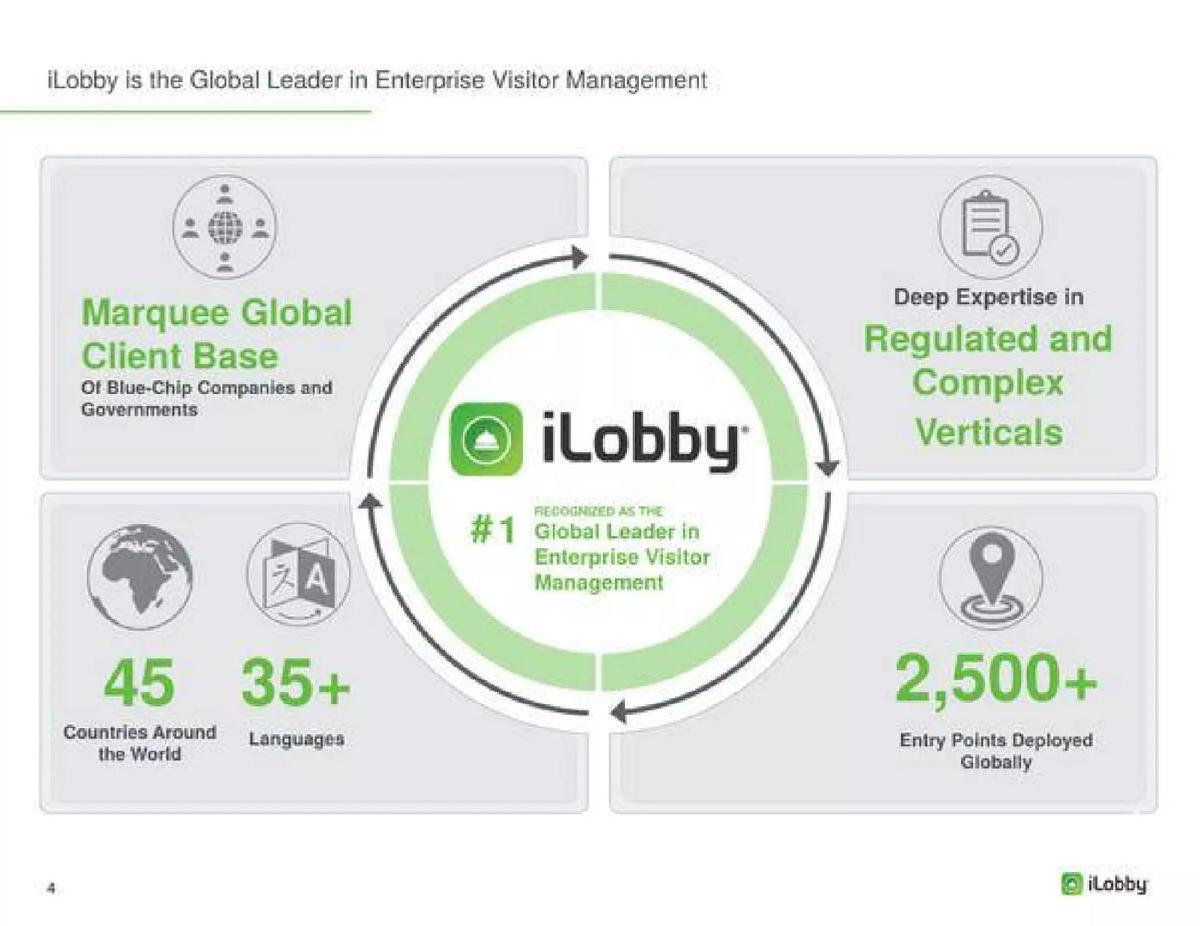
- iLobby emphasizes its global footprint with presence in 45 countries and support for 35+ languages (Slide 4).
- A significant portion of the deck focuses on the 2020 product pivot, launching four COVID-specific modules between April and October (Slide 11).
- The platform has deployed over 2,500 entry points globally for more than 700 clients (Slide 3).
- iLobby positions itself as the leader in 'regulated and complex verticals,' specifically targeting manufacturing, logistics, and pharma (Slide 8).
- The deck includes a detailed competitive matrix comparing iLobby against 8 competitors, including Envoy and Proxyclick, across enterprise-grade features (Slide 9).
- A case study for Toronto Pearson International Airport highlights a 90% decrease in time spent at issuance stations (Slide 14).
- The company reports a 52% CAGR in logos from 2018 to 2020 (Slide 10).
Executive Summary: The Enterprise Compliance Play
iLobby’s pitch deck represents a strategic shift from simple SaaS utility to mission-critical infrastructure. Founded in 2013, the Toronto-based company used this presentation to secure a $100 million investment, positioning itself not just as a visitor logbook, but as a security and compliance gatekeeper for the world’s most complex facilities. The deck is heavy on social proof, utilizing a massive array of Fortune 500 logos to demonstrate that it has already solved the 'hard' problems of enterprise deployment.
Slide 1-2: Branding and Legal Framework
The deck opens with a clean title slide featuring the iLobby tablet hardware, immediately signaling that this is a hybrid hardware-software solution. Slide 2 is a dense Confidentiality and Disclaimer page. Notably, it mentions that iLobby engaged RBC Capital Markets as its financial advisor for a 'potential sale of shares.' This indicates the deck was likely used for a formal secondary sale or a late-stage private equity round rather than an early-stage venture capital pitch.
Slide 3-4: The Global Footprint
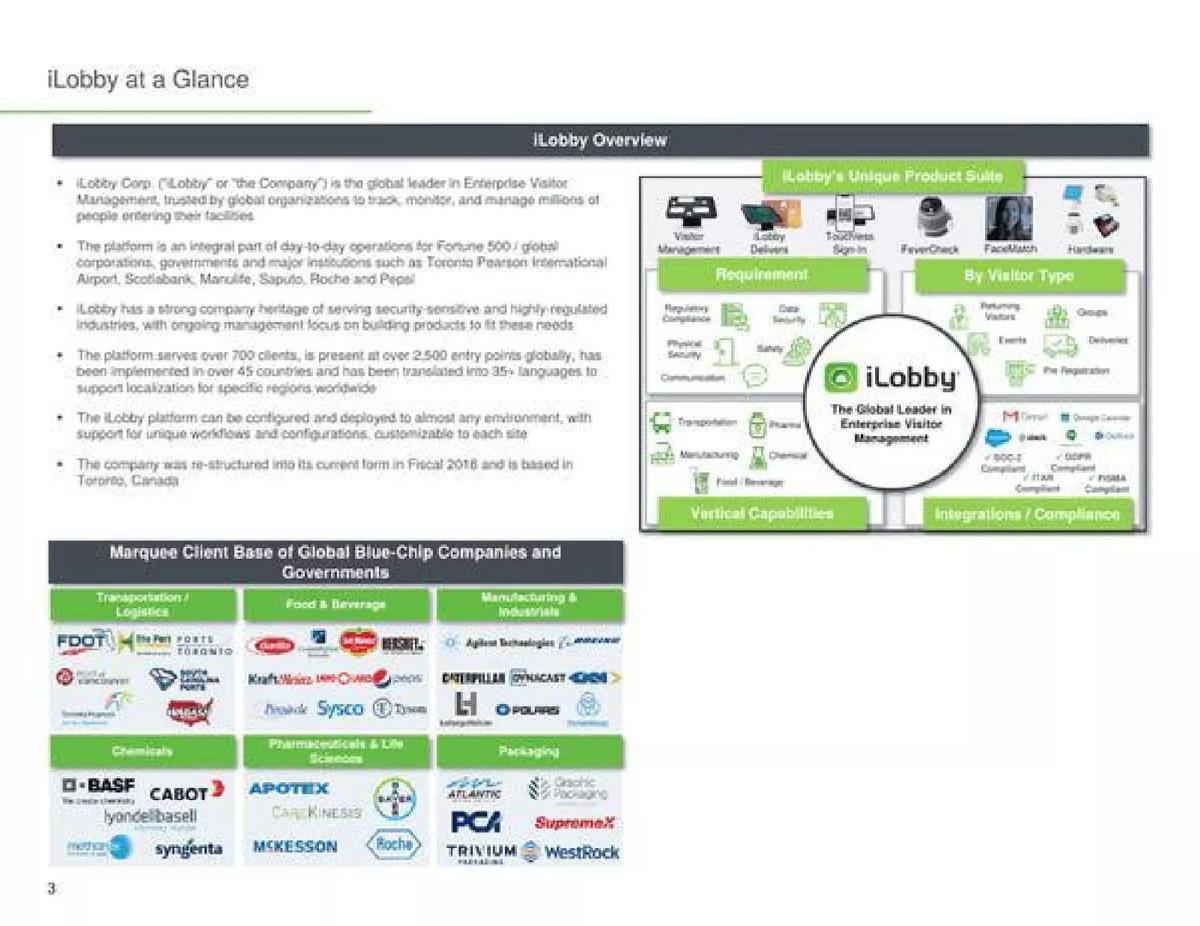
Slide 3, 'iLobby at a Glance,' is the most information-dense slide in the deck. It establishes the company as a 'global leader' with over 700 clients and 2,500 entry points across 45 countries. The slide features a 'Marquee Client Base' divided by industry: Transportation (FedEx, Port Toronto), Food & Beverage (Pepsi, Hershey, Tyson), Manufacturing (Boeing, Caterpillar), Chemicals (BASF, Syngenta), and Pharma (Roche, McKesson). Slide 4 reinforces these stats with large icons, emphasizing the 35+ languages supported, which is a key requirement for global enterprise contracts.
Slide 5-6: Product Evolution and History
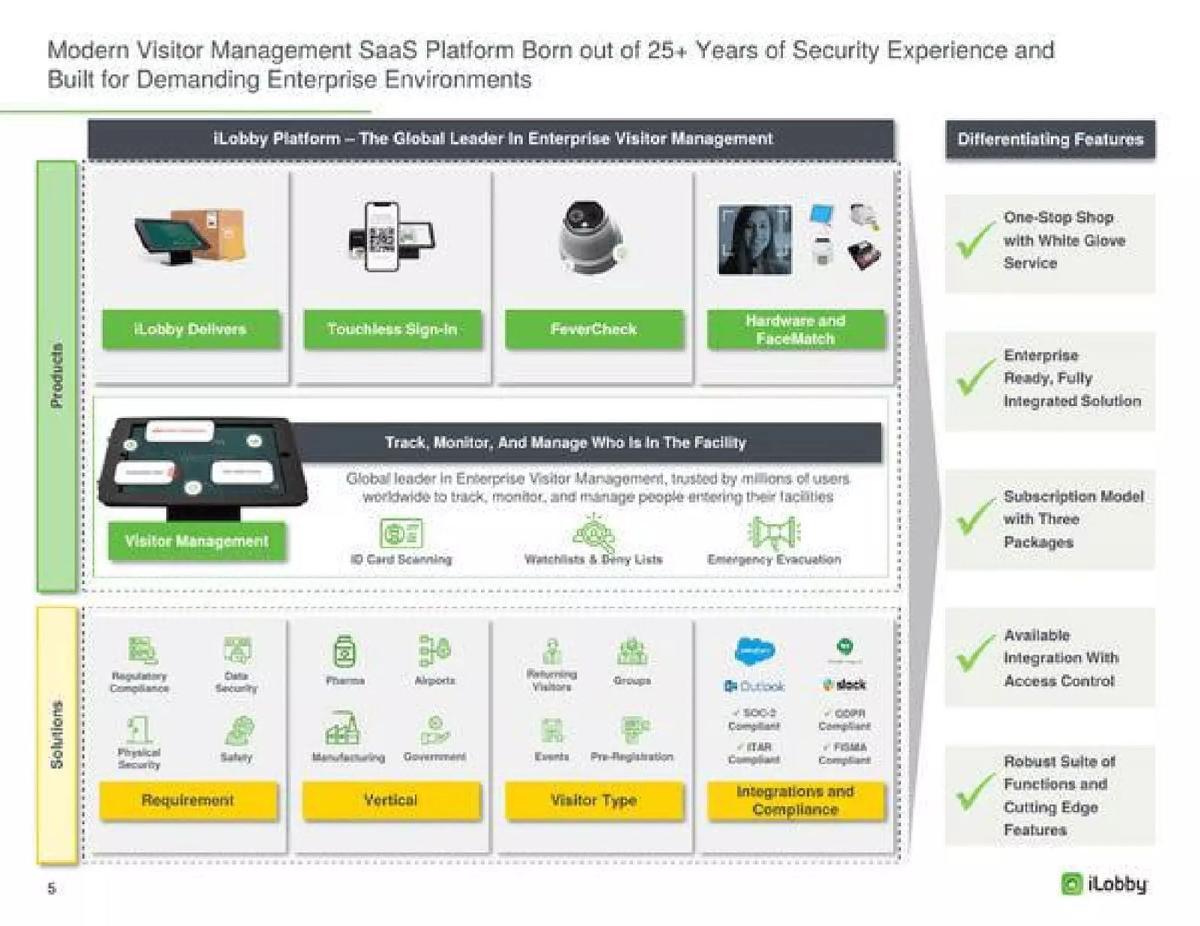
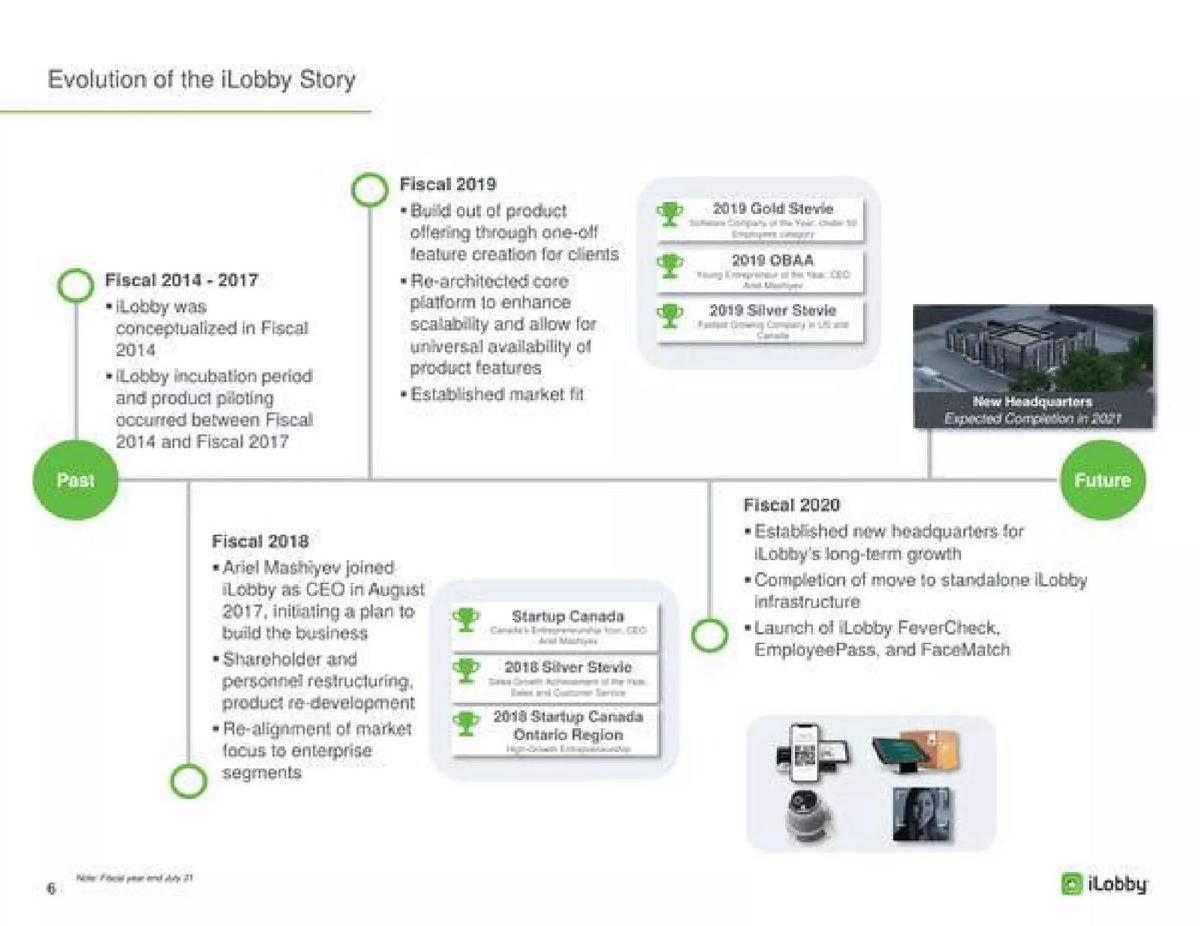
Slide 5 breaks down the 'Modern Visitor Management SaaS Platform.' It categorizes the offering into products (iLobby Delivers, FeverCheck, FaceMatch) and solutions (Regulatory Compliance, Data Security). The slide highlights a 'Subscription Model with Three Packages,' though it does not list specific pricing. Slide 6 provides a timeline of the 'iLobby Story.' It notes that Ariel Mashiyev joined as CEO in 2017, triggering a 'shareholder and personnel restructuring' and a 're-alignment of market focus to enterprise segments.' This slide is crucial as it explains the company's transition from a conceptual startup (2014-2017) to a high-growth enterprise engine.
Slide 7: The C$14 Billion Opportunity
Slide 7 presents a bottom-up TAM analysis. iLobby segments the market by employee count: Extra Large Enterprise (50K+ employees), Large Enterprise (10K-50K), Medium Enterprise (2K-10K), and Small Enterprise (1K-2K). By multiplying the number of companies worldwide by an average number of entry points and a monthly subscription rate (ranging from C$263 to C$659 per month), they arrive at a total TAM of ~C$14.0 billion. This granular approach is much more persuasive to institutional investors than a top-down '1% of a trillion-dollar market' claim.
Slide 8-9: Competitive Advantage and The Matrix
Slide 8 focuses on 'Unique Challenges' like ITAR and C-TPAT compliance, positioning iLobby as the only solution capable of handling 'complex screening and mustering features.' Slide 9 is a standard competitive matrix. iLobby gives itself 'Excellent' ratings across all categories (Enterprise Grade, Vertical Capabilities, Integrated Hardware, etc.), while competitors like Envoy and Proxyclick are shown to have gaps in vertical-specific capabilities and hardware integration. A footnote mentions that Industrial and Commercial sectors are 'less sensitive to decreases in on-site traffic as compared to Office,' a clear nod to the resilience of their business model during the pandemic.
Slide 10-12: The COVID-19 Pivot
These slides detail the product's functionality and its rapid adaptation to the 'New Normal.' Slide 10 shows the visitor management interface with six key features, including ID card scanning and emergency evacuation. Slide 11 lists the launch dates for new modules: FeverCheck (July 2020), FaceMatch (September 2020), and Employee Pass (October 2020). Slide 12 explains how these tools—like contactless body temperature readings—help businesses identify high-risk individuals before they enter a facility. This section proves the engineering team's ability to ship high-stakes features in weeks, not months.
Slide 13-14: Roadmap and Case Study
Slide 13 summarizes the 'Product Roadmap,' showing a transition from building unique customer solutions (2018-2019) to scaling the business to keep up with demand (2020+). It mentions the addition of 239 new customers in 2020, including Comcast and Labatt Brewing. Slide 14 provides a deep dive into the Toronto Pearson International Airport deployment. The KPIs are impressive: a '100% tracking of passes issued and returned' and a '90% decrease in time spent at issuance station.' For an airport processing 450,000 aircraft annually, these efficiencies translate to massive cost savings.
Slide 15-16: Growth Pathways and Conclusion
Slide 15 outlines four pathways for future growth: COVID-19 tailwinds, strengthening customer relationships (upselling contact tracing/timeclock), expansion into new geographies, and utilizing a distributor/VAR (Value Added Reseller) model. The deck concludes on Slide 16 with a high-resolution image of their kiosk hardware, reinforcing the professional, enterprise-ready nature of the brand.
What Works in the iLobby Deck
Vertical Specificity: By explicitly naming industries like 'Chemicals' and 'Aerospace,' iLobby moves away from being a generic office tool. They speak the language of compliance (ITAR, GDPR, FISMA), which is the primary driver for enterprise purchasing decisions. Social Proof: The logo clouds on Slide 3 and Slide 13 are overwhelming. When a founder can show that Boeing, BASF, and FedEx all use the same platform, the 'risk' of the investment drops significantly. Agility Demonstration: The timeline of 2020 product launches (Slide 11) is a powerful narrative of a company that doesn't just survive a crisis but uses it to expand its product moat.
What is Missing from the iLobby Deck
The Team: There is no slide dedicated to the founders or the leadership team. While the CEO is mentioned in the timeline, the lack of bios for the CTO or Head of Sales is a notable omission for a $100M raise. Financials: The deck contains no revenue figures, no EBITDA margins, and no churn data. While the '52% CAGR in logos' is a good growth proxy, it doesn't tell the full story of the company’s financial health. The Ask: The deck does not state how much money is being raised or what the valuation expectations are. This confirms the deck was likely a 'teaser' or a 'capabilities deck' used in a structured M&A or late-stage process rather than a cold pitch to a VC.
What a Founder Should Copy
Bottom-Up TAM: Founders should copy the structure of Slide 7. Instead of quoting a Gartner report, they should show the math: [Number of Customers] x [Number of Seats/Units] x [Price Point]. It shows a deep understanding of the customer base. The Competitive Matrix: Slide 9 is excellent because it doesn't just use checkmarks; it uses 'Harvey Balls' (quarter/half/full circles) to show degrees of capability. This feels more honest and nuanced than a simple Yes/No chart. KPI-Driven Case Studies: Slide 14 is a perfect template for a case study. It identifies the 'Key Challenge,' the 'Project Drivers,' the 'Solution,' and—most importantly—the 'KPIs' (90% time reduction). Always quantify the success of your pilots.
Frequently asked questions
- What is iLobby's core value proposition?
- iLobby positions itself as an enterprise-level visitor management system specifically built for highly regulated and security-sensitive industries. Unlike basic sign-in apps, iLobby integrates with hardware like gates, turnstiles, and thermal cameras to ensure compliance with ITAR, C-TPAT, and other regulatory frameworks. Their value lies in streamlining complex workflows for contractors and visitors in facilities like airports and chemical plants.
- How did iLobby adapt to the COVID-19 pandemic?
- The deck highlights a rapid product expansion in 2020. Between February and October of that year, they launched iLobby Delivers, COVID-19 Workflows (pre-screening), Touchless Sign-In, FeverCheck (thermal imaging), FaceMatch (biometric verification), and a mobile Employee Pass. This agility allowed them to maintain relevance when physical office traffic decreased by pivoting toward essential health and safety infrastructure.
- Who are iLobby's primary competitors according to the deck?
- Slide 9 identifies several competitors categorized by market segment. Enterprise and mid-market competitors include Envoy, Proxyclick, Sine, Teem by iOFFICE, Guest, and Veristream. Small-to-medium business (SMB) competitors listed are Receptionist and SwipedOn. iLobby claims superiority through deeper vertical capabilities, integrated hardware, and enterprise-grade customization that SMB-focused tools lack.
- What metrics does iLobby use to demonstrate growth?
- The deck focuses on scale and adoption rather than raw revenue. Key metrics cited include 700+ clients, 2,500+ entry points, and a 52% CAGR in logo growth between 2018 and 2020. They also highlight their global reach in 45 countries and the successful deployment at major hubs like Toronto Pearson International Airport, which processes 47 million passengers annually.
- What is missing from the iLobby pitch deck?
- The deck is missing three critical components typically found in a fundraising presentation: a team slide detailing executive experience, a financial slide showing historical revenue or profitability, and a specific 'Ask' slide outlining how much capital is being raised and how it will be deployed. This suggests the deck may have been used as a general capabilities briefing or part of a larger data room.