SupportLogic’s deck is an exercise in brevity, utilizing only seven slides to secure a Series B round that eventually totaled $62,000,000. Rather than relying on dense financial tables or exhaustive team bios, the presentation focuses on the structural failure of traditional 'Systems of Record' in the enterprise support space. The narrative centers on the technical capability to extract 'signals' from unstructured data—like support tickets and Slack messages—to move companies from reactive firefighting to proactive customer success. By positioning itself at the crest of the 'Intelligence Era'…
Key takeaways
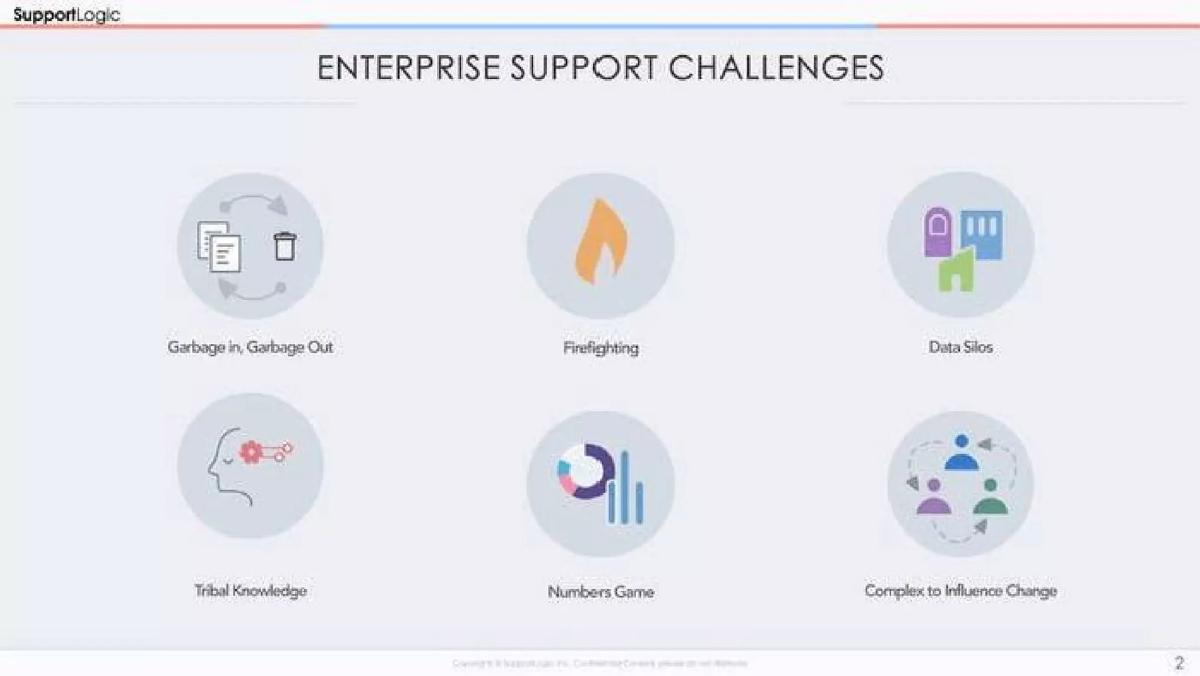
- The deck identifies six core enterprise challenges, including 'Tribal Knowledge' and 'Data Silos,' on slide 2.
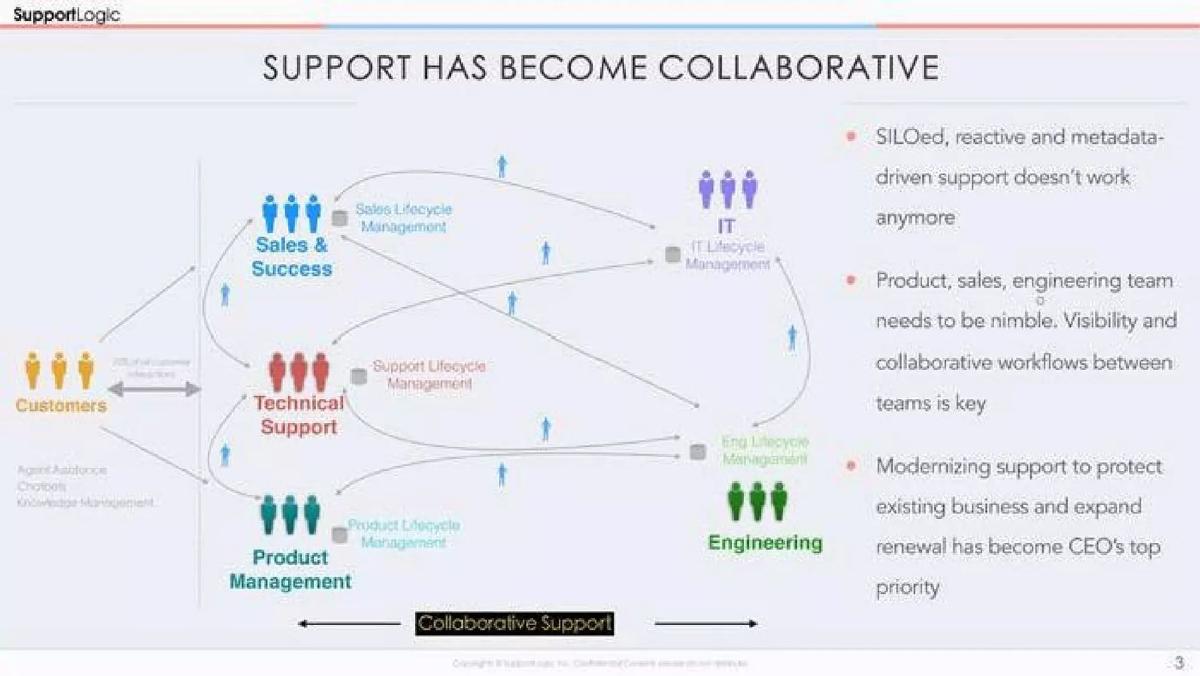
- Slide 3 argues that modernizing support to protect renewals has become a 'CEO's top priority.'
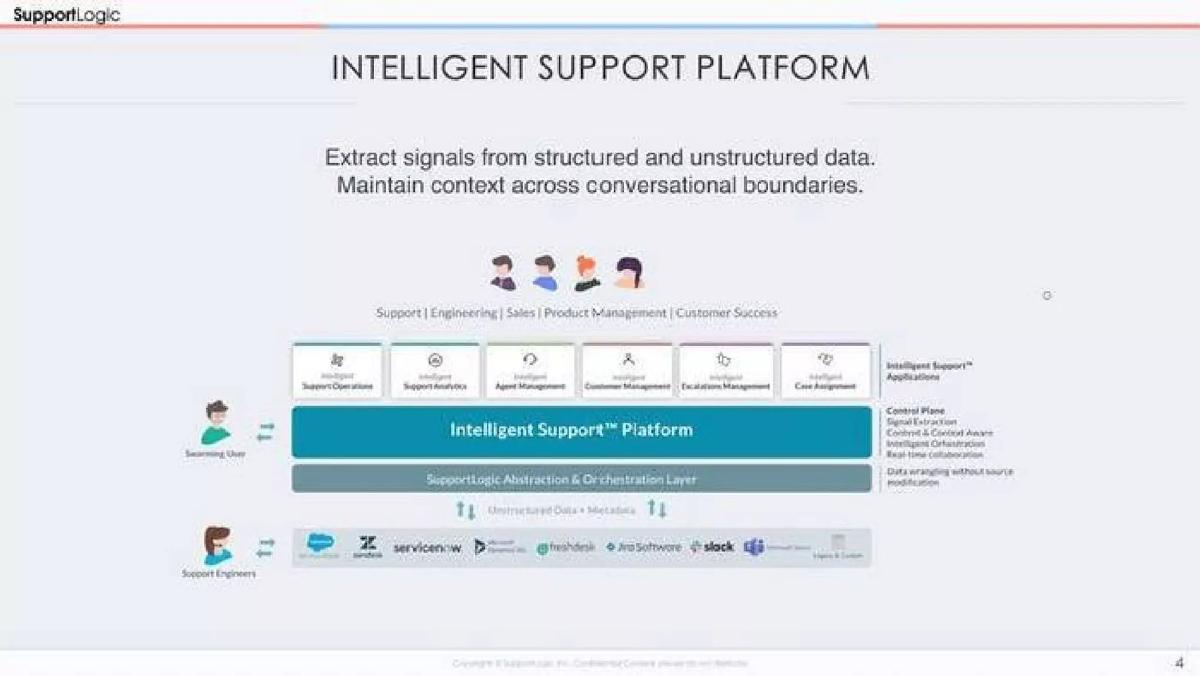
- The platform integrates with major incumbents like Salesforce, Zendesk, ServiceNow, and Slack, as shown on slide 4.
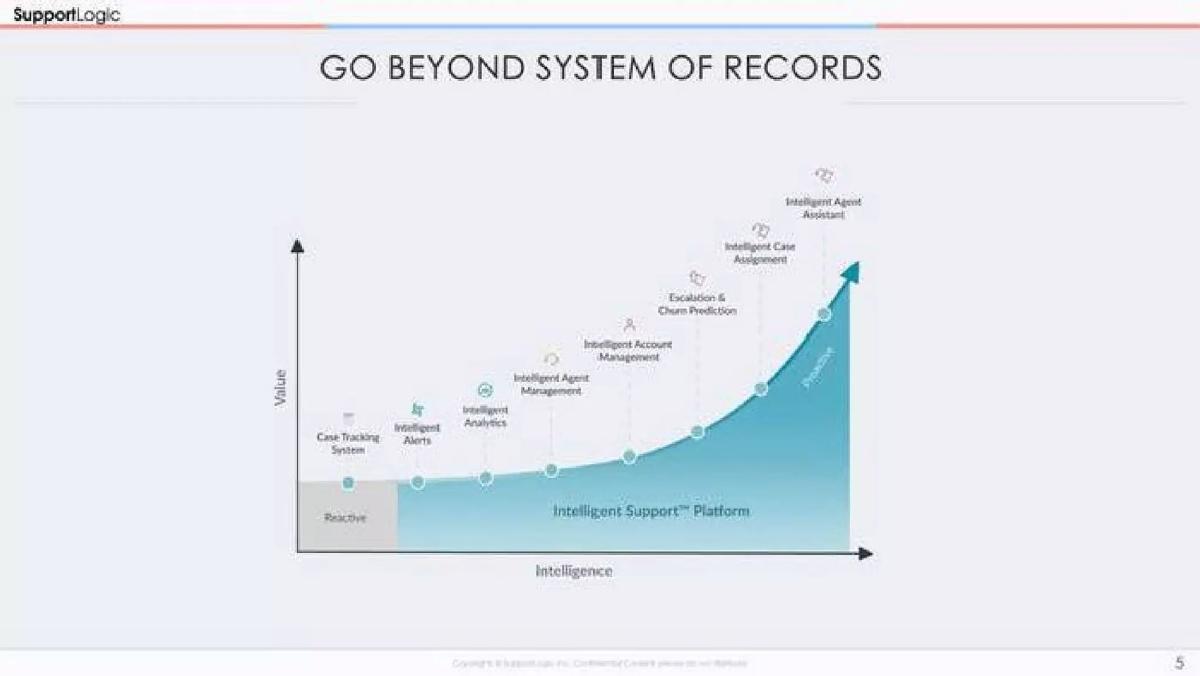
- A value-intelligence curve on slide 5 maps the product's evolution from simple 'Case Tracking' to 'Intelligent Agent Assistant.'
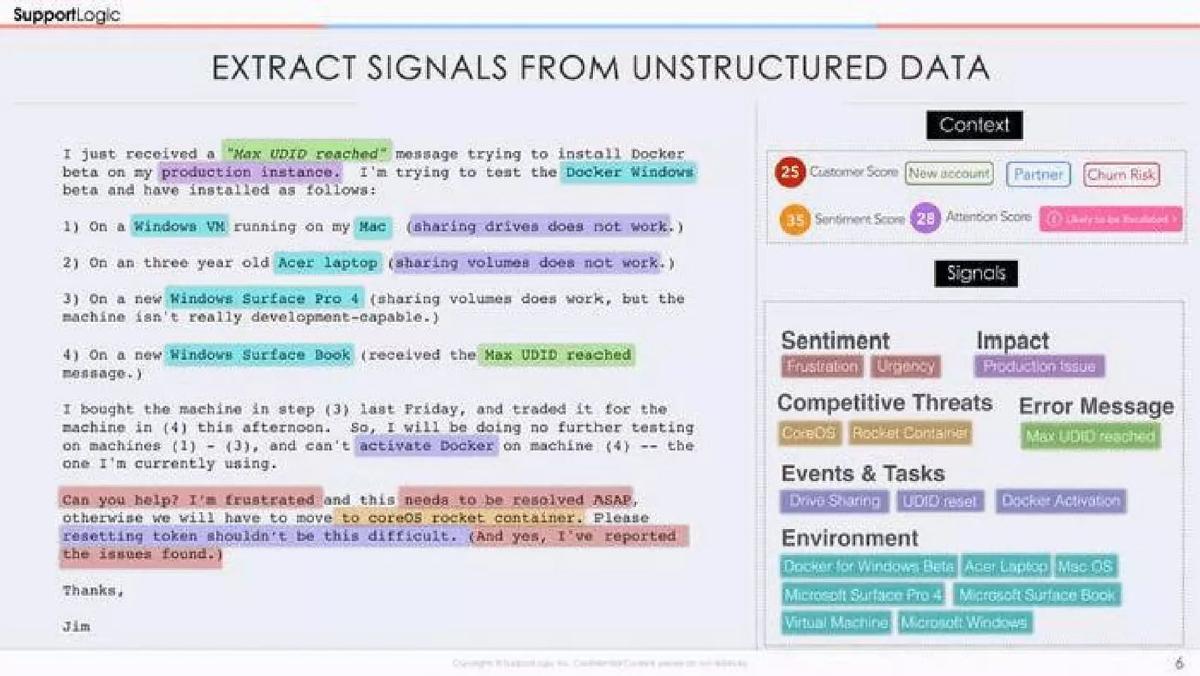
- Slide 6 provides a concrete technical demonstration of how the AI parses a raw support email to identify sentiment, urgency, and competitive threats.
- The presentation concludes on slide 7 by framing the current market as the 'Intelligence Era (2020 Onwards),' characterized by outcome-based licensing and AI tech.
- The deck completely omits a team slide, financial projections, and a specific funding ask within these seven pages.
- The catalogue listing confirms the company successfully raised $62,000,000 in 2016 following this stage of development.
The Narrative of Proactive Intelligence
SupportLogic’s pitch deck is a focused, technical narrative that aims to redefine the category of customer support. Rather than presenting as a simple helpdesk tool, it positions itself as an Intelligent Support Platform . The deck, used to facilitate a total raise of $62,000,000, is remarkably brief at only seven slides. It skips the traditional introductory fluff and dives straight into the structural inefficiencies of enterprise support. By focusing on the transition from 'Systems of Record' to 'Systems of Intelligence,' SupportLogic builds a case for why the next generation of enterprise software must be built on unstructured data analysis.
Slide 1: Title and Identity
The cover slide is minimalist, featuring the company logo and the tagline Intelligent Support Platform™ . It identifies Krishna Raj Raja as the presenter. There are no decorative graphics, which sets a professional, utility-first tone for the rest of the presentation.
Slide 2: The Enterprise Struggle
Slide 2, titled ENTERPRISE SUPPORT CHALLENGES , uses six icons to categorize the pain points SupportLogic aims to solve. These include:
Garbage in, Garbage Out: The failure of data quality. · Firefighting: The reactive nature of support. · Data Silos: Information trapped in specific departments. · Tribal Knowledge: Insights living in employees' heads rather than systems. · Numbers Game: A focus on volume over quality. · Complex to Influence Change: The difficulty of using support data to drive product or sales decisions.
Slide 3: The Collaborative Shift
On slide 3, SUPPORT HAS BECOME COLLABORATIVE , the deck argues that support is no longer a back-office function. A complex diagram shows the flow of information between Customers, Technical Support, Sales & Success, Product Management, IT, and Engineering. The key takeaway here is that 'Modernizing support to protect existing business and expand renewal has become CEO's top priority.' This elevates the product from a departmental tool to a strategic enterprise necessity.
Slide 4: The Platform Architecture
Slide 4 introduces the INTELLIGENT SUPPORT PLATFORM . This is the 'how it works' slide. It shows SupportLogic sitting as an Abstraction & Orchestration Layer above existing systems of record. The slide lists integrations with Salesforce, Zendesk, ServiceNow, Microsoft Dynamics, Freshdesk, Jira, Slack, and Intercom . By showing these logos, SupportLogic demonstrates that it does not require customers to rip and replace their existing infrastructure; it enhances it by extracting signals from the data already residing in those tools.
Slide 5: The Value-Intelligence Curve
Slide 5, GO BEYOND SYSTEM OF RECORDS , is a classic 'up and to the right' graph. The X-axis represents Intelligence and the Y-axis represents Value . It maps the progression from reactive 'Case Tracking Systems' to proactive features like Intelligent Case Assignment, Escalation & Churn Prediction, and Intelligent Agent Assistant . This slide serves to show the product roadmap and the increasing ROI as a customer adopts more of the platform's AI capabilities.
Slide 6: Technical Proof of Concept
Slide 6, EXTRACT SIGNALS FROM UNSTRUCTURED DATA , is perhaps the most important slide for a technical investor. It shows a raw email from a customer named 'Jim' who is frustrated with a Docker installation. The AI highlights specific phrases in different colors to categorize them. For example:
Sentiment: 'I'm frustrated' and 'shouldn't be this difficult.' · Impact: 'production instance.' · Competitive Threats: 'move to coreOS rocket container.' · Error Message: 'Max UDID reached.'
This slide proves the AI's ability to turn 'Dark Matter' (unstructured text) into actionable data points like a Sentiment Score of 35 or an Attention Score of 28 .
Slide 7: The Macro Trend
The final slide, SYSTEMS OF RECORD ARE NOT SUFFICIENT ANYMORE , places SupportLogic in a historical context. It compares four eras: the SQL Era (1990-2000), the Web Era (2000-2010), the SaaS Era (2010-2020), and the Intelligence Era (2020 Onwards) . It claims that in this new era, growth is Product & Service Led , licensing is Outcome Based , and data is Completely Unstructured . This frames the investment not just as a bet on a company, but as a bet on the inevitable direction of the entire software industry.
What Works in This Deck
The primary strength of this deck is its clarity of vision . It does not get bogged down in the minutiae of individual features. Instead, it focuses on a high-level shift in how enterprises handle data. The use of slide 6 to show a real-world example of NLP (Natural Language Processing) in action provides immediate credibility to their AI claims. Furthermore, the integration map on slide 4 addresses the biggest hurdle for enterprise software: the 'rip and replace' fear. By showing they work with Salesforce and Zendesk, they position themselves as a value-add rather than a competitor to the incumbents.
What is Missing
As a standalone document, this deck is incomplete. There is no Team slide , which is unusual for a Series B raise where the pedigree of the engineering team is a major selling point. There are no financials, no churn metrics, and no revenue growth figures . While the catalogue listing mentions a $62,000,000 raise, the deck itself does not state how much capital is being sought or how it will be deployed. Additionally, there is no mention of the competitive landscape beyond the implication that 'Systems of Record' are the legacy status quo.
What a Founder Should Copy
Founders should emulate the 'Era' framing found on slide 7. By creating a timeline that shows the evolution of an industry, you make your solution seem like an inevitable conclusion rather than just another option. The 'show, don't tell' approach on slide 6 is also a gold standard for AI startups. Instead of saying 'our AI is powerful,' show exactly how it parses a messy, real-world input. Finally, the brevity of the deck is a lesson in confidence; if your value proposition is strong enough, you don't need 40 slides to prove it.
Frequently asked questions
- Why is the SupportLogic deck so short at only 7 slides?
- At the Series B stage, investors are often already familiar with the core team and basic business model. This deck functions as a high-level narrative reset, focusing on the 'why now' and the technical differentiation of their AI. It prioritizes the shift from reactive to proactive support rather than re-introducing the company from scratch.
- How does SupportLogic define the problem in the support industry?
- According to slide 2 and 3, the problem is that support has become 'siloed, reactive, and metadata-driven.' The deck argues that traditional systems of record lead to 'firefighting' and 'garbage in, garbage out' data cycles, preventing teams from collaborating effectively across engineering, sales, and product departments.
- What is the 'Intelligence Era' mentioned on the final slide?
- SupportLogic uses slide 7 to frame the market's evolution. They define the Intelligence Era as starting in 2020, moving away from the SaaS Era. Key characteristics include product-led growth, outcome-based licensing, CI/CD development, and the ability to process 'completely unstructured' data, which they refer to as 'Dark Matter.'
- Does the deck show how the product actually works?
- Yes, slide 6 is a 'show, don't tell' technical slide. It displays a sample support email and uses color-coded highlights to demonstrate how the AI extracts specific signals like 'Sentiment' (Frustration), 'Impact' (Production Issue), and 'Competitive Threats' (CoreOS) from raw text.
- What major components are missing from this pitch deck?
- This specific 7-slide sequence lacks a Team slide, a Competition slide, a Go-To-Market strategy, and a Financials/Ask slide. It is likely that these were either handled in a separate document, presented verbally, or omitted from the public version of the deck to protect sensitive data.