Surfboard’s 13-slide deck is a masterclass in positioning a 'boring' enterprise utility—workforce management (WFM)—as a mission-driven wellbeing platform. By framing the problem through the lens of burnout and customer dissatisfaction, they create a moral and economic imperative for change. The deck identifies a $16bn market controlled by four legacy players (Slide 5) and positions Surfboard as the 'simpler, smarter, fairer' alternative (Slide 7). While the deck is light on hard financial traction and unit economics, it excels at social proof, featuring testimonials from recognizable brands l…
Key takeaways
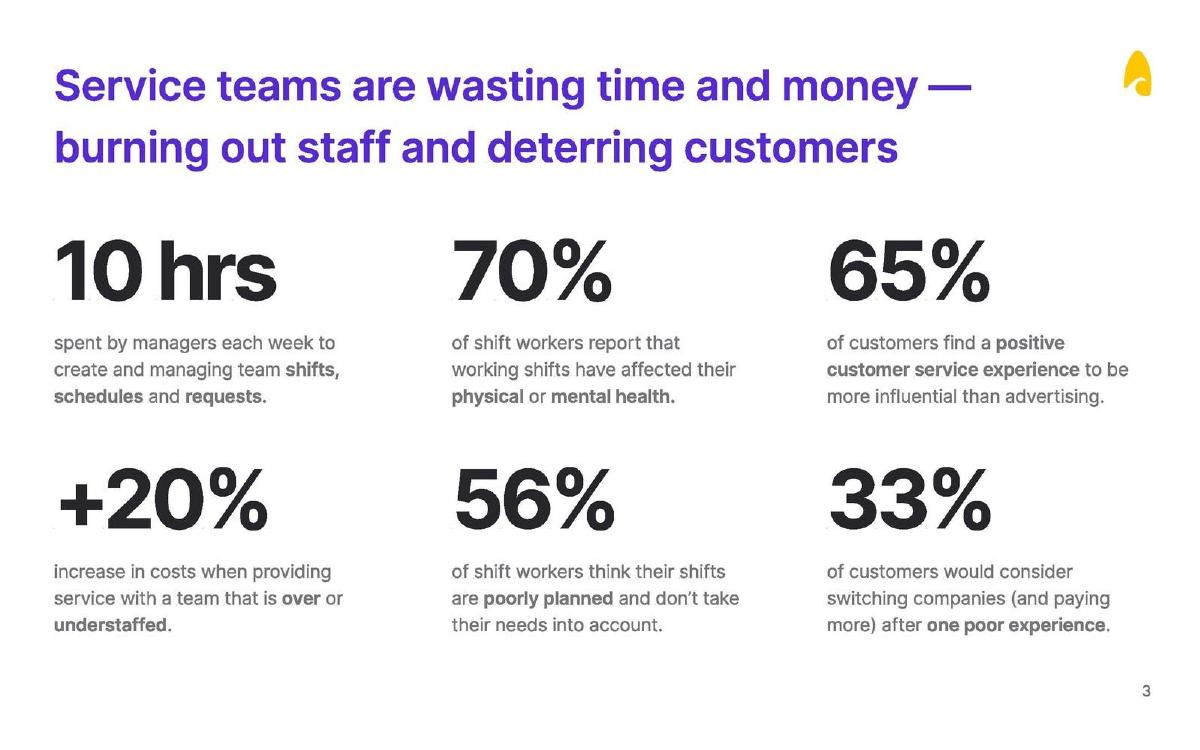
- Managers spend 10 hours each week creating and managing team shifts and schedules (Slide 3).
- Poor planning leads to a 20% increase in costs when teams are over or understaffed (Slide 3).
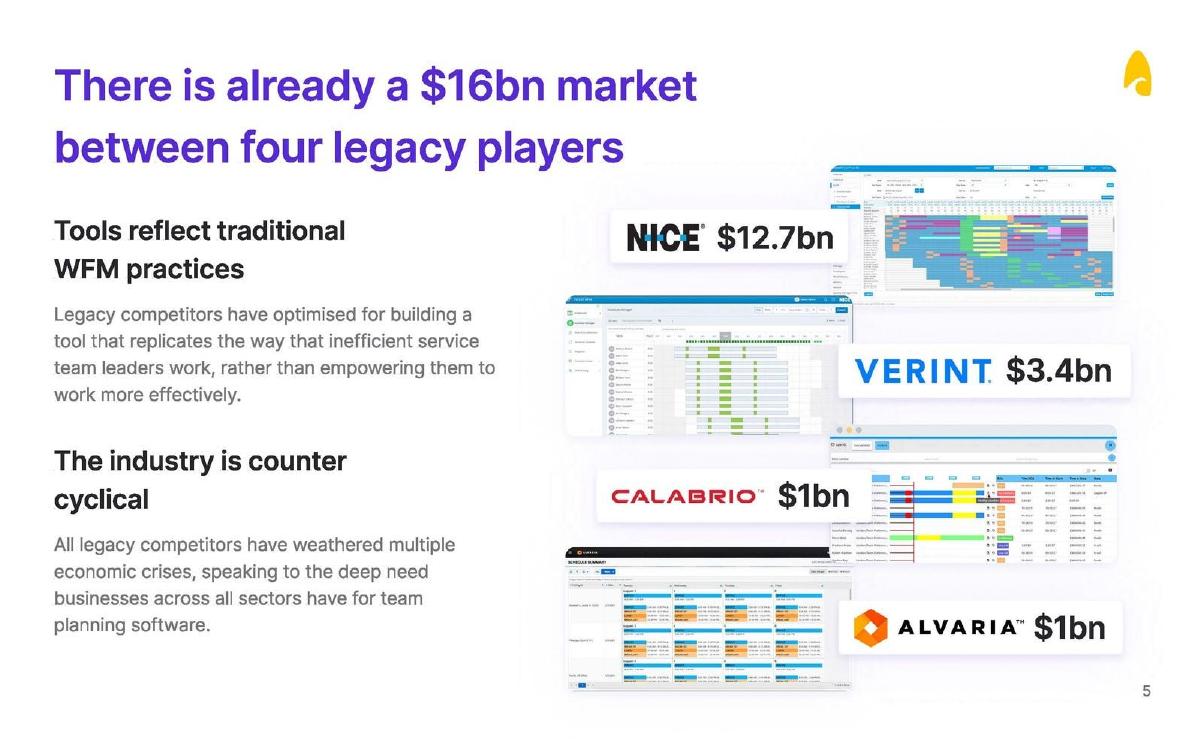
- The workforce management market is valued at $16bn, dominated by NICE, Verint, Calabrio, and Alvaria (Slide 5).
- Surfboard claims their platform can be set up in hours rather than months, requiring no specialist training (Slide 7).
- The product uses data science models to schedule 8 weeks in advance to ensure work-life balance (Slide 7).
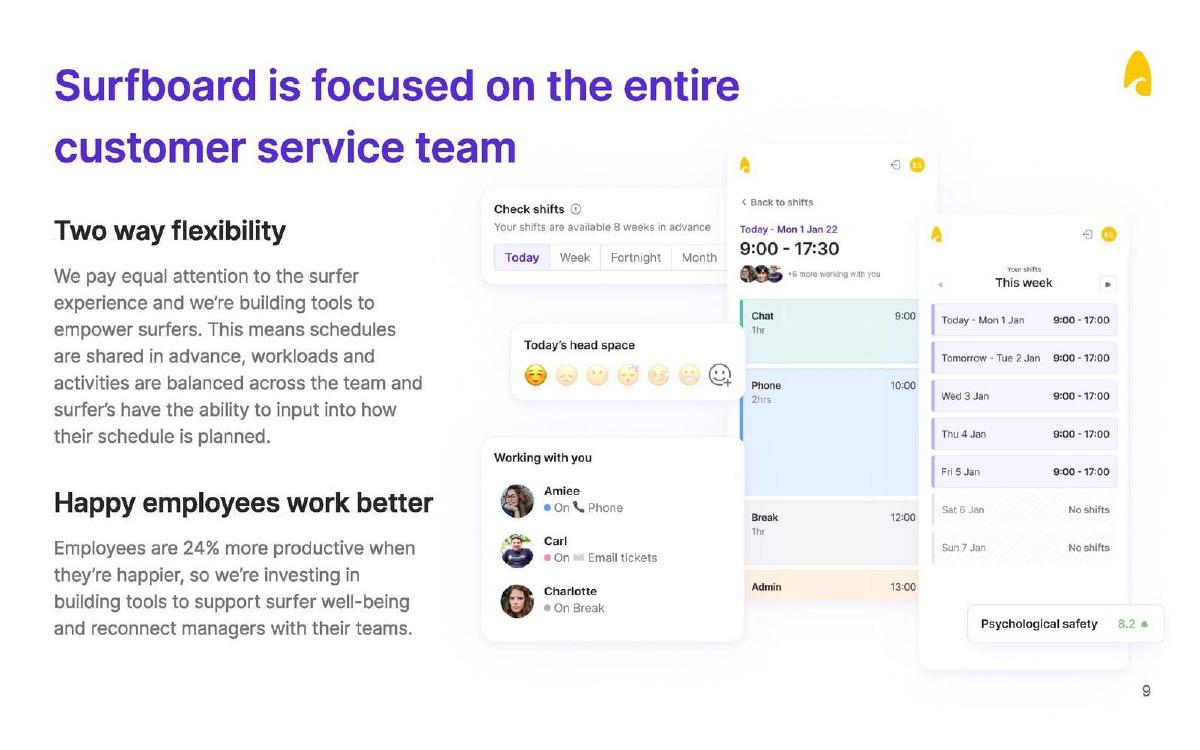
- Happy employees are cited as being 24% more productive, forming a core part of the value proposition (Slide 9).
- The deck omits a traditional team slide, financial projections, and a specific funding ask (Slides 1-13).
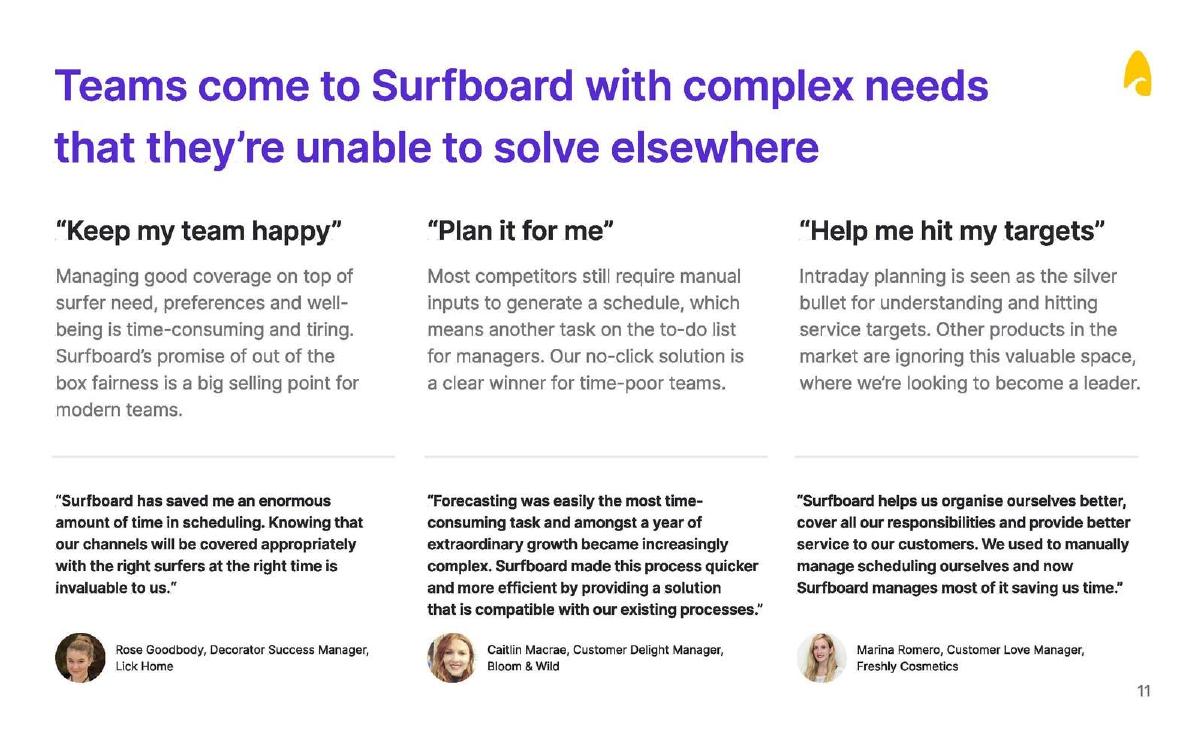
- Customer testimonials from Lick Home, Bloom & Wild, and Freshly Cosmetics validate the product's time-saving claims (Slide 11).
The Human-Centric Pivot in Enterprise SaaS
Surfboard’s pitch deck is a fascinating study in how to rebrand a legacy category. Workforce Management (WFM) software is traditionally sold on the basis of 'optimization' and 'efficiency'—words that often translate to squeezing more labor out of fewer people. Surfboard flips this narrative. By using the tagline 'Make work more human' on Slide 1, they immediately signal a shift toward the 'S' in ESG (Environmental, Social, and Governance) criteria, which has become increasingly important to modern institutional investors.
Slide 1: The Brand Identity
The cover slide is minimalist, featuring the company name, the 'Make work more human' mission statement, and a whimsical illustration of a 'surfer.' Notably, it displays a 'Certified B Corporation Pending' badge and a 'Tech Zero' logo. This establishes the company’s values before a single product feature is mentioned. In a Seed round, where the 'why' is often as important as the 'what,' this branding sets a distinct tone that separates them from the corporate aesthetic of their competitors.
Slide 3: Quantifying the Pain
Slide 3 is the 'Problem' slide, and it is highly effective because it balances operational costs with human costs. It cites that managers spend 10 hours each week on shifts and that understaffing leads to a +20% increase in costs. However, it also notes that 70% of shift workers report health issues due to shifts and 33% of customers would switch companies after one poor experience. By linking employee wellbeing directly to customer retention and operational overhead, Surfboard makes a business case for empathy.
Slide 5: The $16bn Legacy Opportunity
This slide is a direct attack on the status quo. It names the 'Big Four' of WFM: NICE, Verint, Calabrio, and Alvaria. By listing their multi-billion dollar valuations, Surfboard isn't just showing who they are up against; they are showing the size of the prize. The text argues that these tools 'reflect traditional WFM practices' and 'replicate the way that inefficient service team leaders work.' This is a classic 'Innovator’s Dilemma' argument—incumbents are too busy serving legacy processes to reinvent the user experience.
Slide 7: The Reinvention of Team Planning
Slide 7 introduces the solution with three adjectives: Simpler, Smarter, and Fairer. The 'Simpler' claim is the most aggressive from a sales perspective, stating that Surfboard can be 'set up in hours, not months.' Legacy enterprise software is notorious for grueling implementation cycles. If Surfboard can truly deliver a 'no training courses required' experience, their customer acquisition cost (CAC) and time-to-value would be significantly lower than the incumbents listed on Slide 5.
Slide 9: The 'Surfer' Experience
Surfboard refers to employees as 'surfers,' a nomenclature that reinforces their brand. Slide 9 focuses on the employee-facing interface, showing features like 'Today’s head space' (mood tracking) and 'Psychological safety' scores. They cite a statistic that 'Employees are 24% more productive when they’re happier.' This slide moves the product from a manager’s tool to an employee benefit, which is a powerful wedge in a tight labor market where retention is a top-tier KPI for support centers.
Slide 11: Social Proof and Testimonials
Without a slide dedicated to MRR (Monthly Recurring Revenue) or growth charts, Slide 11 carries the weight of the deck’s credibility. It features three testimonials from managers at Lick Home, Bloom & Wild, and Freshly Cosmetics. The quotes focus on 'saving an enormous amount of time' and 'hitting service targets.' These are 'modern' brands, suggesting that Surfboard is winning the battle for the next generation of high-growth companies rather than trying to unseat NICE at a legacy airline or bank immediately.
Slide 13: The Call to Action
The final slide is a simple contact page with a 'Questions?' prompt and an email address for Natasha (presumably Natasha Ratanshi-Stein, the CEO, though her full name and title are not on the slide). It features a waving seal illustration, maintaining the playful, approachable brand identity that persists throughout the deck.
What Surfboard Does Well
Emotional Resonance: Most WFM decks are dry. Surfboard makes the reader care about the 'surfer' on the other side of the schedule. This is a powerful differentiator when pitching to Seed-stage investors who are looking for a unique 'angle' on a crowded market.
Clear Competitive Landscape: Slide 5 is excellent. It doesn't hide from the competition; it uses their massive valuations to validate the market size while simultaneously dismissing their technology as outdated. It frames the incumbents as 'counter-cyclical' survivors rather than innovators.
Product-Led Growth (PLG) Hints: By emphasizing that the tool can be 'set up in hours' and 'used by anybody,' Surfboard is signaling a PLG motion. This is highly attractive to investors because it suggests the company can scale without a massive, expensive enterprise sales force in the early days.
What is Missing from the Deck
The Team: This is the most glaring omission. In a $5M Seed round, the founders' pedigree is usually the primary reason for the investment. There is no mention of the founders' previous experience at places like Monzo or other high-growth startups, which is public knowledge but missing here.
Financial Traction: There are no mentions of revenue, number of customers, or growth rates. While the testimonials prove the product works, they don't prove the business is scaling. Investors usually want to see a 'Traction' slide that shows a hockey-stick graph or at least a list of logos.
The Ask: The deck ends without stating how much they are raising or what the milestones for the next 18 months are. While this information is often shared in the meeting or a separate document, including a high-level 'Use of Funds' slide helps frame the company's strategic priorities.
Unit Economics: There is no mention of pricing models or LTV/CAC (Lifetime Value to Customer Acquisition Cost) ratios. For enterprise software, understanding whether this is a $50/month/seat or a $5,000/month/flat-fee product is crucial for understanding the market ceiling.
Founder's Playbook: What to Copy
Use 'Human' Metrics: If you are building in a cold, technical space, find the human cost of the problem. Surfboard’s use of '70% of shift workers' health' is a much more memorable stat than a generic 'efficiency' percentage.
Own the Terminology: By calling employees 'surfers,' Surfboard creates a proprietary language for their ecosystem. This builds brand loyalty and makes the product feel like a community rather than a utility.
Visual Consistency: The deck uses a consistent color palette (yellow and purple) and a specific illustration style. This makes the startup feel 'larger' and more professional than a deck using stock photos and standard PowerPoint templates.
Direct Competitor Comparison: Don't be afraid to list the giants in your field. If you can articulate exactly why their $10bn+ market cap is a result of old thinking, you make your own 'small' startup look like a necessary evolution.
Frequently asked questions
- What is the primary problem Surfboard solves?
- Surfboard addresses the inefficiency and burnout associated with manual customer service team planning. According to Slide 3, managers waste 10 hours a week on scheduling, while 70% of shift workers report negative impacts on their physical or mental health due to poor shift planning. The platform aims to automate this process to reduce costs and improve employee retention.
- Who are Surfboard's main competitors?
- Slide 5 explicitly names four legacy players that currently control a $16bn market: NICE ($12.7bn valuation), Verint ($3.4bn), Calabrio ($1bn), and Alvaria ($1bn). Surfboard differentiates itself by claiming these legacy tools merely replicate inefficient manual processes rather than empowering teams to work more effectively.
- How does Surfboard differentiate its product features?
- On Slide 7, the company highlights three pillars: Simpler (setup in hours, no training), Smarter (automatic scheduling based on forecasts), and Fairer (8-week advance scheduling to balance work-life needs). They also emphasize 'two-way flexibility,' allowing employees (referred to as 'surfers') to have input into their own schedules (Slide 9).
- What evidence of market traction is provided?
- The deck relies on qualitative social proof rather than quantitative growth metrics. Slide 11 features three testimonials from Success and Delight Managers at Lick Home, Bloom & Wild, and Freshly Cosmetics. These customers highlight time savings in scheduling and forecasting as the primary benefits of the platform.
- What is missing from the Surfboard pitch deck?
- The deck is notably missing several standard venture components: there is no team slide detailing the founders' backgrounds, no financial slide showing revenue growth or burn rate, no market sizing (TAM/SAM/SOM) beyond the competitor valuations, and no 'Ask' slide specifying how the $5M will be spent.