Craft.io, a Tel Aviv-based enterprise software startup, successfully raised $8M in a 2024 Series A round to scale its all-in-one product management platform. The deck focuses heavily on the 'digital transformation' narrative, positioning the product manager as the central hub between customers, technology, and business. By defining the problem through three specific pillars—disconnected tools, knowledge gaps, and mistrust—Craft.io makes a compelling case for a dedicated 'system of record.' While the provided slides use placeholders for market sizing ($XX bn), the structural flow from high-lev…
Key takeaways
- The deck positions product management as the 'heart of digital transformation' on Slide 2, elevating the tool from a utility to a strategic necessity.
- Craft.io identifies three core pain points on Slide 3: Disconnected tools, Massive knowledge gaps, and Mistrust between business and tech units.
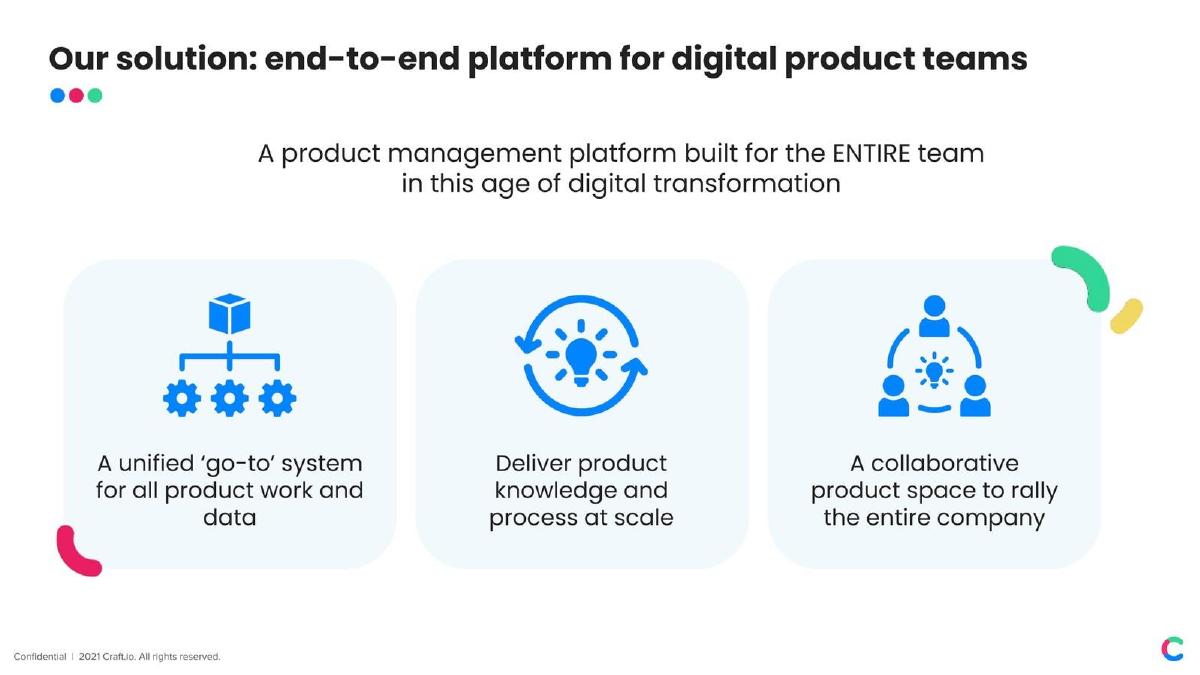
- The solution is defined as a 'product system-of-record' on Slide 4, a powerful category-design term that implies long-term enterprise stickiness.
- Slide 4 details six specific functional areas: Feedback, Feature Definition, Prioritization, Capacity Planning, Roadmap Visualization, and Execution.
- The platform emphasizes integration with existing stacks, specifically highlighting logos like Jira, Slack, Salesforce, and Microsoft Teams on Slide 4.
- Market sizing on Slide 5 uses a staged growth narrative, projecting TAM expansion from 2021 to 2025, though specific figures are redacted as '$XX bn'.
- The team slide (Slide 6) is a high-signal asset, featuring founders with leadership backgrounds at Google, Wix, and Taboola.
- The deck includes a dedicated 'Advisory team' section on Slide 6, featuring executives from Reshuffle, Taboola, and Spotlight.ai to bolster credibility.
Craft.io: The Strategic 'System of Record' for Product Teams
Craft.io is a Tel Aviv-based enterprise software startup that raised $8M in a Series A round in 2024. The company offers an all-in-one product management platform designed to track projects and improve transparency across stakeholders. In a market saturated with project management tools, Craft.io differentiates itself by focusing specifically on the 'Product Manager' persona, rather than general task management. This teardown examines their 12-slide deck, focusing on the narrative arc that secured their Series A funding.
Slide 1: The Human Element
The deck opens with a full-bleed photograph of co-founders Roni Ben-Aharon and Elad Simon. They are seated in a casual office setting. This is a common tactic in early-stage decks to immediately establish the 'human' side of the business. While it contains no data, it sets a tone of accessibility and confidence. The slide explicitly names the co-founders, preparing the investor for the 'Team' slide later in the deck.
Slide 2: The Macro Vision
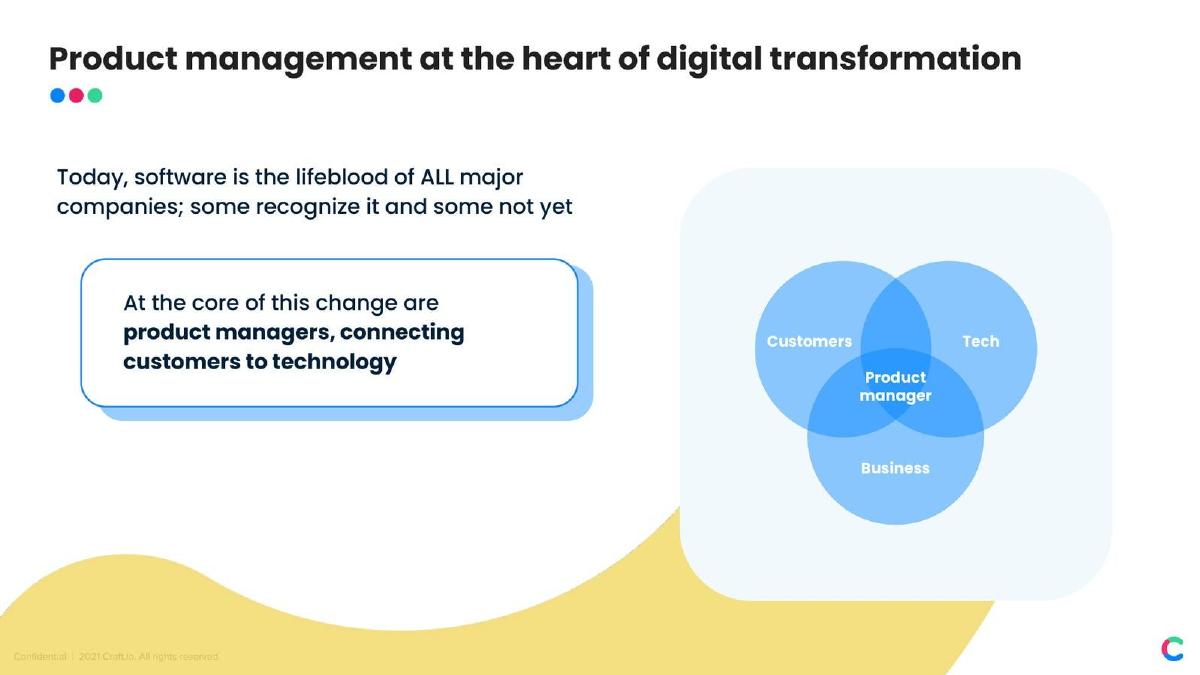
Slide 2 introduces the high-level thesis: 'Product management at the heart of digital transformation.' The slide uses a Venn diagram to place the 'Product Manager' at the intersection of 'Customers,' 'Tech,' and 'Business.' The text notes that 'software is the lifeblood of ALL major companies,' positioning Craft.io not just as a tool, but as a necessary component of modern corporate survival. This is a classic 'Why Now' slide that links the company's success to a broader, unstoppable market trend.
Slide 3: Defining the Pain Points
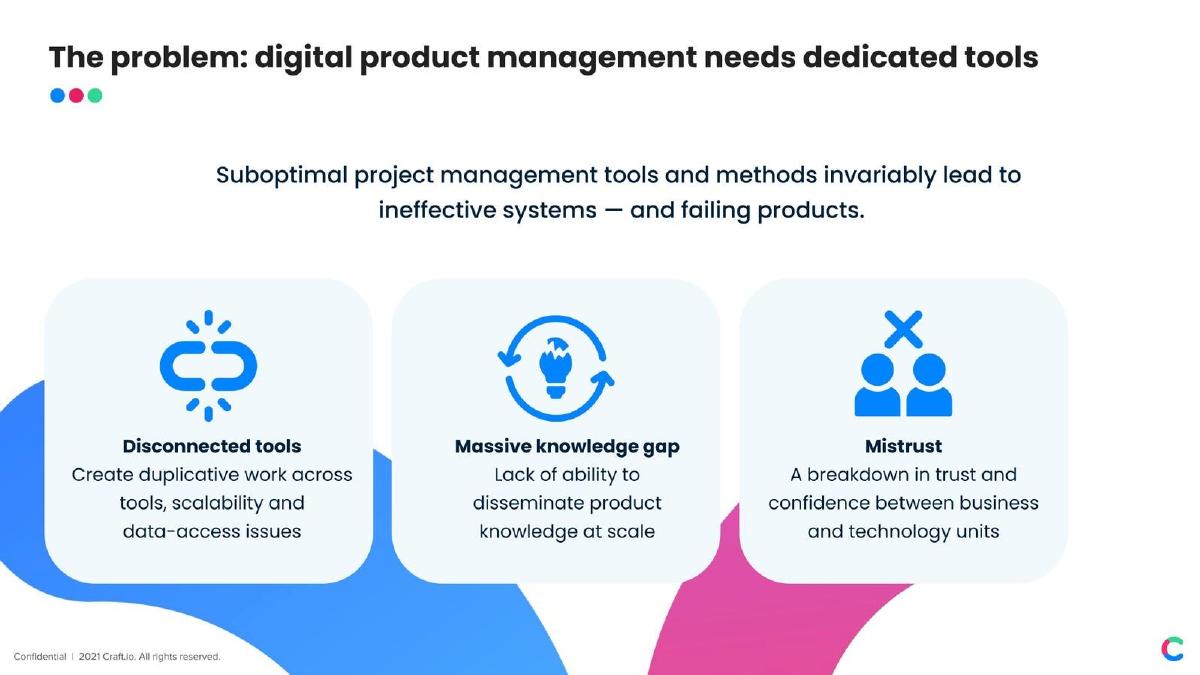
The problem slide is titled 'The problem: digital product management needs dedicated tools.' It identifies three specific failures of current systems:
Disconnected tools: Creating duplicative work and data-access issues. · Massive knowledge gap: An inability to share product knowledge at scale. · Mistrust: A breakdown in confidence between business and technology units.
By framing the problem as 'Mistrust' and 'Knowledge Gaps,' Craft.io moves the conversation beyond simple feature sets and into the realm of organizational health, which is a much more expensive problem for enterprises to solve.
Slide 4: The 'System of Record' Solution
This is the core product slide. It introduces the concept of a 'product system-of-record.' The slide features a circular diagram showing the six stages of the product lifecycle that Craft.io manages: Feedback, Feature Definition, Prioritization, Capacity Planning, Roadmap Visualization, and Execution. Crucially, it shows integrations with heavyweights like Jira, GitHub, Slack, and Salesforce. This addresses the common investor concern about 'yet another tool' by showing that Craft.io acts as a connective layer rather than a silo.
Slide 5: Market Opportunity (TAM)
Slide 5 presents a growth chart for the Total Addressable Market (TAM). The slide is titled '$XX bn TAM as a new market unveils itself.' It shows a timeline from 2021 to 2025, suggesting that the market for product management tools is expanding as companies move from simple 'workflow' tools to 'interconnected systems' that deliver value to the entire organization. Although the specific dollar amounts are redacted as '$XXB,' the logic is clear: the market is growing because the role of the product manager is becoming more data-driven and central to the enterprise.
Slide 6: The Pedigree Slide
The 'Our team' slide is perhaps the strongest in the deck. It highlights the founders' impressive backgrounds:
Elad Simon (CEO): Former Head of SMB Marketing at Google and VP at Taboola. · Roni Ben-Aharon (CPO & CTO): Former Head of Wix Insights and PM at Booking.com.
The slide also includes an 'Advisory team' with members from Google, Microsoft, and Taboola. For a Series A round, this level of institutional experience at major tech companies provides significant de-risking for investors.
Slides 7-12: The Missing Context
The text provided for slides 7 through 12 simply repeats 'Craft.io.' In a standard 12-slide deck, these slides would typically cover:
Traction: Revenue growth, user numbers, or case studies from current enterprise clients. · Business Model: Pricing tiers (SaaS) and Go-To-Market strategy. · Competition: A comparison against tools like Productboard, Aha!, or Jira Product Discovery. · Unit Economics: Customer Acquisition Cost (CAC) vs. Lifetime Value (LTV). · The Ask: How the $8M will be spent (e.g., hiring, R&D, sales expansion).
The omission of these slides in the public version of the deck is common, as they often contain sensitive proprietary data. However, for a teardown, their absence means we cannot evaluate the company's actual performance or financial health.
What Works in the Craft.io Deck
1. Category Positioning: The use of the term 'System of Record' is a brilliant strategic move. In the enterprise software world, systems of record (like Salesforce for CRM or Workday for HR) are considered 'un-killable' software. By claiming this title for product management, Craft.io is signaling that they intend to be the permanent home for a company's most important data.
2. Persona Focus: The deck does a great job of elevating the Product Manager. By showing the PM at the center of the Venn diagram on Slide 2, they make the PM the hero of the story. This resonates with the people who will actually be buying and using the software.
3. Integration-First Mentality: Slide 4 proactively answers the 'how does this fit with Jira?' question. By showing logos of existing tools, they demonstrate that they are a 'collaborative and transparent platform' that enhances, rather than disrupts, existing workflows.
What is Missing from the Craft.io Deck
1. Concrete Metrics: While the narrative is strong, the provided slides are devoid of hard data. There are no mentions of Monthly Recurring Revenue (MRR), churn rates, or the number of active seats. For a Series A, investors usually require a 'Traction' slide that shows a clear 'up and to the right' trend line.
2. Competitive Landscape: The product management tool space is crowded. Competitors like Productboard and Aha! are well-established. The deck does not explicitly state how Craft.io wins against these specific rivals. A 'Competitive Matrix' slide would have been useful to show where Craft.io has a feature or philosophical advantage.
3. The 'Why Now' of AI: Given the 2024 raise date, the absence of an AI narrative is notable. Most enterprise software decks in this period lean heavily into how AI will automate feature prioritization or feedback synthesis. Craft.io focuses on the 'System of Record' and 'Digital Transformation' themes, which are more evergreen but perhaps less 'buzzy' in the current climate.
Founders: What to Copy from this Deck
Use the 'System of Record' Framework: If you are building a tool that centralizes data from multiple other sources, use this terminology. It carries weight with enterprise investors who understand the long-term value of a centralized data hub.
Highlight 'Secondary' Team Credibility: If your founders have great resumes, don't stop there. Craft.io included an 'Advisory Team' (Slide 6) that added even more 'big tech' logos to the deck. This creates a 'halo effect' of expertise around the company.
Visualizing the Workflow: Slide 4's circular diagram is an excellent way to show a complex product in a simple way. Instead of showing 20 screenshots of different features, they grouped those features into six logical stages of a lifecycle. This makes the product feel comprehensive yet easy to understand.
Focus on Organizational Outcomes: Notice how Slide 3 mentions 'Mistrust' as a problem. Most founders focus on 'efficiency' or 'speed.' By focusing on 'trust' and 'transparency,' you are speaking to the pain points of the C-suite, not just the end-user. This is key for enterprise sales.
Frequently asked questions
- What is the core value proposition of Craft.io according to the deck?
- Craft.io positions itself as a 'product system-of-record.' It aims to solve the problem of fragmented product management by providing a centralized platform that connects customer feedback, feature definition, prioritization, and execution. The goal is to eliminate 'disconnected tools' and the 'knowledge gap' that typically exists between business and technology units in large organizations.
- How does Craft.io justify the need for a new tool in a crowded market?
- The deck argues that existing project management tools are 'suboptimal' for the specific needs of digital product management. Slide 3 explicitly states that these general tools lead to 'ineffective systems and failing products.' By focusing on the unique intersection of customers, tech, and business, Craft.io carves out a niche that general-purpose task managers like Trello or Asana might miss.
- What integrations does Craft.io highlight as essential?
- On Slide 4, the deck showcases a robust integration ecosystem. It highlights 'Execution' integrations with tools like Jira, Azure DevOps, and GitHub, and 'Feedback' integrations with communication and CRM platforms like Slack, Microsoft Teams, Intercom, Zendesk, and Salesforce. This suggests the platform is designed to sit on top of existing workflows rather than replace them entirely.
- Who are the founders and what is their background?
- The co-founders are Elad Simon (CEO) and Roni Ben-Aharon (CPO & CTO). Elad Simon brings experience as the Head of SMB Marketing EMEA at Google and VP at Taboola. Roni Ben-Aharon was previously the Head of Wix Insights and a Machine Learning Product Manager at Booking.com. This combination of marketing scale and deep technical product experience is a major highlight of the deck.
- Is there a specific 'Ask' or financial projection in the deck?
- The provided slides do not include a specific 'Ask' slide or detailed financial projections. Slide 5 shows a TAM (Total Addressable Market) growth chart, but the numbers are redacted as '$XX bn.' In a standard Series A deck, these details would typically appear in the final slides, which are not present in this 12-slide summary.