Fifth Dimension AI's pre-seed deck is a masterclass in verticalization. While many AI startups pitch broad horizontal tools, this team focused exclusively on the 'tech-backwards' real estate and construction sectors. The deck successfully raised $2.8M by identifying a specific pain point: highly paid professionals spending 50% of their time on manual document processing. By proposing an email-based interface that integrates into existing workflows rather than forcing a new platform, they lowered the barrier to adoption. The deck relies heavily on qualitative social proof and a clear 'data moa…
Key takeaways
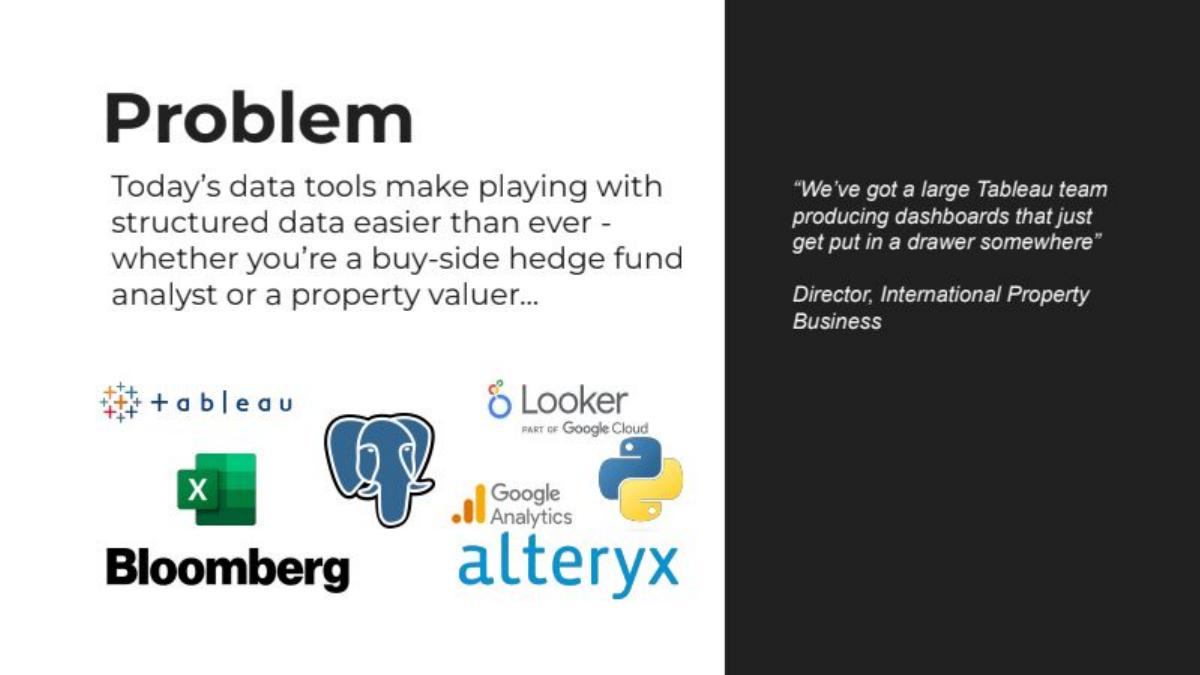
- The company identifies a specific gap where structured data tools like Tableau and Bloomberg fail to address unstructured data needs (Slide 2).
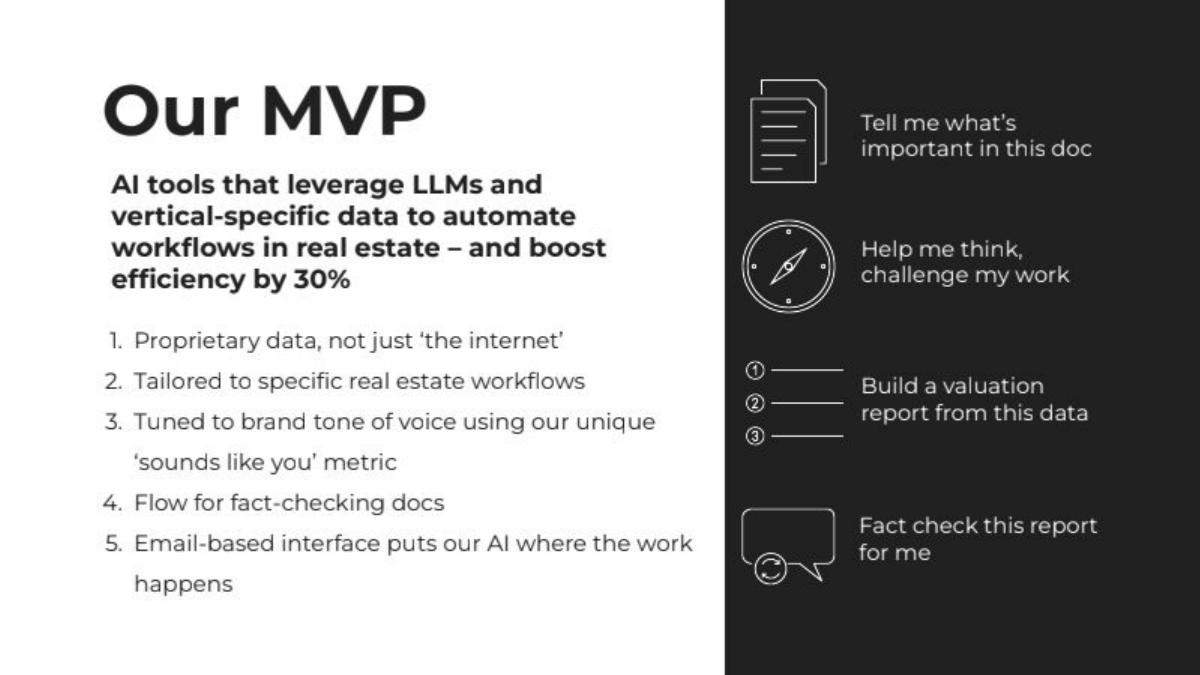
- The MVP claims to boost efficiency by 30% through vertical-specific data and a 'sounds like you' brand tone metric (Slide 5).
- Traction is defined by five paying customers and over 30 in-depth research interviews within a 12-week window (Slide 7).
- The 'Data Moat' slide outlines a flywheel where user interactions create a proprietary structured dataset not available on the open internet (Slide 8).
- Market sizing targets a £16bn Real Estate SAM based on a £15k ACV across 1.1 million medium and large businesses (Slide 10).
- The team slide emphasizes a 'strong relationship forged leading Wayhome,' showcasing prior co-founder history (Slide 12).
- The financial ask is for £2M to achieve £1m+ ARR in 20 months by onboarding 50 companies (Slide 13).
- The deck omits a traditional competitor matrix, choosing instead to position against general-purpose LLMs and manual workflows.
Fifth Dimension AI: The Vertical AI Playbook
Fifth Dimension AI entered the market in 2023, a year defined by the explosion of generative AI. While many founders were pitching 'wrappers' for ChatGPT, this deck demonstrates how to pitch a vertical-specific solution for industries that are traditionally slow to adopt new technology. The $2.8M pre-seed round, co-led by Seedcamp and Anthemis, suggests that investors were bought into the team's specific domain expertise in real estate and their pragmatic approach to user experience.
Slides 1-3: The Unstructured Data Problem
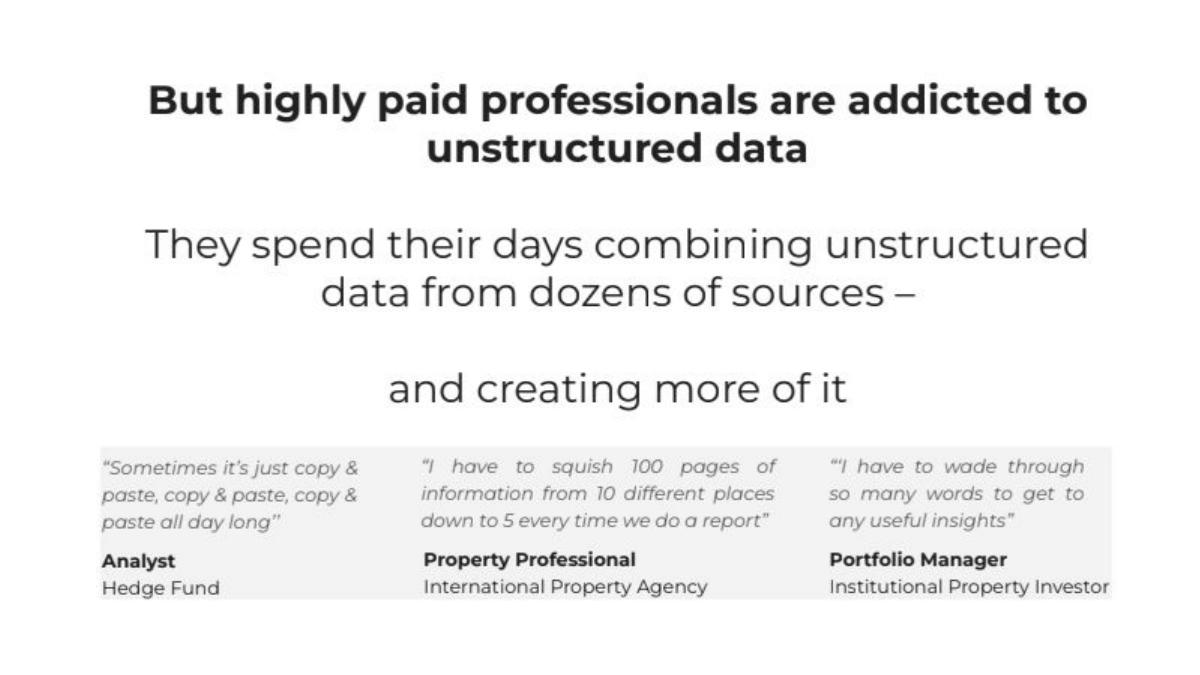
The deck opens with a clear distinction between structured and unstructured data. Slide 2 lists heavyweights like Tableau, Bloomberg, and Alteryx, acknowledging that structured data is 'easier than ever' to manage. However, Slide 3 pivots to the 'highly paid professionals' who are 'addicted to unstructured data.' By quoting an Analyst, a Property Professional, and a Portfolio Manager, the founders ground the problem in human frustration—specifically the 'copy & paste' nature of report writing. This is a classic 'pain point' opening that identifies a massive time-sink in a high-value industry.
Slides 4-6: The Solution and MVP
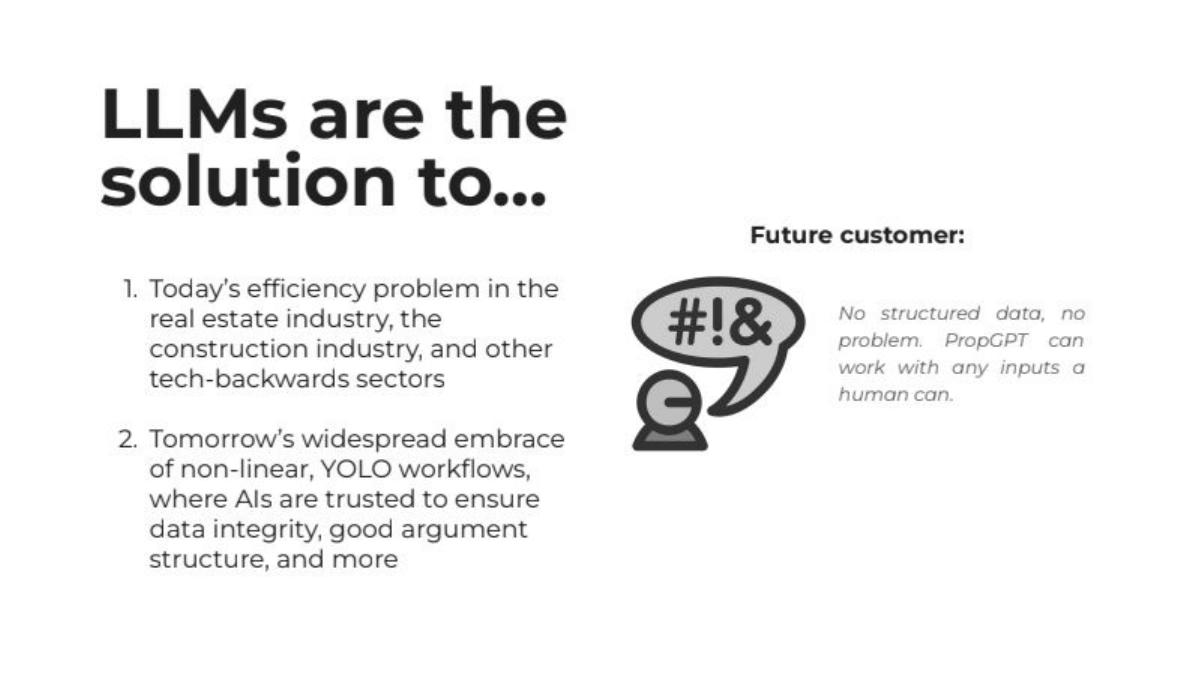
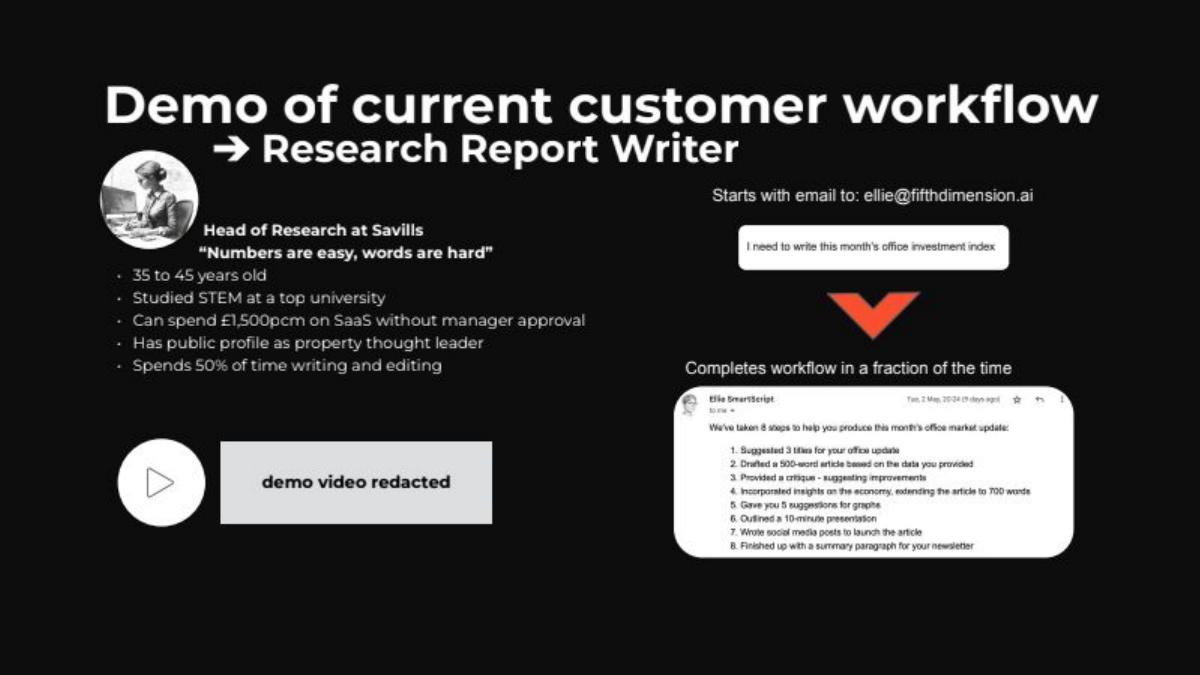
Slide 4 introduces LLMs as the solution for 'tech-backwards sectors' and 'YOLO workflows.' The term 'YOLO workflows' is an interesting choice, likely referring to non-linear, ad-hoc tasks that traditional software can't automate. Slide 5 defines the MVP not as a platform, but as a set of tools that leverage 'vertical-specific data' to boost efficiency by 30%. Key features include a 'sounds like you' metric for brand tone and a fact-checking flow. Slide 6 is perhaps the most important in the deck; it shows a demo of a workflow that starts with a simple email. By meeting users where they already work (inboxes), the company bypasses the 'new software fatigue' that often kills enterprise SaaS adoption.
Slide 7: Early Traction
For a pre-seed deck, Slide 7 provides sufficient evidence of product-market fit. In just 12 weeks, the team secured five paying customers and conducted 30 interviews. The use of redacted customer logos and qualitative quotes ('you have hit the nail on the head') serves to build credibility. While the lack of hard revenue numbers might be a weakness in a Series A deck, for a pre-seed round, the focus is on the speed of execution and the willingness of customers to pay for an early-stage product.
Slides 8-9: Building the Moat
In the AI era, investors are obsessed with 'moats.' Slide 8 addresses this directly with a flywheel diagram. The argument is that by capturing proprietary prompts and responses for property tasks, Fifth Dimension AI is creating a dataset that general LLMs cannot replicate. Slide 9, titled 'The future of our product: PropGPT,' outlines the expansion into Microsoft Plugins and 'Global Real Estate GPT,' signaling that the email interface is just a wedge into a much larger ecosystem.
Slides 10-11: Market Size and Expansion
The deck uses a bottom-up analysis for its market sizing. Slide 10 calculates a £16bn SAM based on an Annual Contract Value (ACV) of £15k across 1.1 million businesses. This is a more believable figure than a generic 'trillion-dollar market' slide. Slide 11 then shows the 'routes to growth,' expanding the Total Addressable Market (TAM) to £114bn by including Finance and Construction. This sequence shows investors that the company has a massive ceiling, even if it starts in a niche vertical.
Slides 12-13: Team and The Ask
The 'Our edge' slide (Slide 12) is strong because it highlights a pre-existing working relationship. Johnny Morris and Dr. Kate Jarvis previously led Wayhome together. Morris brings 15 years of real estate data experience, while Jarvis brings a PhD in Linguistics from Stanford. This combination of domain expertise and technical depth is exactly what VCs look for in vertical AI. Finally, Slide 13 lays out the ask: £2M for an 18-month runway. The 'Cash Burn vs Revenue' chart is a projection, showing a target of £1m+ ARR by Q1 2025. The plan to onboard 50 companies with 10-15 users each provides a clear roadmap for how that capital will be deployed.
What Works in This Deck
The 'Wedge' Strategy: By using an email-based interface (Slide 6), the company solves the adoption problem. They aren't asking a busy real estate executive to learn a new dashboard; they are asking them to send an email. This is a highly effective way to gain initial traction in 'tech-backwards' industries.
Vertical Focus: The deck doesn't try to be everything to everyone. It specifically targets real estate and construction. The mention of 'proprietary data, not just the internet' (Slide 5) is a direct counter to the 'GPT wrapper' criticism that plagues many AI startups.
Founder-Market Fit: The team slide (Slide 12) is excellent. It doesn't just list titles; it explains why this specific pair is uniquely qualified to solve this specific problem, citing their history at Wayhome and academic backgrounds.
What is Missing
Competitive Landscape: There is no slide comparing Fifth Dimension AI to other legal or real estate AI tools (like Harvey or Co-pilot). While they position themselves against manual work, investors usually want to see how a startup plans to defend against other well-funded AI competitors.
Unit Economics: While the ACV is mentioned as £15k (Slide 10), there is no detail on Customer Acquisition Cost (CAC) or the cost of serving these LLM queries. In AI, gross margins can be thin due to API costs, and a pre-seed deck should at least hint at how they will manage these costs at scale.
Product Specifics: The deck is heavy on 'what it does' but light on 'how it does it.' Beyond mentioning 'vertical-specific LLMs,' there is little detail on whether they are fine-tuning existing models, using RAG (Retrieval-Augmented Generation), or building proprietary architecture.
Founder Takeaways
Focus on the workflow, not the tech: Fifth Dimension AI spends more time talking about how a user interacts with the product (email) than the underlying AI architecture. For enterprise sales, the 'how it fits in' is often more important than the 'how it works.' · Use qualitative social proof: If you don't have millions in revenue, use quotes from your first five customers. The quotes on Slide 7 prove that people are actually using the tool to solve real problems. · Define your data moat early: Don't just say you use AI. Explain how your users' interactions make your AI better over time in a way that a generic model can't match. Slide 8 is a great template for this. · Be realistic with market sizing: The bottom-up approach on Slide 10 (ACV x Number of Businesses) is much more persuasive to sophisticated investors than a top-down '1% of a $100B market' slide.
Frequently asked questions
- What is the core problem Fifth Dimension AI is solving?
- According to Slides 2 and 3, the problem is that while structured data tools are abundant, real estate and finance professionals are 'addicted to unstructured data.' They spend half their time manually combining information from dozens of sources and creating reports. The deck argues that existing tools like Tableau or Excel don't help with the 'copy and paste' nature of document-heavy workflows.
- How does the product actually work for a user?
- Slide 6 illustrates an email-based workflow. A user (e.g., a Head of Research) sends an email to an AI alias like 'ellie@fifthdimension.ai' with a request such as 'I need to write this month's office investment index.' The AI then returns a drafted report, social media posts, and presentation outlines, completing the workflow in a 'fraction of the time.'
- What is the company's long-term growth strategy?
- Slide 11 outlines a 'routes to growth' strategy starting with Global Real Estate (£16bn SAM) and expanding into Construction (£42bn TAM) and Finance (£114bn TAM). The ultimate goal is to move from email-based interactions to Microsoft Plugins (Teams/Word) and eventually create vertical-specific LLMs for international markets in multiple languages.
- What kind of traction did the company have at the time of the pitch?
- Slide 7 notes that in 12 weeks, the company signed five paying customers and conducted over 30 research interviews. They also developed a sales pipeline through referrals. While specific revenue figures are redacted, the slide includes qualitative feedback from users praising the 'area description model' and the early-stage involvement.
- What is the 'Data Moat' mentioned in the deck?
- Slide 8 describes a flywheel where more customers lead to more data. Specifically, they are building a structured dataset of prompts and responses for property-specific tasks. Because this data is generated through private user interactions and qualitative feedback, it is not available to general-purpose LLMs trained on the open internet.