Fetch.ai's Series A deck is a technical manifesto for a decentralized AI economy. Rather than focusing on traditional SaaS metrics like MRR or CAC, the presentation prioritizes the structural shift from centralized aggregators to autonomous agents. The company successfully raised $40M led by DWF Labs in 2023, positioning itself at the intersection of blockchain and machine learning. The deck is notable for its heavy reliance on complex architectural diagrams and market size projections that reach into the trillions. However, it noticeably lacks a traditional team slide, historical financial p…
Key takeaways
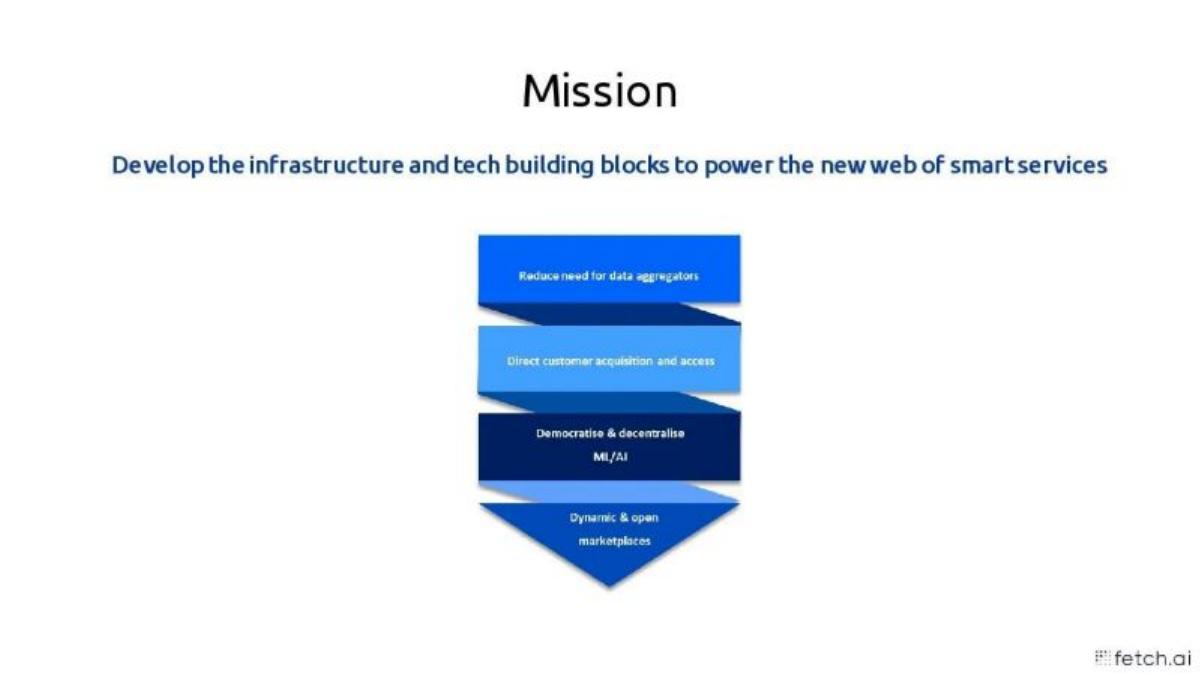
- The company defines its mission as developing infrastructure to power a new web of smart services by reducing the need for data aggregators (Slide 4).
- Market size projections are aggressive, citing a $1.1T market for P2P Gig services by 2030 (Slide 7).
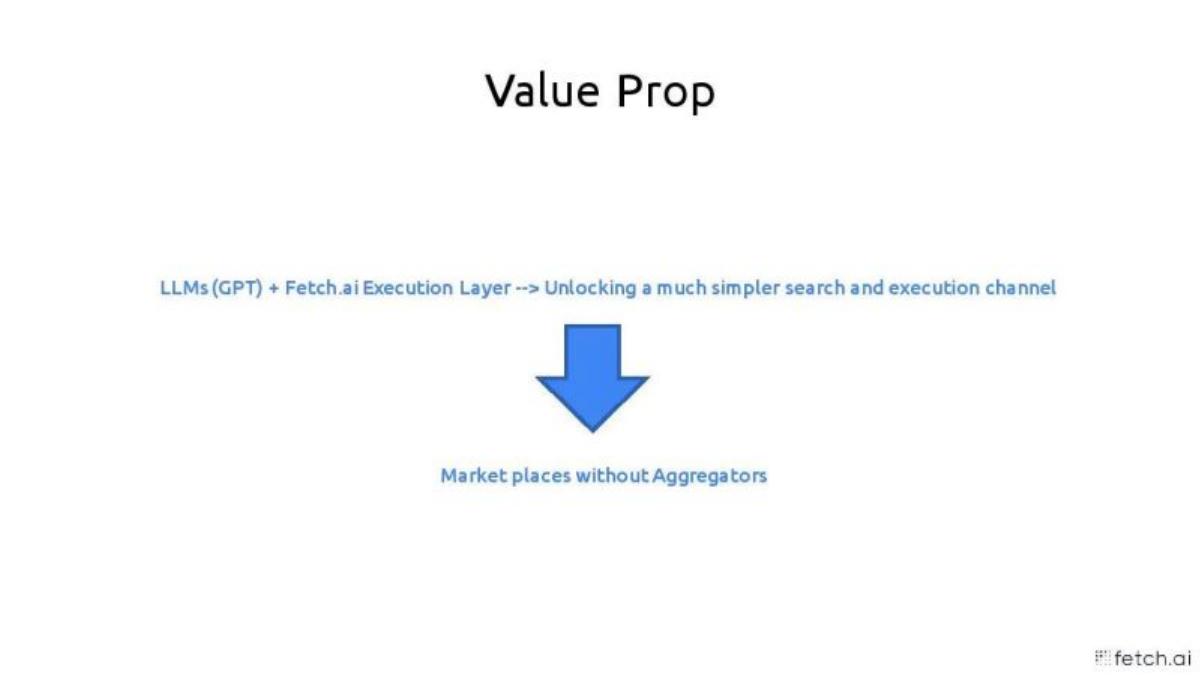
- The core value proposition relies on combining LLMs with a Fetch.ai execution layer to unlock marketplaces without aggregators (Slide 5).
- Technical architecture is centered around four pillars: Agents, Network, AI/ML, and Tooling (Slide 9).
- The business model relies on 'discoverability fees' paid in FET tokens or fiat by agent owners (Slide 12).
- A detailed use case demonstrates an autonomous EV charging and cafe recommendation sequence (Slide 13).
- The deck includes a feature comparison between 'uAgents' and the 'AEA Framework,' highlighting implementation speed as a USP (Slide 15).
- There is no team slide, no historical revenue data, and no explicit 'ask' slide detailing the $40M round terms.
The Visionary Infrastructure of Fetch.ai
Fetch.ai’s Series A deck is less of a commercial pitch and more of a technical roadmap for a decentralized future. In 2023, the company secured $40M in funding, a significant feat that reflects the high investor interest in AI-blockchain integration. The deck focuses on the transition from a web of search to a web of execution, where autonomous agents handle the friction of modern digital life.
Slide 1: Title and Theme
The deck opens with the title "Autonomous Execution" and the name Humyun Sheikh. The visual theme is dark and minimalist, using lightbulbs to signify ideas and innovation. It immediately sets a tone of high-level conceptual thinking rather than immediate retail application.
Slides 2-4: The Vision and Mission
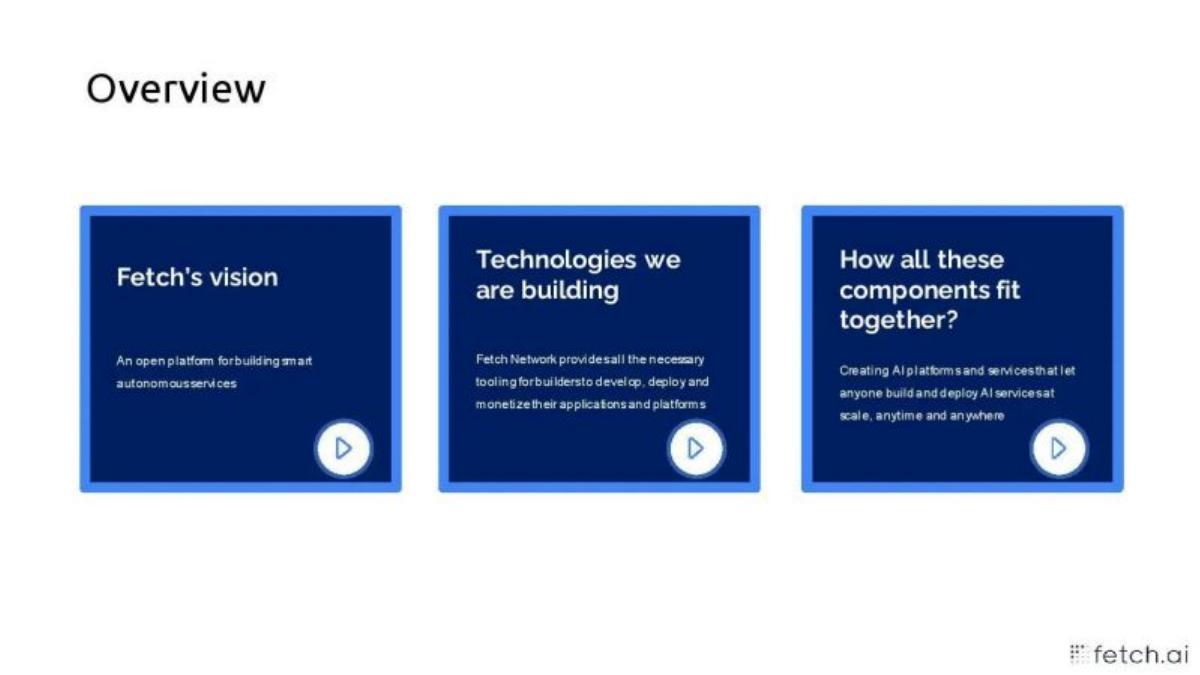
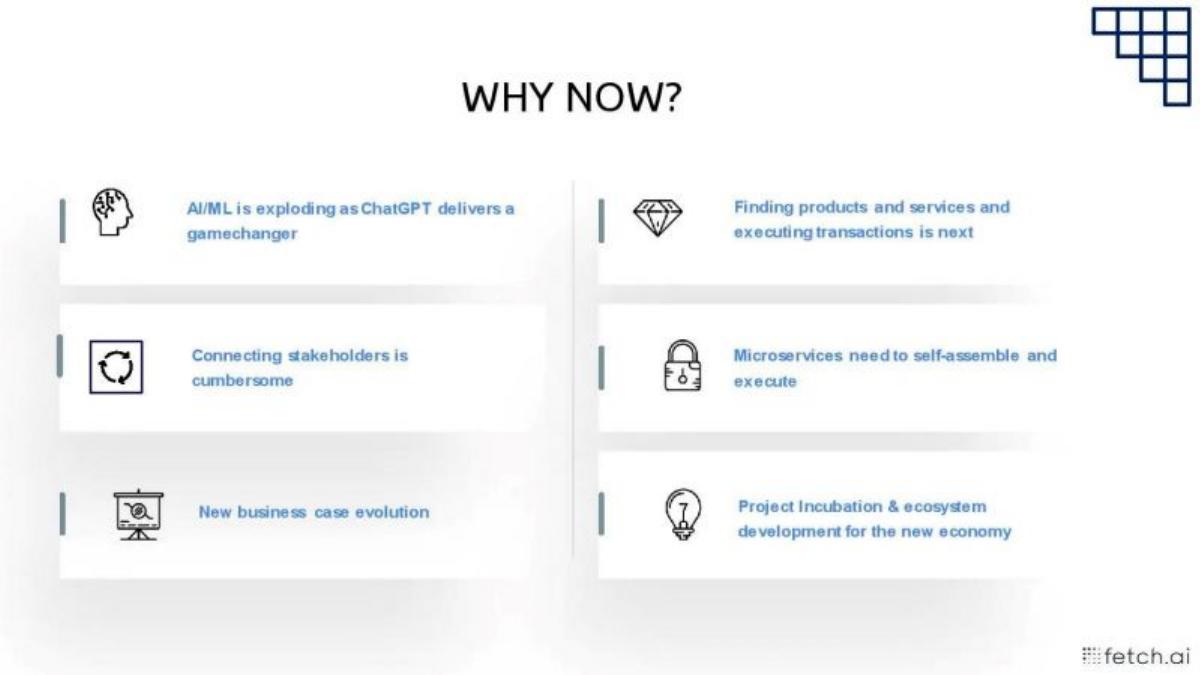
Slide 2 provides a three-part overview: Fetch's vision for an open platform, the technologies being built (tooling for builders), and the integration of these components to let anyone deploy AI services at scale. Slide 3, the "WHY NOW?" slide, cites the explosion of ChatGPT as a gamechanger, arguing that "finding products and services and executing transactions is next." This is a crucial pivot—moving from AI that talks to AI that does.
On Slide 4, the mission is stated as developing the infrastructure to power the "new web of smart services." The graphic emphasizes four goals: reducing the need for data aggregators, direct customer acquisition, democratizing ML/AI, and creating dynamic open marketplaces.
Slide 5: The Value Proposition
The value prop is distilled into a simple equation: LLMs (GPT) + Fetch.ai Execution Layer --> Unlocking a much simpler search and execution channel. The ultimate result is "Market places without Aggregators." This is a direct challenge to the business models of companies like Google, Expedia, or Uber, which act as centralized intermediaries.
Slides 6-8: Market Opportunity
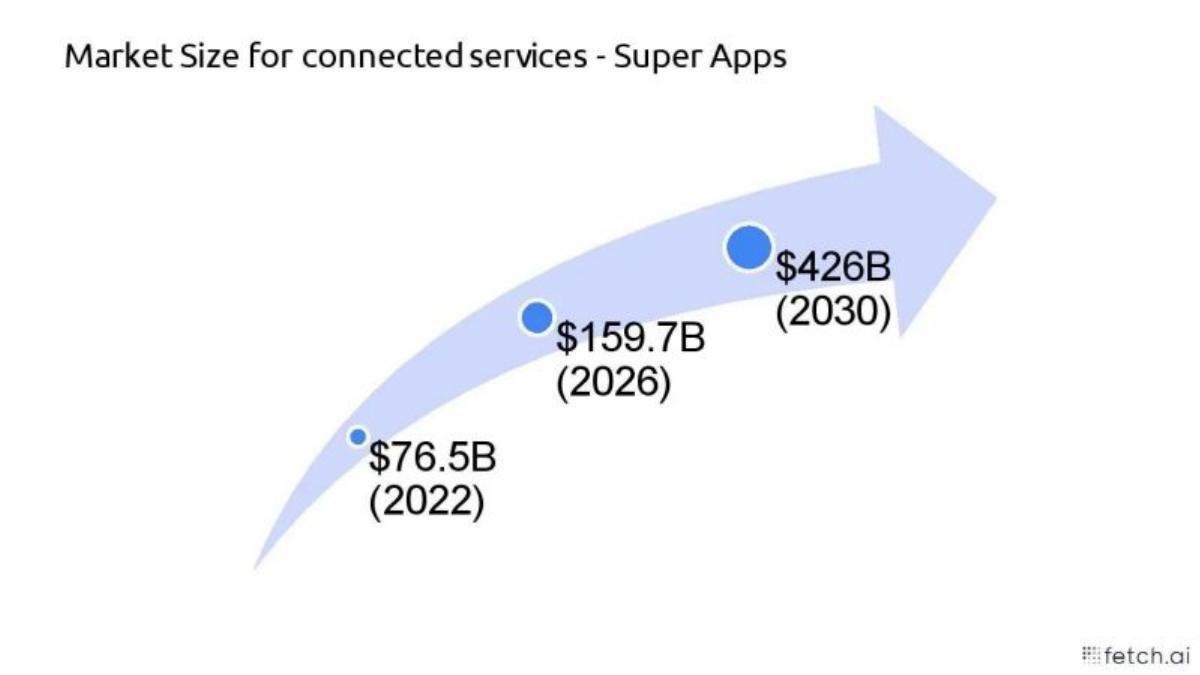
Fetch.ai presents massive market figures. Slide 6 projects the market for "Super Apps" growing from $76.5B in 2022 to $426B in 2030 . Slide 7 looks at "P2P Gig services," projecting a jump from $455.2B in 2023 to $1.1T in 2030 . Slide 8 summarizes the TAM/SAM/SOM. They estimate a Serviceable Obtainable Market (SOM) of $6.4B for Super Apps and $16.5B for Gig Services , calculated as 5% of their SAM.
Slides 9-11: Technical Infrastructure
These slides dive into the "how." Slide 9 shows a circular infrastructure diagram with "Power Autonomous Business Models" at the center. Slide 10, "Agent Based Technology," introduces a complex flow involving data marketplaces, ML models, and the "OEF Agent Based Economy." Slide 11 provides a highly detailed architectural diagram of the "Building Blocks," showing how human actors and machines interface with "uAgents" and the "Fetch Network." These slides are designed to prove technical depth to sophisticated VCs.
Slide 12: Business Models
This slide is critical for understanding how the network sustains itself. It lists four revenue streams:
Consumers: Pay nothing. · Service Providers: Agent owners pay for services consumed by their agents. · Search & Discovery (S&D): Agents pay a time-bound discoverability fee in FET token or fiat. · Data/ML/Inference: Providers get paid by consuming agents; data owners get paid based on contributions. · Agent Hosting: Offered as a paid service using a mailbox feature.
Slide 13: The EV Charging Use Case
To ground the abstract technology, Slide 13 walks through a sequence diagram. A vehicle agent searches for an EV charging agent, negotiates, books, and pays. Simultaneously, it searches for a cafe near the charger, receives a recommendation, and orders a meal. This demonstrates the "autonomous execution" promised in the title.
Slide 14: Consulting and Incubation
Slide 14 introduces "Consulting: Project Incubation." It outlines a four-stage process: Project Initiation, Project Setup, FML Model Development, and Deployment. This suggests that Fetch.ai isn't just a protocol but also acts as a service provider to help enterprises onboard onto their infrastructure.
Slides 15-18: Feature Comparisons
A significant portion of the deck is dedicated to comparing two internal frameworks: uAgents and AEA . Slide 15 highlights that uAgents focus on "Implementation Speed" while AEA focuses on "Modularity/Composability." Slide 17 uses icons to show that uAgents are "Blockchain ready" and "AI enabled from the start." Slide 18 provides a star-rating comparison, giving uAgents 5/5 for "Learning Curve" (meaning it is easy to learn) compared to 2/5 for the AEA Framework.
Slide 19: Upcoming Demos
The deck concludes with a slide for "IGNITION," an upcoming demo series. This serves as a call to action for investors to see the technology in a live environment.
What Fetch.ai Does Well
The deck excels at positioning . By framing the problem as "aggregators are cumbersome," Fetch.ai creates a clear enemy and a clear solution. The use of a specific, multi-step use case (EV charging + cafe) is essential for a product this abstract; it allows the investor to visualize the end-user benefit. Furthermore, the technical diagrams, while dense, signal that the team has built significant intellectual property rather than just a thin wrapper around existing LLMs.
What is Missing
The most glaring omission is a Team Slide . For a $40M Series A, the pedigree of the founders and the engineering team is usually a top-three decision factor. There is also a total lack of Traction Metrics . While the deck mentions the FET token in the business model, it doesn't show token performance, network growth, number of active agents, or developer adoption. Finally, there is no Ask Slide . A founder should always state how much they are raising and, more importantly, what milestones that money will buy (e.g., "$40M to reach 1 million active agents").
Founder Takeaways
Founders building complex infrastructure should copy Fetch.ai's "Why Now" logic . They successfully tied their long-standing project to the current LLM hype cycle, making their execution layer feel like the missing piece of the AI puzzle. However, founders should avoid the lack of transparency regarding the team and current traction. Unless you are a well-known repeat founder, omitting your background and current progress can be a red flag for investors who need to see a path from "vision" to "revenue."
Frequently asked questions
- What is the primary problem Fetch.ai aims to solve?
- Fetch.ai addresses the 'cumbersome' nature of connecting stakeholders in the current economy. According to Slide 3, they believe the next step in AI/ML evolution is autonomous transaction execution. By creating a decentralized network, they aim to eliminate the middleman 'aggregators' that currently dominate search and service discovery, allowing microservices to self-assemble and execute tasks directly.
- How does Fetch.ai plan to generate revenue?
- The business model is multi-faceted, as shown on Slide 12. Revenue comes from 'discoverability fees' paid by agents to be found in the network, which can be paid in FET tokens or fiat. Additionally, the network facilitates payments for inference services, data contributions, and agent hosting. They also mention a 'Project Incubation' consulting arm that provides infrastructure for a fee.
- What are the key technical components of the Fetch.ai network?
- The infrastructure is divided into four quadrants: Agents (P2P microservices), Network (coordination and settlement), AI/ML (inferences and insights), and Tooling (development frameworks). Slide 11 provides a granular view of the 'Agent Hosting' environment, including mailbox services, bridges to other decentralized networks, and a 'Centralized Recommender Service' for inferences.
- How does Fetch.ai compare its different agent frameworks?
- Slides 15, 17, and 18 compare 'uAgents' (micro-agents) with the 'AEA Framework.' The uAgents are positioned as having a lower learning curve (rated 5/5 stars) and faster implementation speed, using a federated/microservices pattern. The AEA Framework is described as more mature (Post v1.0) and monolithic, offering higher modularity and composability for complex applications.
- What is missing from this pitch deck that investors usually expect?
- This deck is missing several standard components: a Team slide featuring founder backgrounds, a Traction slide with hard user or revenue numbers, a Competition slide naming specific rivals, and a clear 'Ask' slide. While the catalogue facts state they raised $40M, the deck itself does not outline the specific funding requirements or the planned allocation of capital.