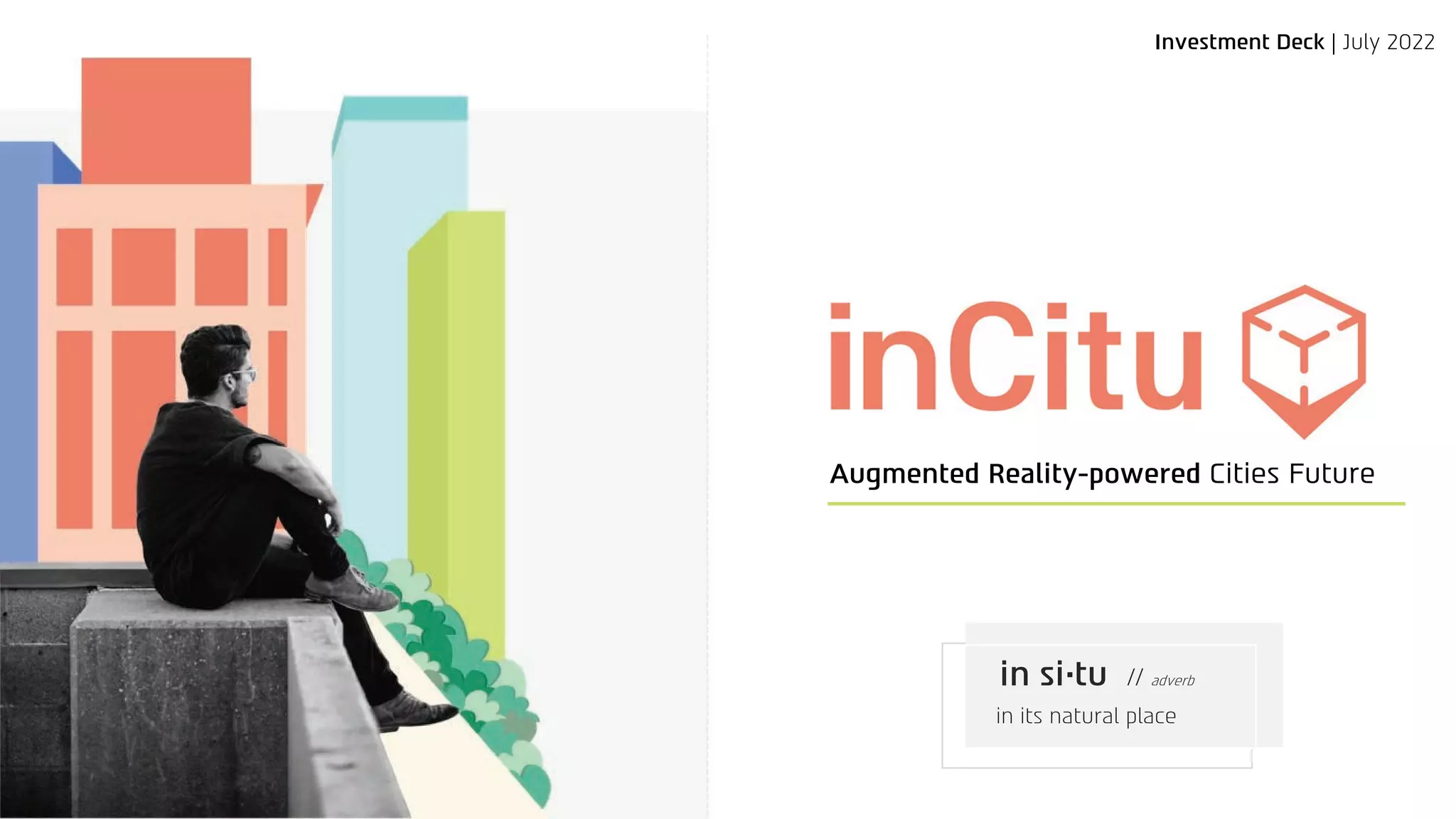
inCitu is an augmented reality platform designed to bridge the gap between urban developers and the communities they serve. By providing hyper-local, visual representations of proposed projects, the company aims to reduce the 'major distrust' that leads to project delays and rejections. The deck argues that traditional planning is exclusive and counterproductive, whereas inCitu’s mobile-first AR approach engages a younger, more diverse demographic—specifically noting that 72.2% of their survey responders are renters. With a roadmap showing pilots in Manhattan and partnerships with Snap Inc.,…
Key takeaways
- The company defines its mission as 'Augmented Reality-powered Cities Future' on slide 1.
- Urban development friction is framed as a distrust problem that makes cities unaffordable on slide 2.
- inCitu claims its platform can accelerate development timelines by 15 months, according to slide 3.
- The go-to-market strategy focuses on large-scale developments, citing 175 Park Avenue as an example on slide 4.
- The business roadmap notes a venture-led pre-seed round in late 2021 and a seed round target for Q2 2022 on slide 5.
- User data on slide 6 shows a demographic shift, with 44.4% of users aged 26-35 and 72.2% being renters.
- The 'Why Now' slide cites $350M in ARPA funds for inclusive recovery and a projected $340.16B AR market by 2028 on slide 7.
- The deck omits a dedicated team slide, detailed unit economics, and a specific funding 'ask' amount in the provided slides.
Introduction and Vision
The inCitu pitch deck, dated July 2022, presents a solution for the friction-filled world of urban planning. The cover slide (Slide 1) establishes a clear identity: "Augmented Reality-powered Cities Future." By defining the term "in situ" as "in its natural place," the company immediately signals its core value proposition—allowing stakeholders to see proposed buildings exactly where they are intended to stand. The visual language is clean, utilizing a mix of architectural illustration and modern typography to appeal to both tech investors and real estate professionals.
The Problem: The NIMBY Friction
Slide 2, titled "The Problem," uses a political cartoon to illustrate the "Not In My Back Yard" (NIMBY) phenomenon. The company identifies four key pain points: major distrust leading to opposition, classic participants having a strong interest in stopping development, projects being delayed or rejected, and the resulting unaffordability of urban centers. This slide is effective because it frames a technical solution (AR) as a social and economic remedy for a well-known systemic bottleneck in the real estate industry.
The Value Proposition: Time and Cost Savings
Slide 3, "Multi-Phase Savings," is the most data-heavy slide in the deck. It maps out a typical four-year planning timeline for New York City. It highlights that the "Community Engagement and Public Review" phase is a primary source of delay. By implementing "Smart engagement," inCitu claims developers can save $750,000 in costs and move the "Plan Approved" milestone forward by 15 months. The tagline at the bottom, "inCitu makes MORE PEOPLE become YIMBY's," directly positions the product as a tool for political and social engineering in favor of development.
Go-To-Market and Strategy
On Slide 4, the company outlines its focus on "Large-Scale Developments." They explicitly state they work with the largest real estate developers in the country. The slide features a rendering of 175 Park Avenue, a 1,575-foot-tall design in Manhattan, as a case study. The strategy is described as "Bottom Up," aiming to build trust and create confidence by incorporating hyper-local knowledge. This indicates a B2B2C model where the developer pays for the service to facilitate smoother public relations and entitlement processes.
Traction and Roadmap
Slide 5 provides a chronological "Business Roadmap" from 2019 to 2022. Key highlights include:
2019: AR Community-led planning in Red Hook, Brooklyn. · July 2020: Selection for a 2-year EIR Program for Schmidt Futures. · May 2021: Midtown Manhattan Pilot with Community Board 5 and PAU Studio. · Q3+Q4 2021: First revenue, first city-partnership, and a venture-led pre-seed round. · 2022 Q1: Partnership with Snap Inc. and winning the Smart 50 Awards.
The roadmap concludes with a mention of a "Q2 2022: Seed Round," though the specific amount sought is not listed on this slide.
Product-Market Fit and Demographics
Slide 6, "Critical Product-Market Fit: Diversifying Participation," uses four pie charts to show who is using the app. The data, based on 56 responders, suggests that inCitu reaches a different crowd than traditional town hall meetings. Key metrics include 44.4% of users in the 26-35 age bracket and a staggering 72.2% of users being renters. This is a powerful argument for developers and city officials who are often criticized for only listening to older, wealthier homeowners.
The Macro Environment: Why Now?
Slide 7 addresses the "Why Now?" question through three lenses. First, "Political Momentum," citing $350M in ARPA funds allocated for inclusive recovery. Second, "Technology is here," noting that the AR market is projected to reach $340.16B by 2028 with a 43.8% CAGR. Third, "Climate Change & Public Health," arguing that stagnated planning literally costs lives. This slide attempts to tie a niche prop-tech tool to massive global trends and government spending priorities.
What Works in the inCitu Deck
Clear ROI Calculation: Slide 3 does an excellent job of quantifying the value of the product. In real estate, time is money, and claiming a 15-month acceleration is a compelling hook for any developer dealing with carrying costs and interest rates.
Demographic Shift: The data on Slide 6 is a unique selling point. Most prop-tech decks focus on the developer's side of the dashboard. By showing that they can actually move the needle on community participation—and specifically engage renters and younger citizens—inCitu offers a solution to a political problem that money alone usually can't solve.
Strategic Partnerships: Mentioning Schmidt Futures and Snap Inc. on the roadmap (Slide 5) provides significant third-party validation. These are not typical real estate names, suggesting the company has broader tech and social impact appeal.
What is Missing from the inCitu Deck
The Team Slide: In the provided selection of slides, there is no mention of the founders or their backgrounds. For a company operating at the intersection of urban planning, AR technology, and municipal government, the pedigree of the team is vital. Investors would want to see expertise in architecture, city government, or high-end software engineering.
Business Model Specifics: While the deck mentions "first revenue" on Slide 5, it doesn't explain how they charge. Is it a per-project fee? A SaaS subscription for developers? A licensing fee for cities? Without this, the $750k savings mentioned on Slide 3 lacks a corresponding cost-of-service context.
The Ask: Slide 5 mentions a Seed Round in Q2 2022, but the deck does not state how much they are raising, the valuation, or the intended use of funds. A standard pitch deck should clearly define what the capital will achieve (e.g., "Raising $2M to expand to 5 new cities").
Competitive Landscape: There is no mention of other visualization tools or traditional architectural rendering firms. Investors need to know why a developer would choose an interactive AR app over a high-quality 3D video walkthrough or a physical scale model.
Founder Takeaways
Quantify the 'Soft' Problems: inCitu takes a soft problem (community distrust) and turns it into a hard metric (15 months of delay). Founders in regulated industries should follow this lead by mapping their solution onto a standard industry timeline to show exactly where they shave off time and cost.
Use Data to Prove Inclusivity: If your startup claims to be "democratizing" or "inclusive," you must prove it with data. Slide 6 is a masterclass in using small-sample data (56 responders) to tell a large, convincing story about demographic shifts that investors care about.
Leverage Macro Trends: The "Why Now" slide (Slide 7) is well-constructed because it doesn't just rely on tech trends. By citing specific government funding (ARPA), the founders show they understand the capital flows of their target market (municipalities and developers).
Frequently asked questions
- What specific problem does inCitu solve for developers?
- According to slide 3, inCitu addresses the 'Community Engagement and Public Review' phase of development. By using AR to visualize projects, they aim to reduce opposition from 'classic participants' who typically want to stop development. The deck claims this 'smart engagement' can save approximately $750,000 in costs and accelerate the timeline from concept to completion by 15 months.
- Who is the target audience for the inCitu application?
- While the customers are large-scale real estate developers (slide 4), the end-users are community members. Slide 6 highlights that their platform successfully engages a 'younger, mixed-income, mixed-education' demographic. Specifically, 44.4% of their users are between 26-35 years old, and 72.2% are renters, groups that are traditionally underrepresented in city planning meetings.
- What traction has the company demonstrated so far?
- Slide 5 outlines a roadmap starting in 2019 with community-led planning in Red Hook, Brooklyn. Key milestones include a 2-year EIR program with Schmidt Futures, a pilot in Midtown Manhattan with Community Board 5, and winning the 'Smart 50 Awards.' They also mention a partnership with Snap Inc. for a NYC city-wide campaign in early 2022.
- How does inCitu justify the timing of their market entry?
- Slide 7 uses three pillars for 'Why Now': Political Momentum (citing $350M in ARPA funds for local governments), Technology (AR market growth to $340B by 2028), and Social Urgency (stagnated planning costing lives). They argue that the ubiquity of AR technology makes this the right moment to replace 'exclusive planning' with their digital solution.
- What are the biggest omissions in the provided deck slides?
- The provided slides lack a team slide, which is critical for a seed-stage venture. There is also no slide detailing the business model (SaaS vs. project-based), no competitive landscape analysis, and no specific 'Ask' slide detailing how much capital is being raised in the Q2 2022 seed round mentioned on slide 5.