authID.ai’s presentation is a structured argument for the transition from legacy 'something you know' security to biometric 'something you are' verification. As a publicly traded entity, the company uses this deck to highlight the massive financial drain of password-related failures, citing that these issues cost smaller banks over $12.5 million annually. The deck emphasizes a developer-friendly, API-first approach to integration, positioning its 'Verified' product suite as a low-to-no-code solution compatible with major identity providers like Okta and Auth0. By focusing on the 'indisputable…
Key takeaways
- The deck identifies a $12.5 million annual cost for smaller banks due to password-related problems, including fraud and resets (Slide 11).
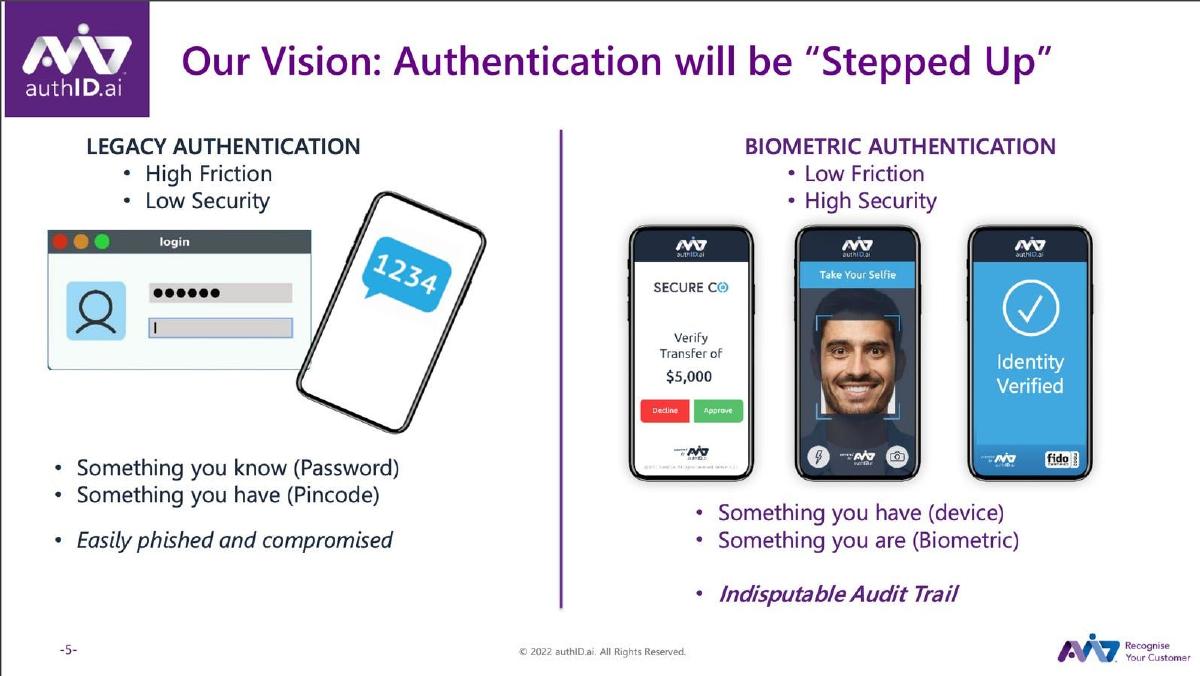
- authID.ai positions its vision as a shift from high-friction legacy authentication to low-friction biometric verification (Slide 5).
- The product suite, 'Verified', is presented as an API-first solution that supports both REST API and no-code integrations (Slide 17).
- The company highlights strategic compatibility with major identity platforms including Okta, Auth0, and Temenos (Slide 17).
- A six-step enterprise SaaS growth model is outlined, moving from MVP to cross-sell and upsell (Slide 21).
- The presentation explicitly targets the 'digital economy' and the acceleration of digital banking (Slide 8).
- Security is framed as a move toward an 'indisputable audit trail' by linking devices to biometric identity (Slide 5).
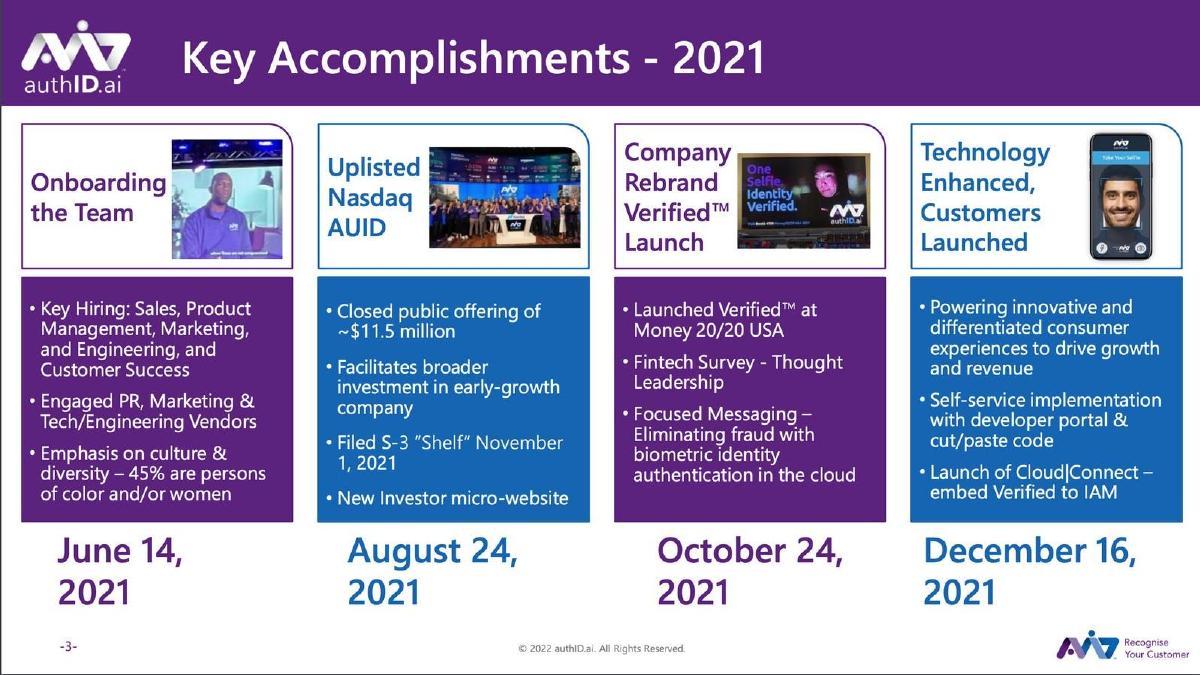
- The deck omits a traditional 'Team' slide in the provided sequence, focusing instead on market mechanics and product utility.
The Post-IPO Pivot to Biometric Dominance
authID.ai (NASDAQ: AUID) operates in the high-stakes world of cybersecurity, specifically targeting the vulnerabilities inherent in traditional password-based systems. This 23-slide deck, used to support a $22.5 million raise in 2024 as reported by Business Insider, serves as a roadmap for how a publicly traded company communicates its value proposition to institutional investors. The narrative is not just about technology; it is about the quantifiable cost of failure in the digital economy.
Slide 1-3: Setting the Stage
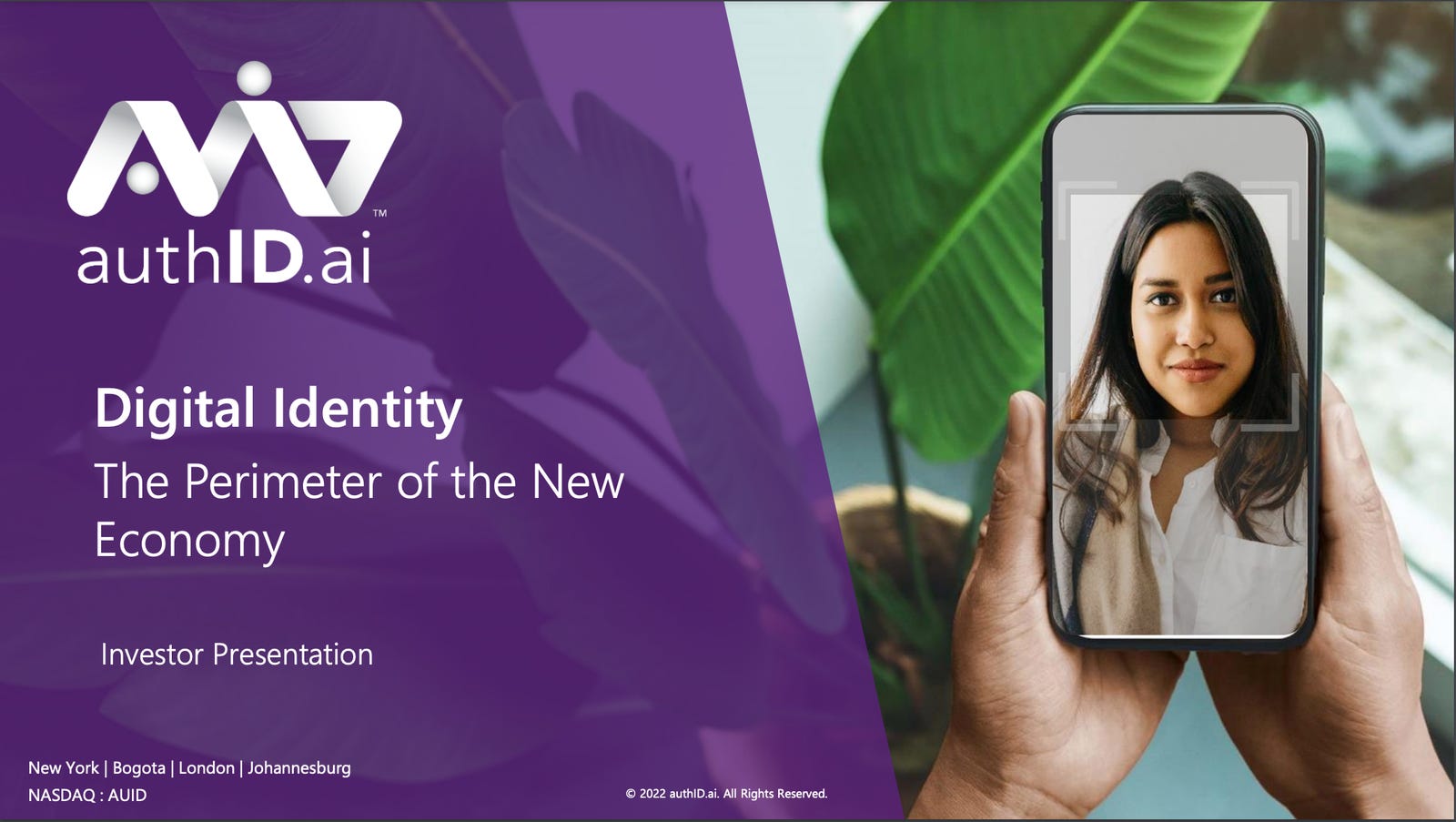
The opening slides establish the brand identity and the core thesis: 'Digital Identity: The Perimeter of the New Economy.' By framing identity as the 'perimeter,' authID.ai aligns itself with modern zero-trust security architectures. The presence of the NASDAQ ticker (AUID) and global office locations (New York, Bogota, London, Johannesburg) on Slide 1 immediately signals the company's scale and public accountability.
Slide 5: The Vision for 'Stepped Up' Authentication
Slide 5 is the central 'Before vs. After' slide. It categorizes legacy authentication as high friction and low security, relying on 'something you know' (passwords) and 'something you have' (pincodes). The company argues these are easily phished. The alternative presented is biometric authentication, which is described as low friction and high security. The key differentiator mentioned here is the 'Indisputable Audit Trail,' which is a critical requirement for regulated industries like finance.
Slide 8: The Macro Environment
Slide 8 uses a quote from American Banker to validate the market timing: 'What we are seeing now is the greatest acceleration of digital banking in history.' This slide serves to prove that the 'New Economy' mentioned in the title is not a future concept, but a current reality that demands better security infrastructure.
Slide 11: The $12.5 Million Problem
This is arguably the most important slide for an investor. It quantifies the 'pain' in dollars. authID.ai claims that password-related problems cost smaller banks over $12.5 million annually. The breakdown is specific: $7.63M for fraud/account takeover, $2.13M for compliance fines, $2.13M for IT labor related to resets, and $0.66M for customer attrition. By providing these specific figures, the company moves the conversation from a vague security benefit to a direct ROI calculation.
Slide 14: The Functional Process
Slide 14 breaks down the product's utility into three simple steps: 1. Verify who you are, 2. Bind you to an identity, and 3. Verify your identity whenever necessary. This simplification is necessary to explain how the backend complexity of biometrics translates into a seamless user experience.
Slide 17: Developer Experience and Ecosystem
Slide 17 addresses the 'how.' It positions authID.ai as an 'API first company.' This is a strategic choice to appeal to CTOs and developers who prioritize ease of integration. The slide highlights the REST API for custom builds and 'Verified Cloud Connect' for low-code/no-code needs. Crucially, it lists logos for Okta, Auth0, Temenos, and CUNextGen, demonstrating that authID.ai is not an isolated silo but a plug-and-play component of the existing enterprise tech stack.
Slide 21: The SaaS Growth Engine
Slide 21 outlines the 'Six Steps to creating a new Enterprise SaaS offering.' This slide is designed to show investors the path to recurring revenue. It starts with an MVP and moves through 'Proof of Value' (POV) and implementation, culminating in step 6: 'Cross-sell & Upsell Enterprise Wide.' This provides a clear framework for how the company intends to scale its $22.5 million in new capital into long-term growth.
Slide 23: Post-IPO Performance
The final slide in the provided sequence refers to 'Two Years Prior and Post IPO' growth rates. For a public company, comparing pre-IPO and post-IPO performance is vital to prove that the transition to public markets has not slowed innovation or market capture. It reinforces the stability of the investment.
What authID.ai Does Well
The deck excels at quantifying the problem. Many cybersecurity decks focus on the 'scare factor' of hackers, but Slide 11 focuses on the 'cost factor' for the bank. By breaking down the $12.5 million loss into fraud, compliance, labor, and attrition, authID.ai gives investors four different ways to justify the purchase of their software. This multi-pronged ROI approach is highly effective in enterprise sales.
Furthermore, the emphasis on being 'API-first' (Slide 17) shows a deep understanding of modern software procurement. Enterprises no longer want monolithic, closed systems; they want modular tools that work with their existing identity providers like Okta. By showcasing these integrations, authID.ai reduces the perceived risk of a difficult implementation.
What is Missing from the Deck
The provided sequence lacks a dedicated 'Team' slide. While the company is public and its leadership is a matter of public record, a pitch deck—especially for a $22.5M raise—usually highlights the specific expertise of the executive team in scaling SaaS or cybersecurity firms. The absence of this slide in the primary narrative flow is a notable omission.
Additionally, there is no explicit 'Competition' slide. While Slide 5 compares the technology to 'Legacy Authentication,' it does not address other biometric competitors or alternative MFA (Multi-Factor Authentication) methods like hardware keys (e.g., YubiKey). Investors in the cybersecurity space typically want to see how a company defends its moat against other well-funded startups in the same niche.
Finally, the deck does not provide a detailed 'Use of Funds' slide. While we know from publisher reports that $22.5M was raised, the deck itself (in the provided slides) does not specify how much is going to R&D versus sales and marketing. For a post-IPO company, this transparency is usually expected to help investors understand the growth levers being pulled.
Lessons for Founders
1. Quantify the Pain: If you are selling to enterprises, do not just say your product is 'better.' Say exactly how much money the customer is losing by not using it. Slide 11 is a masterclass in building a data-backed problem statement.
2. Focus on Integration, Not Just Innovation: Your technology might be revolutionary, but if it doesn't work with the tools your customers already use (like Okta or Auth0), they won't buy it. Highlighting your ecosystem compatibility (Slide 17) is just as important as highlighting your features.
3. Define the Journey: Investors want to see that you have a repeatable process for growth. The 'Six Steps' on Slide 21 shows that authID.ai isn't just hunting for one-off deals; they have a systematic approach to landing and expanding within an enterprise.
4. Use a 'Before and After' Visual: Slide 5 effectively uses simple icons and mobile phone mockups to show the transition from friction-heavy passwords to seamless biometrics. This makes a technical product feel accessible and its benefits obvious.
Final Thoughts
authID.ai’s deck is a professional, corporate-grade presentation that leans heavily on market validation and financial logic. It avoids the 'hype' often found in early-stage decks, instead opting for a sober look at the costs of identity failure and the efficiency of API-driven security. For founders in the B2B SaaS or Security space, the way this deck translates technical features into business outcomes (ROI) is the most valuable takeaway.
Frequently asked questions
- What specific problem does authID.ai solve for banks?
- According to Slide 11, authID.ai addresses a $12.5 million annual loss for smaller banks. This figure is broken down into $7.63M from password fraud, $2.13M from compliance breaches, $2.13M from password reset labor costs, and $0.66M from customer attrition due to poor user experience.
- How does authID.ai differentiate its technology from traditional passwords?
- Slide 5 contrasts 'Legacy Authentication' (passwords and pin codes) with 'Biometric Authentication.' It argues that legacy systems are easily phished, while biometrics offer high security and low friction by combining 'something you have' (a device) with 'something you are' (facial biometrics).
- Is the authID.ai solution difficult for developers to implement?
- No, the company emphasizes ease of use. Slide 17 describes authID.ai as an 'API first company' where integration can be done with a few lines of code via REST API. They also offer 'Verified Cloud Connect' for low-code to no-code implementations.
- What is the company's strategy for enterprise growth?
- Slide 21 outlines a six-step process: 1. Market MVP, 2. Sell Proof of Value, 3. Iterate with POVs and book contracts, 4. Customer implementation, 5. First user subset goes live, and 6. Cross-sell and upsell enterprise-wide.
- Which third-party platforms does authID.ai integrate with?
- Slide 17 lists several key integrations and partners, including identity providers Okta and Auth0, as well as banking and fintech platforms Temenos and CUNextGen.