Nobal Technologies used a minimalist, high-impact 10-slide deck to secure $861.6K in seed funding. The narrative centers on the tension between the 90% of retail sales still occurring in physical stores and the high efficiency of digital data. By identifying a specific pain point—the 33% return rate of online sales—Nobal positioned its iMirror as a solution that combines the tactile benefits of in-store shopping with the data-driven upsell capabilities of e-commerce. The deck is notable for its brevity, relying on large-scale metrics like a '22 Trillion' market size and a claim of '$450K in 4…
Key takeaways
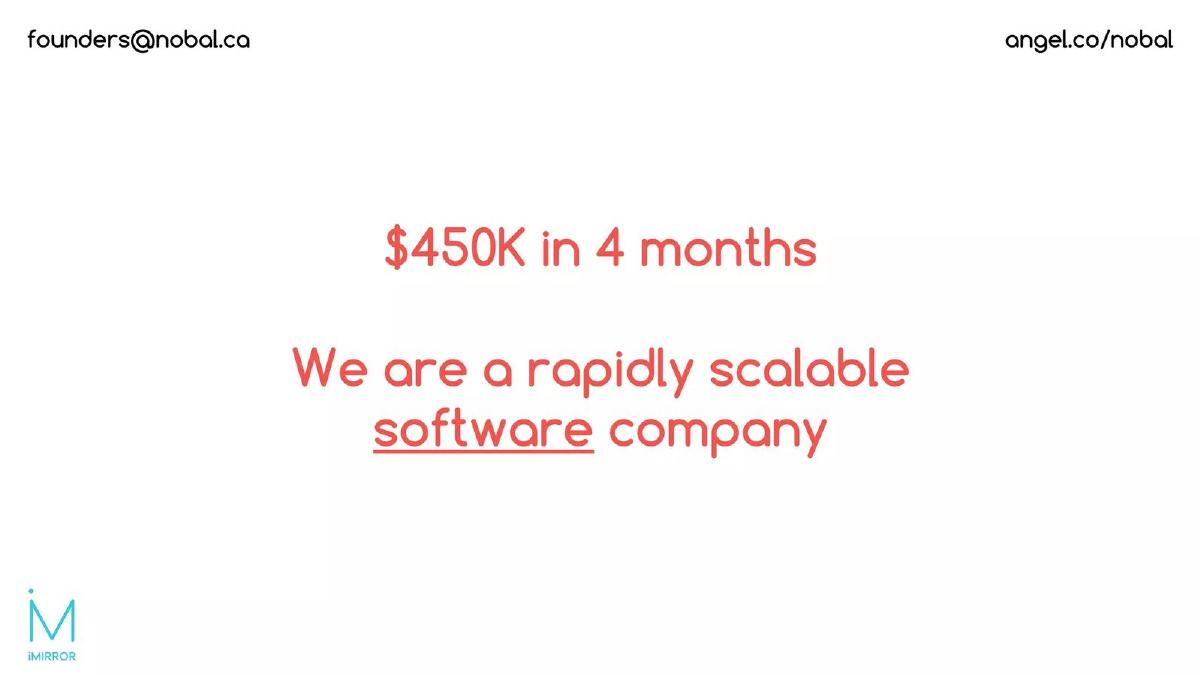
- The company claims to have generated $450,000 in revenue within a four-month period (Slide 3).
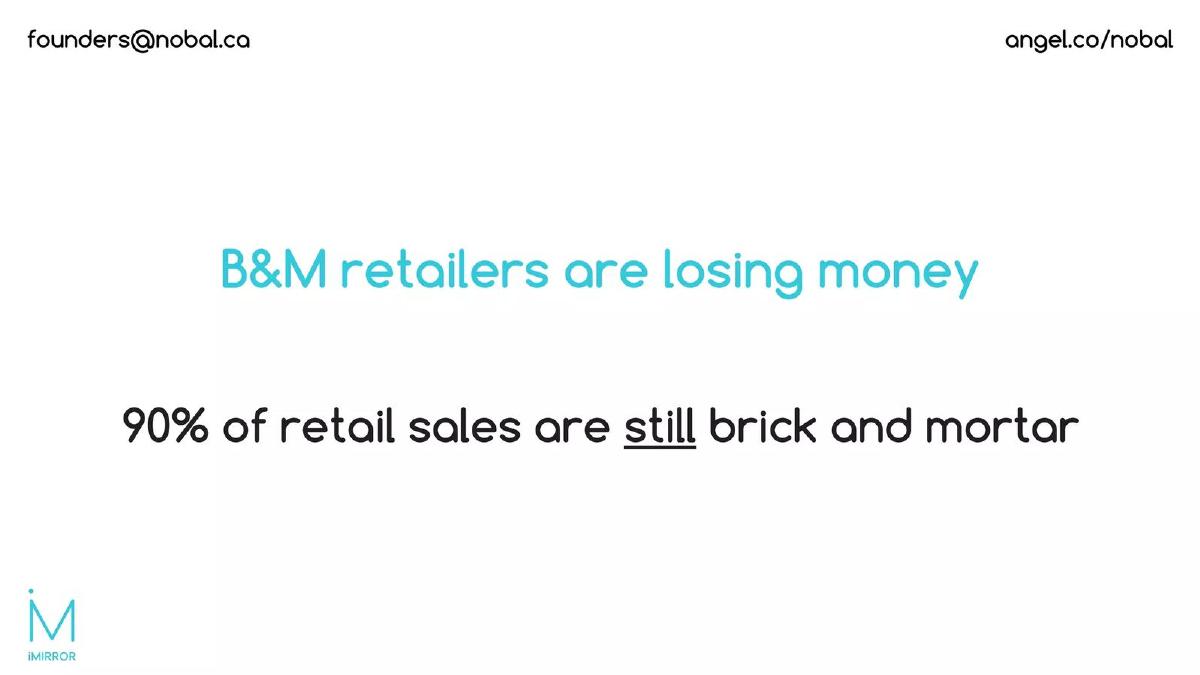
- Physical retail is framed as a dominant but struggling market, with 90% of sales still happening in brick-and-mortar stores (Slide 4).
- Omnichannel shoppers are identified as a high-value segment, being 8x more valuable to retailers than single-channel shoppers (Slide 5).
- The deck highlights a massive 33% return rate for online sales, positioning the iMirror as a way to reduce this friction (Slide 6).
- The total addressable market is cited as $22 Trillion, with a target of $220 Billion representing a '100X' opportunity (Slide 7).
- Social proof is established through a collage of images featuring the product in stores like Lululemon, Ralph Lauren, and Nordstrom (Slide 8).
- The team includes a 'Top 40 under 40' CEO and a marketing executive with over 15 years of experience (Slide 9).
- The business model is presented as a hybrid of hardware sales ('iMirrors') and recurring revenue ('SaaS') (Slide 10).
The Minimalist Approach to IoT Fundraising
Nobal Technologies' 2013 seed deck is a masterclass in brevity. At only 10 slides, it avoids the common pitfall of over-explaining the technical specifications of its hardware. Instead, it focuses on the economic delta between physical and digital retail. In an era where 'omnichannel' was becoming a buzzword, Nobal used data to prove that their iMirror wasn't just a novelty, but a revenue recovery tool. By citing a 33% return rate for online sales, they gave investors a concrete reason why a digital interface in a physical dressing room was a necessity rather than a luxury.
Slide 1: Title and Branding
The deck opens with the 'iMIRROR' logo and the tagline 'The future of retail and hospitality.' It includes contact information and an AngelList URL. The branding is clean and minimalist, setting a professional tone for a technology-focused pitch. There is no clutter here; the focus is entirely on the product name and the broad industry it aims to disrupt.
Slide 2: The Product in Action
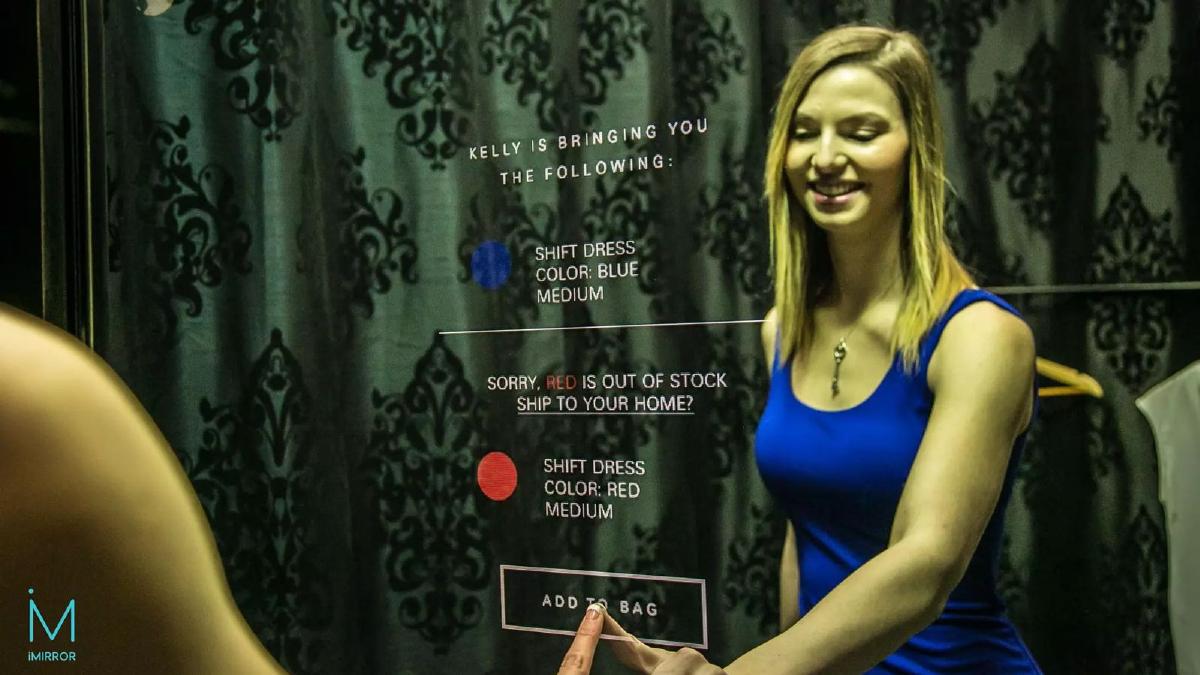
Slide 2 is a full-bleed photograph of the iMirror being used in a dressing room. This is a critical 'show, don't tell' moment. The image displays a woman interacting with a transparent interface on the mirror. The text on the mirror reads: 'Kelly is bringing you the following: Shift Dress Color: Blue Medium.' Crucially, it shows a 'Red' version is out of stock and offers to 'Ship to your home?' with an 'Add to Bag' button. This single slide explains the entire value proposition: inventory expansion, personalized service, and e-commerce integration within a physical space.
Slide 3: Immediate Traction
Slide 3 presents a bold claim: '$450K in 4 months.' Below this, it states, 'We are a rapidly scalable software company.' This slide serves two purposes. First, it proves market demand with a significant revenue figure for a seed-stage startup. Second, it attempts to preempt investor concerns about the 'hardware drag' by explicitly labeling themselves as a software company, suggesting that the long-term value lies in the platform, not just the glass.
Slide 4: The Market Reality
Nobal uses Slide 4 to frame the 'Problem.' It states, 'B&M retailers are losing money,' yet '90% of retail sales are still brick and mortar.' This creates a compelling paradox for investors: the vast majority of commerce is happening in a format that is currently inefficient. By highlighting that retailers are losing money despite having the lion's share of the market, Nobal positions its solution as the necessary evolution for survival.
Slide 5: The Omnichannel Opportunity
The deck introduces a key metric on Slide 5: 'Omnichannel shoppers are 8X more valuable to retailers.' This is the 'Why Now' of the deck. It suggests that if a retailer can bridge the gap between their physical store and their digital presence, they can unlock a customer segment that spends significantly more. Nobal positions the iMirror as the bridge that creates these high-value shoppers.
Slide 6: The Return Rate Pain Point
Slide 6 compares 'Brick and Mortar' to 'Online Sales.' It uses a graphic of t-shirts to show 'Out of Stock' issues in stores, then contrasts this with a '33% Return Rate' for online sales. This is a sophisticated argument. It implies that physical stores are better for fit (reducing returns) but bad for inventory, while online is great for inventory but bad for fit. The iMirror, as shown in Slide 2, solves both by allowing physical fit-testing with digital inventory access.
Slide 7: Market Size and Scale
Slide 7 uses a donut chart to visualize a '22 Trillion' total market. It identifies a '220 Billion' segment as '1%' of that market, labeling it the 'Market Share for 100X.' While 22 trillion is an extraordinarily large and somewhat vague figure (likely referring to total global retail), the slide's purpose is to show that even capturing a tiny fraction of the industry results in a massive, venture-scale company.
Slide 8: Social Proof and Pilots
Slide 8 is a collage of the iMirror in various high-end retail environments. It lists Lululemon, Neiman Marcus, Ralph Lauren, Bloomingdale's, and Nordstrom . This is the most powerful slide in the deck. For a seed-stage company, having your product on the floor of the world's most prestigious retailers is the ultimate validation. It moves the conversation from 'Will this work?' to 'How fast can we roll this out?'
Slide 9: The Team
The team slide lists four key members. Pieter Boekhoff (CEO/Founder) is noted as a 'Top 40 under 40.' Alain Kassangana (Strategy/Biz Dev) is a 'McGill Grad. engineer.' David Cree (Marketing/Sales) brings '15+ yrs marketing executive' experience. Daniel Mather (Software Engineer) is described as a 'Technology thought leader.' The team covers the essential bases: leadership, engineering, and high-level sales/marketing.
Slide 10: The Business Model and Closing
The final slide is a minimalist summary of the business model and contact info. It lists '$450K' (reiterating traction), '$1.5M' (likely the target for the current raise, though not explicitly labeled as the 'Ask'), 'iMirrors' (hardware sales), and 'SaaS' (recurring software revenue). This confirms that the company intends to monetize both the initial installation and the ongoing software usage.
What Nobal Technologies Did Well
The deck is exceptionally focused. It identifies a single, massive friction point in the retail industry—the disconnect between physical inventory and digital convenience—and presents a product that solves it visually. The use of the 33% return rate metric is a stroke of genius because it quantifies a 'hidden' cost that every retailer understands. Furthermore, the social proof on Slide 8 is undeniable. Seeing the product in Nordstrom and Lululemon eliminates the 'technical risk' in the eyes of an investor; the only remaining question is 'market risk' and 'execution risk.'
What is Missing from the Deck
Despite its success, the deck has several notable omissions. There is no Competition slide, which is surprising given that smart mirrors and interactive signage were a growing field in 2013. There is also no Unit Economics slide. While they mention 'iMirrors' and 'SaaS,' they don't explain the cost to manufacture a mirror versus the sale price, nor do they detail the expected Lifetime Value (LTV) of a SaaS contract. Finally, the 'Ask' is vague. While '$1.5M' appears on the final slide, it isn't framed as a formal request for capital with a breakdown of how those funds will be used (e.g., hiring, R&D, sales expansion).
What Other Founders Should Copy
Founders should emulate Nobal's ability to anchor their value proposition to a specific, painful metric . By focusing on the 33% return rate, they aren't just selling a 'cool mirror'; they are selling a 'return-reduction machine.' Additionally, the visual demonstration of the product on Slide 2 is a perfect example of how to explain complex IoT functionality without using a single bullet point of technical jargon. If your product is physical, show it in its natural habitat, solving a problem for a real user. Lastly, the use of logos for social proof cannot be overstated. If you have pilots with major brands, those logos are more valuable than five slides of financial projections.
Frequently asked questions
- How much did Nobal Technologies raise and at what stage?
- According to catalogue facts from Failory, Nobal Technologies raised $861.6K during a Seed round in 2013. The deck itself mentions a $450K figure in four months on Slide 3, which likely refers to early revenue or traction rather than the total investment amount.
- What is the core product offered by Nobal Technologies?
- The core product is the 'iMirror,' an interactive smart mirror designed for retail and hospitality environments. As shown on Slide 2, the mirror allows customers to interact with digital interfaces while trying on clothes, enabling features like 'Add to Bag' for items that might be out of stock in the physical store.
- What specific retail problem does the iMirror solve?
- The deck identifies two primary problems: the high 33% return rate of online sales and the 'out of stock' issues in physical stores. By allowing customers to try on items physically but order out-of-stock variations (colors/sizes) via the mirror for home delivery, Nobal aims to capture lost sales and reduce returns.
- Who are the key members of the Nobal Technologies team?
- The team consists of Pieter Boekhoff (CEO/Founder), Alain Kassangana (Strategy/Biz Dev), David Cree (Marketing/Sales), and Daniel Mather (Software Engineer). The deck emphasizes their credentials, such as Boekhoff's 'Top 40 under 40' status and Cree's 15+ years of executive marketing experience.
- What is the business model for the iMirror?
- Slide 10 indicates a dual revenue stream. The company generates revenue through the sale of the physical 'iMirrors' hardware and maintains ongoing revenue through a 'SaaS' (Software as a Service) model, likely for the software interface, data analytics, and integration services provided to retailers.