Indifi is a digital lending platform focused on India's underserved MSME sector. The deck highlights a transition from a high-growth startup to a profitable, late-stage institution, underscored by a $35 million Series E round in June 2023. Their core strategy relies on a 'partnership-led' model, integrating with major platforms like Amazon, Flipkart, and Zomato to acquire customers with lower CAC. The deck effectively communicates institutional stability through its blue-chip investor roster (Accel, Omidyar, British International Investment) and an upgraded BBB/Stable credit rating. While it…
Key takeaways
- The company achieved profitability at the beginning of FY'23, a critical milestone for late-stage fintechs (Slide 6).
- Indifi successfully raised $35 Million in a Series E funding round in June 2023 (Slide 6).
- The business model targets five specific segments: E-commerce, Restaurants, Retail, Pharmacies, and Tourism & Hospitality (Slide 2).
- Customer acquisition is driven by 'Anchor Partners' including major platforms like Amazon, Flipkart, Myntra, and Google Pay (Slide 5).
- The platform offers four primary financial products: Term Loans, Line of Credit, Merchant Cash Advance, and Invoice Discounting (Slide 2).
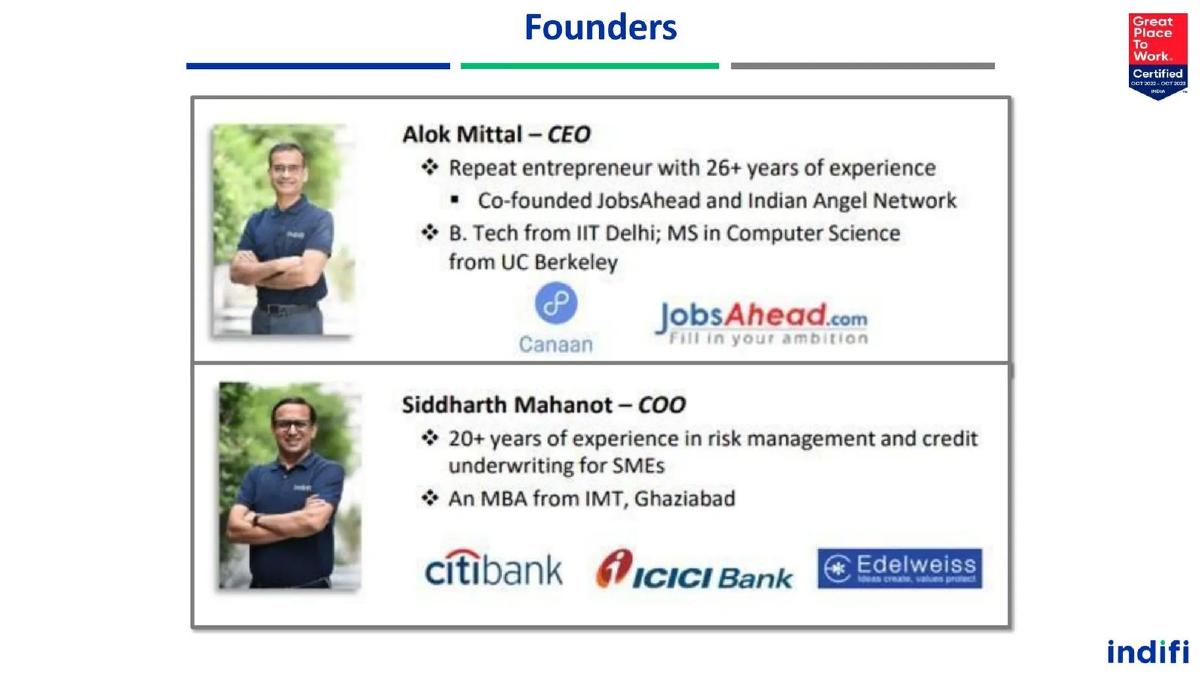
- The leadership team possesses deep domain expertise, with the CEO having 26+ years of experience and the COO having 20+ years in risk management (Slide 3).
- The company reported 2x growth in Assets Under Management (AUM) and Disbursals during the FY'22-23 period (Slide 6).
- Indifi has secured a diverse range of institutional lenders, including IDFC First Bank, IndusInd Bank, and Northern Arc (Slide 5).
Executive Summary: The Institutionalization of MSME Lending
The Indifi pitch deck represents a company that has moved past the 'move fast and break things' phase of fintech. Instead, it presents a narrative of institutional stability, diversified risk, and ecosystem integration. Operating in the Indian MSME lending space—a market notoriously difficult due to thin credit files and high collection costs—Indifi demonstrates how a partnership-led model can scale profitably. The deck focuses heavily on the quality of its partners, the experience of its founders, and its recent transition to a profitable, Series E-funded entity.
Slide 1: Title and Certification
The cover slide is minimalist, featuring the Indifi logo and the title 'Introduction to Indifi.' Notably, the top right corner features a 'Great Place To Work' certification badge for Oct 2022 - Oct 2023. For a late-stage company, this is a subtle signal to investors that the internal culture is stable enough to support the rapid headcount growth mentioned later in the deck.
Slide 2: The Digital Platform and Segment Focus
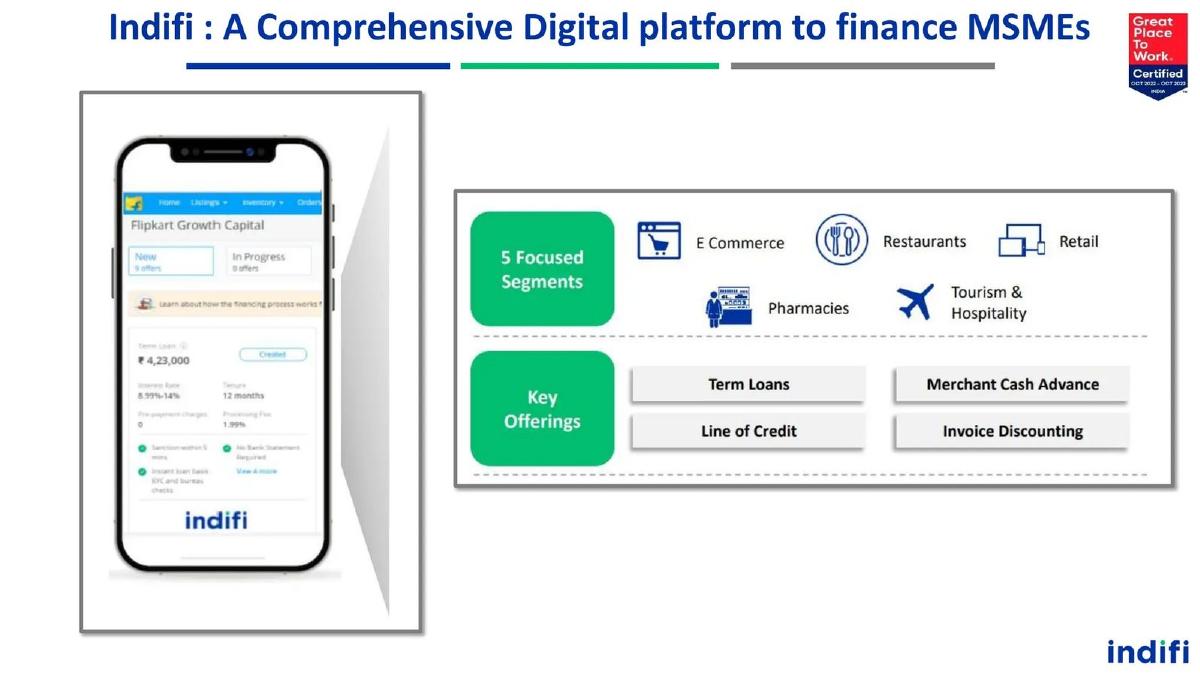
This slide defines Indifi as a 'Comprehensive Digital platform to finance MSMEs.' It uses a mobile mockup to show the user interface, specifically highlighting a 'Flipkart Growth Capital' loan offer of ₹4,23,000. This is a crucial visual cue—it shows the product is already embedded in major marketplaces.
The slide categorizes the business into two areas: 5 Focused Segments (E-commerce, Restaurants, Retail, Pharmacies, Tourism & Hospitality) and Key Offerings (Term Loans, Line of Credit, Merchant Cash Advance, and Invoice Discounting). By narrowing their focus to these five segments, Indifi suggests they have developed specialized underwriting models for the specific cash-flow patterns of those industries.
Slide 3: Founder Pedigree
The 'Founders' slide emphasizes deep experience over youthful disruption. Alok Mittal (CEO) is presented as a 'Repeat entrepreneur with 26+ years of experience,' citing his roles at JobsAhead and the Indian Angel Network, with an academic background from IIT Delhi and UC Berkeley. Siddharth Mahanot (COO) brings the necessary 'banking' credibility with 20+ years in risk management and credit underwriting, featuring logos from Citibank, ICICI Bank, and Edelweiss. This balance of 'Tech/Entrepreneurship' and 'Hard Banking Risk' is a requirement for any fintech seeking Series E levels of capital.
Slide 4: The Investor Roster
Slide 4 is a 'logo wall' of investors. It includes Accel Partners, British International Investment, Elevar Equity, Flourish, Omidyar Network, and Finnfund. The presence of both traditional VC (Accel) and impact/development-focused investors (Omidyar, Finnfund, BII) suggests that Indifi successfully pitches itself as both a high-growth tech play and a financial inclusion vehicle. This diversity of capital sources is a significant de-risking factor for future rounds.
Slide 5: The Three-Sided Ecosystem
This is perhaps the most important slide in the deck, titled 'Some of Our Business Tie ups.' It breaks the ecosystem into three pillars:
Customers - SMEs: Defined as businesses with $200K – $4M annual revenue that are 'Working Capital Hungry.' · Anchor Partners: This is Indifi's 'secret sauce.' Logos include Amazon, Flipkart, Myntra, Zomato, Swiggy, and Google Pay. The slide notes these partners provide a 'Scalable Digital Origination' with a reach of over 2000+ SMEs. · Lenders: Indifi acts as a bridge to 'Multiple Balance Sheets,' listing partners like IDFC First Bank, IndusInd, and Northern Arc.
The bottom of the slide explains the value proposition for each: SMEs get unsecured credit and a fast process; Anchor Partners get better-financed suppliers/customers; Lenders get access to new segments with minimal operating overhead.
Slide 6: Recent Achievements (FY'22-23)
The final slide in this selection serves as a 'Traction' and 'Roadmap' hybrid. It lists several high-impact milestones:
Raised $35 Million in Series E (June '23). · Became profitable at the beginning of FY'23. · Headcount doubled to 750+. · Credit rating upgraded to BBB/Stable from BBB-. · 2x growth in AUM (Assets Under Management) and Disbursals.
The mention of a credit rating upgrade is particularly important for a fintech, as it directly lowers their cost of capital, further fueling the profitability mentioned in the second bullet point.
What Works in the Indifi Deck
1. The Partnership-Led Narrative: The deck clearly explains how Indifi avoids the 'CAC trap' (high Customer Acquisition Costs). By showing the logos of Amazon, Zomato, and Flipkart, they prove they are integrated into the workflows where MSMEs already conduct business. This makes the business model seem much more defensible than a standalone lending app.
2. Institutional Credibility: Between the BBB/Stable credit rating, the ISO 27001-2017 upgrade, and the 'Great Place to Work' certification, the deck screams 'adult in the room.' For Series E investors, these operational hygiene factors are often as important as growth metrics.
3. Clear Segmentation: Rather than saying they lend to 'everyone,' they specify five segments. This allows an investor to understand the underlying risk profile (e.g., the volatility of the restaurant industry vs. the stability of pharmacies).
What is Missing from the Indifi Deck
1. Unit Economics: While the deck mentions profitability, it does not show the 'Contribution Margin' or 'Net Interest Margin' (NIM). Investors would want to see the spread between their cost of funds and the interest rates charged to SMEs, minus defaults.
2. Cohort Analysis/Default Rates: In lending, growth is easy; getting paid back is hard. The deck mentions 2x growth in AUM but does not provide Non-Performing Asset (NPA) percentages. A slide showing that default rates have remained stable or decreased as they scaled would be a powerful addition.
3. The 'Ask': Since this deck appears to be an 'Introduction' or a post-Series E update, there is no specific slide detailing how much they are looking to raise next or what the specific use of funds would be for a future Series F.
Founder's Playbook: What to Copy
The 'Ecosystem' Slide: If you are a B2B startup, copy the structure of Slide 5. Don't just show your customers; show the partners who give you access to customers and the infrastructure partners who support your backend. It demonstrates that you are a 'platform' rather than just a 'vendor.'
Milestone Stacking: Slide 6 is a great example of how to combine financial, operational, and cultural wins. By listing a fundraise, a profitability milestone, and a credit rating upgrade together, you create a sense of 'unstoppable momentum' that is very attractive to late-stage investors.
Founder-Market Fit: Slide 3 is a perfect template for showing why you are the right person for the job. It doesn't just list titles; it lists 'years of experience' and specific domain expertise (risk management, credit underwriting) that directly relates to the business's biggest risks.
Frequently asked questions
- What is Indifi's primary target market?
- Indifi targets Micro, Small, and Medium Enterprises (MSMEs) in India, specifically those with annual revenues between $200K and $4M. These businesses are characterized as being 'working capital hungry' and often have insufficient or low collateral, making them underserved by traditional banking institutions.
- How does Indifi acquire its customers?
- Indifi uses a 'Scalable Digital Origination' strategy through anchor partners. By integrating with large online aggregators like Amazon, Flipkart, Zomato, and Swiggy, they reach over 2,000 SMEs. This allows them to leverage the transaction data of these partners for better credit underwriting and lower acquisition costs.
- What are the core financial products offered by the platform?
- According to slide 2, the platform offers four key products: Term Loans, Line of Credit, Merchant Cash Advance, and Invoice Discounting. These products are tailored to the cash flow cycles of their five focus segments, such as restaurants and retail shops.
- Who are the key investors backing Indifi?
- The company is backed by a mix of global venture capital and development finance institutions. Notable investors shown on slide 4 include Accel Partners, British International Investment (formerly CDC Group), Elevar Equity, Flourish Ventures, Omidyar Network, and Finnfund.
- What recent financial milestones has the company achieved?
- As of the January 2024 deck, Indifi reported reaching profitability at the start of FY'23. They also closed a $35 million Series E round in June 2023, doubled their headcount to over 750 employees, and achieved a 2x growth in AUM and disbursals.