The 2017 Cancer Genetics (CGI) investor deck serves as a strategic roadmap for a publicly traded company (Nasdaq: CGIX) transitioning from a service-oriented biopharma partner to a clinical diagnostics powerhouse. With $11.6M in revenue for 2015 and $9.3M reported for the first nine months of 2016, CGI demonstrates significant market penetration, claiming contracts with 8 of the top 10 biopharma companies. The presentation focuses on their 'Bench to Bedside' mission, leveraging a portfolio of proprietary genomic tests across blood cancers and solid tumors. A critical element of the deck is th…
Key takeaways
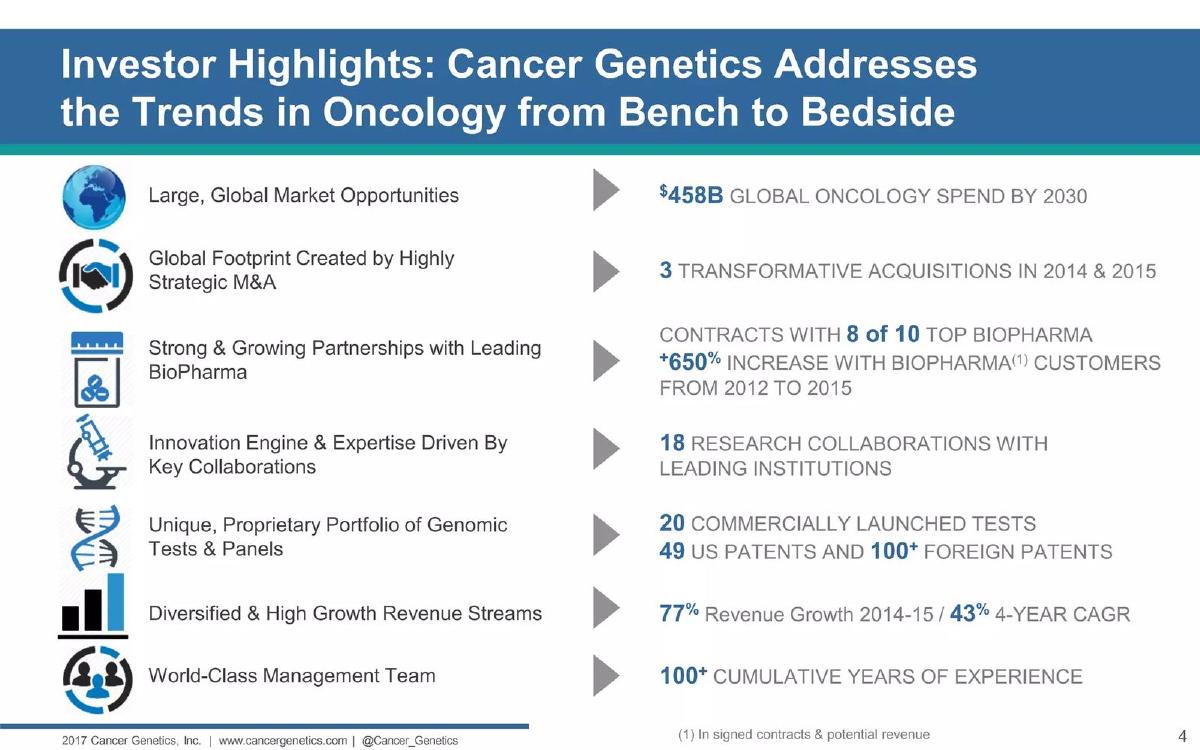
- CGI reports working with 8 of the top 10 biopharma companies, indicating high industry trust (Slide 9).
- The company is actively supporting over 120 clinical trials with its genomic services (Slide 9).
- Revenue grew from $0.6M in 2012 to $11.6M in 2015, with an additional $40M in anticipated future revenues (Slide 9).
- The product portfolio includes 14 tests already in market across blood cancers, solid tumors, and hereditary conditions (Slide 13).
- CGI operates a joint venture with the Mayo Clinic called OncoSpire Genomics (Slide 13).
- The business model relies on a 15% estimated approval rate for trials to transform into long-term clinical care revenue (Slide 21).
- Commercial payer mix increased from 39% in FY 2015 to 52% by Q2 2016 (Slide 25).
- The company has secured agreements covering more than 180 million lives via national networks (Slide 25).
Executive Summary: The Precision Medicine Pivot
The Cancer Genetics (CGI) investor deck from January 2017 represents a company at a crossroads between being a specialized service provider and a broad-scale clinical diagnostic leader. As a Nasdaq-listed entity (CGIX), the stakes for this presentation were high, aiming to prove to investors that their 'Bench to Bedside' strategy was not just a slogan but a scalable financial model. The deck relies heavily on two pillars: blue-chip validation (8 of the top 10 biopharma companies) and a massive clinical trial pipeline (120+ trials) that serves as a precursor to future market share.
Slide 1: Title and Positioning
The cover slide establishes the core thesis: "The Oncology Diagnostics Partner from Bench to Bedside." The imagery is clinical and abstract, featuring cellular structures and genomic patterns. Notably, it identifies the presentation as part of the RedChip Global Online Growth Conference on January 25, 2017. The inclusion of the Nasdaq ticker (CGIX) immediately signals to the viewer that this is a public company teardown, requiring a focus on growth metrics and regulatory milestones rather than just early-stage product-market fit.
Slide 5: The Mission and Value Chain
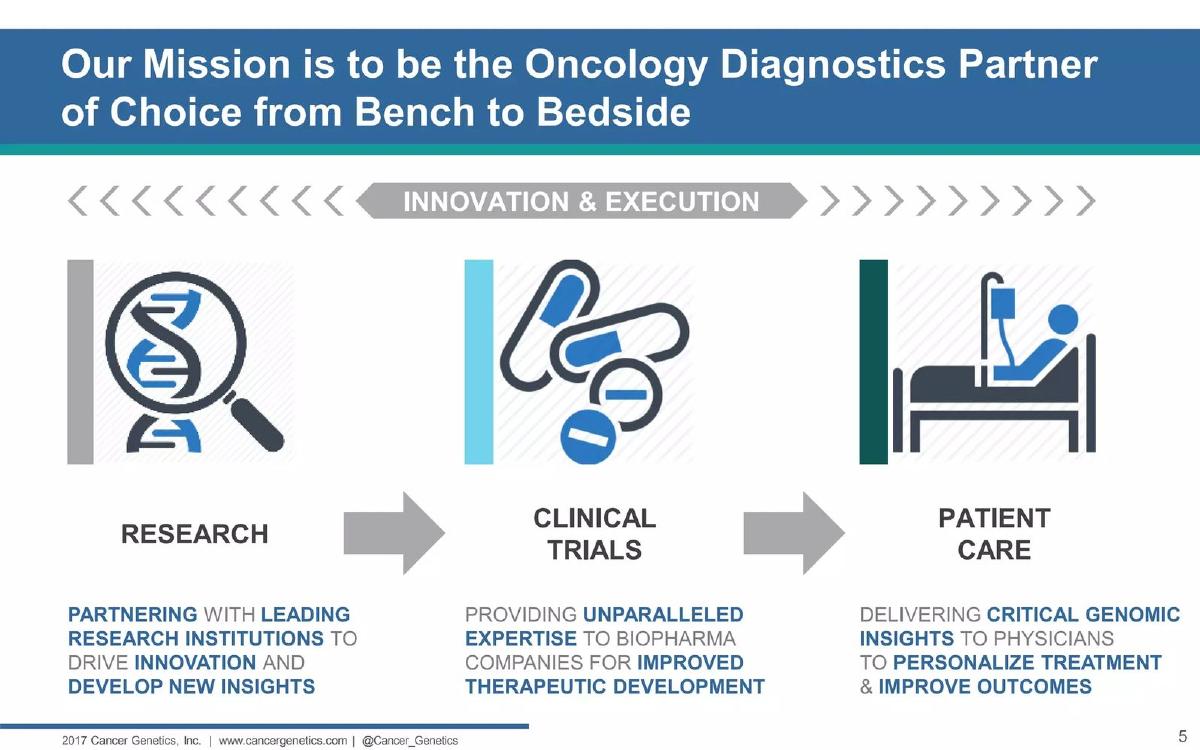
Slide 5 breaks down the "Bench to Bedside" concept into three distinct phases: Research, Clinical Trials, and Patient Care. Research involves partnering with leading institutions to drive innovation. Clinical Trials focuses on providing expertise to biopharma companies for therapeutic development. Patient Care is the final stage, delivering genomic insights to physicians to personalize treatment. This slide is crucial because it explains the company's long-term strategy: capture the data and the relationship during the research phase to own the diagnostic market during the care phase.
Slide 9: Revenue Growth and Biopharma Traction
This is the 'traction' slide, and it is dense with data. CGI reports that they have contracts with 8 of the top 10 biopharma companies and are actively supporting 120+ clinical trials . The bar chart shows a clear upward trajectory in revenue:
2012: $0.6M · 2013: $2.7M · 2014: $5.6M · 2015: $11.6M · 9 months 2016: $9.3M
The slide also introduces a speculative but significant figure: +$40M in anticipated future revenues from signed contracts with biotech and pharma customers. This forward-looking metric is intended to give investors confidence in the 'locked-in' nature of their service revenue.
Slide 13: The Product Portfolio
Slide 13 provides a comprehensive look at the company's intellectual property. The portfolio is categorized by disease state and development stage. Under Blood Cancers , they list 14 tests already in the market, including MATBA for B-cell cancers and various NGS panels. Solid Tumors include FDA-cleared tests like "Tissue of Origin." A significant footnote mentions OncoSpire Genomics , a joint venture with the Mayo Clinic, which is developing tests for Multiple Myeloma and Lung Cancer. This slide serves to prove the breadth of their technical capability across multiple oncology verticals.
Slide 17: The Precision Medicine Era
This is a transition slide featuring a high-resolution image of a clinician writing chemical formulas. The text states: "CGI operates at the forefront of the era where genomic and immune markers will enable precision medicine." While it lacks specific data, it serves to align the company with the broader macroeconomic and scientific trend of personalized healthcare, positioning CGI as an essential infrastructure provider for this shift.
Slide 21: The Revenue Conversion Model
Slide 21 attempts to quantify the transition from trials to clinical care. It visualizes the 120+ clinical trials funneling down. The company estimates a 15% approval rate for these trials, which would result in >15 therapies that might transform cancer care. From there, they anticipate 3-5 potential companion diagnostics (Dx) to accelerate clinical growth and profitability. This is a vital slide for investors because it explains the 'why' behind their service business: it is a low-cost acquisition strategy for high-margin diagnostic products.
Slide 25: Reimbursement and Payer Mix
For a diagnostics company, how they get paid is as important as what they test. Slide 25 shows the evolution of their clinical reimbursement mix. In FY 2015, Commercial Payers accounted for 39% of revenue, with Medicare at 32%. By Q2 2016, the Commercial Payer segment grew to 52% , while Direct Bill dropped from 29% to 14%. The slide also highlights that they have more than 180M covered lives represented by agreements with national integrated networks. This indicates a maturing business that is successfully navigating the complex US healthcare billing landscape.
Slide 29: Board of Directors
The final slide in this selection details the Board of Directors. It is a 'heavyweight' board, emphasizing academic and clinical prestige over venture capital. Key members include:
John Pappajohn: Involved in 100+ start-ups and 40+ public companies. · Dr. Raju Chaganti: The founder and a recognized leader in molecular genetics. · Howard McLeod, PharmD: A leader in pharmacogenomics with 475+ peer-reviewed papers. · Franklyn Prendergast, MD, PhD: Retired Director of the Mayo Clinic for Individualized Medicine.
The presence of high-ranking former Mayo Clinic and MSKCC (Memorial Sloan Kettering Cancer Center) personnel provides the scientific 'halo' necessary to win the trust of both biopharma partners and clinical oncologists.
What Cancer Genetics Does Well
The deck excels at demonstrating institutional validation . By citing the "8 of 10" biopharma metric and the Mayo Clinic joint venture, CGI bypasses the need to prove their technology works; the market has already voted with its checkbook. They also do an excellent job of explaining a complex business model—moving from services to products—using a simple funnel graphic (Slide 21). This helps investors understand that the current service revenue is a leading indicator of future, more profitable diagnostic revenue.
What is Missing from the Deck
Despite the strong revenue growth shown on Slide 9, the deck is notably silent on profitability and burn rate . As a public company, these figures are available in SEC filings, but their omission here suggests the company was still in a heavy 'growth and investment' phase. There is also a lack of competitive landscape analysis . The precision medicine space in 2017 was becoming crowded with players like Foundation Medicine and Guardant Health; CGI does not explicitly state how their NGS panels or 'Tissue of Origin' tests outperform these rivals. Finally, while they mention 180M covered lives, they do not provide unit economics or the average selling price (ASP) for their tests, which is a key metric for diagnostic scale-ups.
Founder's Lessons: Copy This, Avoid That
Copy the 'Payer Mix' transparency: If you are in HealthTech or MedTech, showing the shift from 'Direct Bill' (which is often one-off or pilot-based) to 'Commercial Payers' (which represents recurring, insurance-backed revenue) is the best way to prove your business is becoming part of the standard of care. CGI’s Slide 25 is a masterclass in showing market maturity.
Avoid the 'Anticipated Revenue' trap: While CGI uses a footnote to explain their +$40M figure, early-stage founders should be wary of including 'anticipated' revenue from unsigned or 'planned' trials in their main charts. It can lead to difficult questions about the sales pipeline and conversion rates that might overshadow current actuals. CGI gets away with it because they are a public company with signed contracts, but for a Seed or Series A deck, stick to GAAP revenue or clearly separated 'Contracted Backlog.'
Conclusion
The Cancer Genetics deck is a professional, data-driven presentation that successfully bridges the gap between complex science and investment logic. By focusing on the 'Bench to Bedside' journey, they provide a narrative that justifies their current service-heavy revenue while promising a future of high-margin clinical diagnostics. For any founder building in the life sciences space, the way CGI maps their clinical trial pipeline to future market share is a strategy worth emulating.
Frequently asked questions
- What is Cancer Genetics' primary value proposition?
- CGI positions itself as a 'Bench to Bedside' partner in oncology diagnostics. They provide genomic testing and biomarker services to biopharma companies during research and clinical trials, then transition those same insights into personalized clinical care for patients once therapies are approved. This creates a continuous revenue loop from drug development through to long-term patient monitoring.
- How does the company generate revenue?
- Revenue is split between biopharma services and clinical care. In 2015, they generated $11.6M in total revenue. A significant portion comes from supporting over 120 clinical trials. They also earn through direct billing, Medicare, and commercial insurance for diagnostic tests performed in a clinical setting, with commercial payers representing 52% of their clinical mix in mid-2016.
- What specific types of cancer does CGI target?
- Their portfolio is broad, covering blood cancers (B-cell cancers, Lymphoma, Myeloid malignancies), solid tumors (Kidney, Cervical, Lung, and Colorectal via the OncoMine and Tissue of Origin tests), and hereditary conditions like breast and ovarian cancer. They also have a pipeline for Multiple Myeloma and Follicular Lymphoma through their Mayo Clinic joint venture.
- What is the significance of their biopharma partnerships?
- Working with 8 of the top 10 biopharma companies provides CGI with a massive 'top of funnel' for future clinical diagnostics. By being the testing partner during the trial phase, they are uniquely positioned to become the 'companion diagnostic' provider once the drug hits the market, which is a high-margin, long-term revenue stream.
- Who leads the company according to the deck?
- The deck highlights a Board of Directors with deep institutional roots. Key figures include CEO Panna Sharma, founder Dr. Raju Chaganti (who co-discovered lymphoma patents), and Franklyn Prendergast, the retired Director of the Mayo Clinic for Individualized Medicine. This emphasizes scientific credibility over purely financial leadership.