Examedi’s Series A deck is a masterclass in narrative simplicity, focusing on the logistical inefficiencies of the Latin American healthcare market. By positioning themselves as the 'food-delivery logistics' equivalent for healthcare, the founders clearly articulated a high-frequency entry point—lab testing—to capture a broader ecosystem. The deck identifies four distinct pain points across patients, nurses, retail labs, and analysis labs, suggesting a multi-sided marketplace solution. While the provided slides lack specific financial metrics, team bios, or a formal 'ask,' the conceptual fram…
Key takeaways
- The deck identifies a fragmented LATAM healthcare market characterized by high mark-ups and low availability on slide 3.
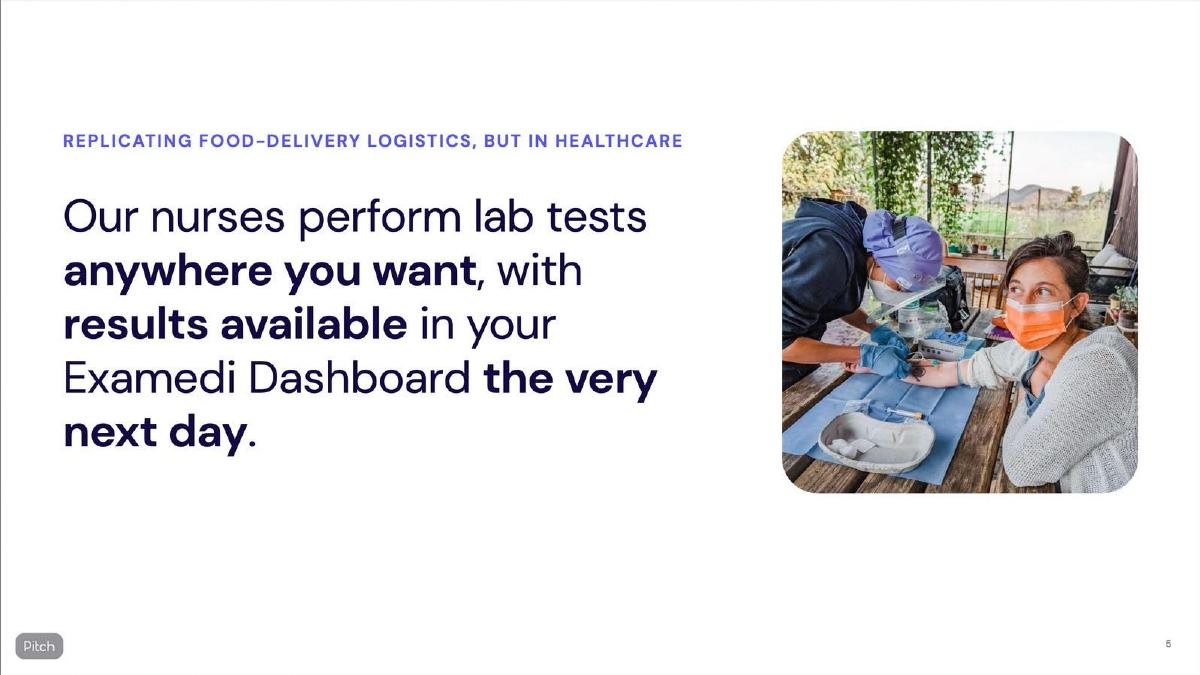
- Examedi positions its core service as at-home lab tests with results delivered via a dashboard the next day on slide 5.
- The business model relies on a referral structure where doctors and insurance companies drive patient volume to Examedi, as shown on slide 7.
- The long-term vision is to build a 'healthcare super app' that integrates telehealth, lab tests, and digital pharmacy services on slide 9.
- The deck uses a 'logistics-first' analogy, explicitly stating they are 'replicating food-delivery logistics, but in healthcare' on slide 5.
- Specific pain points for nurses include being underpaid and high-stress, which Examedi aims to address through its platform on slide 3.
- The 'Ideal patient journey' outlined on slide 9 emphasizes patient control over the entire process from consultation to medicine delivery.
- The deck is remarkably brief at only 11 slides, focusing on market gaps and product vision rather than dense data tables.
Examedi: The Logistics-First Approach to LATAM Healthcare
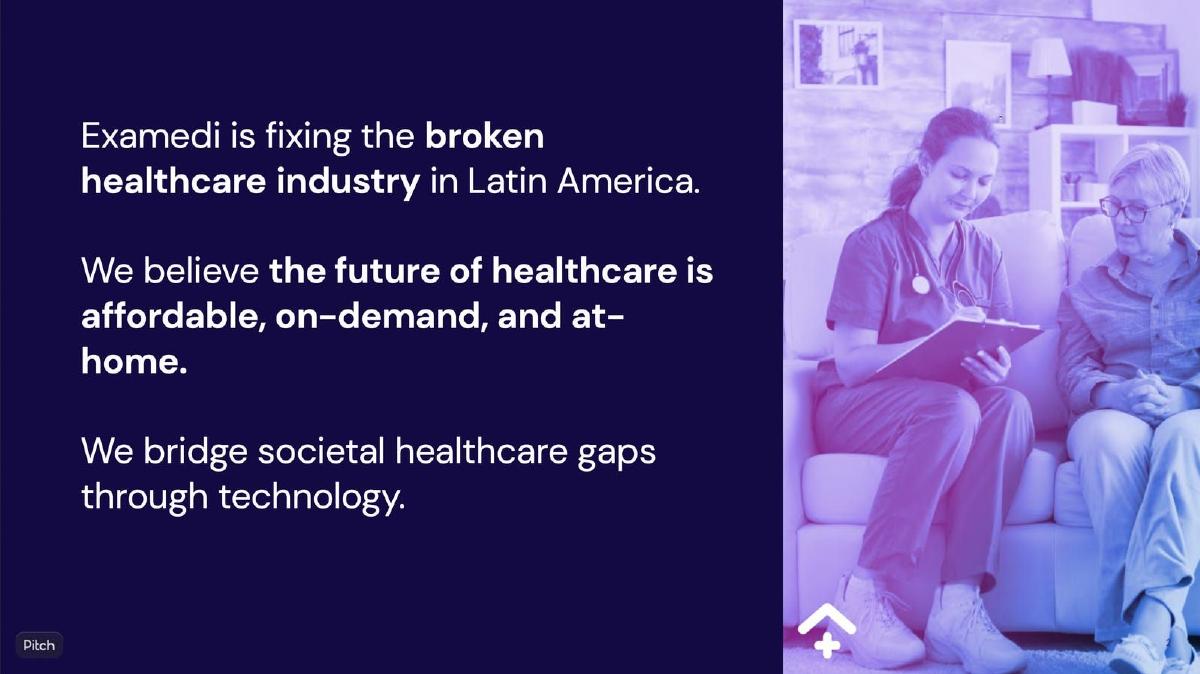
Examedi’s Series A pitch deck, which reportedly helped secure $17M in 2022, is a lean 11-slide presentation that prioritizes market narrative over data density. Operating in South America, the company focuses on the logistical friction inherent in traditional healthcare systems. The deck is structured to move the investor from the current 'unfair experience' to a future where Examedi is the central 'super app' for all medical needs.
Slide 1: Executive Summary
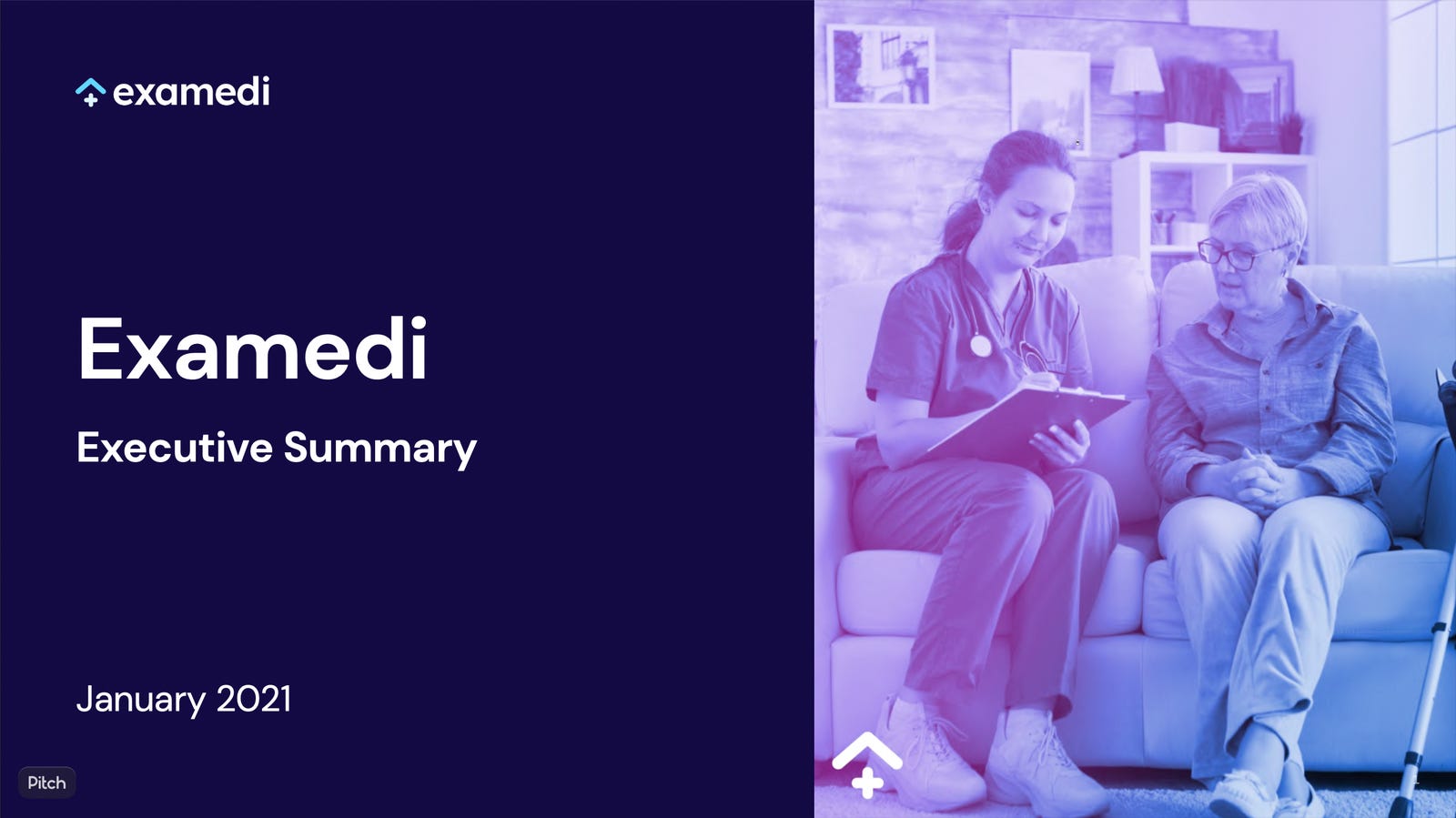
The title slide is minimalist, featuring the Examedi logo and the subtitle 'Executive Summary.' It is dated January 2021. The imagery on the right shows a healthcare professional in a home setting with an elderly patient, immediately signaling the company’s focus on at-home care and the human element of their service.
Slide 2: The Problem Context
While the text for slide 2 is not visually detailed in the provided images, the narrative flow suggests it sets the stage for the specific market failures detailed in the following slide. In a deck of this length, the second slide usually establishes the scale of the Latin American healthcare market to justify the 'Series A' ask.
Slide 3: The Fragmented Market
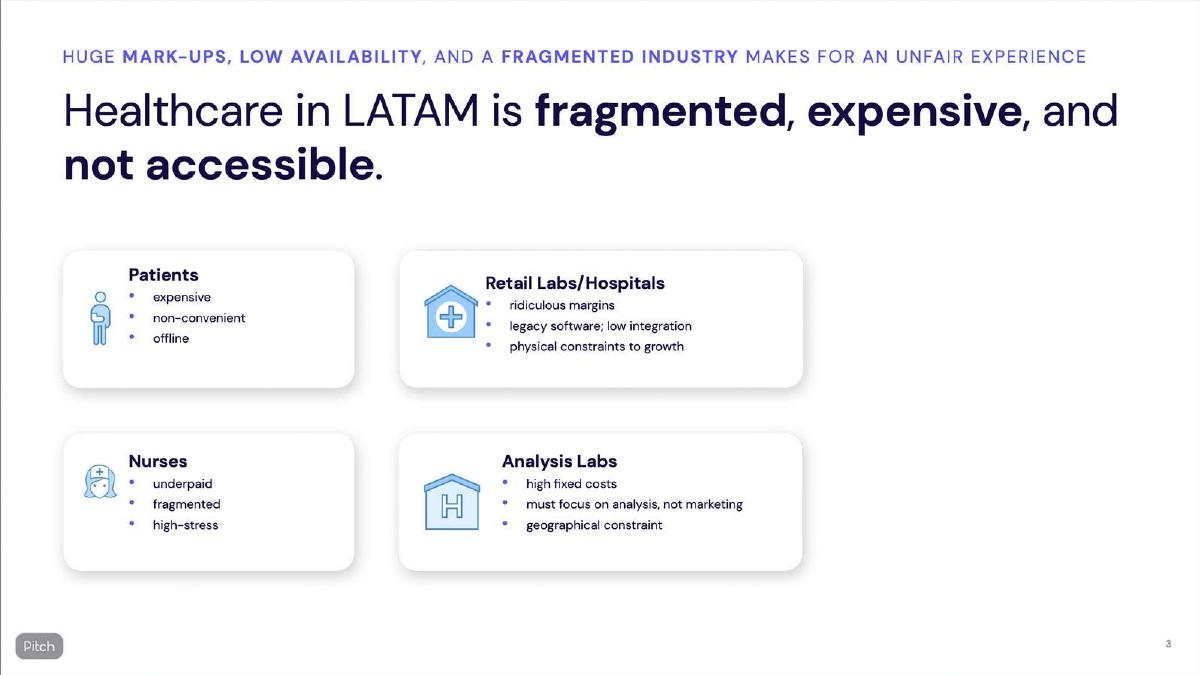
This is one of the most critical slides in the deck. It breaks down the 'unfair experience' into four quadrants: Patients, Retail Labs/Hospitals, Nurses, and Analysis Labs. Patients are described as facing 'expensive' and 'non-convenient' offline services. Retail Labs are criticized for 'ridiculous margins' and 'legacy software.' Nurses are identified as 'underpaid' and 'high-stress.' Finally, Analysis Labs are noted for 'high fixed costs' and a need to focus on analysis rather than marketing. By identifying pain points for every stakeholder, Examedi positions itself as a platform that provides value to the entire ecosystem, not just the end consumer.
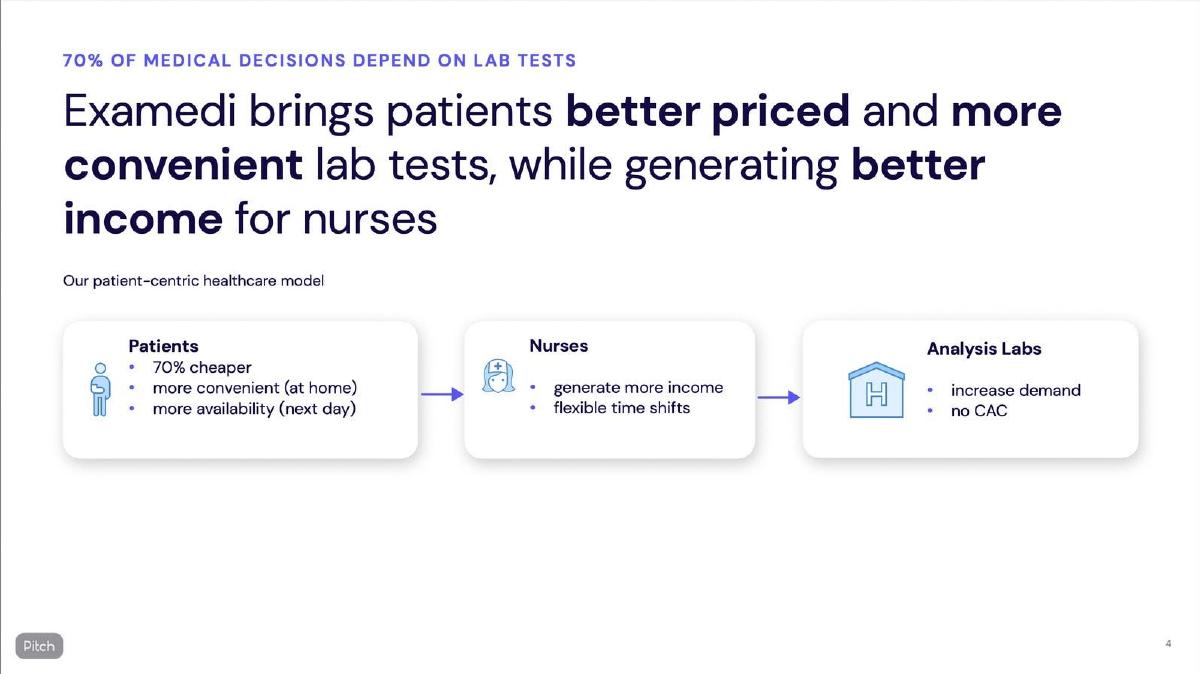
Slide 4: The Transition to Solution
Following the problem breakdown, slide 4 acts as a bridge. In the context of the deck's flow, this slide likely introduces the core concept of Examedi as the unifying layer that solves the fragmentation mentioned on the previous slide.
Slide 5: The Core Product - At-Home Lab Tests
Slide 5 contains the company's 'Aha!' moment. It uses a powerful analogy: 'REPLICATING FOOD-DELIVERY LOGISTICS, BUT IN HEALTHCARE.' This tells the investor exactly what the operational model is—a gig-economy or highly optimized logistics fleet for medical professionals. The slide promises that nurses will perform tests 'anywhere you want' and that results will be available in the 'Examedi Dashboard the very next day.' The accompanying photo shows a nurse drawing blood from a patient at an outdoor table, emphasizing the 'anywhere' aspect of the service.
Slide 6: Operational Depth
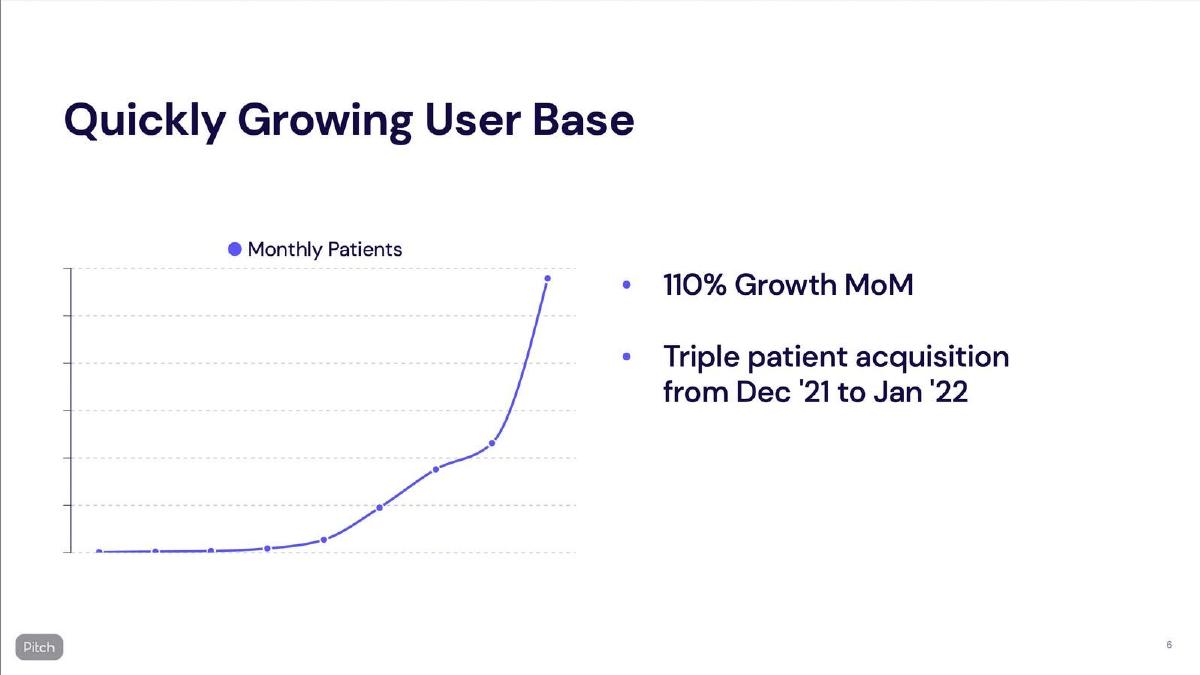
Slide 6 likely elaborates on the technology or the logistics engine that allows for the 'next day' results promised on slide 5. In healthcare, the 'last mile' of sample transport is often where speed is lost; this slide would be the place to address how Examedi overcomes those hurdles.
Slide 7: The Referral Ecosystem
On slide 7, the deck addresses customer acquisition costs (CAC) and defensibility. Under the heading 'LEVERAGING PROVIDER-PATIENT RELATIONSHIPS TO CREATE NETWORK EFFECTS,' it shows how Doctors and Insurance companies feed into the Examedi platform. Doctors refer patients because they need 'lab tests done quickly and at an affordable price.' Insurance companies refer patients because they want to 'reimburse as little as possible' and need the convenience to ensure customers actually get their blood tests done. This slide proves that Examedi isn't just a D2C play; it is an integrated part of the existing medical referral chain.
Slide 8: Scaling the Model
Slide 8 likely discusses the geographic expansion or the scaling of the nurse network. For a logistics-heavy business, showing how the model moves from one city to a continent is vital for a Series A round.
Slide 9: The Healthcare Super App Vision
This slide represents the 'upside' for investors. It states, 'We are building the healthcare super app for LATAM.' It maps out a journey from Telehealth to Lab Tests to Digital Pharmacy . The 'Ideal patient journey' listed includes talking to a doctor, booking the test, getting results, and having medicine delivered. This transition from a single-service provider (lab tests) to a full-stack healthcare platform is a classic venture capital narrative designed to increase the Total Addressable Market (TAM).
Slide 10: The Path Forward
Slide 10 typically contains the roadmap or the 'Ask.' While the text provided is minimal, this is where a founder would usually detail how the $17M would be deployed—likely into technology development and market expansion into new Latin American territories.
Slide 11: Conclusion
The deck ends with a simple 'Thanks' and the company URL. It maintains the clean, dark-blue branding seen throughout the presentation.
What Works in the Examedi Deck
The Logistics Analogy: By comparing themselves to food delivery logistics on slide 5, Examedi bypasses the need for complex medical jargon. Investors immediately understand the operational requirements: a mobile workforce, a routing engine, and a customer-facing app. This makes a complex healthcare problem feel like a solvable logistics problem.
Multi-Stakeholder Value: Slide 3 is excellent because it doesn't just focus on the patient. By highlighting that nurses are underpaid and analysis labs lack marketing expertise, Examedi shows it is building a marketplace that solves problems for the supply side as well. This is crucial for long-term sustainability in a service-based business.
Strategic B2B2C: Slide 7 shows a sophisticated understanding of the healthcare industry. Relying solely on social media ads to get people to buy blood tests is expensive. By tapping into doctors and insurance companies—who are already incentivized to have these tests performed—Examedi demonstrates a low-CAC growth engine.
What is Missing from the Examedi Deck
Unit Economics: For a Series A deck, the absence of unit economics (in the provided slides) is a significant omission. Investors in 2022 were increasingly focused on contribution margins. The deck does not explicitly state the cost of a nurse visit versus the revenue generated per test, nor does it mention the take-rate from the analysis labs.
Competitive Landscape: The deck claims the industry is 'fragmented' on slide 3, but it does not name specific competitors or explain why a traditional hospital group couldn't simply launch their own mobile nurse unit. A slide showing the competitive moat—whether it is the proprietary routing software or the depth of the insurance integrations—would have strengthened the case.
Team Background: There is no team slide in the 11-slide sequence. In healthcare, 'founder-market fit' is essential. Investors want to know if the founders have backgrounds in logistics, medicine, or Latin American regulatory environments. Without this, the deck relies entirely on the strength of the business model and the market opportunity.
Lessons for Founders
Start with a Wedge: Examedi doesn't try to be a 'super app' on day one. They start with lab tests—a high-frequency, high-friction necessity. Founders should follow this 'wedge' strategy: solve one specific, painful problem exceptionally well before pitching the broader ecosystem expansion shown on slide 9.
Visual Simplicity: This deck uses very little text. It relies on clear headings and simple diagrams (like the referral structure on slide 7). If your business model is complex, your slides should be simple. Use the 'one idea per slide' rule to ensure the investor doesn't get lost in the details.
Identify the 'Unfairness': The phrase 'unfair experience' on slide 3 is a powerful emotional hook. It frames the market problem not just as an inefficiency, but as a systemic failure that needs to be corrected. Framing your problem as an 'injustice' to the consumer can create a more compelling narrative than simply calling it a 'market gap.'
Frequently asked questions
- What is Examedi's primary value proposition for patients?
- According to slide 3, patients currently face expensive, non-convenient, and offline healthcare experiences. Examedi solves this by offering at-home lab tests where results are available digitally the very next day, as stated on slide 5. This shifts the experience from a physical, fragmented process to a convenient, digital-first dashboard.
- How does Examedi plan to acquire customers at scale?
- Slide 7 details a B2B2C referral strategy. Examedi leverages existing relationships by having doctors (who need quick, affordable tests) and insurance companies (who want to minimize reimbursement costs) refer patients directly to the Examedi platform. This creates a network effect through established healthcare providers.
- What is the 'Healthcare Super App' mentioned in the deck?
- Slide 9 outlines a three-step ecosystem: Telehealth, Lab Tests, and Digital Pharmacy. The goal is to own the entire patient journey, allowing a user to talk to a doctor, book a test, receive results, and have medicine delivered to their door, all within a single integrated application.
- What specific market problems does the deck highlight for labs?
- Slide 3 differentiates between 'Retail Labs' and 'Analysis Labs.' Retail labs suffer from ridiculous margins, legacy software, and physical constraints. Analysis labs face high fixed costs and geographical constraints, and they struggle because they must focus on analysis rather than marketing. Examedi acts as the bridge for these entities.
- Does the deck include financial projections or a team slide?
- No. Based on the 11 slides provided, there are no financial projections, unit economics, or team biographies included. The deck focuses almost entirely on the market problem, the logistics-based solution, the referral ecosystem, and the future product roadmap.