Front raised $10M in 2016 with a 21-slide deck that prioritizes data over narrative fluff. The deck is notable for its extreme transparency, featuring a detailed MRR retention cohort table and a breakdown of capital efficiency that showed they spent only $1.3M to reach $1.4M in ARR. By positioning themselves as the 'external communication' equivalent to Slack's internal dominance, Front successfully framed a clear market opportunity. The deck avoids traditional marketing jargon, instead focusing on high-signal metrics like negative net MRR churn and a 5.4x MRR growth rate over 12 months. This…
Key takeaways
- The deck highlights a 5.4x MRR growth over the 12 months leading up to March 2016 (Slide 8).
- Front demonstrates negative net MRR churn, a critical indicator of SaaS health (Slide 9).
- A full cohort analysis table is included, showing MRR retention relative to starting months, even highlighting anomalies like a 'Stripe error' (Slide 13).
- The company proved capital efficiency by spending $1.3M to reach $1.4M in ARR over 18 months (Slide 14).
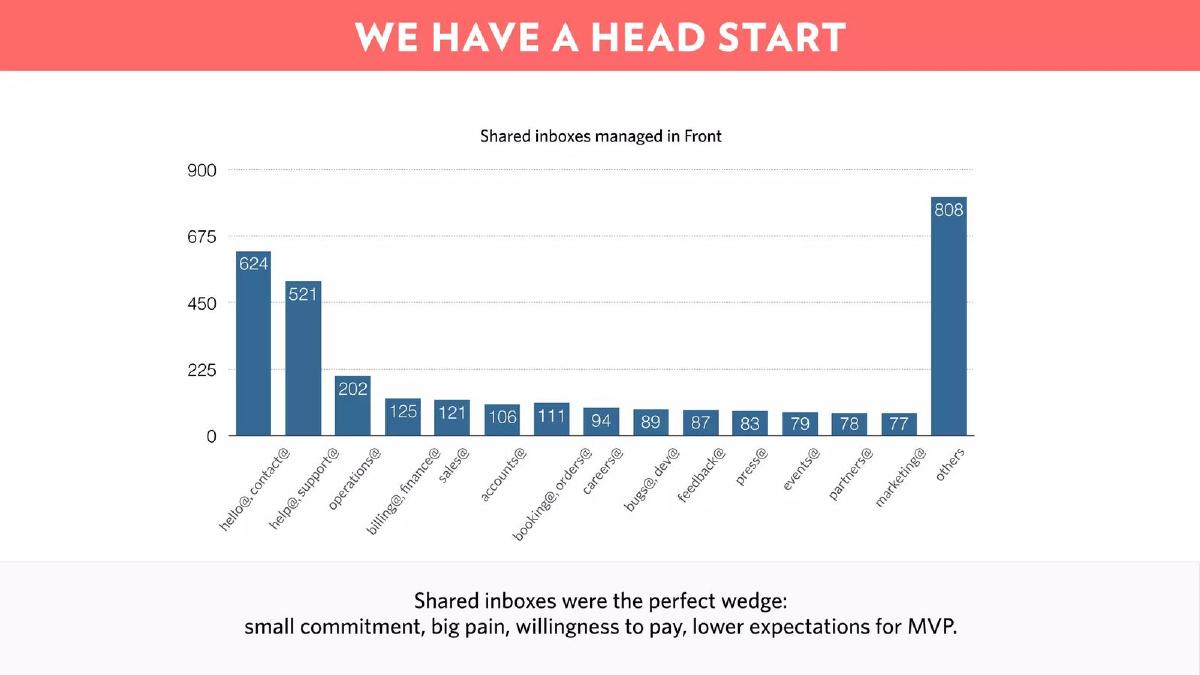
- The 'shared inbox' is identified as the primary wedge, with 'hello@' and 'help@' being the most common use cases (Slide 5).
- Front explicitly compares its market opportunity to Slack, aiming to own 'external communications' while Slack owns internal (Slide 20).
- The team slide emphasizes 'unfair access' to French engineering talent and hires from Box and Dropbox (Slide 16).
- The deck lists specific committed investors for the Series A, including Stewart Butterfield and Eoghan McCabe (Slide 19).
Introduction: The Data-Driven Series A
Front’s 2016 Series A pitch deck is a seminal document in the SaaS world. At a time when many decks relied on visionary storytelling, Front co-founder Mathilde Collin opted for a presentation built almost entirely on transparency and hard metrics. The deck, which secured $10M, serves as a blueprint for how to demonstrate product-market fit through cohort data and capital efficiency. It doesn't just claim growth; it proves the quality of that growth through granular retention tables and unit economics.
The Problem and Solution (Slides 1-3)
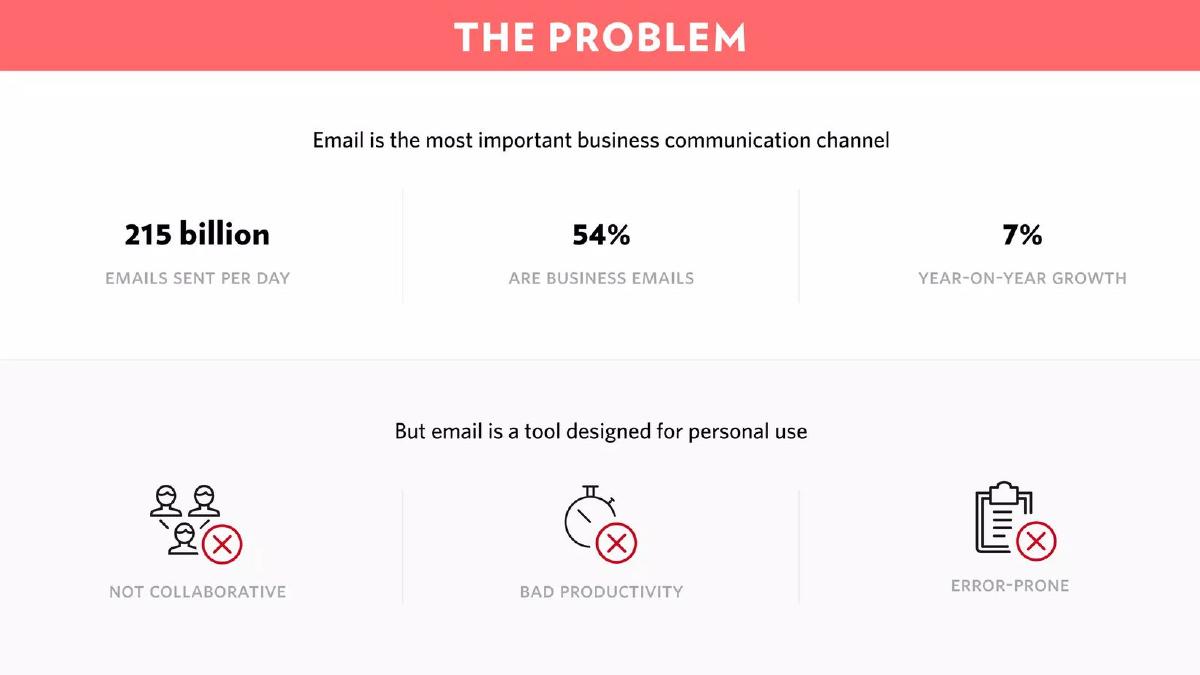
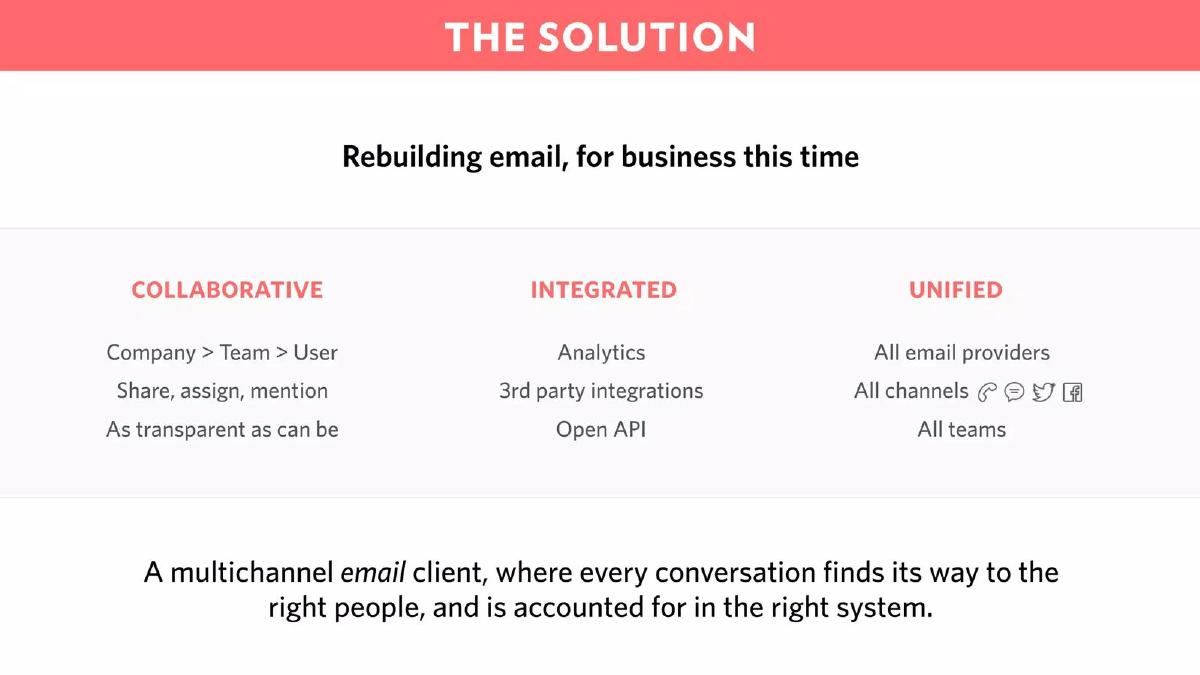
Slide 1 introduces the company with a simple tagline: "All your company’s external communications in one collaborative inbox." This immediately sets the stage for a utility-first product. Slide 2, "The Problem," uses high-level statistics to validate the market size: 215 billion emails sent per day , with 54% being business emails . It identifies three core failures of traditional email for business: it is not collaborative, it results in bad productivity, and it is error-prone. Slide 3 presents the solution as "Rebuilding email, for business this time." It categorizes the value proposition into three pillars: Collaborative (share, assign, mention), Integrated (analytics, API), and Unified (all channels like Twitter, Facebook, and email in one place).
Market Positioning and The Wedge (Slides 4-5)
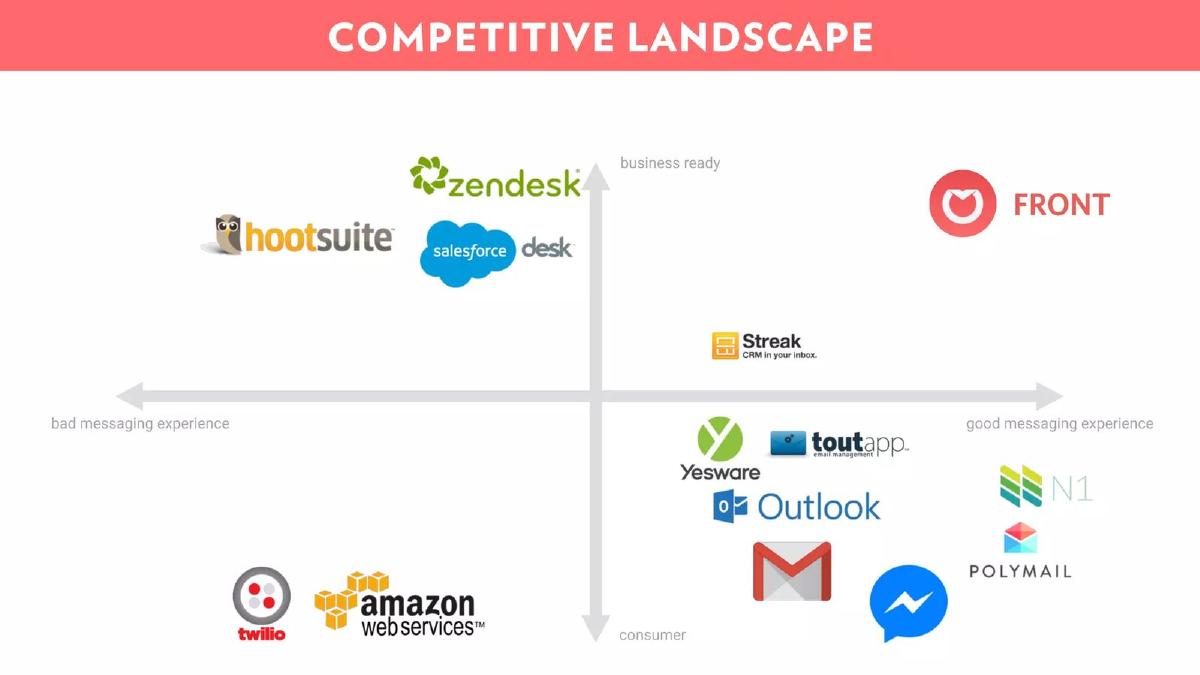
Slide 4, "Competitive Landscape," uses a standard 2x2 matrix. Front positions itself in the top-right quadrant, balancing a "good messaging experience" with being "business ready." It places incumbents like Zendesk and Salesforce Desk in the "bad messaging experience" category, while Gmail and Outlook are labeled as "consumer" tools. Slide 5 is perhaps the most strategic in the deck. Titled "We Have a Head Start," it shows a bar chart of shared inboxes managed in Front. The highest volumes are in "hello@, contact@" (624) and "help@, support@" (521) . The slide explicitly states that shared inboxes were the "perfect wedge" because they represent a small commitment but solve a big pain point with lower expectations for an MVP.
Traction and Social Proof (Slides 6-7)
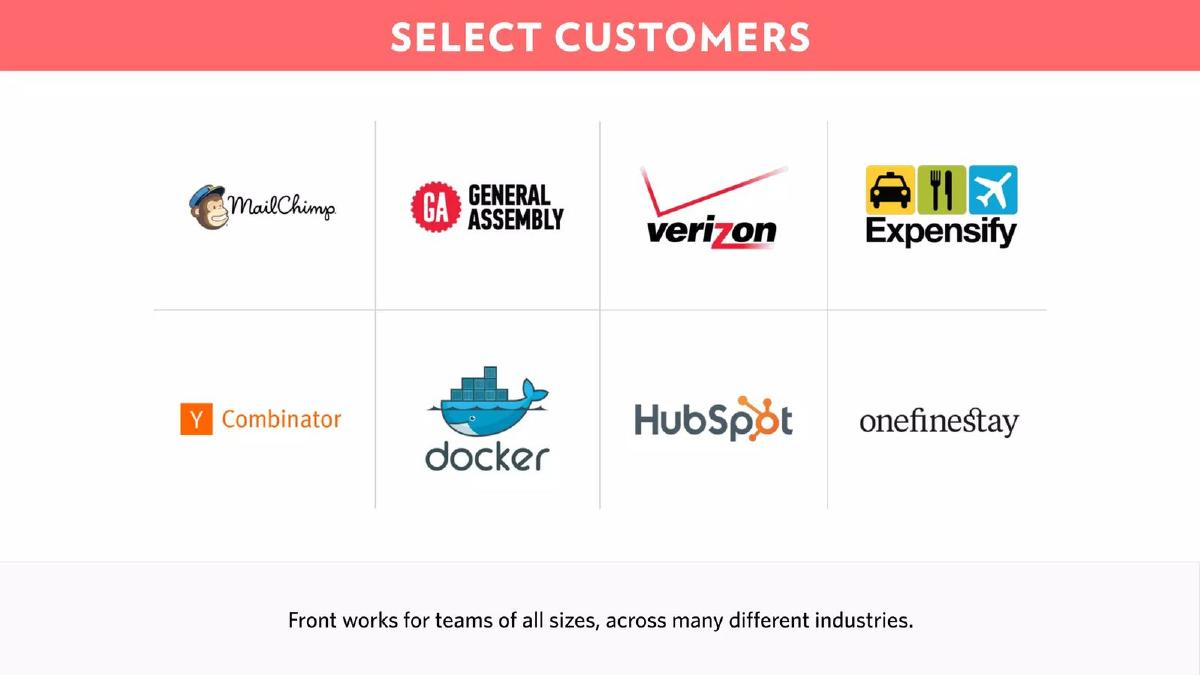
Slide 6 lists "Select Customers," featuring recognizable logos like MailChimp, Verizon, Expensify, Y Combinator, and HubSpot . This provides the necessary enterprise and startup credibility. Slide 7, "Customers are Very Satisfied," offers four testimonials. Notably, one quote from Baroo (a 20-seat customer) states, "Wouldn’t go back to Gmail if you paid me." These quotes emphasize the user experience and the stickiness of the product across different team sizes.
The Core Metrics: Growth and Churn (Slides 8-9)
Slide 8, "Consistent Organic Growth," is a dual-axis chart showing MRR and the number of companies using the platform. The headline metric is that "MRR grew 5.4 times in the past 12 months" (from March 2015 to March 2016). The chart shows MRR climbing toward the $120,000 mark. Slide 9, "Low Churn," is a critical slide for any SaaS investor. It tracks User Churn, MRR Churn, and Net MRR Churn. The deck reports "~3% monthly user churn" and, most importantly, "negative net MRR churn." Negative churn indicates that expansion revenue from existing customers is outpacing the lost revenue from departing customers, a hallmark of a healthy SaaS business.
Operational Focus and Acquisition (Slides 10-12)
Slide 11, "The Product Comes First," highlights the company's lean, engineering-heavy culture. It states that "60% of payroll = Engineering" and that they have "Support agents = 0," implying the product is intuitive enough or the team is technical enough to handle support without dedicated heads. Slide 12 breaks down "Acquisition Channels" into three buckets. Organic Growth accounted for 70% of 2015 leads . The Sales bucket shows 40 qualified demos per month per SDR and a 28% post-demo conversion . The Marketing bucket mentions a content playbook and paid acquisition unit economics, signaling that the company has identified repeatable strategies to scale.
The Transparency Peak: Cohorts and Efficiency (Slides 13-14)
Slide 13 is the famous "We Land and Expand" cohort table. It shows the percentage of MRR retained relative to the starting month for 22 months of data. The table is color-coded, with most cells exceeding 100%, proving expansion. Front is honest about its failures, pointing out a "Stripe error" that caused a dip to 57% retention in October 2014 and the "Homejoy shutdown" affecting later cohorts. Slide 14, "We’ve Been Capital Efficient," is a masterclass in Series A reporting. It states they spent $1.3M to reach $1.4M in ARR , had $1.8M left from their seed round, and were burning only $90k per month . They projected being profitable in just five months.
The Team and Roadmap (Slides 15-18)
Slide 16, "The Right Mix of Passion and Experience," introduces Mathilde Collin and Laurent Perrin, both with Y Combinator and prestigious French educational backgrounds (HEC Paris and École Polytechnique). They highlight an "unfair access to pool of excellent French engineers" and key hires from Box and Dropbox . Slide 17 provides a detailed "Product Roadmap" through Q3 of the following year, including new platforms (Android, iPad, Native Mac App), integrations (HubSpot, Salesforce, Slack), and enterprise features like SSO, SLAs, and Advanced Reporting . Slide 18, "Projections," shows a chart of expenses versus revenue, projecting an ARR of $3M in 2016 and $10M in 2017 , with headcount growing from 39 to 53.
The Ask and The Vision (Slides 19-21)
Slide 19, "Funding," details the $3.1M Seed round led by Softtech VC and the current $10M Series A . It lists committed investors like Stewart Butterfield (Slack) and Eoghan McCabe (Intercom) . Slide 20, "The Opportunity," frames the ultimate vision. It acknowledges that Slack proved businesses will buy communication tools for internal use, but asserts that "Front will own the external communications space," which they claim is the "bigger opportunity." The deck concludes on Slide 21 with a simple "Thanks."
What Works in This Deck
Radical Transparency: The inclusion of the full cohort table (Slide 13) is the deck's strongest asset. By showing every month of data and explaining the anomalies, Front builds immediate trust. It moves the conversation from "Do you have product-market fit?" to "How fast can we scale this?"
Capital Efficiency as a Feature: Most Series A decks focus on how they will spend the money. Front focuses on how well they have already spent it. Showing a 1:1 ratio of spend to ARR (Slide 14) proves the founders are disciplined stewards of capital, which is highly attractive to VCs.
The Slack Comparison: By positioning themselves as the "external" version of Slack (Slide 20), Front piggybacks on a massive success story that investors already understood. It provides a clear mental model for the company's potential scale without needing to explain the entire category from scratch.
What is Missing
Detailed Market Sizing (TAM): While the deck mentions the number of emails sent daily, it lacks a formal Total Addressable Market (TAM) calculation in dollars. It assumes the investor agrees that the "external communications space" is a multi-billion dollar opportunity based on the Slack comparison.
Unit Economics (LTV/CAC): While Slide 12 mentions "paid acq. unit economics," the deck does not explicitly state the Customer Acquisition Cost (CAC) or the Lifetime Value (LTV) of a customer. Given the negative churn, the LTV is likely high, but the specific ratios are omitted.
Competitive Depth: The 2x2 matrix (Slide 4) is quite simplified. It doesn't address how Front will defend against incumbents like Zendesk if they decide to improve their messaging experience, or how they compete with other emerging shared inbox tools that were appearing at the time.
What a Founder Should Copy
The Cohort Table: If your retention is good, show the raw table. Averages can hide churn issues; a cohort table proves that your oldest customers are still paying (and ideally paying more). It is the highest-signal slide a SaaS founder can produce.
The Wedge Explanation: Clearly identifying your "wedge" (Slide 5) shows that you understand how to enter a crowded market. Don't just say you are a communication platform; say you are the tool for "hello@" aliases that eventually becomes the communication platform.
Efficiency Metrics: In a tighter funding environment, the "Capital Efficient" slide (Slide 14) is more relevant than ever. Tracking and reporting your burn-to-ARR ratio demonstrates operational maturity that sets you apart from founders who only focus on top-line growth.
Social Proof from Peers: Listing committed investors who are CEOs of complementary companies (Slide 19) is incredibly powerful. Having the CEOs of Slack and Intercom back a communication tool is a stronger signal than almost any VC brand name could provide.
Frequently asked questions
- What makes Front's cohort analysis slide so effective?
- Slide 13 is effective because it doesn't hide behind averages. By showing the 'Percentage of MRR retained relative to starting month' for every month since June 2014, Front proves that their customers not only stay but spend more over time (expansion revenue). They even include notes on negative outliers, such as a 'Stripe error' and the 'Homejoy shutdown,' which builds immense trust with investors through radical honesty.
- How does Front define its competitive advantage against giants like Google and Microsoft?
- Front uses a 2x2 matrix on Slide 4 to position itself. While Gmail and Outlook are categorized as having a 'good messaging experience' but being 'consumer' focused, and Zendesk/Salesforce are 'business ready' but have a 'bad messaging experience,' Front claims the top-right quadrant: a tool that is both business-ready and provides a high-quality messaging experience.
- What was Front's 'wedge' strategy mentioned in the deck?
- On Slide 5, Front identifies 'shared inboxes' as their perfect wedge. They argue that shared email addresses (like contact@ or support@) represent a 'small commitment' but 'big pain' for companies. By solving this specific, high-frequency problem first, they gained a foothold in organizations with lower expectations for an MVP, allowing them to expand into broader communication workflows later.
- How did Front demonstrate capital efficiency to Series A investors?
- Slide 14 is a dedicated 'Capital Efficient' slide. It states they spent $1.3M in 18 months to reach $1.4M in ARR, essentially achieving a 1:1 ratio of burn to recurring revenue. With $1.8M left from their seed round and a monthly burn of only $90k, they were able to show they were only five months away from profitability, reducing the perceived risk for new investors.
- Who were the key team members and investors highlighted in this round?
- Slide 16 features co-founders Mathilde Collin (CEO) and Laurent Perrin (CTO), both Y Combinator alumni. They also highlight heads of Sales and Customer Success from Box and Dropbox. Slide 19 notes that the $10M round already had commitments from Stewart Butterfield (Slack CEO) and Eoghan McCabe (Intercom CEO), providing strong social proof from leaders in the communication space.