Frontegg's Series A deck is a highly technical yet accessible presentation that successfully argues for the necessity of 'Full-Stack User Management' in the Product-Led Growth (PLG) era. By dedicating six slides to a detailed breakdown of Slack's user interface—expressly stating Slack is not a customer but a gold standard—Frontegg creates a tangible target for their product's capabilities. The deck highlights a 10x growth in product adoption and a team of 25 members, providing the necessary social proof and execution signals. While it lacks a traditional competitor matrix and specific financi…
Key takeaways
- The deck defines a new category, 'Full-Stack User Management,' to differentiate from simple authentication providers (Slide 2).
- Frontegg uses Slack as a benchmark for modern user management, dedicating slides 6 through 11 to analyze Slack's UI as the ideal end-state for their customers.
- The platform is positioned as developer-first, showcasing code snippets and compatibility with React, Angular, Vue, Node, and Django (Slide 13).
- Traction is evidenced by a 10x growth in product adoption and self-serve signups (Slide 17).
- The business model uses a tenant-based pricing structure with three tiers: Basic, Growth, and Enterprise (Slide 16).
- The deck highlights high-profile use cases including Medigate and Kovrr, noting one customer processes billions of dollars monthly (Slide 15).
- A significant omission is a dedicated 'Team' slide featuring founder backgrounds, though Slide 17 mentions a team size of 25.
- The 'Ask' and specific use of funds are not detailed within the slides, though the round size is known to be $25M from external records.
The Product-Led Infrastructure Narrative
Frontegg's Series A deck, dated July 2021, is a masterclass in narrative-driven fundraising for developer tools. At a time when Product-Led Growth (PLG) was becoming the dominant SaaS strategy, Frontegg positioned itself not just as a tool, but as the essential infrastructure for that era. The deck consists of 20 slides that move from a high-level market shift to a granular product deep-dive, using a unique benchmarking strategy to prove value.
Slides 1-2: The Hook and Category Definition
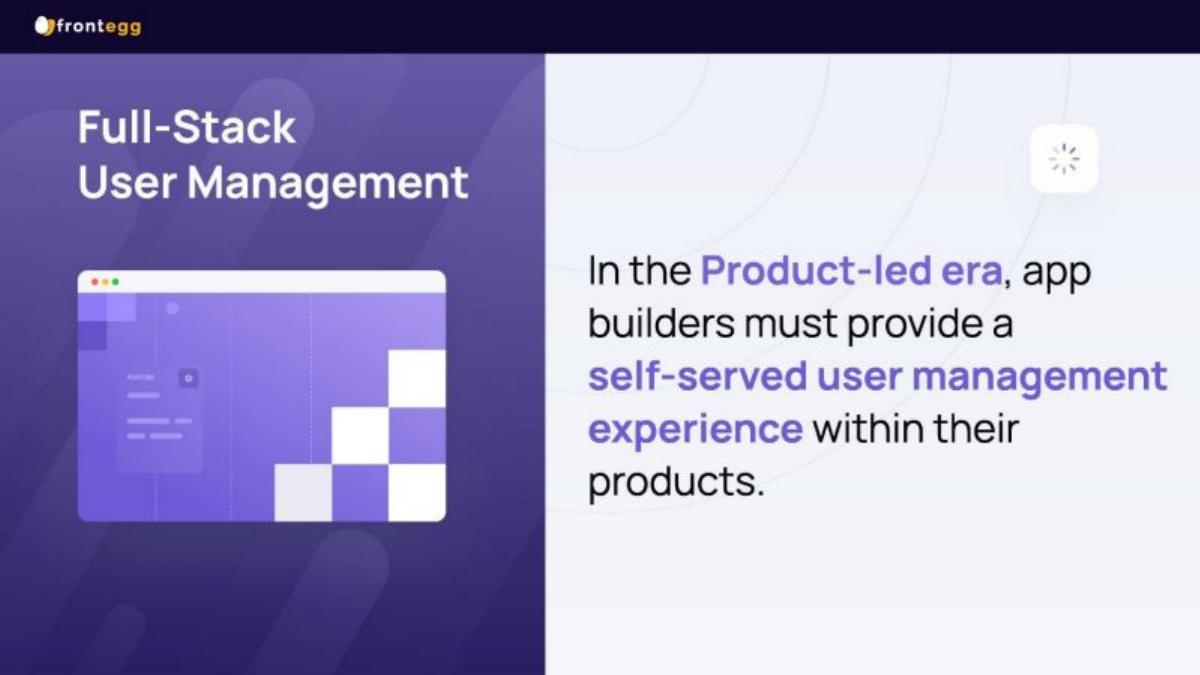
The deck opens with a clear, minimalist title slide: "User Management for the Product-Led Era" (Slide 1). This immediately signals that the company is riding a specific market trend. Slide 2 introduces the term "Full-Stack User Management," which is their attempt to own a new category. The core thesis is presented plainly: in the PLG era, builders must provide a self-served user management experience within their products. This moves the conversation beyond simple 'login' and into the broader user experience.
Slides 3-5: The Problem Expansion
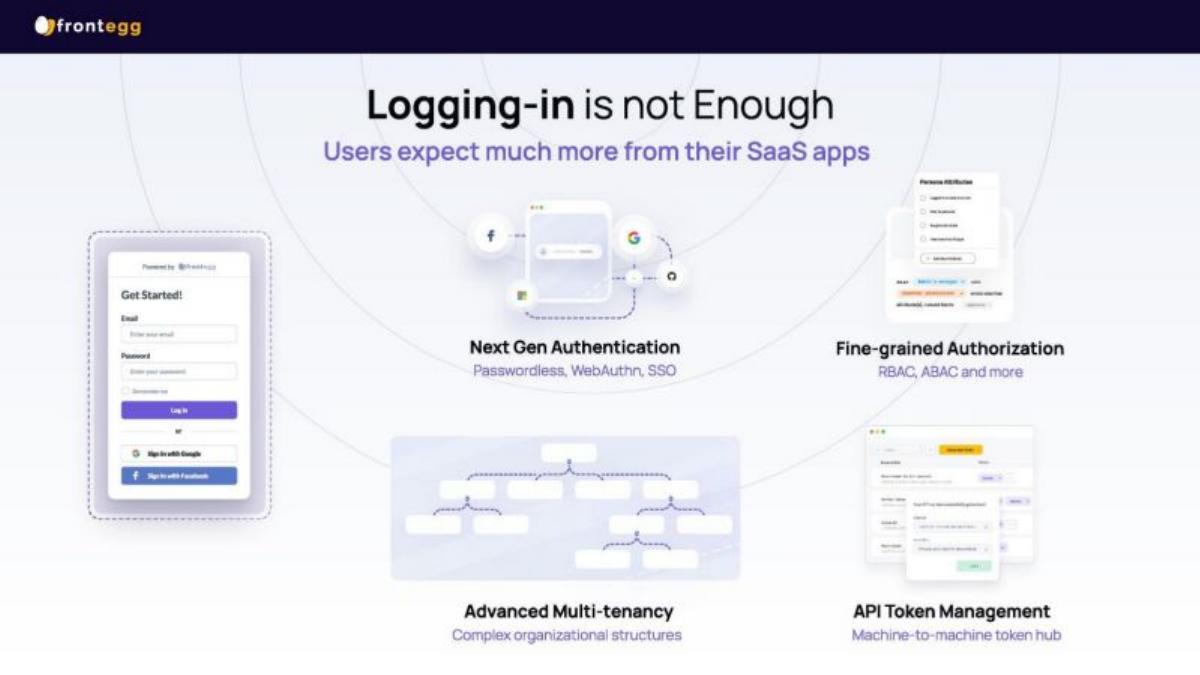
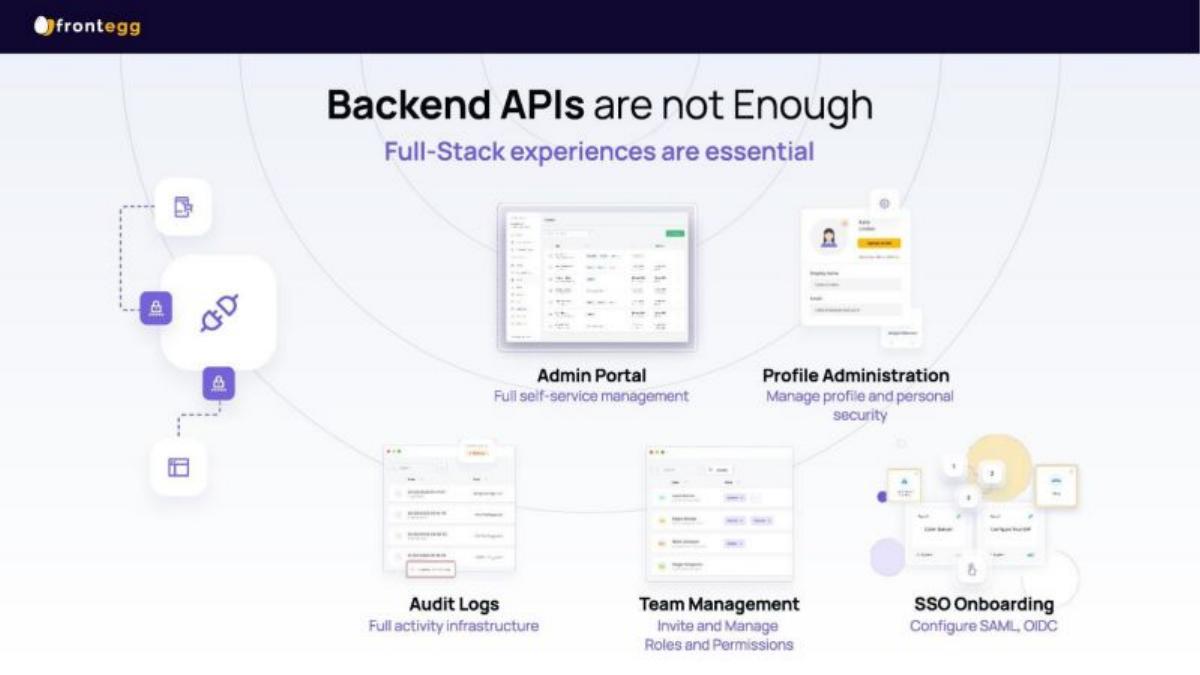
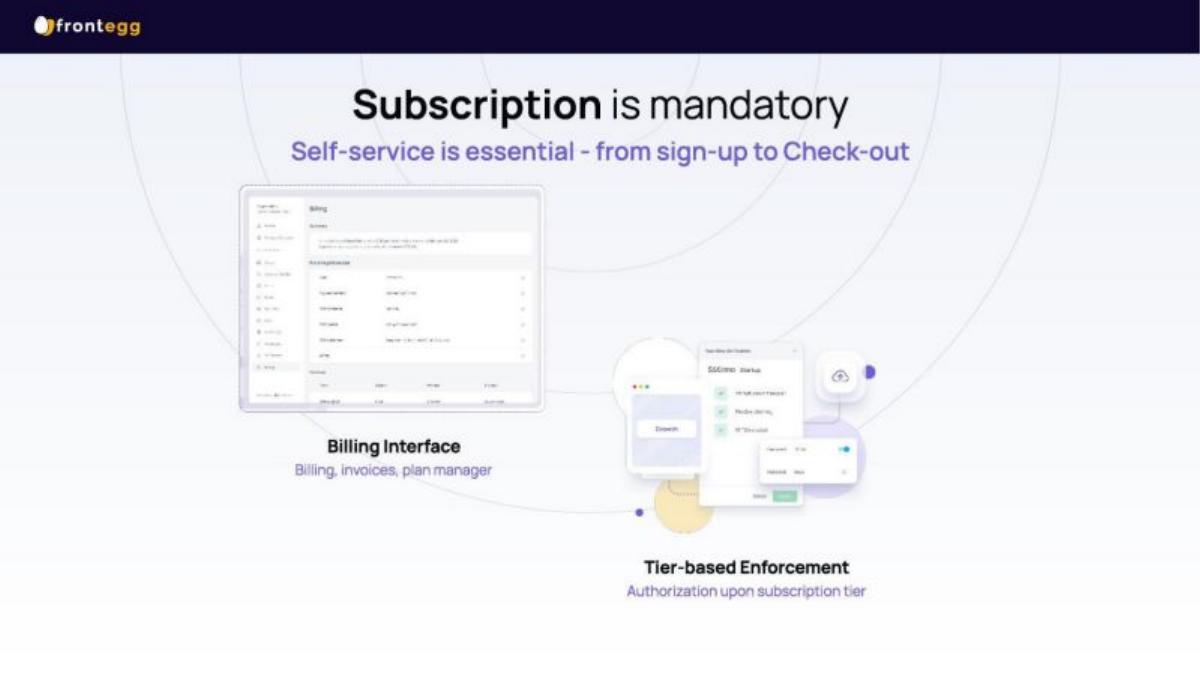
Frontegg uses these slides to expand the scope of the problem they solve. Slide 3, titled "Logging-in is not Enough," lists advanced requirements like Next Gen Authentication (Passwordless, WebAuthn), Fine-grained Authorization (RBAC, ABAC), and Multi-tenancy. Slide 4, "Backend APIs are not Enough," argues that developers need pre-built UI components like Admin Portals and Audit Logs, not just endpoints. Slide 5 completes the trifecta by stating "Subscription is mandatory," linking user management directly to billing and revenue enforcement. This sequence effectively tells the investor: "The problem is much bigger than you think, and existing solutions only solve 20% of it."
Slides 6-11: The Slack Benchmark Strategy
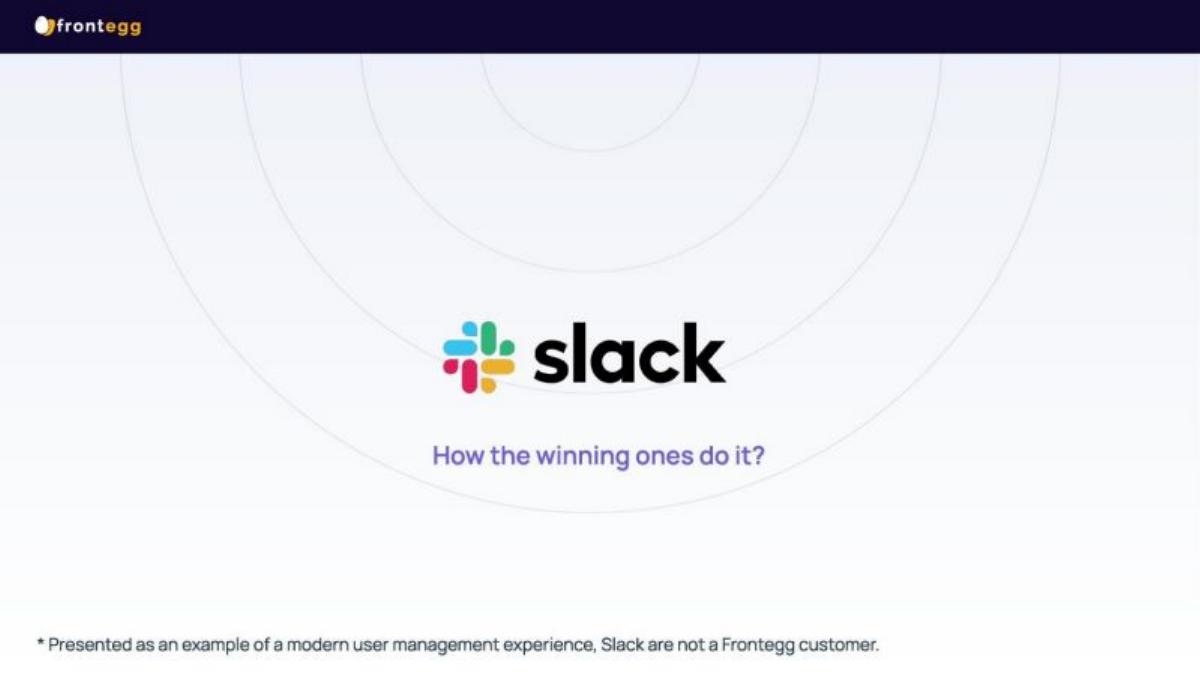
This is the most unconventional part of the deck. Frontegg spends six slides (30% of the deck) analyzing Slack's user interface. Slide 6 asks, "How the winning ones do it?" and includes a disclaimer that Slack is not a customer. They then walk through Slack's Sign-in (Slide 7), Profile Management (Slide 8), Team Management (Slide 9), Security Policy (Slide 10), and Billing (Slide 11). By doing this, Frontegg creates a visual target. They are telling investors: "We enable every SaaS company to look and function as professionally as Slack without spending years building the plumbing." It is a clever way to demonstrate product value without showing their own (potentially less mature) UI at every step.
Slides 12-14: The Solution and Developer Experience
Slide 12, "The Product-Led Journey," summarizes the 'tons of work' required to become self-served, listing 14 different technical components. Slide 13 introduces the "Single Platform for Modern Apps," showcasing a code snippet to emphasize ease of integration. This slide is critical for a developer-first tool, as it lists compatibility with React, Angular, Vue, Node, Django, and .NET. Slide 14 provides a high-level visual of the "Next Generation of User Management," showing how their components sit within a customer's application.
Slides 15-17: Traction and Social Proof
Slide 15 covers "Customer Use-cases." While two names are blurred, they include Medigate and Kovrr. The metrics here are impressive: one customer processes "billions of dollars on a monthly basis" and another protects "billions of people worldwide." This proves the platform can handle enterprise-scale loads. Slide 16 outlines "Pricing Tiers" (Basic, Growth, Enterprise), showing a clear path to monetization through tenant-based pricing. Slide 17, "Accomplished so far," lists three key milestones: a stable release, a team of 25 members, and "10x growth of product adoption and self-serve signups."
Slides 18-20: The Future and Closing
Slide 18, "Plans for the near future," is relatively vague, mentioning establishing a management team and scaling the product. It lacks a specific roadmap or technical milestones, which is common in Series A decks where the focus is on scaling what already works. Slide 19 is a simple "Thank you" with a contact email, and Slide 20 is a promotional slide for the deck repository and does not contain company information.
What Works in this Deck
The Slack Comparison: Using a gold-standard industry leader as a benchmark is a brilliant way to communicate a complex value proposition. It makes the 'Full-Stack' claim tangible. · Developer-First Focus: Including code snippets and a list of supported frameworks (Slide 13) speaks directly to the technical due diligence investors will perform. · Problem Expansion: By linking user management to billing and security, they increase their perceived Total Addressable Market (TAM) and importance to the customer's stack. · Scale Metrics: Mentioning "billions of dollars" processed by customers (Slide 15) provides immediate credibility regarding the platform's reliability.
What is Missing
Team Slide: There is no slide dedicated to the founders' backgrounds or the expertise of the early team. While Slide 17 mentions 25 members, investors usually want to see the pedigree of the leadership at Series A. · Competitive Landscape: The deck ignores competitors like Auth0, Okta, or Stytch. A founder should usually address how they win against established players. · The Ask: There is no mention of how much they are raising or what the specific allocation of funds will be. While we know from the listing it was $25M, a standard pitch deck usually includes this. · Financial Projections: There are no charts showing revenue growth, burn rate, or future projections. The traction is described only in terms of "10x growth" in adoption.
Lessons for Founders
Define your own category: Don't just be 'better auth.' Be 'Full-Stack User Management.' Defining the category allows you to set the rules of the competition. · Use benchmarks wisely: If you are building infrastructure, show what the 'perfect' end-state looks like (like the Slack slides) to help investors visualize the value you provide to your customers' end-users. · Focus on the 'Mandatory': Slide 5 calls subscription billing 'mandatory.' Positioning your product as a 'must-have' rather than a 'nice-to-have' is essential for high-valuation rounds. · Keep it visual: The deck uses very little body text, relying instead on screenshots, icons, and bold headlines. This makes it easy to digest during a first pass by a VC associate.
Frequently asked questions
- What is Frontegg's core value proposition?
- Frontegg provides a full-stack user management platform designed for the product-led growth era. Unlike basic authentication services, it offers a complete self-service suite including an admin portal, team management, audit logs, and subscription billing interfaces. The goal is to allow SaaS companies to integrate complex, enterprise-grade user management features with a simple code snippet, saving months of internal development time.
- Why does the deck spend so much time on Slack?
- Frontegg uses Slack as a 'North Star' example of what great user management looks like. By walking through Slack's sign-in, profile management, and billing screens, they demonstrate the complexity required for a modern SaaS app. They explicitly state Slack is not a customer, but use the comparison to show that Frontegg allows any startup to offer a 'Slack-like' management experience out of the box.
- How does Frontegg handle competition in this deck?
- The deck does not include a traditional competitor grid (e.g., vs. Auth0 or Okta). Instead, it competes against the 'status quo' of internal development. Slides 3, 4, and 5 argue that 'Logging-in is not enough' and 'Backend APIs are not enough,' suggesting that existing solutions only solve a fraction of the total user management problem that modern PLG companies face.
- What metrics does Frontegg share to prove traction?
- Frontegg is relatively conservative with raw numbers in this public version of the deck. However, Slide 17 claims a 10x growth in product adoption and self-serve signups. Slide 15 also provides qualitative social proof by mentioning customers that process 'billions of dollars on a monthly basis' and protect 'billions of people worldwide,' emphasizing the scale and reliability of their infrastructure.
- What is missing from the Frontegg Series A deck?
- The deck lacks several standard components: a detailed team slide with bios, a specific financial 'Ask' slide, a competitor comparison matrix, and detailed unit economics (CAC/LTV). It focuses heavily on product vision and the 'Product-Led Journey,' which suggests the founders were leaning into a strong product-market fit narrative rather than a purely financial one for this round.