Front’s Series B pitch deck is notable for its extreme transparency and focus on operational excellence. Rather than relying on abstract vision, the deck uses 24 slides to demonstrate a highly predictable revenue engine. Key highlights include a 150% net retention rate at one year (Slide 13), a clear path to profitability within 10 months (Slide 15), and a sales team delivering above capacity (Slide 10). The deck successfully argues that Front is no longer just a 'shared email client' but a 'collaborative communication' hub. While it omits a traditional biographical team slide, it compensates…
Key takeaways
- The company reports a 150% net retention rate at the one-year mark, indicating significant expansion within existing accounts (Slide 13).
- Front claims to be 'default alive,' with a projection to reach profitability in 10 months based on current growth and hiring assumptions (Slide 15).
- Usage metrics show high stickiness, with users spending an average of 2.5 hours per day in the app and a 64% DAU/MAU ratio (Slide 18).
- The sales organization is demonstrated to be predictable, with actual sales exceeding sales capacity in Q3 2017 (Slide 10).
- Capital efficiency is a core theme, noting that $7m in cash remains from previous rounds with an 18-month runway (Slide 15).
- The product vision has evolved from a simple shared email tool to an integrated collaborative communication platform (Slide 5).
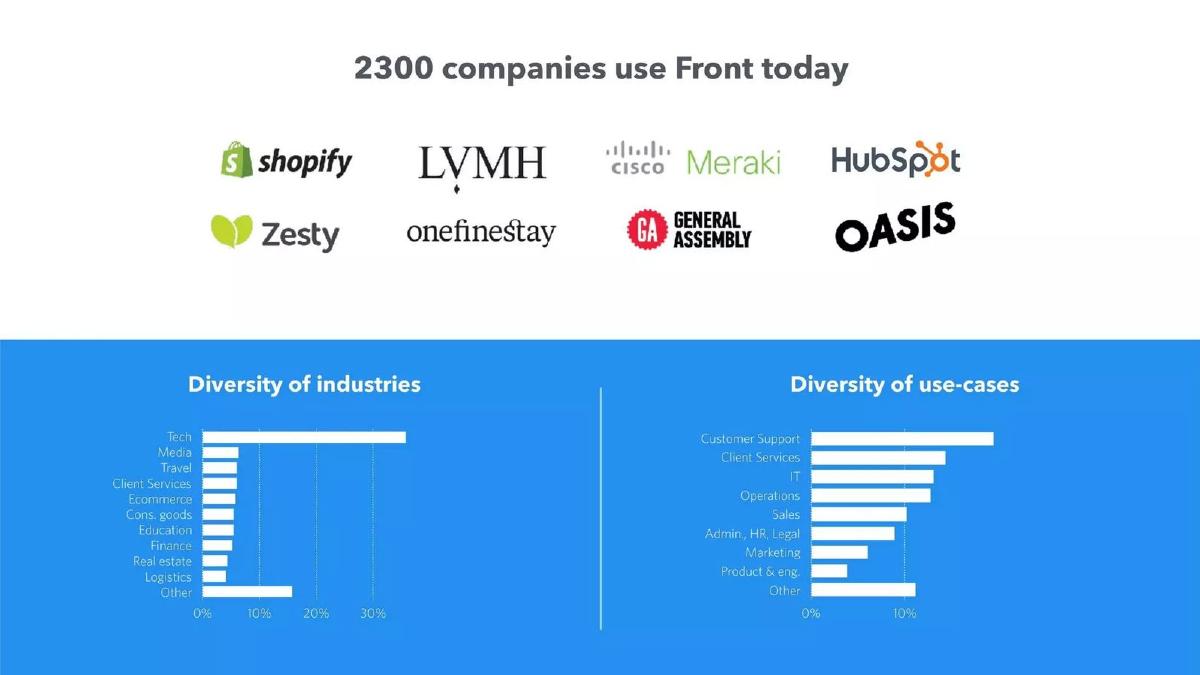
- Customer concentration is low, with 2,300 companies using the platform across diverse industries like Tech, Media, and Logistics (Slide 6).
- Internal culture is used as a stability metric, citing zero voluntary departures for employees with over 3 months of tenure (Slide 14).
Introduction: The Transparency of the Series B
Front’s Series B pitch deck is frequently cited in the startup community as a gold standard for transparency. At this stage, investors are no longer looking for just a 'big idea'; they are looking for a machine that turns capital into predictable revenue. Front delivers this by focusing almost exclusively on unit economics, cohort behavior, and operational efficiency. The deck, consisting of 24 slides, moves quickly from the problem/solution fit to the 'engine' of the business.
Slides 1-5: Problem, Solution, and Evolution
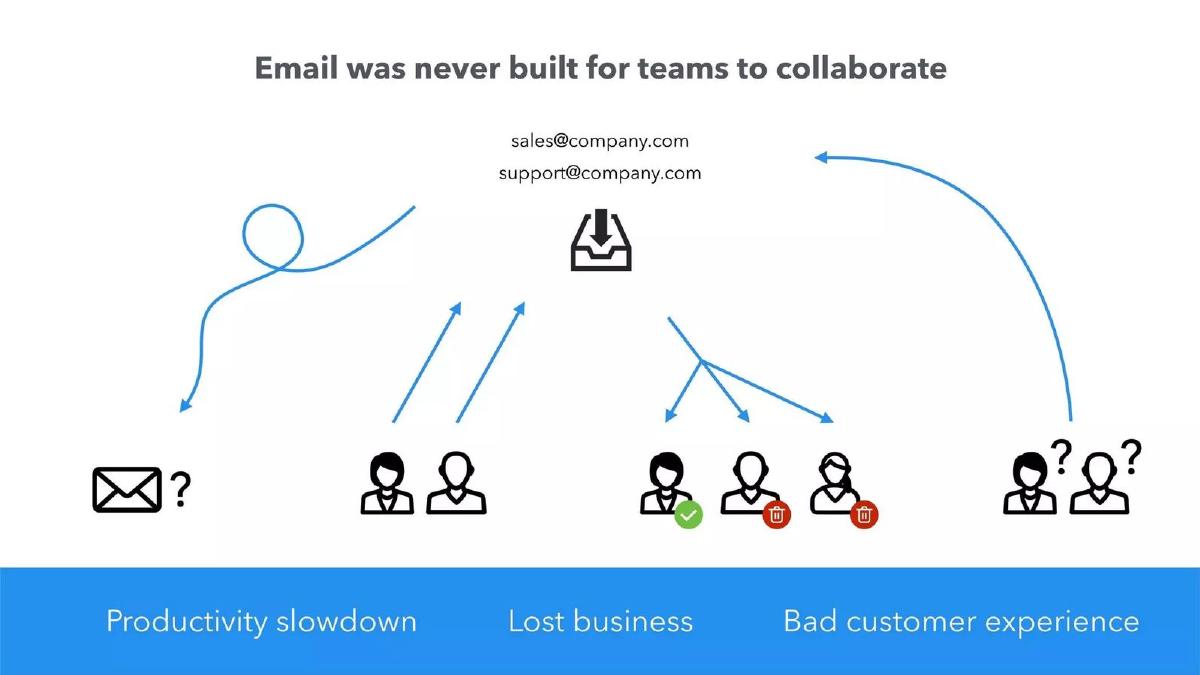
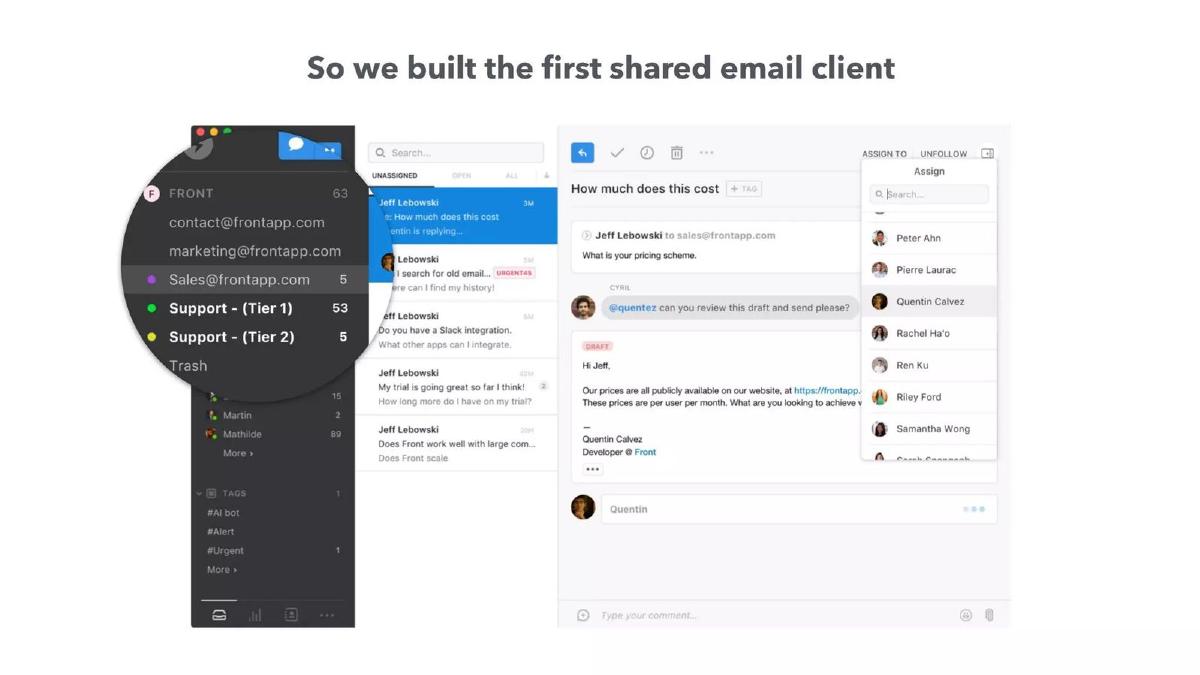
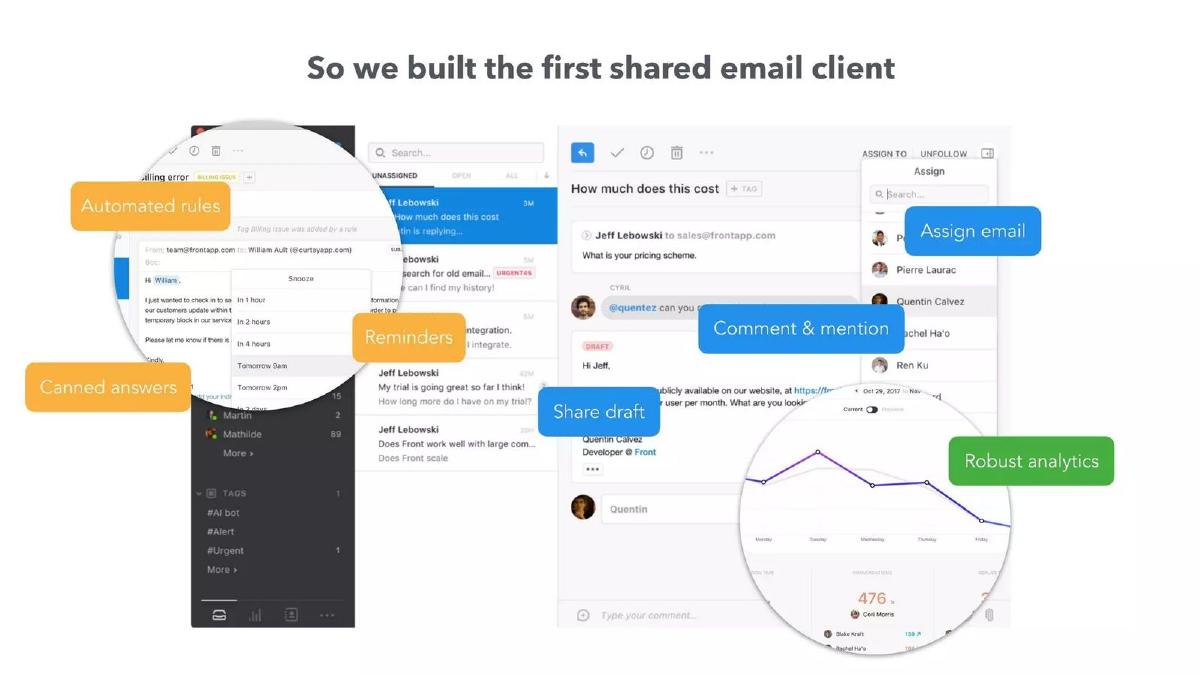
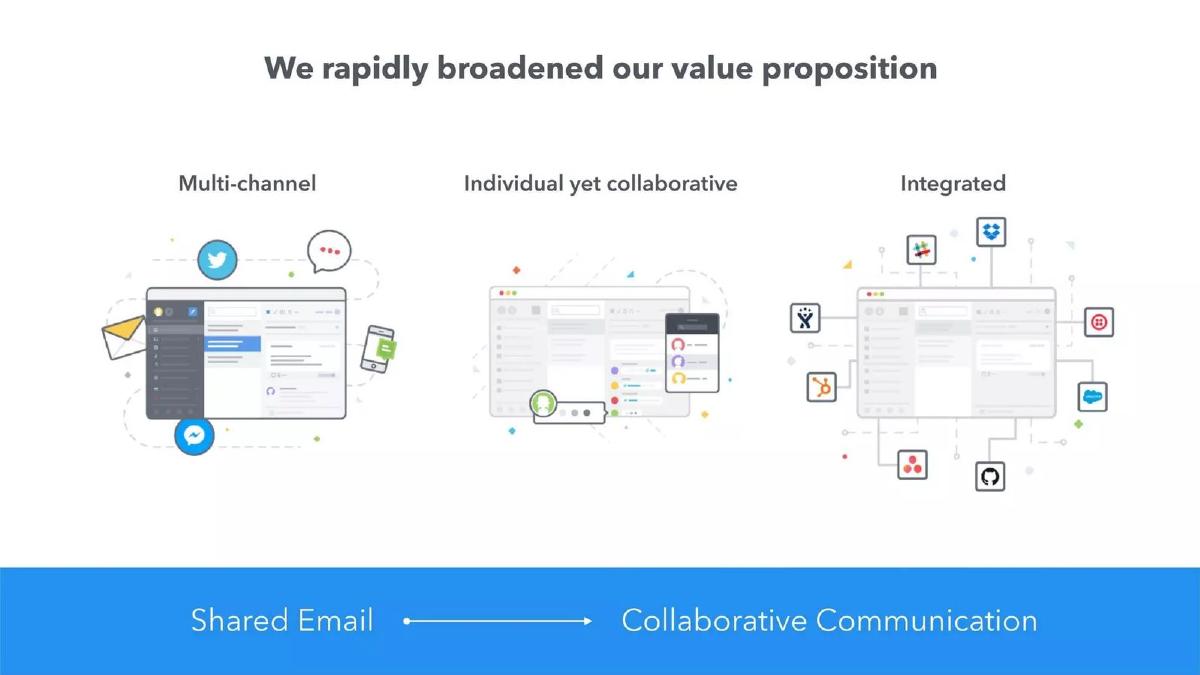
Slide 1 is a minimalist title slide featuring the Front logo on a blue background. Slide 2 defines the problem: 'Email was never built for teams to collaborate.' It uses a simple diagram showing the chaos of shared aliases like sales@ or support@, resulting in productivity slowdowns and bad customer experiences. Slide 3 introduces the solution: 'the first shared email client,' showing a clean interface with team-based navigation. Slide 4 expands on this by highlighting specific features: automated rules, canned answers, reminders, and robust analytics. Slide 5 is a pivotal transition slide. It shows how Front 'rapidly broadened' its value proposition from a simple 'Shared Email' tool to a 'Collaborative Communication' platform that is multi-channel, integrated with other apps, and individual yet collaborative.
Slides 6-9: Traction and Usage Growth
Slide 6 validates the market demand by stating '2300 companies use Front today.' It features logos from Shopify, LVMH, and HubSpot, and provides two bar charts showing a diversity of industries (Tech being the largest at over 30%) and a diversity of use cases (Customer Support and Client Services leading the way). Slide 7 displays a bar chart of ARR showing 'a very consistent growth of revenue,' though specific dollar amounts are omitted. Slide 8 addresses churn, showing that Gross churn, Net MRR churn, and Logo churn are all trending downward. Slide 9 reinforces this with usage data, showing exponential growth in messages sent, comments, mentions, and individual email users. This slide is crucial because it proves that the product is becoming more embedded in the customer's daily workflow.
Slides 10-12: The Sales and Marketing Engine
Slide 10 , titled 'Building a predictable sales organization (1/2),' shows that the company is hiring and ramping reps effectively. More importantly, it shows that 'Actual sales' exceeded 'Sales capacity' in Q3 2017. Slide 11 continues this theme, showing that Average Selling Price (ASP) is up every quarter and the number of 'large deals' is increasing significantly. It lists three anonymized customers (Transportation, Operations Management, Online Retail) with redacted ARR and seat counts. Slide 12 focuses on lead generation. It shows that as marketing spend increases, lead growth follows. The slide notes that the LTV/CAC ratio improved from 2.5 in Q1 17 to 4.4 in Q3 17, while spend as a percentage of revenue remained stable at around 18-19%.
Slides 13-16: Unit Economics and Financial Health
Slide 13 is perhaps the most impressive slide in the deck. It shows that 'Cohorts keep growing across all metrics,' with a 120% net retention rate at 6 months and a 150% net retention rate at 1 year. It also notes that ACV doubled in 15 months. Slide 14 shifts to the team, but instead of bios, it focuses on 'solid foundations.' It shows headcount growth to approximately 50 people by November 2017, zero voluntary departures for employees past 3 months, and a 5.0 Glassdoor rating. Slide 15 makes the case for capital efficiency. It reveals that Front raised $10m from Series A to date and has $7m left. It explicitly states the company is 'Default alive' and would be 'Profitable in 10 months' assuming no hiring and 5% monthly growth. Slide 16 projects a positive operating margin by the end of 2019 while maintaining a high gross margin (plotted at roughly 80% based on the chart).
Slides 17-21: Future Vision and Strategy
Slide 17 asks 'Where do we go from there?' Slide 18 answers by highlighting the product's 'unreasonable stickiness,' citing 2.5 hours per user per day and a 64% DAU/MAU ratio. It positions Front as the hub for messages, files, contacts, and meetings. Slides 19 and 20 outline the two areas of focus for 2018: adding more users and improving the platform. Specific goals include shipping a new Extension API, extending the collaborative model beyond messaging, and launching an app store for 3rd party apps. Slide 21 is a visual 'Long-term vision' slide showing a simple login screen over a wave background, suggesting a seamless entry point for all work communication.
Slides 22-24: The Ask and Conclusion
Slide 22 is a curious inclusion, directing viewers to a jobs page to find out more about the long-term vision. Slide 23 is the 'Raising our Series B' slide. It uses a growth curve to show the company's journey from 'Shared email address' to 'Collaborative Communication' and its current position. All ARR figures are marked as '$xx ARR' and the future target is marked as 'Confidential.' Slide 24 is a simple 'Thanks' slide.
What Works in This Deck
The strength of this deck lies in its data density and honesty . By Slide 15, an investor knows exactly how much cash is left, how long the runway is, and what the path to profitability looks like. The use of cohort analysis (Slide 13) is particularly effective for a SaaS business, as a 150% net retention rate is an elite metric that almost guarantees long-term success if the top-of-funnel remains healthy. Furthermore, the deck does a great job of showing operational control . Slide 10, which compares sales capacity to actual sales, proves that management understands the levers of their own business and can predict how new hires will impact the bottom line.
What is Missing
The most glaring omission is a traditional team slide . While Slide 14 discusses culture and retention, it does not provide the backgrounds or pedigrees of the executive team. For a Series B, investors usually know the founders, but a summary of the leadership's experience in scaling companies would typically be expected. Additionally, there is no explicit 'Ask' in terms of a dollar amount. While the deck is titled 'Raising our Series B,' it functions more as a performance report than a request for a specific sum of capital. Finally, the competitive landscape is entirely absent. The deck assumes the investor agrees that traditional email is the only competitor, ignoring other collaborative tools or CRM-adjacent platforms that might vie for the same budget.
What a Founder Should Copy
Founders should emulate the 'Default Alive' transparency found on Slide 15. Showing that you don't need the money to survive, but rather want it to accelerate an already working machine, is the strongest possible position for a fundraiser. Additionally, the usage stickiness metrics on Slide 18 (DAU/MAU and hours per day) are excellent ways to prove product-market fit beyond just revenue. Finally, the way Front visualizes the transition from a feature (shared email) to a platform (collaborative communication) on Slide 5 is a perfect example of how to frame a company's evolution to justify a higher valuation multiple.
Frequently asked questions
- What is Front's primary value proposition according to the deck?
- Front positions itself as the first shared email client designed for team collaboration. Slide 2 identifies the core problem as email not being built for teams, leading to productivity slowdowns and lost business. By Slide 5, the company explains its evolution into a 'Collaborative Communication' hub that integrates multi-channel messaging with contextual data from other systems.
- How does Front demonstrate its market fit and growth?
- The deck uses a combination of revenue and usage data. Slide 7 shows a 'very consistent growth of revenue' (ARR), while Slide 9 shows exponential growth in messages sent and individual email users. Most importantly, Slide 13 highlights that usage intensifies over time, with 4.9x more comments written per user after one year.
- What are the key financial health indicators mentioned?
- Front emphasizes capital efficiency and a path to profitability. Slide 15 explicitly states the company has $7m in cash on hand and is 'default alive,' meaning it would become profitable in 10 months without further hiring. Slide 16 projects a positive operating margin by the end of 2019.
- How does the deck address the team and company culture?
- Unlike most decks that list founder resumes, Front uses Slide 14 to show 'solid foundations' through headcount evolution and attrition rates. It highlights a 5.0 Glassdoor rating and 100% CEO approval for Mathilde Collin, suggesting that the company's internal health is a competitive advantage for scaling.
- What is the 'Ask' in this Series B deck?
- Slide 23, titled 'Raising our Series B,' shows a growth curve but redacts the specific dollar amount and exact ARR figures as 'Confidential' or '$xx ARR.' The slide serves to show the company's current position on its long-term trajectory rather than stating a specific valuation or round size.