Front’s Series C deck, which raised $59M in 2020, stands out for its heavy emphasis on company culture and sales predictability rather than just raw revenue numbers. The deck frames the problem of 'email overload' and 'duplicated work' as a structural flaw in the traditional 1-to-1 inbox model. It then provides a granular breakdown of its sales motion, showing a transition from inbound to a predictable outbound engine. With a staggering 148 minutes spent in-app per user per day and a 72% DAU/MAU ratio, the deck proves high utility. While it lacks a traditional team slide or a detailed financi…
Key takeaways
- The deck leads with culture, highlighting a 5.0 Glassdoor rating and an eNPS of 94 to signal organizational health (Slide 3).
- Front identifies the core bottleneck as the '1 inbox only ever accessible to 1 user' model, leading to duplicated work (Slide 4).
- The product vision is articulated through a musical metaphor, moving from a 'piano' (individual) to an 'orchestra' (team) (Slide 6).
- A quadrant analysis defines Front's territory as the intersection of 'Relies on email to get work done' and 'Needs complex workflows' (Slide 7).
- The company demonstrates industry diversity, with Software and Logistics being the largest revenue contributors (Slide 8).
- Sales efficiency is proven through a chart showing the 'Start of Outbound' in Q4 '18 leading to a significant increase in deals over $XXk ARR (Slide 9).
- User engagement is exceptionally high, with users spending 148 minutes in the app per day (Slide 11).
- The 'End Game' slide positions Front as a central hub for integrations including Salesforce, GitHub, and Figma (Slide 12).
The Narrative Strategy of Front's Series C
Front’s Series C deck is a departure from the typical metric-heavy growth decks seen at this stage. While it includes growth data, the narrative is anchored in the philosophy of work and the health of the organization. By the time a company reaches Series C, the product-market fit is assumed; the question is whether the company can become a platform. Front uses these slides to argue that they have not only built a tool people love but also a predictable machine for capturing a 500-million-user market.
Section 1: The Cultural Foundation
Slide 1: Title Slide The deck opens with a minimalist pink slide featuring the Front logo and the text 'Series C' and 'Work happier.' It sets a tone of confidence and brand clarity.
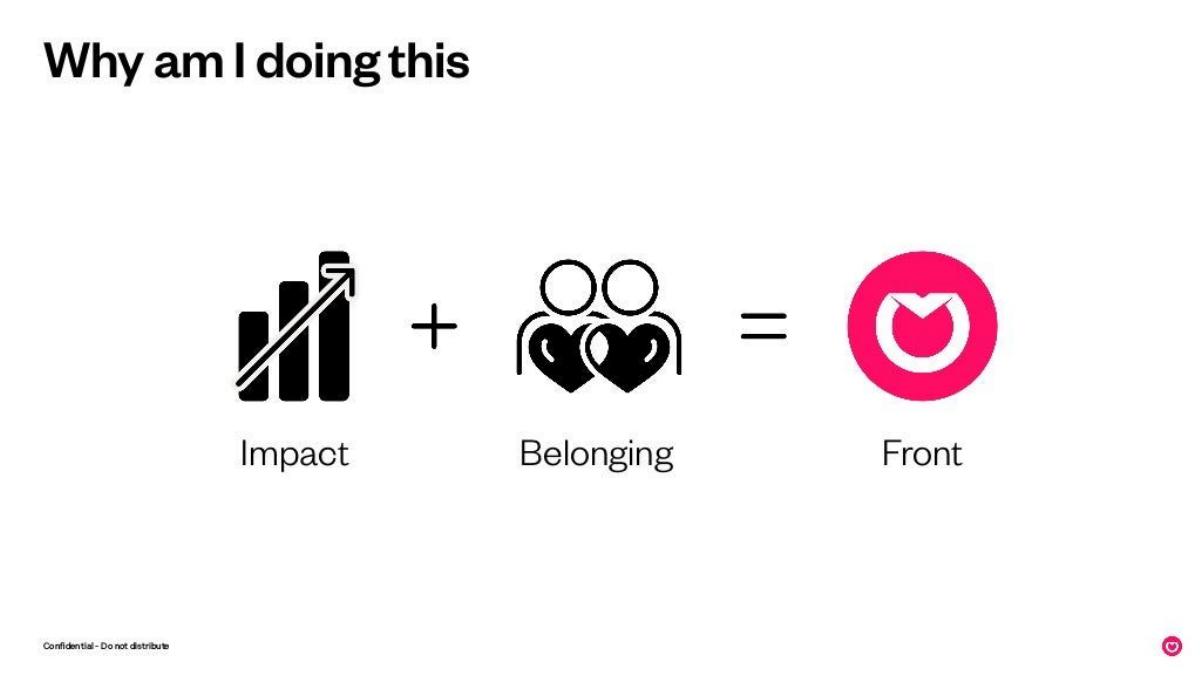
Slide 2: Why am I doing this This is a highly personal slide for a late-stage deck. It uses a simple equation: Impact + Belonging = Front. It signals that the founder's motivation is tied to both market results and internal culture.
Slide 3: Culture Metrics Front doubles down on culture here. They cite a 5.0 Glassdoor rating, a #1 ranking as a 'Great Place to Work' (July 2019-July 2020), and an eNPS (Employee Net Promoter Score) of 94. For an investor, these aren't just 'feel-good' stats; they are indicators of low turnover and high productivity, which are critical for scaling from Series C to an IPO.
Section 2: The Problem and The Pivot
Slide 4: The Productivity Bottleneck The deck identifies the '1 inbox only ever accessible to 1 user' model as the primary enemy. It lists three symptoms: No visibility, Duplicated work (illustrated by a chat bubble saying 'I had already sent them an estimate!'), and Email overload (+1K unread messages). This frames the problem as a structural limitation of legacy email technology.
Slide 5: The Solution Front 'flips the email model upside down' by making inboxes accessible to many users. The slide promises Information access, Efficiency and speed, and Focus. The visual transition from the siloed inboxes in Slide 4 to the circular, collaborative inbox in Slide 5 is a clear representation of their value proposition.
Slide 6: The Conductor Metaphor To explain how Front scales within an organization, they use a musical metaphor. They move from '1 piano' (individual) to '1 quartet' (small team) to '1 orchestra' (large organization), with Front acting as the 'conductor.' This slide addresses the 'land and expand' strategy without using dry corporate jargon.
Section 3: Market Positioning and Segmentation
Slide 7: The Quadrant Front uses a 2x2 matrix to define its territory. The axes are 'Communication form' and 'Need for workflows.' They position themselves in the top-right quadrant: 'Relies on email to get work done' and 'Needs complex workflows.' By labeling this as 'Front’s to own,' they tell investors exactly where they will win and why they aren't directly fighting Slack or traditional email providers.
Slide 8: Industry and Use Case Diversity This slide provides a bar chart of revenue by industry and customers by use case. Software (approx. 17%) and Logistics (approx. 12%) are the top industries. Customer Support (20%) and CEO/Owner (approx. 16%) are the top use cases. This data proves that Front is not a niche tool for one department but a horizontal solution with broad market appeal.
Section 4: Sales Predictability and Growth
Slide 9: The Predictable Sales Org This is arguably the most important slide for a Series C investor. It shows three charts: Outbound opportunities growing month-over-month in 2019, a scatter plot of 'Repeatable sales motions' showing most reps hitting 100%+ of quota, and a bar chart showing the 'Start of Outbound' in Q4 '18 leading to a surge in large deals (over $XXk ARR). This proves the business is a 'coin-operated' machine: if you put capital in, the sales org can predictably turn it into revenue.
Slide 10: The Expansion Opportunity Front returns to the quadrant from Slide 7 but highlights a larger area, stating '500m users live in this quadrant.' It’s a classic TAM (Total Addressable Market) slide that suggests they have only scratched the surface of the 'email-reliant' workforce.
Section 5: Engagement and The Platform Vision
Slide 11: User Stickiness The metrics here are staggering for a B2B SaaS company: 72% of MAUs (Monthly Active Users) are DAUs (Daily Active Users), and users spend 148 minutes in the app per day. The bar chart shows internal comments growing faster than external messages (+125% YoY), which proves that Front is becoming the internal collaboration layer, not just an email client.
Slide 12: The End Game The final conceptual slide shows Front at the center of an ecosystem, surrounded by icons for Asana, Excel, Jira, Salesforce, Figma, and others. This is the 'Platform Play.' Front isn't just a tool; it's the interface through which all other work tools are managed.
Slide 13: The Login The deck ends with a simple, clean image of the Front login screen against a wave background. It reinforces the 'Work happier' theme and leaves the investor with a sense of product polish.
What works in this deck
Predictability: Slide 9 is a masterclass in proving that the sales team is ramped and successful. Investors at Series C are buying a growth engine, and this slide proves the engine works. · Engagement Metrics: The 148 minutes per user per day (Slide 11) is a 'killer metric.' It turns a utility tool into a mission-critical platform in the eyes of an investor. · Clear Positioning: The quadrant on Slide 7 prevents the 'Why won't Google/Microsoft just build this?' question by highlighting the complexity of the workflows Front handles. · Culture as a Moat: By leading with eNPS and Glassdoor scores, Front suggests they have a superior ability to attract and retain the talent needed to win the market.
What is missing from this deck
The Team: In this 13-slide sample, there is no mention of the executive team or their backgrounds. While the founder's 'Why' is addressed, the 'Who' is missing. · Financial Specifics: The deck uses '$XXk ARR' placeholders and percentage-based growth charts. While common in public versions of decks, the lack of hard ARR numbers makes it difficult to assess the actual scale of the business from these slides alone. · Unit Economics: There is no mention of CAC (Customer Acquisition Cost), LTV (Lifetime Value), or Churn rates. For a Series C, these are usually mandatory. · Competitive Landscape: While the quadrant defines the space, it doesn't name competitors like Zendesk or Intercom, which often overlap with Front's support use cases.
What a founder should copy
The 'Conductor' Metaphor: If your product scales from individuals to large teams, find a simple visual metaphor like the piano-to-orchestra transition on Slide 6. It’s much more memorable than a list of features. · Sales Rep Performance Data: Don't just show total revenue. Show that your individual sales reps are hitting their numbers (Slide 9). It proves that your success isn't just due to one 'superstar' founder or salesperson. · Internal vs. External Growth: If you are building a collaboration tool, show that internal engagement (comments/shares) is outpacing external utility (Slide 11). This proves 'network effects' within a single company. · Focus on 'Why': Starting with the founder's motivation and the company's culture (Slides 2-3) creates an emotional hook that makes the subsequent data feel like the fulfillment of a mission rather than just a spreadsheet.
Frequently asked questions
- Why does Front spend so much time on culture in a Series C deck?
- At Series C, investors are looking for a company that can scale without breaking. By showcasing a 94 eNPS and a #1 ranking as a 'Great Place to Work,' Front signals that its internal 'operating system' is robust. This reduces the perceived risk of talent churn and execution failure during the rapid expansion phase that typically follows a $59M round.
- How does Front define its market positioning against competitors?
- Front uses a 2x2 matrix to carve out a specific niche. It avoids the 'Communication can take any form' (Slack-like) and 'Doesn't need workflows' (standard Gmail/Outlook) quadrants. Instead, it targets users who are tethered to email but require complex, collaborative workflows, claiming this space is 'Front's to own' and represents 500 million potential users.
- What is the significance of the '148 minutes in app' metric?
- This is a 'stickiness' metric. For a SaaS tool, 148 minutes per day is incredibly high, suggesting that Front is not just a utility but the primary workspace for its users. Combined with a 72% DAU/MAU ratio, it proves that the product is deeply embedded in the daily habit of the workforce, making it very difficult to displace.
- What does the 'Deliberate approach to growth' slide tell us about their sales strategy?
- It shows a transition from a reactive, inbound-heavy model to a proactive, outbound-led organization. By plotting 'Outbound Opps' against 'Ramped BDRs,' Front demonstrates that they have cracked the code on a repeatable sales motion. This predictability is exactly what Series C investors want to see before injecting large amounts of capital into the sales engine.
- What is missing from this deck that you would usually see in a Series C?
- This specific 13-slide selection omits a detailed management team slide, a clear 'Ask' (though catalogue facts state $59M), and a deep dive into unit economics like CAC or LTV. It also lacks a competitive landscape slide that names specific rivals, choosing instead to focus on the structural 'email model' as the primary competitor.