Fulfil.io's pitch deck is a masterclass in narrative efficiency, using a 10-slide structure to argue that legacy Enterprise Resource Planning (ERP) systems are failing modern businesses. The company positions itself as a 'Next Generation ERP' by highlighting a specific failure point—a $500,000 implementation disaster—and contrasting it with their own success story involving Lie-Nielsen Toolworks. By the time the deck reaches its traction slide, showing $100K ARR and 22% month-over-month growth as of Q1 2016, the problem-solution fit has already been established through visual storytelling rat…
Key takeaways
- The deck identifies a specific high-cost pain point: a $500,000 ERP implementation failure (Slide 3).
- Fulfil.io positions its core differentiator as an 'AI powered smart assistant' that integrates with tools like Slack (Slide 5).
- The product is marketed as 'Fully Customizable' with 'Open APIs,' addressing common complaints about legacy ERP rigidity (Slide 6).
- A single case study shows a 27% increase in revenue and an 11% decrease in back orders for a client (Slide 7).
- The company reported reaching $100K ARR with a $700K pipeline by Q1 2016 (Slide 8).
- Growth was stated at 22% Month-over-Month since launching in June 2015 (Slide 8).
- The founding team claims 15+ years of combined experience specifically in ERP deployment (Slide 9).
- Team members bring direct experience from industry incumbents NetSuite and OpenERP (Slide 9).
Slide-by-Slide Analysis
Slide 1: Title Slide
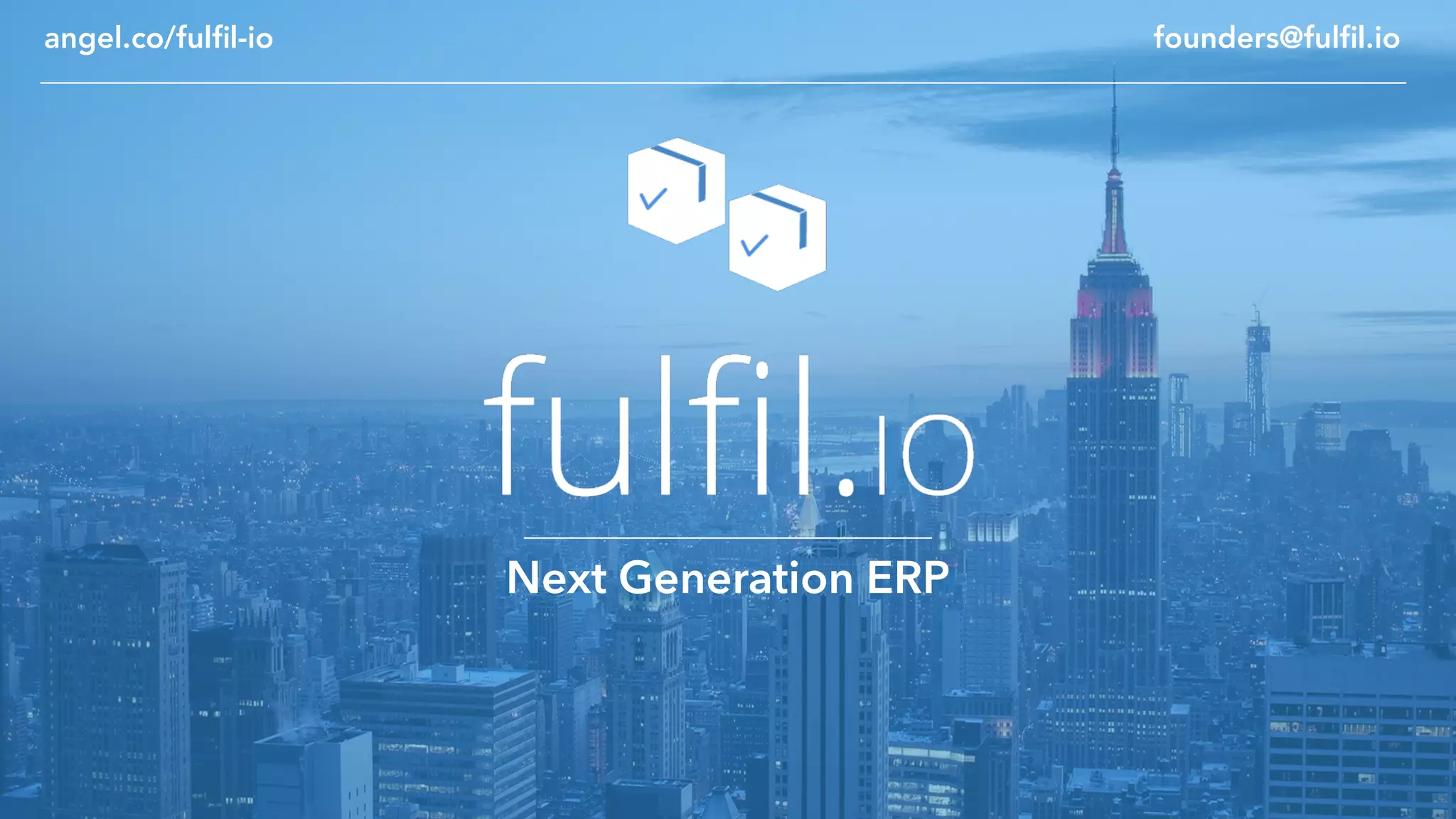
The deck opens with the company name, Fulfil.io, and the tagline 'Next Generation ERP.' The background is a blue-tinted cityscape of New York, featuring the Empire State Building. Contact information for the founders and an AngelList link are provided in the header. The branding is clean, using a logo of two boxes with checkmarks, signaling a focus on logistics and completion.
Slide 2: Customer Introduction
Unusually, the second slide is dedicated to a customer: Lie-Nielsen Toolworks Inc. It features a large group photo of the customer's staff in front of their facility. This slide serves as a 'hero' introduction, grounding the software in a real-world, physical business context ('Heirloom Quality Tools Since 1981'). It sets the stage for a narrative-driven pitch.
Slide 3: The Problem Statement
This slide uses a high-impact visual of stacked binders and the text '$500,000 ERP implementation fail?' It identifies the core market pain: the massive financial risk and administrative burden associated with traditional enterprise resource planning software. It frames the problem not just as a lack of features, but as a catastrophic business failure.
Slide 4: The Consequences
Slide 4 uses simple iconography to show the ripple effect of the problem mentioned in the previous slide. A 'no box' icon leads to a 'thumbs down' icon, which leads to a 'declining revenue' icon. The text labels these as 'Months of back orders,' 'Unhappy customers,' and 'Millions in Lost Revenue.' This quantifies the cost of inaction for the target customer.
Slide 5: The Solution - AI Assistant
Fulfil.io introduces its 'Next Generation ERP' through the lens of an 'AI powered smart assistant.' The slide features a mockup of an iPhone running a chat interface (Slack-like). A user named Ritu asks, 'What was the sales last week?' and the '@fulfilbot' responds with specific revenue and order counts. This highlights ease of use and instant data accessibility.
Slide 6: Product Pillars
This slide outlines four key value propositions: 'Fully Customizable,' 'Any Device Anywhere,' 'Open APIs,' and 'AI Powered.' It uses clean line icons to represent these technical advantages. This addresses the common 'walled garden' complaint of legacy ERPs by emphasizing openness and mobility.
Slide 7: Success Story (Case Study)
Returning to the Lie-Nielsen example, this slide provides concrete metrics. Against a background of a brass woodworking tool, the slide claims a '27% Revenue' increase and an '11% Back Orders' decrease. This is the 'proof' slide, showing that the software delivers measurable financial outcomes for established businesses.
Slide 8: Traction
The traction slide shows a line graph trending upward from Q2 '15 to Q1 '16. Key figures include: 'Launched June 2015,' '$100K ARR,' '$700K Pipeline,' and '22% MoM Growth.' The y-axis of the graph is labeled in increments of $3K, showing a steady climb in monthly revenue. This slide proves the business has moved past the conceptual stage.
Slide 9: The Team
The team slide features four individuals: Sharoon Thomas (CEO), Rituparna Panda (Customer Success), Tarun Bhardwaj (Tech Lead), and Prakash Pandey (Solutions Architect). The slide claims '15+ years of combined experience in deploying and managing ERP systems.' Crucially, it includes logos for 'Open ERP' and 'NetSuite,' signaling that the founders have 'insider' knowledge of the competitors they are trying to disrupt.
Slide 10: Closing Slide
The final slide returns to the chat interface, showing a '@fulfilbot' message history next to a photo of a smiling worker in a machine shop giving a thumbs up. It repeats the company name, tagline, and contact info. The imagery reinforces the idea that this software is built for the people actually working on the shop floor, not just executives in boardrooms.
What Works Well
The Narrative Arc: The deck follows a very clear story: a real company (Lie-Nielsen) had a massive problem with old software, Fulfil.io fixed it, and here are the numbers to prove it. This is far more compelling than a list of features.
Founder-Market Fit: By explicitly mentioning NetSuite and OpenERP, the founders immediately answer the question 'Why you?' They aren't just software developers; they are ERP specialists who saw the flaws in the industry leaders firsthand.
Focus on Mobile/Chat: In 2016, the idea of managing a complex ERP via a Slack bot was highly differentiated. The deck leans into this 'smart assistant' angle to make a boring category (ERP) feel modern and innovative.
What Is Missing
Market Size (TAM): There is no mention of how large the ERP market is. While investors generally know it is a multi-billion dollar space, a slide showing the specific segment Fulfil.io is targeting would have helped define the scale of the opportunity.
Competition: Aside from the subtle mention of NetSuite on the team slide, there is no competitive landscape analysis. The deck assumes the investor agrees that all existing ERPs are 'fails,' which may not always be the case.
The Ask: The deck ends without a call to action. There is no mention of how much money is being raised, the valuation, or what the specific goals are for the next 12-18 months. This makes it feel more like a company overview than a formal fundraising pitch.
Founder's Playbook: What to Copy
Use a 'Hero' Customer: If you have one customer who loves you and has seen massive results, make them the centerpiece of the deck. It moves the conversation from 'Will this work?' to 'How fast can you do this for others?'
Quantify the Pain: Don't just say the old way is bad. Say it's a '$500,000 fail.' Specific numbers in the problem statement make the solution feel more valuable.
Keep it Short: At only 10 slides, this deck is extremely digestible. It doesn't get bogged down in technical architecture, focusing instead on user experience and business outcomes.
Final Thoughts
Fulfil.io's deck is a strong example of an early-stage pitch that relies on momentum and specific proof points rather than broad market generalities. While it leaves out several 'standard' slides, the strength of the Lie-Nielsen case study and the 22% MoM growth likely provided enough signal for investors to take a meeting. It is a 'show, don't tell' deck that prioritizes the user's emotional and financial relief over technical jargon.
Frequently asked questions
- What is the primary problem Fulfil.io is solving?
- Fulfil.io targets the failure of legacy ERP systems. Slide 3 highlights a '$500,000 ERP implementation fail,' while Slide 4 illustrates the downstream effects: months of back orders, unhappy customers, and millions in lost revenue. The deck suggests that traditional enterprise software is too complex, expensive, and rigid for modern commerce.
- How does Fulfil.io use AI in its product?
- According to Slide 5, the company offers an 'AI powered smart assistant' called @fulfilbot. The slide shows a mobile interface where a user asks for inventory levels and sales stats, and the bot returns specific data points, such as '$260,435.68 across 701 orders.' This positions the ERP as a conversational tool rather than just a database.
- What traction did the company have at the time of this deck?
- Slide 8 details the company's performance since its June 2015 launch. At the time of the deck's creation (Q1 2016), they had achieved $100K in Annual Recurring Revenue (ARR) and maintained a 22% month-over-month growth rate. They also cited a sales pipeline valued at $700K.
- Who is the target customer for Fulfil.io based on the slides?
- The deck heavily features Lie-Nielsen Toolworks Inc., a company that produces 'Heirloom Quality Tools since 1981' (Slide 2). This suggests the initial target market is mid-sized manufacturing or retail businesses with complex inventory needs that have outgrown basic tools but are struggling with high-end enterprise solutions.
- What is missing from this pitch deck?
- The deck is missing several standard components: a 'Market Size' (TAM/SAM/SOM) slide, a 'Competition' matrix, a 'Business Model' slide explaining pricing, and a clear 'Ask' slide detailing how much capital they are raising and what the milestones for that capital will be.