Fundid's 2022 Seed deck is a masterclass in establishing a proprietary acquisition wedge. By focusing on 'micro-businesses' (those with fewer than 10 employees), the company identifies a massive, underserved segment of the $100B SMB revenue pool. The deck successfully argues that traditional lending is broken for this cohort and proposes a three-step solution: grants, a business-building card, and micro-lending. The standout metric is their early traction with the Grant Match Program, which generated 170-190 sign-ups per day with minimal marketing spend. While the deck is light on specific un…
Key takeaways
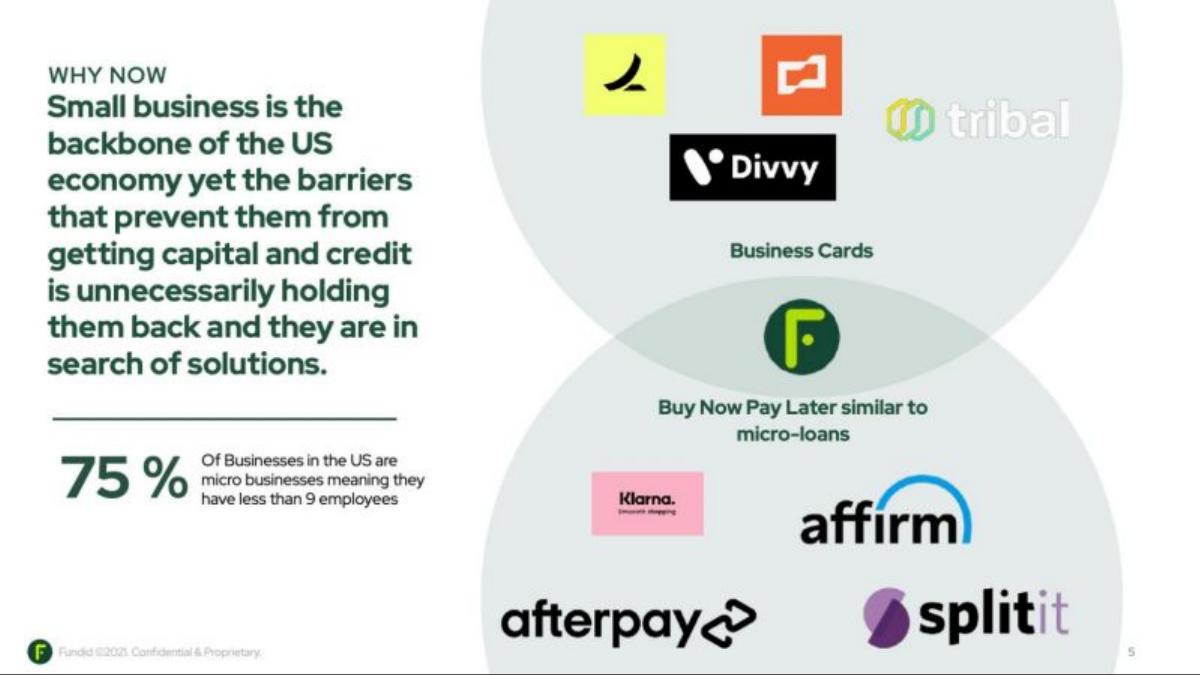
- Fundid identifies that 75% of U.S. businesses are micro-businesses with fewer than 9 employees, a segment often ignored by traditional banks (Slide 5).
- The company uses a Grant Match Program as a low-cost entry point to attract their ideal customer profile into the lending funnel (Slide 7).
- Early traction metrics show 170-190 new sign-ups per day for the grant program and a waitlist of 1,560+ for their credit card (Slide 8).
- The revenue model is diversified across interchange fees from their business card and interest from micro-loans (Slide 7).
- The team slide highlights significant domain expertise, including a CEO with 13 years of experience and a Head of Banking Technology who was formerly Head of Product at Venmo (Slide 10).
- Customer discovery is backed by data from over 800 surveys, showing that 76.5% of respondents are unsure how to get funding (Slide 11).
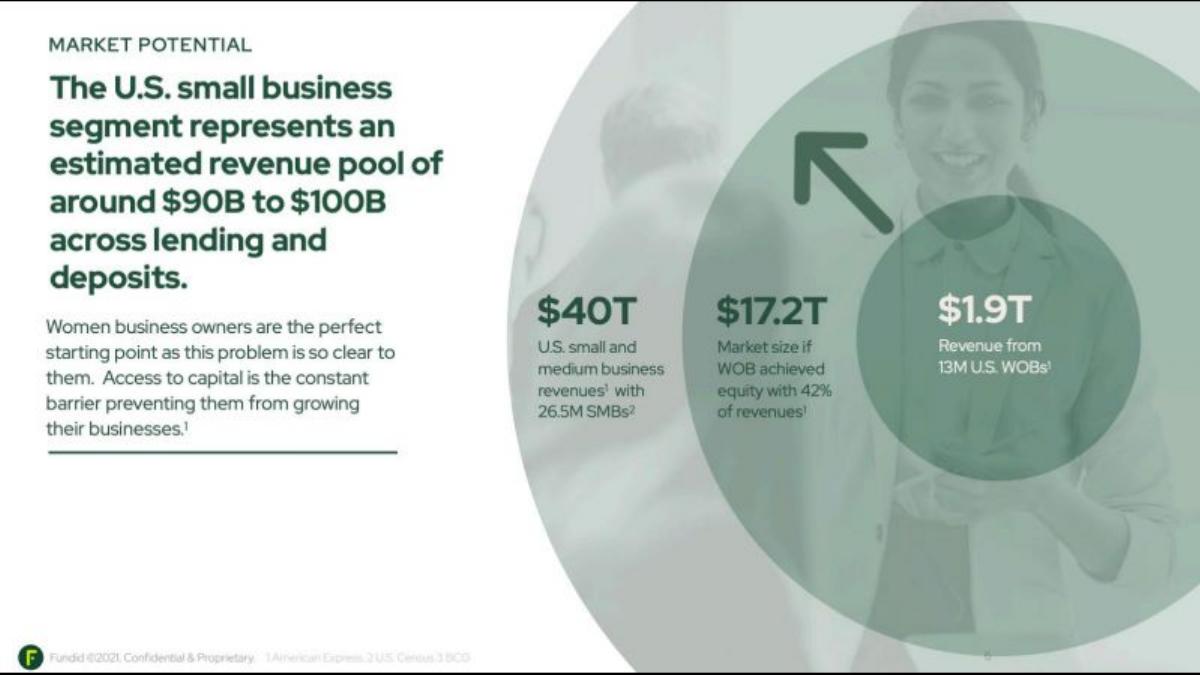
- The market potential slide targets a $90B to $100B revenue pool across lending and deposits for the U.S. small business segment (Slide 6).
- The deck lacks a specific 'Ask' slide detailing the exact valuation or breakdown of how the $3.25M will be spent.
The Wedge Strategy: How Fundid Pitched a $3.25M Seed Round
Fundid’s 2022 pitch deck is a clear example of how to pitch a fintech solution in a crowded market by identifying a specific, underserved niche and a proprietary acquisition channel. While many fintechs chase the general SMB market, Fundid narrowed its focus to "micro-businesses"—those with fewer than 10 employees. The deck uses 13 slides to move from a systemic problem to a data-backed solution, leveraging a high-pedigree team to instill confidence in their ability to execute in a regulated space.
Slide 1-2: Purpose and Identity
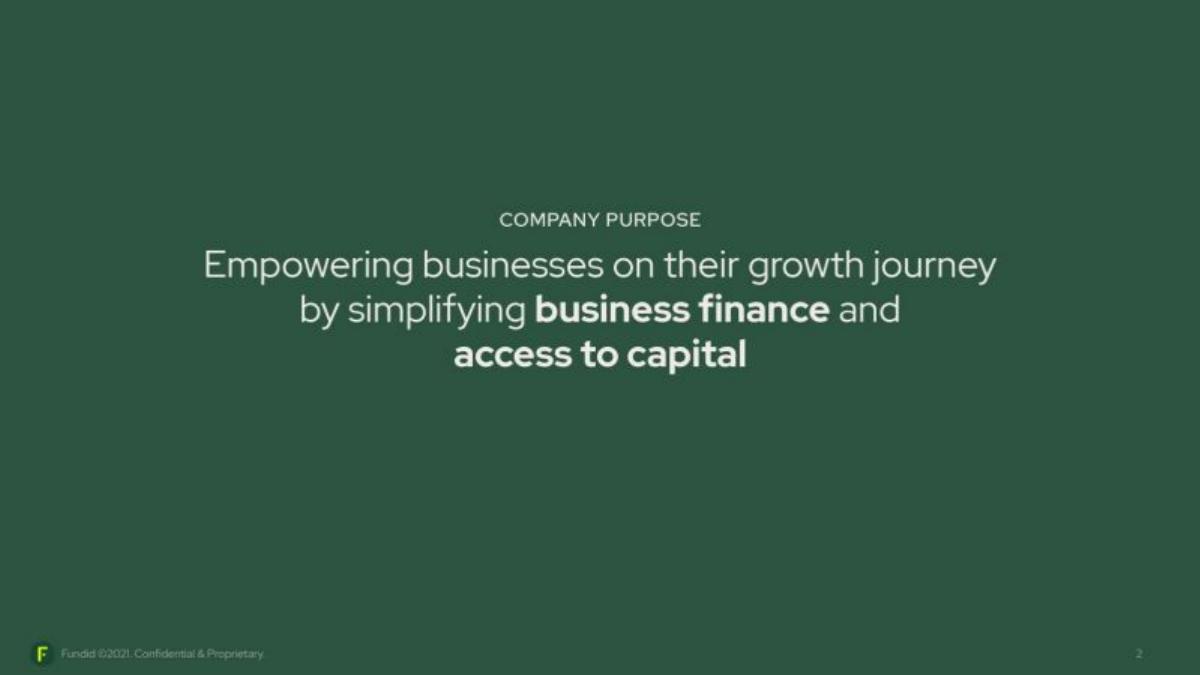
The deck opens with a standard title slide featuring the Fundid logo and a lifestyle image of a smiling entrepreneur. Slide 2 immediately defines the Company Purpose : "Empowering businesses on their growth journey by simplifying business finance and access to capital." This is a broad mission statement, but it sets the stage for the specific problems addressed in the following slides.
Slide 3: The Problem
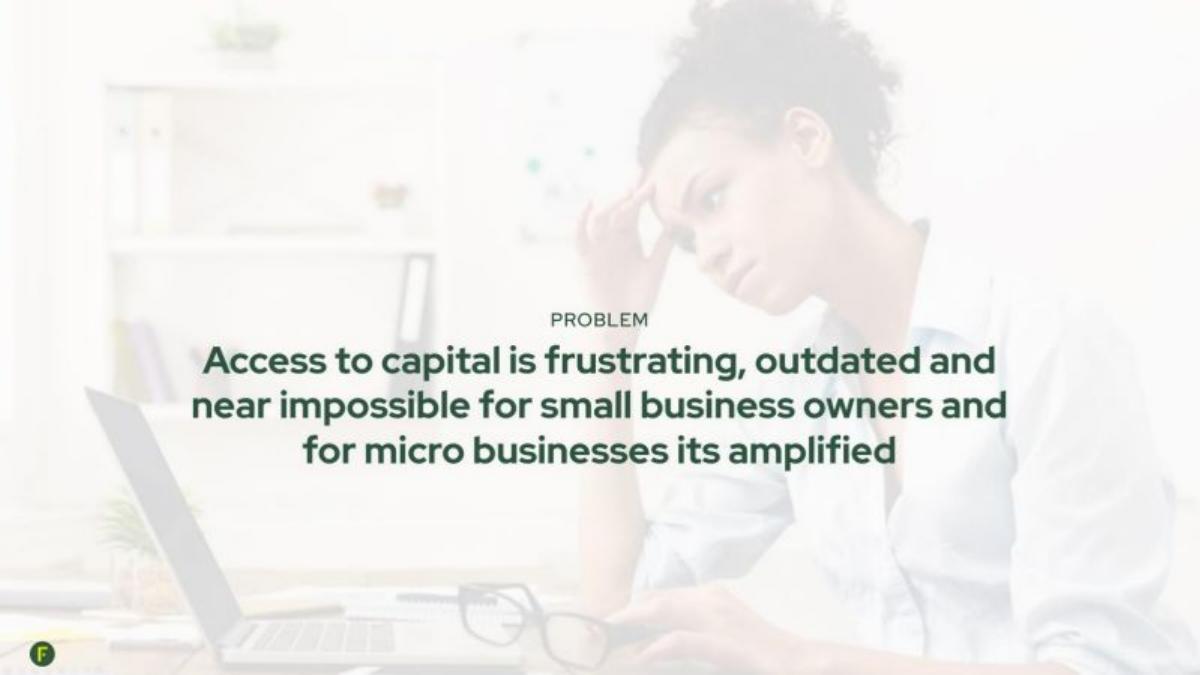
Slide 3 identifies the core friction point: "Access to capital is frustrating, outdated and near impossible for small business owners." Crucially, the slide adds that for micro businesses , this problem is "amplified." By highlighting this specific sub-segment, Fundid avoids competing directly with every other SMB lender and instead focuses on the most neglected part of the market.
Slide 4: The Three-Pillar Solution
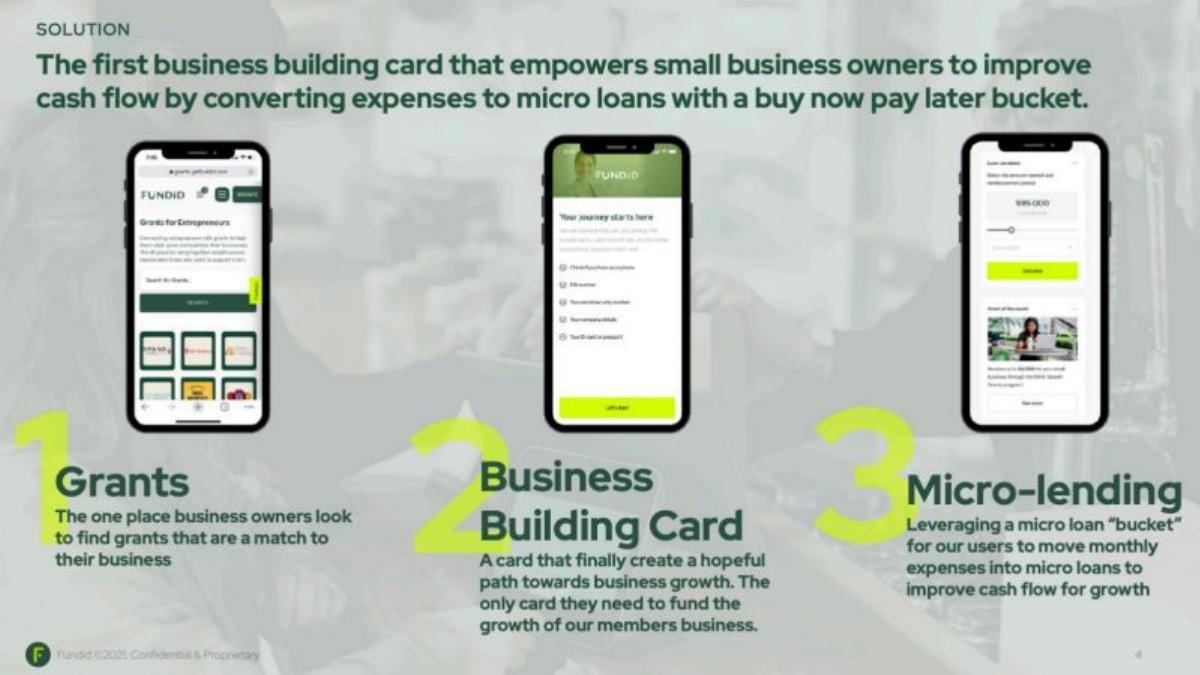
The solution is presented as a three-part ecosystem. 1. Grants: A centralized place to find business grants. 2. Business Building Card: A credit card designed to create a path toward growth. 3. Micro-lending: A feature that allows users to move monthly expenses into a "buy now pay later bucket." This slide is effective because it shows a clear progression from a free, high-value tool (grants) to a core financial product (the card) and finally to a high-margin lending product.
Slide 5: Why Now and Market Segmentation
Slide 5 provides the statistical backbone for their niche focus. It states that 75% of businesses in the US are micro businesses , meaning they have fewer than 9 employees. The slide also includes a Venn diagram placing Fundid at the intersection of "Business Cards" (referencing logos like Divvy and Brex) and "Buy Now Pay Later" (referencing Klarna and Affirm). This positioning suggests that Fundid is bringing consumer-style flexibility to the smallest business owners.
Slide 6: Market Potential
Fundid estimates the U.S. small business segment represents a revenue pool of $90B to $100B across lending and deposits. The slide uses a concentric circle graphic to show the scale: $40T in total SMB revenue, $17.2T if Women Business Owners (WOB) achieved equity, and $1.9T in current revenue from 13M U.S. WOBs. This slide signals that while they are starting with women-owned micro-businesses, the total addressable market is massive.
Slide 7: The Business Model
The revenue model is straightforward, split between Interchange (fees from card usage) and Business Loans . The slide emphasizes that the grant marketplace is the "entry point" for the platform. This is a critical strategic point: by offering a service that helps businesses get "free" money (grants), Fundid lowers its Customer Acquisition Cost (CAC) and builds a database of businesses looking for capital.
Slide 8: Growth and Traction
This is the most important slide in the deck for a Seed round. Fundid shares specific metrics from their May 2021 launch:
170-190 new Grant Match Program sign-ups per day. · 7,057 total Grant Match Program users. · 1,560+ total waitlist for the Business Building Card. · 56K monthly website impressions. · 9-10k website users per month.
These figures prove that their "wedge" (the grant tool) is working to attract their target audience at scale.
Slide 9: The Vision and Roadmap
The roadmap outlines four phases: accelerating the grant program, launching the card, introducing the micro-lending "bucket," and finally leveraging data to create a proprietary Fundid Business Health Score . This indicates an intent to move beyond simple lending into becoming a data provider or a more sophisticated credit underwriter.
Slide 10: The Team
For a fintech startup, the team slide is often the deciding factor for VCs. Fundid’s team is exceptionally strong for a Seed stage:
Stefanie Sample (CEO): 13-year serial entrepreneur and former bank advisory board member. · Cameron Peake: Co-founder of Azlo and former Innovation lead at BBVA. · Matthew Browning: Former COO of Snap Finance and CEO of Target Bank. · Millicent Tracy: Former SVP at Wells Fargo. · Camellia George: Former Head of Product at Venmo.
This level of institutional experience in banking and payments mitigates the perceived risk of building a lending platform.
Slide 11: Customer Discovery Data
Rather than just stating opinions, Fundid includes a slide dedicated to survey results from 800+ respondents. The data is compelling: 76.5% are unsure how to get funding, and 62.7% do not have a business credit card. This validates the "Problem" slide with direct feedback from the target market.
Slide 12-13: Conclusion
The deck ends with a contact slide and a repeat of the logo. Notably, there is no explicit 'Ask' slide in this version of the deck. While the catalogue listing confirms they raised $3.25M, the deck itself does not specify the amount sought, the valuation, or the intended use of funds. This is common in decks shared publicly after a round, but founders should note that a live pitch deck must include these details.
What Fundid Does Well
The deck excels at defining a wedge . Most fintechs struggle with high CAC; Fundid’s use of a grant marketplace as a lead generator is a brilliant way to acquire customers for free while they are actively thinking about their capital needs. The deck also does a great job of segmenting the market . By focusing on businesses with fewer than 10 employees, they make a convincing case that they are not just another Brex clone, but are serving a distinct and massive population.
What is Missing from the Deck
The most glaring omission is Unit Economics . While the business model is mentioned, there is no data on expected LTV (Lifetime Value), CAC (Customer Acquisition Cost), or the projected default rates for their micro-loans. In a lending business, the cost of capital and the risk of loss are paramount, and this deck remains at a very high level regarding those risks. Additionally, there is no competitive matrix . While slide 5 mentions other logos, it doesn't explicitly state how Fundid’s terms or technology differ from existing SMB credit cards like American Express or newer players like Ramp.
Founder Takeaway: The Power of the Wedge
Founders should copy Fundid’s approach to traction reporting . Instead of just showing a revenue graph, they showed how their top-of-funnel (grants) was feeding their bottom-of-funnel (card waitlist). This demonstrates a repeatable system for growth. Furthermore, the inclusion of raw survey data (Slide 11) is a powerful way to prove that you understand your customer better than the incumbent banks do. If you are entering a crowded space, find your "Grant Match Program"—the free tool that makes your paid product the obvious next step.
Frequently asked questions
- What is Fundid's primary customer acquisition strategy?
- Fundid uses a 'Grant Match Program' as a lead magnet. According to slide 8, this program attracts 170-190 new sign-ups per day. By providing a free tool that helps micro-business owners find grants, Fundid builds a high-trust relationship and a proprietary data set, which they then use to funnel those users toward their paid credit and lending products.
- How does Fundid define its target market?
- Fundid specifically targets 'micro-businesses,' which they define on slide 5 as businesses with fewer than 9 employees. They note that these businesses make up 75% of all U.S. companies. Slide 6 further narrows the initial focus to Women Business Owners (WOBs), citing a $1.9T revenue opportunity from 13M U.S. WOBs.
- What are the core products offered by Fundid?
- As shown on slide 4, the product suite consists of three pillars: a Grant search tool, a 'Business Building Card' designed to help owners build credit, and a 'Micro-lending' feature. The micro-lending component allows users to move monthly expenses into a 'buy now pay later bucket' to improve cash flow.
- Who are the key members of the Fundid leadership team?
- The team is led by Founder & CEO Stefanie Sample, a serial entrepreneur of 13 years. The leadership includes deep fintech experience: Cameron Peake (former CEO of Azlo), Matthew Browning (former COO of Snap Finance), Millicent Tracy (former SVP at Wells Fargo), and Camellia George (former Head of Product at Venmo). This is detailed on slide 10.
- What evidence of product-market fit does the deck provide?
- Slide 11 presents data from over 800 customer discovery surveys. Key findings include that 76.5% of micro-business owners don't know how to get funding and 62.7% do not have a business credit card. Additionally, slide 8 notes 56,000 monthly website impressions and 9,000-10,000 monthly users, achieved shortly after starting marketing in May 2021.