Fundnesia is an Indonesian agritech platform designed to bridge the financial gap between urban investors and rural farmers. The deck outlines a simple peer-to-peer marketplace where investors provide capital, farmers produce goods, and the platform facilitates distribution. The business model relies on a 40/40/20 profit-sharing split between the investor, the farmer, and the platform respectively. Notably, the deck seeks an exceptionally small 'Angel Investment First Round' of just $2,500 USD, intended primarily for product development and working capital. While the team slide highlights tec…
Key takeaways
- The platform operates on a tripartite profit-sharing model: 40% to the investor, 40% to the farmer, and 20% to Fundnesia (Slide 4).
- The funding request is remarkably low for a tech startup, seeking only $2.5K USD for its first angel round (Slide 5).
- Product development is the primary use of funds, allocated at 40% of the total investment (Slide 5).
- The target customer base is segmented into urban investors, people interested in agriculture, and youth (Slide 3).
- The founders, Bintang Thunder and Adiputra Sinaga, both have backgrounds in Computer Science/IT from USU and were Microsoft Student Partners (Slide 6).
- The deck omits a traditional 'Problem' slide, moving directly from the title to a high-level 'Solution' (Slide 2).
- There is no mention of market size (TAM/SAM/SOM) or specific agricultural sectors targeted (Slide 1-6).
- The deck lacks a roadmap or timeline for scaling beyond the initial $2.5K injection (Slide 5).
Fundnesia Pitch Deck Analysis
Fundnesia represents a specific niche of the Indonesian startup ecosystem: the student-led or early-stage social enterprise. The deck, published in 2018, focuses on the intersection of fintech and agritech, attempting to solve the credit gap for farmers by leveraging urban capital. However, the deck is extremely lean, consisting of only 12 slides (6 provided here), and lacks the depth typically required for a professional seed round. It functions more as a concept note for a micro-grant or a very early angel check.
Slide 1: Title Slide
The title slide features the Fundnesia logo, which incorporates a stylized infinity loop containing leaf patterns, reinforcing the agricultural and collaborative nature of the business. The tagline "POTENTIAL & COLLABORATION" is vague but sets a tone of social impact. The imagery of farmers in a rice paddy provides immediate context for the sector, though it is a generic stock-style photo common in this industry.
Slide 2: Solution
Interestingly, the deck skips a formal "Problem" slide and moves directly to the "Solution." Slide 2 states two primary outcomes: "Farmer Get Funding" and "Agricultural Products will be Distributed." This suggests the platform is not just a lending tool but also potentially involved in the supply chain or off-taking of the goods produced. The lack of a problem slide is a weakness, as it fails to quantify the credit gap in Indonesia or explain why current microfinance options are insufficient for these farmers.
Slide 3: Target Customer
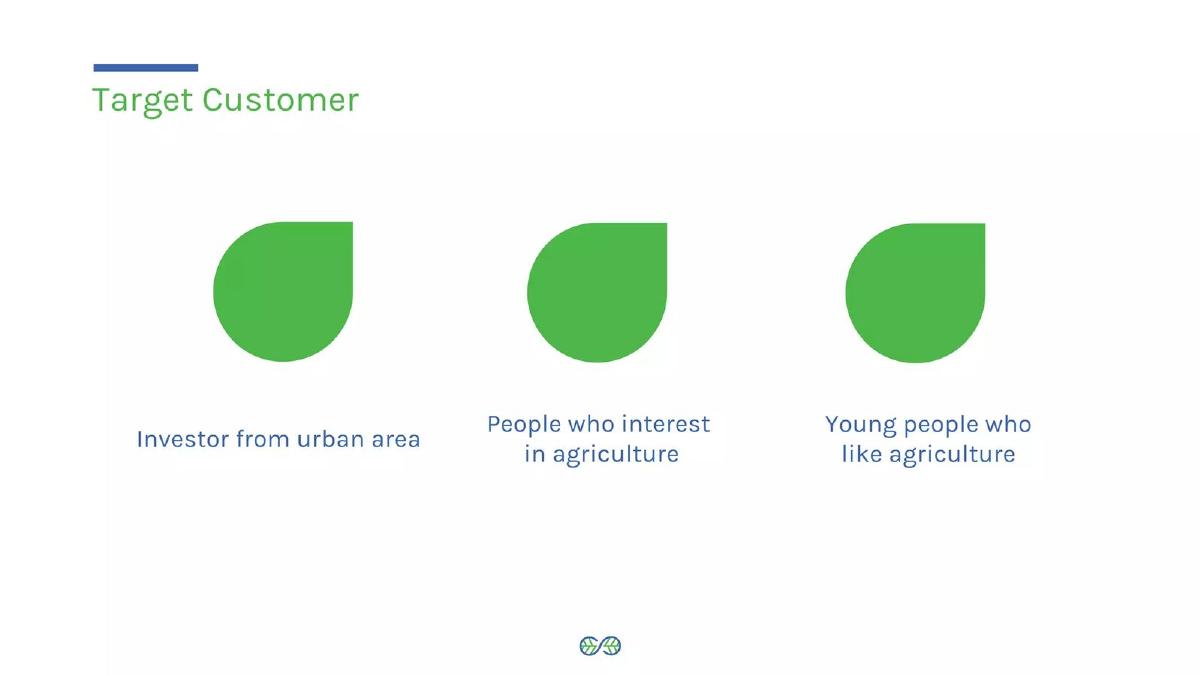
Slide 3 identifies the demand side of the marketplace. The targets are "Investor from urban area," "People who interest in agriculture," and "Young people who like agriculture." The use of the term "Young people" is notable, suggesting a play on the growing trend of impact investing among millennials in Southeast Asia. However, the slide is purely qualitative; it does not provide data on the number of potential investors or the average ticket size they expect to capture.
Slide 4: Business Model
This is the most substantive slide in the deck. It illustrates a peer-to-peer (P2P) lending flow. An investor gives funding through the Fundnesia platform to a farmer. The resulting profit is shared: 40% to the investor, 40% to the farmer, and 20% to Fundnesia. This 20% take-rate is quite high for a pure financial intermediary, which may be justified if Fundnesia is also handling the distribution mentioned on Slide 2. The slide does not clarify if the 40% is a return on capital or a split of net profits, which is a critical distinction for investors.
Slide 5: Funding Allocation
Slide 5 reveals the scale of the ambition: a "2.5K USD Angel Investment First Round." This is an exceptionally small ask, even for the Indonesian market in 2018. The allocation is:
Product Develop: 40% ($1,000) · Working Capital: 20% ($500) · Recruitment: 15% ($375) · Project Runaway [sic]: 15% ($375) · Marketing: 10% ($250)
The term "Project Runaway" is likely a typo for "Project Runway" or "Runway." The small dollar amounts suggest this is a student project seeking to build a Minimum Viable Product (MVP) rather than a commercial startup looking to scale.
Slide 6: Team
The team consists of two co-founders, Bintang Thunder (CEO) and Adiputra Sinaga (CTO). Both are students or recent graduates from USU (Universitas Sumatera Utara). Their credentials as Microsoft Student Partners and XL Future Leaders suggest they are high-achieving students with technical literacy. Thunder is positioned as the business analyst, while Sinaga is the developer and designer. The team appears balanced for a technical build but lacks a member with deep agricultural or financial regulatory experience, which is often a hurdle for P2P lending platforms in Indonesia (OJK compliance).
What Fundnesia Does Well
The deck is visually clean and easy to follow. The business model slide (Slide 4) is the highlight, as it clearly explains the value exchange and the revenue split in a single graphic. Many early-stage decks overcomplicate their revenue streams, but Fundnesia keeps it to a simple tripartite profit-sharing arrangement. The focus on "urban investors" is also a smart marketing angle, tapping into the desire of city dwellers to support rural development.
What is Missing from the Deck
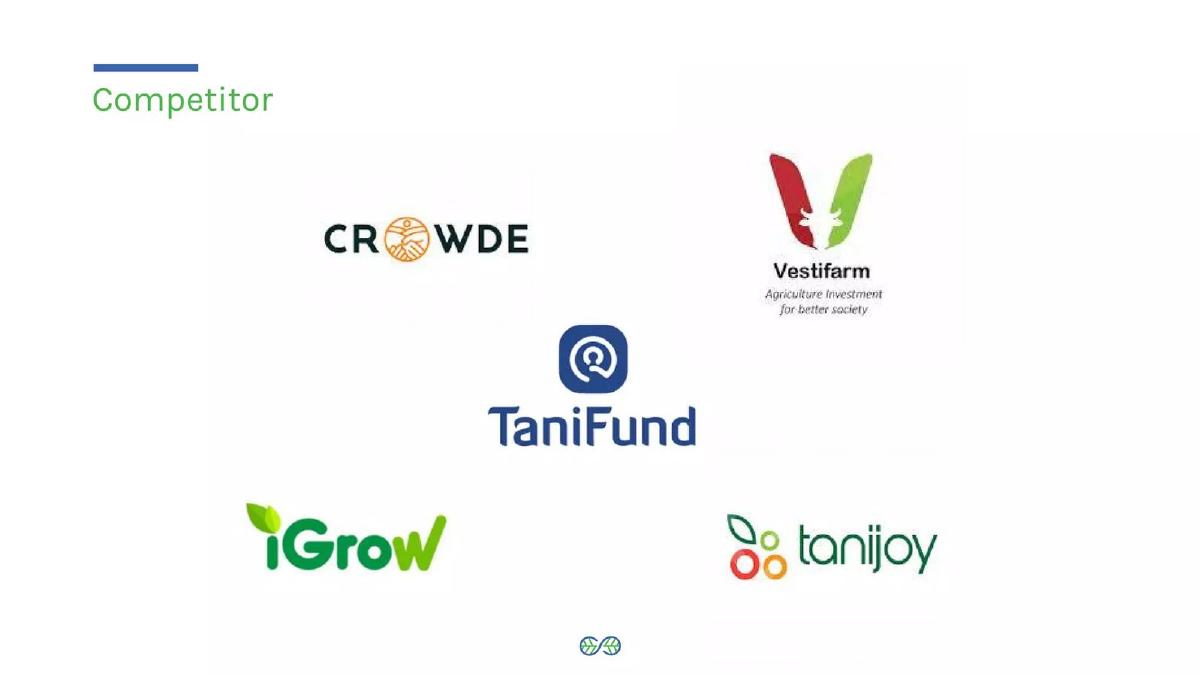
The omissions in this deck are significant and would prevent it from moving past a preliminary screening with most professional investors: 1. Market Size: There is no mention of the Total Addressable Market (TAM). How many farmers in Indonesia need this? What is the total value of the agricultural lending market? 2. Competition: Indonesia has several established agritech players (e.g., TaniHub, iGrow, Crowde). The deck does not explain how Fundnesia differs from these existing platforms. 3. Risk Mitigation: Agriculture is high-risk due to weather, pests, and market price volatility. The deck does not explain who bears the loss if a crop fails. If the investor loses 100% of their capital, the "40% profit sharing" model looks very different. 4. Regulatory Compliance: P2P lending in Indonesia is strictly regulated by the OJK. There is no mention of licensing or legal frameworks. 5. Traction: Even for a $2.5K ask, investors usually want to see a pilot or a proof of concept. The deck does not mention any farmers currently on the platform or successful harvests completed.
What a Founder Should Copy
Founders should emulate the clarity of the Business Model slide. Using icons and simple flow arrows to show how money moves from an investor, through a platform, to a recipient—and how the returns flow back—is a best practice. Additionally, the specific percentage breakdown of the funding ask (Slide 5) is good, as it shows the founders have at least thought about their immediate budgetary needs, even if the total amount is very low.
Final Thoughts
The Fundnesia deck is a "pre-seed" or "idea-stage" document. The $2,500 ask is more akin to a prize from a pitch competition than a venture capital round. While the team has the technical foundation to build a basic web platform, the deck needs to address the harsh realities of agricultural lending—specifically risk management and regulatory hurdles—to be taken seriously by professional angel investors. As it stands, it is a clear, albeit incomplete, vision of a student-led social enterprise.
Frequently asked questions
- What is the core business model of Fundnesia?
- Fundnesia acts as a marketplace platform connecting urban investors with farmers. According to Slide 4, the platform facilitates 'Give Funding' from investors to farmers and then manages a 'Profit Sharing' arrangement. The revenue is split three ways: 40% goes back to the investor, 40% is retained by the farmer, and 20% is kept by the Fundnesia platform as a service fee.
- How much money is Fundnesia raising and what is it for?
- Fundnesia is seeking a $2.5K USD Angel Investment for its first round, as stated on Slide 5. The allocation is broken down into five categories: Product Development (40%), Working Capital (20%), Recruitment (15%), 'Project Runaway'—likely meaning runway—(15%), and Marketing (10%). This is an unusually small amount for a venture-backed startup, suggesting a micro-seed or student-led pilot phase.
- Who are the founders and what is their experience?
- The company was founded by Bintang Thunder (CEO) and Adiputra Sinaga (CTO). Slide 6 indicates both studied at USU (University of North Sumatra) in Computer Science and Information Technology. Both were Microsoft Student Partners in Indonesia. Thunder’s role focuses on business and system analysis, while Sinaga handles web development and UI/UX design.
- Who is the target audience for the Fundnesia platform?
- Slide 3 identifies three primary target customers: Investors from urban areas, people with a general interest in agriculture, and young people who like agriculture. The deck suggests a focus on democratizing agricultural investment for those who live in cities but want exposure to the farming sector.
- What critical information is missing from this pitch deck?
- The deck is missing several standard components required for institutional investment. There is no 'Problem' slide defining the pain point, no 'Market Size' slide (TAM/SAM/SOM), no 'Competition' analysis, and no 'Traction' data showing previous successful harvests or loans. Additionally, there are no financial projections beyond the initial $2.5K allocation.