Domino Data Lab’s Series E deck is a high-signal enterprise fundraising document that prioritizes market authority over granular product walkthroughs. By the time a company reaches a $43M Series E, the narrative shifts from 'can we build it' to 'we have already won the enterprise.' Domino achieves this by showcasing a client roster that includes 20% of the Fortune 100 and utilizing analyst reports from Gartner and Forrester to frame themselves as the category leader. The deck is notable for its lack of specific financial figures—using placeholders like 'x%' for churn—suggesting this version w…
Key takeaways
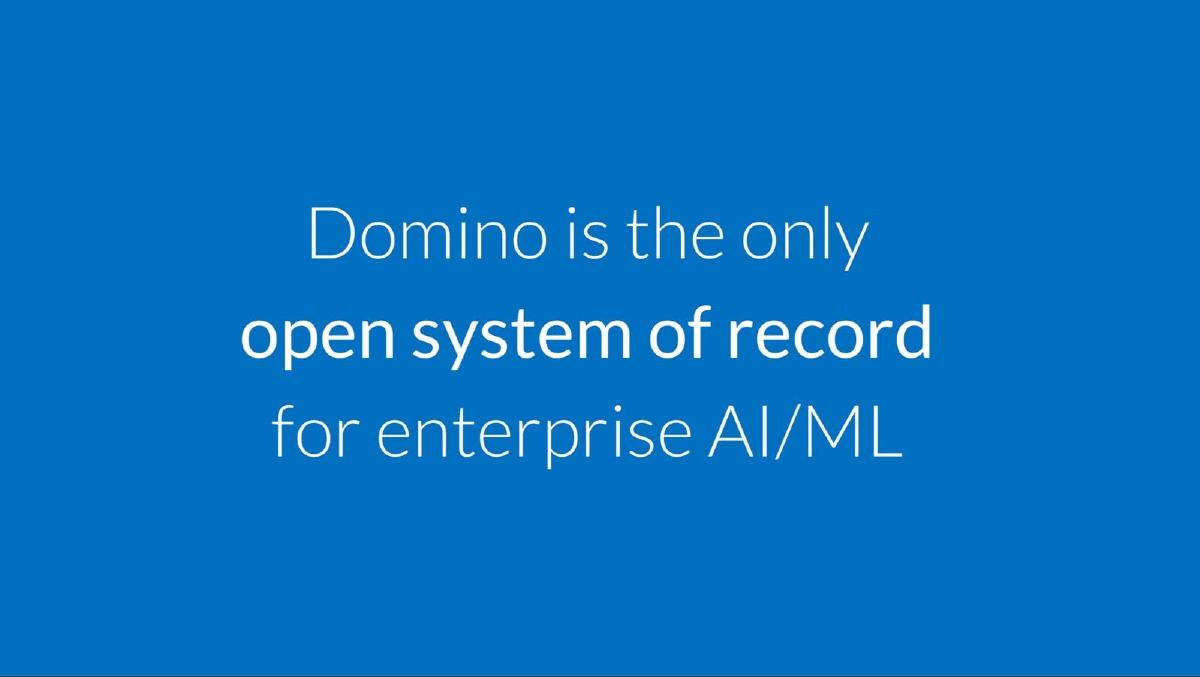
- The deck positions the company as the 'only open system of record for enterprise AI/ML' on slide 3, creating a high-value category anchor.
- Third-party validation is central, featuring a Forrester Wave chart placing Domino in the 'Leaders' category on slide 4.
- Enterprise penetration is quantified on slide 7, claiming 20% of the Fortune 100 and 4 of the top 10 pharma companies as customers.
- A specific case study on slide 5 highlights a $1.2M ACV win with a major health insurance company, detailing the transition from 'shadow IT' to governance.
- The team slide (slide 9) emphasizes 'scaling' with hires from Salesforce, DocuSign, and Microsoft, signaling a shift from engineering to commercial maturity.
- Slide 8 uses a cohort-based bar chart to show increasing net retention over a three-year period, though specific percentages are redacted.
- The deck addresses the 2020 macro environment directly on slide 10, claiming 'Strong ARR growth - even since COVID.'
- The presentation omits a specific 'Ask' slide, valuation targets, or a detailed use of funds, which is common for late-stage growth rounds.
The Series E Narrative: From Product to Powerhouse
Domino Data Lab’s 2020 pitch deck is a textbook example of late-stage fundraising strategy. At the Series E level, investors are rarely looking for a deep dive into the code or a basic explanation of why AI is important. Instead, they are looking for evidence of market capture, organizational scalability, and high-value customer retention. This 18-slide deck, which supported a $43M raise as reported by Business Insider, focuses almost entirely on these pillars.
Slide 1: Title and Branding
The deck opens with a clean, minimalist title slide. It identifies the company as Domino Data Lab and dates the document to Q1 2020. The 'Confidential' tag is standard for a deck of this stage, signaling that the contents are intended for a select group of institutional investors.
Slide 2: The Visual Metaphor for Chaos
Slide 2 uses a full-bleed image of a youth soccer game where all the children are clustered around the ball. The text reads: 'But it’s a mess of disorganized people, tools, and infrastructure.' This is a classic 'Problem' slide, but instead of using technical jargon about Kubernetes or Python environments, it uses a relatable visual to describe the 'herd' mentality and lack of coordination in enterprise data science teams. It sets the stage for a solution that provides order.
Slide 3: The Category Definition
Slide 3 is a bold, single-sentence statement on a blue background: 'Domino is the only open system of record for enterprise AI/ML.' This is the most important strategic claim in the deck. By calling itself a 'system of record,' Domino is positioning itself alongside companies like Salesforce (CRM) or SAP (ERP). A system of record is 'sticky' and essential, making it a much more attractive investment than a 'system of engagement' or a point tool.
Slide 4: External Validation (The Analyst Slide)
Slide 4 leverages the authority of Forrester and Gartner. It shows a Forrester Wave chart where Domino Data Lab is circled in the 'Leaders' quadrant for 'Notebook-based Predictive Analytics and ML Solutions.' It also quotes Gartner, noting that Domino's customer scores for support and service were 'among the highest of all vendors evaluated.' For a Series E investor, this slide removes the technical risk; the experts have already verified that the product is top-tier.
Slide 5: The $1.2M ACV Case Study
Slide 5 provides a concrete example of the company's value proposition in action. It details a win with a 'major health insurance company' resulting in a $1.2M Annual Contract Value (ACV). The slide breaks down the problem (1000+ researchers needing 'workforce orchestration') and the reason for the win ('Most diverse tool and compute support'). This slide proves that Domino can close seven-figure deals in highly regulated industries.
Slide 6: Enterprise Penetration
Slide 6, titled 'Every enterprise will depend on Domino – Many already do,' is a 'flex' slide. It lists impressive market share statistics: 20% of the Fortune 100, 3 of the top 5 ratings agencies, 2 of the top 5 healthcare companies, 4 of the top 10 pharma companies, 5 F500 US manufacturers, and 8 of the largest global banks. This demonstrates that Domino is not a niche tool but a horizontal platform with broad industrial appeal.
Slide 7: Retention and LTV
Slide 7 addresses the unit economics of the business. It features a bar chart showing 'Historical expansion, cohorted by time as a customer.' The chart shows that net retention increases significantly from Year 1 to Year 3. However, the specific figures for 'Gross churn in FY20' and 'Net retention in FY20' are represented by placeholders ('x%' and 'xxx%'). This suggests the deck was used for high-level pitches, with the hard data living in a separate spreadsheet or data room.
Slide 8: The Team to Scale
Slide 8 introduces the leadership team. The headline, 'In the last year, we built the team to scale,' is telling. It highlights that the company has moved beyond its founder-led roots by hiring executives from established giants like Microsoft, Salesforce, DocuSign, and Adobe. This slide is designed to convince investors that the company has the 'adult supervision' and operational experience necessary to manage a global enterprise software business.
Slide 9: Growth Through Crisis
Slide 9 shows a bar chart of ARR growth from FY 2018 to a projected FY 2021E. The title, 'Strong ARR growth - even since COVID,' is a direct response to the uncertainty of early 2020. By showing that the growth trajectory remained steep despite the pandemic, Domino demonstrated the 'essential' nature of its platform. Like the retention slide, the Y-axis lacks specific dollar amounts, focusing instead on the visual trend of consistent doubling or near-doubling of revenue.
What Domino Data Lab Does Well
The primary strength of this deck is its unwavering focus on social proof . By the time an investor reaches the end, they have seen endorsements from the two biggest analyst firms in the world, a list of Fortune 100 clients, and a team of executives from the most successful SaaS companies in history. Domino doesn't try to explain how the machine learning works; they explain who is buying it and why they are staying. This is exactly what a growth-stage investor needs to see.
Furthermore, the framing of 'System of Record' is a brilliant piece of positioning. In a crowded AI market, many startups are seen as features that will eventually be absorbed by cloud providers like AWS or Google Cloud. By positioning as the 'open system of record' that sits above those providers, Domino carves out a defensible space that is platform-agnostic.
What is Missing from the Deck
The most obvious omission is hard financial data . While the charts show growth and retention trends, the lack of specific ARR numbers, churn percentages, and CAC (Customer Acquisition Cost) metrics makes this a 'narrative deck' rather than a 'transactional deck.' Investors would certainly require these details, but they are likely omitted here to protect trade secrets during the initial outreach phase.
There is also no mention of the 'Ask' or 'Use of Funds.' We know from publisher reports that they raised $43M, but the deck itself doesn't state how much they were looking for or whether the money was intended for R&D, international expansion, or sales hiring. In late-stage rounds, the 'Ask' is often a fluid conversation based on valuation and dilution rather than a fixed slide.
Lessons for Founders
Sell the 'System,' not the 'Tool': If you are building enterprise software, try to frame your product as a 'system of record.' This implies that your software is the primary source of truth for a specific business function, which justifies a higher valuation and suggests higher switching costs. · Use Case Studies to Justify ACV: Don't just say your product is valuable; show a slide detailing a specific high-value win. Breaking down the 'Why we won' section (as seen on slide 5) helps investors understand your competitive advantage in the real world. · Leverage Analyst Logos: If you are in a category covered by Gartner or Forrester, getting mentioned—even as a 'Visionary' or 'Contender'—is worth its weight in gold. Use those logos prominently to borrow their credibility. · Address Macro Trends Head-On: Domino’s inclusion of a 'since COVID' note on their growth chart shows they were proactive. If there is a major economic shift or a new technological trend (like Generative AI), your deck must explain why your company is resilient to or fueled by that change. · Focus on the 'Team to Scale': Once you hit Series B or C, your team slide should stop focusing on where the founders went to school and start focusing on the 'scale-up' experience of your new executive hires. Investors want to see that you have hired people who have 'been there and done that' at a much larger scale.
Frequently asked questions
- Why are the specific growth percentages and churn rates hidden in this deck?
- In late-stage rounds like a Series E, decks are often shared widely among potential investors and partners. Founders frequently use placeholders like 'x%' or 'xxx%' (as seen on slide 8) in the version of the deck intended for initial circulation. The actual sensitive financial data is typically reserved for a secure virtual data room accessible only after an NDA is signed or a preliminary interest is established.
- How does Domino Data Lab define its competitive advantage?
- Domino defines its advantage through 'openness' and 'orchestration.' On slide 5, they explicitly state they won a $1.2M ACV deal because they offered the 'most diverse tool and compute support' and the 'best knowledge management solution.' By positioning themselves as an 'open system of record' (slide 3), they argue they are the glue that connects various fragmented AI tools rather than just another tool in the stack.
- What is the significance of the Gartner and Forrester mentions?
- For enterprise software, being named a 'Leader' or 'Visionary' by top analysts is a massive de-risking signal for late-stage investors. Slide 4 uses these logos to prove that the market has already been vetted by experts. This shifts the investor's focus from 'is this a good product' to 'how big can this leader become,' which is essential for justifying a Series E valuation.
- How does the deck handle the impact of the COVID-19 pandemic?
- Since this deck is dated Q1 2020, it was produced just as the global pandemic began. Slide 10 addresses this head-on with a chart titled 'Strong ARR growth - even since COVID.' By showing a projected increase for FY 2021E despite the macro-economic shock, Domino signaled to investors that their enterprise contracts were resilient and that digital transformation/AI remained a priority for their clients.
- What is missing from this deck that a seed-stage founder should include?
- This deck lacks a problem/solution breakdown, a detailed product demo, and a 'the ask' slide. A Series E company assumes the investor already understands the basic problem. A seed-stage founder cannot afford to skip these; they must prove the problem exists and that their specific solution works. Domino relies on momentum and social proof, whereas early-stage founders must rely on insight and execution.